
加密资产

Search documents
美元稳定币:市场叙事背后的真相
Guan Cha Zhe Wang· 2025-07-03 03:25
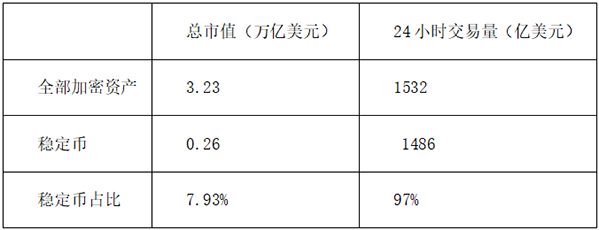
Core Insights - The seminar highlighted the transformative role of USD stablecoins in reshaping the global monetary landscape, emphasizing the need to address challenges from multiple dimensions including technology, market impact, and regulatory responses [1][2][3] Group 1: Market Dynamics of Stablecoins - The current market capitalization of stablecoins is nearly $260 billion, accounting for approximately 8% of the total cryptocurrency market, with stablecoin trading volume representing 97% of total cryptocurrency trading volume [4][5] - 99% of stablecoins are pegged to the US dollar, and over 99% of stablecoin trading volume is derived from cryptocurrency transactions, indicating their primary use case in the crypto market [7][8] - The largest stablecoin, USDT, holds a market share of 62%, followed by USDC, which has recently gained traction [8] Group 2: Regulatory and Economic Implications - The US has adopted a "let it be" approach towards stablecoin regulation, allowing commercial entities to lead the way in promoting dollarization through stablecoins before tightening compliance frameworks [2][32] - The rapid growth of USD stablecoins poses risks for China, including capital flight and challenges to existing foreign exchange management and anti-money laundering systems [2][37] - The issuance of stablecoins is heavily reliant on US Treasury securities, with significant investments in these assets, which raises questions about the sustainability of this model [34][36] Group 3: Global Dollarization and Financial Sovereignty - USD stablecoins are driving a digital form of dollarization globally, which could undermine the monetary sovereignty of other nations and exacerbate economic imbalances [30][31] - The use of stablecoins in regions with economic instability, such as Latin America and Africa, highlights their role in providing financial services but also raises concerns for local governments [31] Group 4: Future Outlook and Strategic Recommendations - The potential for USD stablecoins to enhance financial accessibility in underdeveloped regions must be balanced against the risks posed to national monetary policies [31] - China is advised to monitor the circulation of USD stablecoins and regulate them as foreign currency payment instruments to safeguard its monetary sovereignty [37]

美国首支Solana加密货币ETF上市 加密资产进一步迈入主流市场
智通财经网· 2025-07-02 22:32
智通财经APP获悉,一项旨在为投资者打开新型数字资产投资通道的金融产品于周三正式在美国上市交 易。该产品为REX-Osprey Solana + Staking ETF(SSK.US),是美国首支直接投资于Solana加密货币的交 易所交易基金,在Cboe BZX交易所开始交易。这一产品的推出不仅象征着加密资产进一步迈向主流市 场,也引发市场对于小型加密货币ETF未来发展的讨论。 与此前受到市场广泛关注的比特币和以太坊现货ETF不同,SSK首次将较为小众的Solana推向了传统投 资平台。Solana是目前全球第六大加密货币,被视为以太坊的有力竞争对手。通过SSK,美国投资者可 在不直接持有加密货币的情况下,间接投资Solana,从而绕开钱包管理、加密交易所账户等复杂程序。 这也是目前市场上首支允许质押的加密ETF。相比之下,即便以太坊支持质押,去年上市的ETH现货 ETF出于监管考量仍未纳入质押功能。 SSK与去年上市的比特币和以太坊ETF结构不同,采用的是《1940年证券法》架构,而大部分主流加密 ETF基于《1933年证券法》。前者对投资公司运作结构有更严格规定,导致管理成本更高。SSK的管理 费为0. ...
关于稳定币,国际清算银行究竟说了什么?
2025-07-02 15:49
Summary of Key Points from the Conference Call on Stablecoins Industry Overview - The discussion revolves around the stablecoin industry and its relationship with fiat currencies, particularly in the context of the International Bank for Settlements (BIS) report [1][2]. Core Insights and Arguments - **Limitations of Stablecoins**: BIS highlights that stablecoins lack uniformity, elasticity, and compliance integrity, making them unable to replace fiat currencies as mainstream options, serving only as a supplement [2][5]. - **Characteristics of Stablecoins**: Stablecoins are characterized by private issuance, full reserves, cryptocurrency attributes, and a shadow currency role. They are dependent on fiat currencies and cannot disrupt them [7][6]. - **Market Impact**: The release of the BIS report significantly affected the stock prices of related companies, such as Circle, indicating high market sensitivity to stablecoin developments [4]. - **Current Applications**: Stablecoins are primarily used in high-frequency trading on cryptocurrency exchanges, with only a small percentage utilized for payment scenarios, yet the volume remains substantial [9]. - **Cross-Border Payment Efficiency**: Stablecoins demonstrate advantages in cross-border payments, offering faster and cheaper transactions compared to traditional methods, which can take days or weeks [11]. Regulatory Developments - **Legislative Actions**: The U.S. and Hong Kong are moving towards regulating stablecoins to manage their connection to fiat currencies and enhance the influence of the U.S. dollar [3][14]. - **Hong Kong's Market Potential**: The Hong Kong market is expected to see the development of a Hong Kong dollar stablecoin aimed at facilitating cross-border trade settlements, with potential for a renminbi stablecoin as well [15][16]. Challenges and Opportunities - **Impact on Traditional Banking**: Stablecoins pose challenges to commercial banks, which may respond by tokenizing deposits to leverage blockchain technology for improved transaction efficiency [12][13]. - **Future of Stablecoins**: The evolving regulatory landscape and market dynamics suggest that stablecoins will continue to gain attention, with traditional financial systems increasingly recognizing their significance [5][14]. Additional Important Points - **Historical Context**: Stablecoins emerged in 2014 to address high costs and delays in transferring funds, particularly for cryptocurrency trading [8]. - **Payment Limitations**: Cryptocurrencies are deemed unsuitable for domestic payment clearing due to their point-to-point nature and slow transaction confirmation times [10]. This summary encapsulates the critical aspects of the conference call regarding stablecoins, their market implications, regulatory responses, and future prospects.
「改革创新」王永利:美元稳定币加快发展带来深刻警示
Sou Hu Cai Jing· 2025-06-25 16:42
Core Viewpoint - The emergence and rapid development of stablecoins, particularly USD-pegged stablecoins, have created a bridge between cryptocurrency and fiat currency, facilitating 24/7 global transactions and reshaping the financial landscape [3][5][9]. Group 1: Development of Stablecoins - The introduction of Bitcoin in 2009 and Ethereum in 2013 laid the groundwork for the rise of stablecoins, with USDT being the first significant stablecoin launched in 2015 [1][3]. - USDT is backed by reserves of USD and other liquid assets, allowing it to maintain its value against the dollar, but it has faced scrutiny regarding its reserve transparency and potential over-issuance [4][5]. - The launch of USDC in 2018 aimed to provide a more transparent alternative to USDT, addressing concerns about reserve adequacy [4][5]. Group 2: Regulatory Landscape - The recent legislative actions in the US and Hong Kong signify a shift towards regulating stablecoins, which is expected to prevent over-issuance and ensure adequate reserves [6][7]. - The US Senate's passage of the Stablecoin Innovation Act and Hong Kong's Stablecoin Ordinance reflect a growing consensus on the need for regulatory frameworks to govern stablecoins [6][7]. - Regulated stablecoins are anticipated to enhance their payment functionalities while diminishing their investment appeal, as they will be required to maintain strict reserve requirements [7][8]. Group 3: Market Impact and Future Outlook - The rapid growth of USD stablecoins has led to increased demand for US Treasury securities and has positioned the dollar as a dominant force in the stablecoin market, accounting for over 99% of the global stablecoin market cap by April 2025 [8][9]. - The transaction volume of stablecoins is projected to surpass $27.6 trillion in 2024, exceeding the combined volume of major card organizations [8]. - The development of stablecoins poses challenges for traditional currencies, particularly the RMB, which must enhance its cross-border payment efficiency to remain competitive [11][12].
再问稳定币
HTSC· 2025-06-24 08:14
Investment Rating - The report maintains an "Accumulate" rating for the diversified financial sector [5] Core Insights - Stablecoins are essentially privately issued digital shadow currencies backed by sufficient reserves, gradually penetrating into real economy payment scenarios, which warrants attention regarding their impact on currency circulation and the government bond market [1][12] - As of June 18, 2025, the total market size of USD stablecoins reached approximately $220 billion, accounting for about 1% of USD M2 [1][21] - The initial use case of stablecoins was as a medium for cryptocurrency trading, with around 80% of stablecoin transaction volume still attributed to crypto asset trading as of 2024 [2][30] - Stablecoins exhibit low-cost and high-efficiency characteristics, particularly in cross-border payments, contributing to over 70% of the $600 billion in cross-border flows in Q2 2024 [2][43] - The interaction between stablecoins and currency liquidity is generally neutral, with their issuance not significantly altering the factors determining fiat currency liquidity [62] Summary by Sections Nature of Stablecoins - Stablecoins are issued by private commercial entities and are considered credit money, as they represent a claim against the issuing institution [12] - They are backed by sufficient reserves, which limits their issuance scale to the reserve size, unlike traditional fiat money which can be created with leverage [12][21] - Stablecoins are based on blockchain technology, allowing for peer-to-peer transactions without central control [12] Initial Use Cases - The development of stablecoins like USDT was driven by the need for a stable medium of exchange in cryptocurrency trading, particularly to reduce the high friction costs associated with converting fiat to crypto [30][31] Payment Integration - Stablecoins are increasingly accepted in traditional payment scenarios, especially in cross-border transactions where they provide a more efficient alternative to fiat currencies [43][45] Central Bank Digital Currency (CBDC) Outlook - CBDCs and stablecoins share similar technological foundations but differ in their issuers, with CBDCs being state-backed and stablecoins being privately issued [56] - The potential for CBDCs to penetrate the market is significant, especially in areas where stablecoins are currently utilized [58] Interaction with Currency Liquidity and Government Bonds - The issuance of stablecoins does not significantly impact fiat liquidity, as their effects are largely neutral unless considering the choice of reserve assets [62]
国别税收资讯播报(第七十八期)——德国、澳大利亚、巴西
Sou Hu Cai Jing· 2025-06-19 13:25
Germany - The German Ministry of Finance has issued new regulations regarding the taxation of specific crypto assets, replacing the previous version from May 2022 [4] - The new regulations introduce detailed compliance obligations, including tax reporting, collaboration, and record-keeping requirements [5] - The regulations clarify the tax treatment of passive staking income and the criteria for determining transaction value, while non-fungible tokens (NFTs) and liquidity mining activities are currently excluded from these regulations [6] Australia - The Australian government has announced a two-year freeze on beer excise tax rates, halting tax increases on draft beer, which is beneficial for beer drinkers, brewers, and the hospitality industry [11] - Historically, beer excise tax rates have increased twice a year in line with the Consumer Price Index (CPI), with an 8% increase over the past year [11] - The government is also raising the excise tax exemption cap for eligible alcohol manufacturers to AUD 400,000, effective July 1, 2026 [11] Brazil - The Brazilian government has proposed a bill to adjust personal income tax policies, expanding the tax-exempt range for low-income earners and increasing tax burdens on high-income individuals [14] - The bill aims to raise the tax-exempt income threshold for low-income individuals to BRL 5,000, up from BRL 2,824, with full exemption for those earning below this threshold [14] - If approved, non-resident individuals receiving dividend income will be subject to a 10% withholding tax, and high-income earners will face an additional tax on exempt income, potentially raising their effective tax rate to 37.5% [15][16]

【越南通过法律承认加密资产】6月16日讯,越南通过了一项法律,正式承认数字和加密资产,朝着监管和促进加密货币经济迈出了决定性的一步。《数字技术产业法》于6月14日通过,将于2026年1月1日生效。据当地媒体报道,该法案概述了一个管理数字资产和促进区块链创新的广泛框架。
news flash· 2025-06-16 09:32
金十数据6月16日讯,越南通过了一项法律,正式承认数字和加密资产,朝着监管和促进加密货币经济 迈出了决定性的一步。《数字技术产业法》于6月14日通过,将于2026年1月1日生效。据当地媒体报 道,该法案概述了一个管理数字资产和促进区块链创新的广泛框架。 (CoinDesk) 越南通过法律承认加密资产 ...
中国人民银行副行长陆磊出席金融稳定理事会全体会议
news flash· 2025-06-13 03:07
Group 1 - The meeting of the Financial Stability Board (FSB) in Madrid discussed global financial system vulnerabilities, non-bank financial intermediation, crypto assets, climate-related financial risks, and risk management [1] - The appointment of Andrew Bailey, Governor of the Bank of England, as the new Chair of the FSB was approved during the meeting [1] - The Deputy Governor of the People's Bank of China, Lu Lei, expressed appreciation for the outgoing Chair, Klaas Knot, for his effective leadership and contributions [1] Group 2 - Lu Lei held discussions with the Chair of the FSB's Standards Implementation Committee and the Deputy Governor of the Bank of Japan, Masayoshi Amamiya, regarding international financial regulatory standards and peer reviews [1]
贝莱德(BLK.US)大幅上调2030年营收目标 私募和加密资产成未来增长引擎
智通财经网· 2025-06-12 12:21
Group 1 - The core objective of BlackRock is to achieve annual revenue exceeding $35 billion by 2030, up from $20 billion in 2024, and to double its market value from approximately $140 billion to $280 billion [1] - BlackRock aims to raise a total of $400 billion in private markets by 2030, with a focus on expanding its presence in the private market and digital asset sectors [1] - The company plans to manage $700 billion in insurance-related assets by 2030, positioning itself as the largest third-party manager in the balance sheet insurance asset space [1] Group 2 - BlackRock's strategy includes significant investments in private asset companies, having spent around $28 billion over the past year to catch up with established players like Blackstone and Carlyle [1] - The company targets managing at least $50 billion in crypto assets over the next 15 years and aims to introduce digital asset ETF products in Europe and Canada based on its U.S. operational experience [1] - The CFO of BlackRock indicated that the ongoing expansion in private, digital assets, and active ETFs will enhance the overall fee structure and positively impact the company's profitability [2] Group 3 - BlackRock has set a financial target of achieving an adjusted operating profit of $15 billion by 2030, significantly higher than the projected $8 billion for 2024 [2] - The company anticipates a compound annual growth rate (CAGR) of 10% in revenue [2]

贝莱德:目标到2030年成为全球最大的加密资产管理机构,资产规模超过500亿美元。
news flash· 2025-06-12 10:46
Core Viewpoint - BlackRock aims to become the world's largest cryptocurrency asset management firm by 2030, targeting an asset size exceeding $50 billion [1] Group 1 - The company has set a clear goal for its future in the cryptocurrency market [1] - The target asset size of over $50 billion indicates significant growth expectations in the crypto asset management sector [1]