
多模态大模型

Search documents
为防AI刷题,Nature等顶刊最新封面被做成数据集,考验模型科学推理能力|上海交通大学
量子位· 2025-08-25 15:47
Core Viewpoint - The article discusses the development of the MAC (Multimodal Academic Cover) benchmark, which aims to evaluate the true capabilities of advanced AI models like GPT-4o and Gemini 2.5 Pro by using the latest scientific content for testing, addressing the challenge of outdated "question banks" in AI assessments [1][5]. Group 1: Benchmark Development - The MAC benchmark utilizes the latest covers from 188 top journals, including Nature, Science, and Cell, to create a testing dataset from over 25,000 image-text pairs, ensuring that the AI models are evaluated on the most current and complex scientific concepts [3][4]. - The research team designed two testing tasks: "selecting text from images" and "selecting images from text," to assess the AI's understanding of the deep connections between visual elements and scientific concepts [17][18]. Group 2: Testing Results - The results revealed that even top models like Step-3 achieved only a 79.1% accuracy when faced with the latest scientific content, indicating significant limitations in their performance compared to their near-perfect results on other benchmarks [4][19]. - The study highlighted that models such as GPT-5-thinking and Gemini 2.5 Pro, while proficient in visual recognition, still struggle with deep reasoning tasks that require cross-modal scientific understanding [19]. Group 3: Dynamic Benchmarking Mechanism - The MAC benchmark introduces a dynamic approach to testing by continuously updating the dataset and questions, which helps maintain the challenge level as scientific knowledge evolves [24][26]. - The research team conducted a comparison experiment showing that all models performed worse on the latest data (MAC-2025) compared to older data (MAC-Old), demonstrating that the natural evolution of scientific knowledge provides ongoing challenges for AI models [26]. Group 4: DAD Methodology - The DAD (Divide and Analyze) method was proposed to enhance AI performance by structuring the reasoning process into two phases: a detailed visual description followed by high-level analysis, simulating human expert thinking [21][22]. - This two-step approach significantly improved the accuracy of multiple models, showcasing the effectiveness of extending reasoning time in multimodal scientific understanding tasks [22][23]. Group 5: Future Prospects - The MAC benchmark is expected to evolve into a more comprehensive evaluation platform, with plans to include more scientific journals and dynamic scientific content such as conference papers and news [28]. - As AI capabilities approach human levels, the MAC benchmark will serve as a "touchstone" to better understand the boundaries of AI capabilities and the path toward true intelligence [28].


格灵深瞳2025半年报:多元化业务发力,二季度营收同比增70%
Huan Qiu Wang· 2025-08-25 11:59
Core Viewpoint - Geling Deep Vision reported significant growth in Q2 2025 revenue, with a 70% increase compared to Q2 2024, while the first half of 2025 saw a 17.22% decline year-on-year [1] Group 1: Financial Performance - In Q2 2025, Geling Deep Vision achieved revenue of 34.7981 million yuan, marking a substantial increase of approximately 70% compared to the same period in 2024 [1] - For the first half of 2025, the company's revenue totaled 42.4728 million yuan, reflecting a year-on-year decrease of 17.22% [1] Group 2: Business Strategy and Development - The company is focusing on diversifying its business structure and growth system, emphasizing a "2+2" strategy in smart finance and urban management, along with innovation in government, special applications, and smart education [1] - Geling Deep Vision is committed to R&D investments in key areas to maintain its technological leadership, particularly in multimodal large models [1] Group 3: Technological Advancements - Geling Deep Vision has a strong technical foundation in the visual field, continuously evolving its self-developed visual model Glint-MVT, with the latest version outperforming previous iterations in tasks like OCR and segmentation [2] - The company has launched the Super-Agent platform, an enterprise-level product for financial scenarios, integrating various modules to address challenges in risk control and marketing [2] Group 4: Product Launches and Collaborations - New products and upgrades have been introduced in areas such as AIPC, industry large model integrated machines, and smart education, including the "Mo Ren AIPC" which combines secure hardware with intelligent applications [3] - Geling Deep Vision has established partnerships with leading tech companies like Baidu and Feiteng to enhance the domestic computing foundation and promote AI industry upgrades [3]

AI动态汇总:智元推出机器人世界模型平台genieenvesioner,智谱上线GLM-4.5a视觉推理模型
China Post Securities· 2025-08-25 11:47
- The Genie Envisioner platform introduces a video-centric world modeling paradigm, directly modeling robot-environment interactions in the visual space, which retains spatial structure and temporal evolution information. This approach enhances cross-domain generalization and long-sequence task execution capabilities, achieving a 76% success rate in long-step tasks like folding cardboard boxes, outperforming the π0 model's 48%[12][13][16] - The Genie Envisioner platform comprises three core components: GE-Base, a multi-view video world foundation model trained on 3000 hours of real robot data; GE-Act, a lightweight 160M parameter action decoder enabling real-time control; and GE-Sim, a hierarchical action-conditioned simulator for closed-loop strategy evaluation and large-scale data generation[16][17][19] - The GLM-4.5V visual reasoning model, with 106B total parameters and 120B activation parameters, achieves state-of-the-art (SOTA) performance across 41 multimodal benchmarks, including image, video, document understanding, and GUI agent tasks. It incorporates 3D-RoPE and bicubic interpolation mechanisms to enhance 3D spatial relationship perception and high-resolution adaptability[20][21][22] - GLM-4.5V employs a three-stage training strategy: pretraining on large-scale multimodal corpora, supervised fine-tuning with "chain of thought" samples, and reinforcement learning with RLVR and RLHF techniques. This layered training enables superior document processing capabilities and emergent abilities like generating structured HTML/CSS/JavaScript code from screenshots or videos[23][24][26] - VeOmni, a fully modular multimodal training framework, decouples model definition from distributed parallel logic, enabling flexible parallel strategies like FSDP, HSDP+SP, and EP. It achieves 43.98% MFU for 64K sequence training and supports up to 192K sequence lengths, reducing engineering complexity and improving efficiency by over 90%[27][28][31] - VeOmni introduces asynchronous sequence parallelism (Async-Ulysses) and COMET technology for MoE models, achieving linear scalability in training throughput for 30B parameter models under 160K sequence lengths. It also integrates dynamic batch processing and FlashAttention to minimize memory waste and optimize operator-level recomputation[31][32][34] - Skywork UniPic 2.0, a unified multimodal framework, integrates image understanding, text-to-image (T2I) generation, and image-to-image (I2I) editing within a single model. It employs a progressive dual-task reinforcement strategy (Flow-GRPO) to optimize image editing and T2I tasks sequentially, achieving superior performance in benchmarks like GenEval and GEdit-EN[35][38][39] - UniPic 2.0 leverages Skywork-EditReward, an image-editing-specific reward model, to provide pixel-level quality scores. This design enables precise recognition of image elements and generation of corresponding textual descriptions, achieving 83.5 points in MMBench, comparable to 19B parameter models[38][42][43] - FlowReasoner, a query-level meta-agent framework, dynamically generates personalized multi-agent systems for individual queries. It employs GRPO reinforcement learning with multi-objective reward mechanisms, achieving 92.15% accuracy on the MBPP dataset and outperforming baseline models like Aflow and LLM-Blender[63][64][68] - FlowReasoner utilizes a three-stage training process: supervised fine-tuning with synthetic data, SFT fine-tuning for workflow generation, and RL with external feedback for capability enhancement. It demonstrates robust generalization, maintaining high accuracy even when the base worker model is replaced[66][68][69]
自动驾驶转具身智能有哪些切入点?
自动驾驶之心· 2025-08-24 23:32
Core Viewpoint - The article discusses the transition from autonomous driving to embodied intelligence, highlighting the similarities and differences in algorithms and tasks between the two fields [1]. Group 1: Algorithm and Task Comparison - Embodied intelligence largely continues the algorithms used in robotics and autonomous driving, such as training and fine-tuning methods, as well as large models [1]. - There are notable differences in specific tasks, including data collection methods and the emphasis on execution hardware and structure [1]. Group 2: Community and Learning Resources - A full-stack learning community named "Embodied Intelligence Heart" has been established to share knowledge related to algorithms, data collection, and hardware solutions in the field of embodied intelligence [1]. - Key areas of focus within the community include VLA, VLN, Diffusion Policy, reinforcement learning, robotic arm grasping, pose estimation, robot simulation, multimodal large models, chip deployment, sim2real, and robot hardware structure [1].
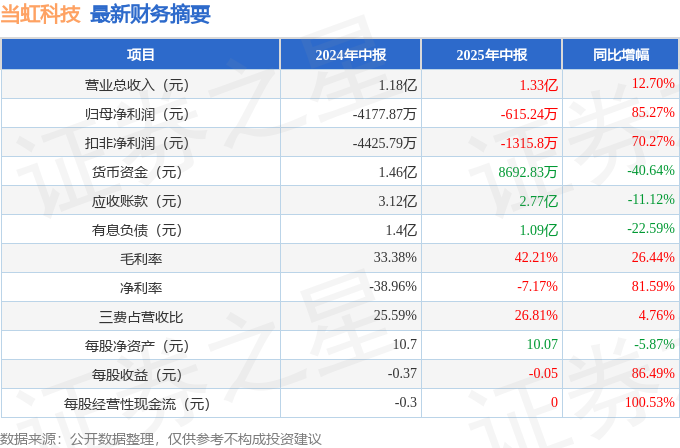
当虹科技2025年中报简析:营收上升亏损收窄,盈利能力上升
Zheng Quan Zhi Xing· 2025-08-23 22:58
Core Viewpoint - The recent financial report of Danghong Technology (688039) shows a positive trend in revenue and profit margins, indicating improved operational efficiency and potential growth opportunities in various business segments [1]. Financial Performance - Total revenue for the first half of 2025 reached 133 million yuan, a year-on-year increase of 12.7% [1]. - The net profit attributable to shareholders was -6.15 million yuan, showing an improvement of 85.27% compared to the previous year [1]. - In Q2 2025, total revenue was 83.9 million yuan, up 50.44% year-on-year, with a net profit of 5.74 million yuan, an increase of 130.65% [1]. - Gross margin improved to 42.21%, a year-on-year increase of 26.44%, while net margin improved to -7.17%, up 81.59% [1]. - The total of selling, administrative, and financial expenses was 35.65 million yuan, accounting for 26.81% of revenue, a slight increase of 4.76% year-on-year [1]. Key Financial Metrics - Earnings per share improved to -0.05 yuan, an increase of 86.49% year-on-year [1]. - Operating cash flow per share was 0.0 yuan, reflecting a 100.53% increase year-on-year [1]. - The company's cash and cash equivalents decreased by 40.64% to 86.93 million yuan due to operational expenditures [1]. Business Segments - The AI products and multimodal large model derivatives have rapidly applied in the market, particularly boosting the media culture business and in-vehicle intelligent cockpit business [8]. - The smart connected vehicle business is expected to grow significantly as demand for in-cabin multimodal interaction and intelligent entertainment cockpit experiences increases [12]. - The industrial and satellite business focuses on intelligent video analysis and data mining applications, enhancing capabilities in high-precision inspections and real-time satellite remote sensing [13]. - The media culture business is evolving from a hardware supplier to a comprehensive intelligent video ecosystem service provider, capitalizing on opportunities in the ultra-high-definition video industry [13].

推荐一个大模型AI私房菜!
自动驾驶之心· 2025-08-23 16:03
Group 1 - The article emphasizes the growing interest in large model technologies, particularly in areas such as RAG (Retrieval-Augmented Generation), AI Agents, multimodal large models (pre-training, fine-tuning, reinforcement learning), and optimization for deployment and inference [1] - A community named "Large Model Heart Tech" is being established to focus on these technologies and aims to become the largest domestic community for large model technology [1] - The community is also creating a knowledge platform to provide industry and academic information, as well as to cultivate talent in the field of large models [1] Group 2 - The article describes the community as a serious content-driven platform aimed at nurturing future leaders [2]
格灵深瞳2025年半年度报告:明确“2+2”战略方向 第二季度营收同比增长近70%
Zheng Quan Ri Bao Zhi Sheng· 2025-08-23 03:38
Core Insights - The company, Beijing Geling Deep Vision Technology Co., Ltd., reported a nearly 70% year-on-year revenue growth in Q2 2025, indicating a successful diversification strategy [1] - 2025 is identified as a critical year for the company's reform, focusing on multi-modal large model development and the "2+2" strategy in key sectors [1] Financial Sector Developments - The company has recently launched and upgraded its entire range of financial products, promoting the large-scale application of AI technology in various core banking scenarios [2] - The "Deep Vision Golden Brick Bank Intelligent Calculation Solution" and the "Super-Agent Financial Super Assistant" are designed to enhance security, compliance, and efficiency in banking operations [2] - Pilot programs for the new generation Agent platform have been initiated in several banks, expanding application scenarios beyond security to include operations, risk control, and marketing [2] Urban Management Initiatives - Strategic cooperation with key clients in urban management has deepened, focusing on traditional visual analysis and advancing in areas like visual models and multi-modal large models [2] - The company has begun to establish a presence in urban management across various regions, including Northwest, Central, and East China [2] Innovations in Government and Education - The company has made breakthroughs in government, special sectors, and smart education by integrating AI algorithms with hardware through its subsidiary [3] - New hardware products for smart education, such as the "Zhi Ying Large Screen All-in-One" and "Chi Tu Small Screen All-in-One," have been launched to cater to specific educational scenarios [3] - In the first half of 2025, over 90% of the company's revenue came from clients other than the Agricultural Bank of China, with a year-on-year revenue increase of over 40% [3]
格灵深瞳: 格灵深瞳2025年半年度报告
Zheng Quan Zhi Xing· 2025-08-22 16:29
Core Viewpoint - The report highlights the financial performance and operational strategies of Beijing DeepGlint Technology Co., Ltd. for the first half of 2025, indicating a decline in revenue and net profit while emphasizing ongoing investments in AI technology and market expansion efforts [1][3][5]. Company Overview and Financial Indicators - Beijing DeepGlint Technology Co., Ltd. is focused on integrating advanced technologies such as computer vision and big data analysis into various sectors including smart finance and urban management [6][7]. - The company reported a revenue of approximately 42.47 million yuan, a decrease of 17.22% compared to the same period last year [3]. - The net profit attributable to shareholders was approximately -79.85 million yuan, reflecting a slight decline from the previous year [3]. Industry Context - The artificial intelligence industry is recognized as a strategic technology driving the next wave of technological revolution and industrial transformation, with significant government support in China [5][6]. - The government has implemented various policies to promote AI development, aiming to integrate digital technology with manufacturing and enhance economic competitiveness [5]. Main Business Activities - The company aims to benefit humanity through AI, focusing on sectors such as smart finance, urban management, and education, leveraging technologies like multimodal large models and 3D vision [6][7]. - In the smart finance sector, the company has deployed AI solutions across thousands of branches of major banks, enhancing operational efficiency and fraud detection [6][7][23]. - The urban management sector has seen the implementation of intelligent systems in various government agencies, utilizing advanced data analytics and AI technologies [7][23]. Financial Performance Analysis - The company experienced a net cash flow from operating activities of approximately -103.12 million yuan, indicating challenges in cash generation [3]. - The total assets decreased by 8.26% to approximately 2.13 billion yuan compared to the end of the previous year [3]. Research and Development Focus - The company is investing heavily in the development of multimodal large models, with a projected investment of 368 million yuan over three years to enhance its technological capabilities [14]. - The launch of the Glint-MVT visual model series has positioned the company as a leader in the field, outperforming competitors in various benchmarks [14][21]. Market Expansion Strategies - The company is diversifying its revenue sources by expanding its customer base beyond traditional banking clients, with over 90% of revenue coming from clients other than the Agricultural Bank of China [17]. - A matrix sales system combining regional and industry-focused teams is being implemented to enhance market penetration and customer engagement [13][17]. Organizational Development - The company has undergone organizational restructuring to improve operational efficiency and enhance talent management, aiming to foster a culture of innovation and responsiveness to market demands [18].
格灵深瞳: 格灵深瞳2025年度“提质增效重回报”行动方案的半年度评估报告
Zheng Quan Zhi Xing· 2025-08-22 16:28
Core Viewpoint - The company has implemented a "Quality Improvement and Efficiency Enhancement" action plan for 2025, focusing on optimizing operations, governance, and enhancing investor returns, particularly for small and medium investors [1][11]. Business Focus and Quality Improvement - The company aims to integrate advanced technologies such as computer vision and big data analysis into various sectors, including smart finance and urban management, to enhance operational quality [1][2]. - The company has seen growth in sectors outside of smart finance, indicating a diversification of its business [2][4]. R&D Investment and Technological Advancements - The company has committed to significant R&D investments, with 68.04 million yuan allocated in the first half of 2025, representing 160.21% of its revenue [8]. - The company has developed multiple core technologies and holds numerous patents, emphasizing its commitment to technological innovation [7][8]. Sales Team and Market Expansion - The company has restructured its sales team, adding nearly 30 specialized sales personnel to enhance market penetration and customer engagement [6]. - The revenue from clients outside of China Agricultural Bank exceeded 90%, with a year-on-year growth of over 40%, showcasing successful market expansion efforts [4]. Governance and Compliance - The company is focused on improving its governance structure and compliance with regulations, ensuring that independent directors can effectively oversee operations [9][12]. - The company is enhancing its internal systems to improve risk management and operational standards [9]. Shareholder Returns and Investor Relations - The company has initiated a share buyback plan, committing between 40 million and 80 million yuan to repurchase shares, reflecting its commitment to enhancing shareholder value [10]. - The company actively engages with investors through various channels to communicate its operational performance and address investor concerns [12].
7000+人围观!具身智能赛道迎来硬核玩家,史河机器人技术直播全景揭秘
机器人大讲堂· 2025-08-22 04:27
Core Viewpoint - Embodied AI is becoming a key force in advancing robotics from "executable" to "efficient excellence," addressing current research bottlenecks in hardware adaptability, high algorithm reproduction costs, and the disconnection in the "perception-decision-execution" chain [1][4][21]. Group 1: Research Bottlenecks - Current research teams face three main bottlenecks: insufficient hardware platform adaptability, high costs of algorithm reproduction, and the disconnection in the "perception-decision-execution" chain [1]. - The lack of general-purpose robots to meet the refined needs of multi-modal data collection is a significant challenge [1]. - The complexity of heterogeneous data processing and model training cycles adds pressure to research efforts [1]. Group 2: Technical Sharing Event - A recent technical sharing live stream titled "Frontier Practice of Embodied Intelligence" hosted by Shihe Robotics attracted over 7,000 viewers, focusing on the integration of advanced algorithms with robotic hardware [1][4]. - Dr. Hu systematically analyzed six categories of VLA (Vision-Language-Action) algorithms and demonstrated the reproduction of the RDT (Robotics Diffusion Transformer) model on real hardware [1][4]. Group 3: EA200 Robot Introduction - The EA200 robot, based on Shihe's years of expertise in mobile chassis and dual-arm collaboration, serves as a stable and comprehensive platform for embodied research [7]. - EA200 features a multi-dimensional perception input matrix, enhancing environmental understanding and human-robot interaction capabilities [9]. - The robot's 6-degree-of-freedom arm system supports high-load capabilities and complex dual-arm collaborative tasks, providing quality action execution and sample collection for models like RDT [9][15]. Group 4: Software and Computational Support - EA200 integrates the ROS2 navigation system and proprietary algorithms, supporting a full process from environment mapping to autonomous navigation, significantly reducing the complexity and cost of secondary development [11]. - The robot is equipped with external inference industrial computers and training servers to meet real-time response and large-scale training computational requirements [13]. - EA200 enables multi-modal data collection, model training optimization, and embedded inference deployment, effectively shortening the cycle from algorithm design to experimental validation [13][15]. Group 5: Market Positioning and Value Proposition - EA200 targets the robotics research and education market, providing a complete and user-friendly research support platform for universities, research institutes, and corporate R&D departments [16]. - The robot accelerates research rather than replacing it, standardizing key parameters to lower the threshold for algorithm reproduction and enhance model generalization [16]. - EA200 can simulate various real environments, supporting algorithm validation under different conditions, thus addressing the urgent need for standardized research platforms in embodied intelligence technology [16][18]. Group 6: Future Outlook - Embodied intelligence is positioned as a crucial direction for the evolution of AI and robotics, with VLA algorithms enabling robots to better understand human intentions and execute complex operations [19]. - Shihe Robotics aims to be an "enabler" in this breakthrough, allowing researchers to focus on algorithm innovation while minimizing hardware platform adaptation efforts [21]. - The launch of EA200 marks a significant transition for Shihe from a component supplier to a provider of integrated solutions, reflecting a deep understanding of market pain points and a strategic response to the growing demand for embodied intelligence [21].
