
量子科技

Search documents
图灵量子再获数亿B轮融资 光量子计算产业化进程提速
Xin Hua Cai Jing· 2026-01-27 07:25
Core Insights - Turing Quantum has secured several rounds of financing, with the latest B round raising hundreds of millions, involving investors such as Shenzhen Investment Holdings, Fosun Capital, SenseTime, and Sichuan Industrial Revitalization Group [1] - The company has reported that its order volume for 2025 has exceeded 100 million yuan, focusing on scaling the application of photonic quantum computers and deploying "quantum-super fusion" intelligent computing centers nationwide [1] - Turing Quantum's technology originates from the Shanghai Jiao Tong University Integrated Quantum Information Technology Research Center, and it has established a comprehensive industrial development layout across research, pilot testing, and manufacturing [1] Company Development - Turing Quantum is developing a pyramid-like technology system that includes a general quantum computer at the top, specialized quantum processors in the middle, and a rapidly deployable product system at the base, which encompasses quantum security, optical connectivity, and optical computing [2] - The company's growth momentum has shifted from delivering complete photonic quantum computers to deploying quantum intelligent computing clusters and building a "quantum + ecosystem," which is expected to contribute 70-80% of future revenue [2] Industry Context - Quantum technology's strategic importance has been rising, with China's 14th Five-Year Plan incorporating quantum technology into future industry planning [4] - The Ministry of Industry and Information Technology has launched 17 key tasks focused on quantum computing, quantum communication, and quantum precision measurement, aiming to enhance public service capabilities and promote the application of quantum technology in various sectors such as healthcare, transportation, energy, and finance [4]

四川省首只量子科技产业基金正式落户,成都锦江区大步迈入“量子时代”
Sou Hu Cai Jing· 2026-01-27 06:49
作为大会核心亮点,锦江区发布的"量子走廊"规划,明确将在成渝科创带与成都都市圈核心科创廊道交汇点,打造全长约4公里的西部量子科技核心产业承 载带,构建"研发核心区—制造聚集区—融合示范区"一体联动的产业空间格局,全力建设量子科技创新应用先导区。同步发布的"十大量子科技应用场景", 以量子加密、计算、精密测量等技术为支撑,覆盖"量子+能源""量子+金融"等关键领域,延伸至城市治理、民生服务、产业升级等多个层面,推动量子技术 从实验室走向经济社会主战场。 现场,6家量子科技产业链重点企业完成锦江区量子科技大厦意向入驻签约。作为"量子走廊"核心引擎,量子科技大厦位于成都金融城三期(锦江片区), 规划四大功能板块,将构建全链条产业支撑体系。其中,意向入驻企业四川川能智网实业有限公司将与锦江区共建坤维量子科技公司,打造全国首个"量子 虚拟电厂",该项目也作为"锦江造"量子科技典型案例在现场展示。 近年来,锦江区将量子科技列入六大未来产业之一,深度对接顶尖科研机构,聚焦核心技术攻关、场景落地、人才引育,打通技术研发到产业应用的关键链 路。下一步,锦江区将聚焦技术应用落地、配套服务优化、场景示范引领三大目标,持续集聚高端创 ...
为全球经济增长带来更多动力(外媒看中国)——国际舆论看好中国经济发展前景
Ren Min Ri Bao· 2026-01-27 03:51
Core Insights - In 2025, China's economy demonstrated resilience amidst complex domestic and international environments, achieving a GDP growth of 5.0% and maintaining its position as the world's second-largest economy [1][2][3] Economic Performance - The industrial added value for large-scale industries increased by 5.9% year-on-year, while total goods import and export rose by 3.8% [2] - Final consumption expenditure contributed over 50% to economic growth, with real per capita disposable income growing by 5.0%, aligning with overall economic growth [2] Government Initiatives - The Chinese government implemented various economic stimulus measures, including a trade-in policy for consumer goods, which significantly boosted retail sales [2][3] - The government's focus on innovation and high-quality development has led to increased contributions from domestic consumption and foreign trade to economic growth [3] Technological Advancements - R&D expenditure intensity reached 2.8%, surpassing the OECD average for the first time, indicating a strong commitment to innovation [4] - China made significant strides in advanced technology sectors, with notable growth in the production of civilian drones (37.3%), 3D printing equipment (52.5%), industrial robots (28.0%), and new energy vehicles (25.1%) [4] Global Economic Impact - China's economic growth is projected to contribute approximately 30% to global economic growth, reinforcing its role as a stable and reliable driver of the world economy [7] - International organizations have raised their growth forecasts for China, reflecting confidence in the effectiveness of the government's economic measures [3][7] Innovation and Sustainability - China is rapidly advancing in green technologies, including electric vehicles and solar panels, which are becoming increasingly popular in various countries [6] - The focus on integrating artificial intelligence with various sectors is driving digital transformation and improving public service levels [5][6]
为全球经济增长带来更多动力
Ren Min Ri Bao· 2026-01-27 02:52
Core Insights - The 2025 China Economic Report highlights the resilience and growth of the Chinese economy amidst complex domestic and international environments, maintaining its position as the world's second-largest economy and contributing significantly to global economic growth [1][2][3] Economic Performance - The industrial added value for large-scale industries increased by 5.9% year-on-year, while total goods import and export rose by 3.8% [2] - The contribution rate of final consumption expenditure to economic growth exceeded 50%, with real disposable income per capita growing by 5.0%, aligning with economic growth [2] - China's GDP surpassed 140 trillion RMB for the first time, achieving a year-on-year growth of 5.0% [2][3] Government Initiatives - The Chinese government implemented various economic stimulus measures, including a trade-in policy for consumer goods, which boosted retail sales of consumer goods [2] - The government’s actions have effectively stimulated domestic demand and enhanced national economic confidence [3] Innovation and Technology - R&D expenditure intensity reached 2.8%, surpassing the OECD average for the first time, indicating a strong focus on innovation [4] - China’s innovation index entered the global top ten, with significant advancements in AI, quantum technology, and green energy [4] - Production in advanced technology sectors, such as civilian drones (up 37.3%), 3D printing equipment (up 52.5%), industrial robots (up 28.0%), and new energy vehicles (up 25.1%), has seen notable growth [4] Global Economic Impact - China is projected to contribute approximately 30% to global economic growth, reinforcing its role as a stable and reliable driver of the world economy [7] - The country’s advancements in technology and innovation are transforming it from a "world factory" to a technology and innovation powerhouse [7][8]
为全球经济增长带来更多动力——国际舆论看好中国经济发展前景
Ren Min Ri Bao· 2026-01-27 02:25
"中国的成功是有充分理由的" 2025年,中国经济展现出"向新而行"的鲜明特征:研发经费投入强度达2.8%,比上年提高0.11个百 分点,首次超过经济合作与发展组织国家平均水平;世界知识产权组织数据显示,中国创新指数排名首 次进入全球前十;中国在人工智能、量子科技、脑机接口等前沿领域捷报频传,一批重大科研成果竞相 涌现,绿电、绿能、绿色经济蓬勃发展…… 近日,2025年中国经济年报出炉,引发国际社会广泛关注。多家外媒刊发报道认为,面对国内外经 济环境复杂变化,中国经济展现稳中有进的态势、向新向优的活力和顶压前行的韧性,中国经济体量稳 居世界第二、增速位居世界主要经济体前列,继续发挥全球经济引擎作用,以高质量发展、高水平开放 为全球经济增长带来更多动力。 "在面临复杂国内外环境时表现出增长韧性" 规模以上工业增加值比上年增长5.9%,货物进出口总额比上年增长3.8%,最终消费支出对经济增 长贡献率超过五成,居民人均可支配收入实际增长5.0%,与经济增长同步……2025年,中国经济取得 一系列亮眼成绩。 "面对复杂严峻的国际形势,2025年中国经济预期目标圆满实现,得益于中国政府采取的一系列经 济提振措施。"巴基 ...
李诚:找准新阶段强化产业链韧性着力点
Jing Ji Ri Bao· 2026-01-27 00:02
Core Viewpoint - The resilience of industrial chains is crucial for a country's economic risk resistance and development autonomy, with a shift from efficiency-first to a balance of security and efficiency in global industrial chain layouts [1][2]. Group 1: Industrial Chain Resilience - The industrial chain is defined as the related supporting chain and system formed by upstream, midstream, and downstream links based on the production of final products, playing a vital role in the modern economy [1]. - China is the only country with all industrial categories listed in the United Nations industrial classification, indicating a complete industrial system [1]. - During the 14th Five-Year Plan period, China has made significant progress in enhancing industrial chain resilience, particularly addressing issues like "chip shortages" and "weak foundations" through various policy measures [1]. Group 2: Opportunities and Challenges - Opportunities include the acceleration of cutting-edge technologies such as artificial intelligence and quantum technology, which will enhance the integration of the real economy with digital technologies [2]. - The steady advancement of institutional openness is expanding cooperation space, with China aligning with international high-standard trade rules to improve the business environment [2]. - Challenges involve intensified technological competition and geopolitical tensions, leading to increased risks in industrial chain security, particularly in high-tech sectors [3]. - The difficulty in restructuring supply chains is compounded by high external dependency in certain industries, necessitating the establishment of a self-reliant and diversified supply chain system [3]. Group 3: Strategic Focus Areas - Emphasizing self-reliance, key core technologies are essential for solving development challenges and ensuring smooth industrial circulation, with a focus on areas like integrated circuits and industrial mother machines [4]. - Digital empowerment is crucial, with a push for deep integration of artificial intelligence in manufacturing and the promotion of smart transformation across various sectors [4]. - Regional collaboration is highlighted, leveraging comparative advantages of different regions to enhance cross-regional cooperation and support the transfer of traditional industries to central and western regions [5]. Group 4: Open Cooperation - A higher level of openness is necessary to address domestic and international circulation bottlenecks, promoting economic globalization and maximizing trade benefits [5]. - Continuous optimization of the business environment and alignment of domestic regulations with international standards are essential for attracting foreign investment [5]. - Strengthening international cooperation in key and emerging technology fields, along with establishing globally recognized Chinese standards, is vital for building a secure and efficient global industrial chain system [5].
为全球经济增长带来更多动力 国际舆论看好中国经济发展前景
Ren Min Ri Bao· 2026-01-26 23:56
Core Viewpoint - In 2025, China's economy demonstrated resilience and growth amid complex domestic and international environments, maintaining its position as the world's second-largest economy and contributing significantly to global economic growth through high-quality development and openness [1][2][3]. Economic Performance - The industrial added value for large-scale industries increased by 5.9% year-on-year, while total goods import and export rose by 3.8% [2]. - Final consumption expenditure contributed over 50% to economic growth, with real disposable income per capita increasing by 5.0%, aligning with economic growth [2]. - China's GDP surpassed 140 trillion yuan for the first time, achieving a year-on-year growth of 5.0% and successfully meeting annual economic growth targets [2][3]. Government Initiatives - The Chinese government implemented various economic stimulus measures, including a trade-in policy for consumer goods like home appliances and automobiles, which boosted retail sales of consumer goods [2][3]. - International organizations, including the International Monetary Fund, have raised their growth forecasts for China, attributing this to effective government measures that stimulated domestic demand and boosted economic confidence [3]. Innovation and Technology - Research and development expenditure intensity reached 2.8%, exceeding the OECD average for the first time, with China ranking in the global top ten for innovation index [4]. - Significant growth was noted in advanced technology sectors, with production increases in civil drones (37.3%), 3D printing equipment (52.5%), industrial robots (28.0%), and new energy vehicles (25.1%) [4]. - China's advancements in green technologies, such as electric vehicles and solar panels, have solidified its position as a global manufacturing hub [4][6]. Global Economic Impact - China's economic growth is projected to contribute approximately 30% to global economic growth, making it one of the most stable and reliable sources of economic momentum worldwide [7]. - The country's governance model, emphasizing cohesion, order, and long-term planning, has been identified as a key factor in its economic success [7][8].
“6G通信有了超宽高速公路”
Ren Min Wang· 2026-01-26 22:38
Group 1 - The "14th Five-Year Plan" suggests forward-looking layouts for future industries, exploring diverse technological routes, typical application scenarios, feasible business models, and market regulatory rules to promote quantum technology, biomanufacturing, hydrogen energy, nuclear fusion energy, brain-computer interfaces, embodied intelligence, and sixth-generation mobile communication as new economic growth points [1] - 6G, as the next generation of wireless communication networks, requires high-speed transmission of wireless signals across various frequency bands in diverse scenarios. Traditional electronic hardware is limited to single frequency bands, making it challenging to achieve cross-band or full-band operation [1] - A joint team from Peking University and City University of Hong Kong has successfully developed an ultra-wideband optoelectronic integrated system for 6G communication, achieving the first full-band, flexibly tunable high-speed wireless communication, ensuring smoother and more reliable 6G wireless communication in the future [1] Group 2 - The development of ultra-high-frequency optoelectronic fusion chips is a research hotspot both domestically and internationally, with many global teams concurrently working on this technology. The collaboration between Peking University and City University of Hong Kong demonstrates effective cooperation despite geographical distance [1] - The new system, enhanced by AI algorithms, will create a more flexible and intelligent AI wireless network capable of operating in various complex scenarios, achieving real-time data transmission and precise environmental perception while automatically avoiding interference signals for safer and smoother network signal transmission [2]
一批“四川造”量子科技成果正式发布
Xin Lang Cai Jing· 2026-01-26 21:05
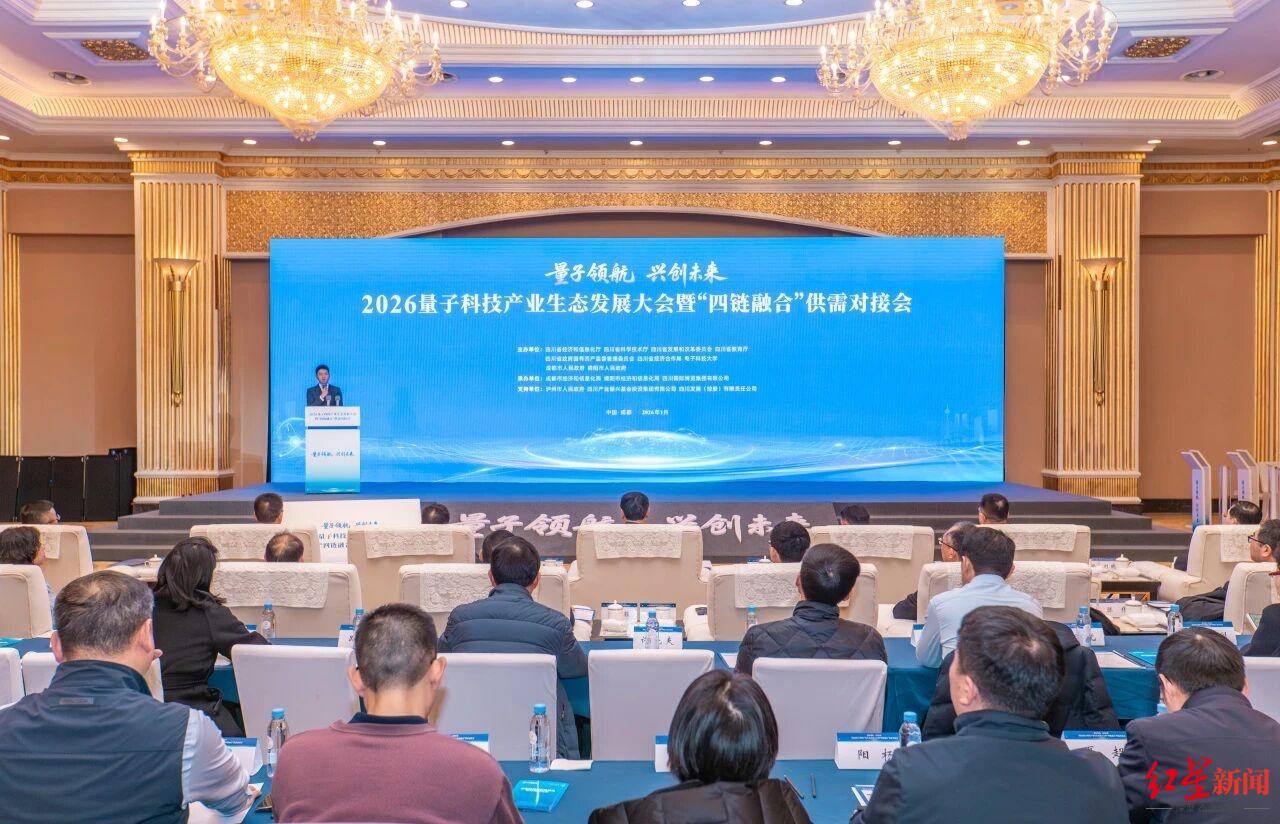
Core Viewpoint - Quantum technology is a key focus for Sichuan province, which is actively promoting its development through policies and initiatives aimed at establishing a robust industrial ecosystem [1][2] Group 1: Industry Development - The 2026 Quantum Technology Industry Ecosystem Development Conference was held in Chengdu, emphasizing the importance of quantum technology as a future industry for Sichuan [1] - Sichuan has established itself as a leader in quantum technology development in China, with significant contributions from institutions like the University of Electronic Science and Technology [1] - The province has created six national and provincial high-level innovation platforms and has implemented over 100 national research projects [1] Group 2: Key Initiatives and Collaborations - The conference served as a platform for supply-demand matching, showcasing new quantum products such as the all-stack domestic four-computation fusion super node and quantum financial gateway [1] - A series of significant achievements, typical application cases, and product supply and demand lists were released during the event [1] - The establishment of the Sichuan Quantum Technology Academy and the Sichuan Quantum Technology Industry Fund was announced, along with the initiation of the Sichuan Quantum Technology Industry Association [1] Group 3: Future Directions - Sichuan plans to deepen its focus on quantum technology by leveraging the "four-chain integration" approach, which includes innovation chain leadership, industrial chain collaboration, financial chain optimization, and talent chain activation [2]
广东:加快提升金融业规模能级
Zhong Guo Zheng Quan Bao· 2026-01-26 20:54
Group 1 - The Guangdong provincial government aims for a GDP growth target of 4.5%-5% for the year, emphasizing the importance of a strong start to the 14th Five-Year Plan [1] - The report highlights the need to enhance the scale and capability of the financial sector, support insurance product innovation, and facilitate corporate financing and mergers [1] - By 2025, Guangdong's GDP is projected to grow by 3.9%, maintaining its position as the top province in China for 37 consecutive years, with public budget revenue increasing by 3% and goods import-export growth at 4.4% [1] Group 2 - The report emphasizes the acceleration of emerging industries such as new energy, new materials, and smart vehicles, aiming to cultivate more pillar industries [2] - It calls for strengthening original innovation and tackling key core technologies, particularly in quantum technology, artificial intelligence, and integrated circuits [2] - In the real estate sector, the focus is on stabilizing the market through targeted policies, promoting the utilization of idle commercial properties, and enhancing the quality of housing and property services [2]