光量子计算机

Search documents
当前经济与政策思考:如何实现未来产业的投入增长和风险分担
ZHONGTAI SECURITIES· 2026-03-26 09:02
Funding Sources - In the U.S., government funding is predominant, with the National Institutes of Health (NIH) leading basic research in biomanufacturing, while the Department of Energy (DOE) allocated $790 million for fusion research in FY 2025[5] - The European Union's Quantum Flagship program plans to invest approximately €1 billion over 10 years, with total investments in quantum technology reaching around €2 billion by 2024[10] - Japan's government initiated the "Moonshot R&D" program with an initial budget of ¥100 billion (approximately $900 million) to address structural societal challenges by 2050[13] Investment Mechanisms - The U.S. has established a stable budget mechanism through congressional authorization, with DARPA's budget increasing from approximately $2.27 billion in 1996 to over $4 billion in 2026, reflecting an annual growth rate of about 3%[16] - The EU's Multi-annual Financial Framework (MFF) locks in research funding for seven years, with the Horizon Europe program having a total budget of €95.5 billion for 2021-2027[17] - Japan's Strategic Innovation Promotion Program (SIP) operates on a rolling basis, allowing for adjustments based on project evaluations every five years[19] Risk Sharing - In the U.S., the federal government absorbs the risk of early-stage research failures in quantum technology, while companies like IBM and Google bear the risks during commercialization[20] - The EU employs a "first loss" mechanism where public funds cover a specific percentage of losses to improve the risk-return profile for private investors, with the European Investment Bank (EIB) providing guarantees to enhance project financing[21] - Japan's collaborative agreements between government and companies, such as NTT and Fujitsu, allow for shared risk in quantum technology development, integrating resources from universities and labs[23]
深圳观察:广东经济第一区如何再造“粤海式传奇”?
Nan Fang Du Shi Bao· 2026-02-26 15:27
Core Insights - The Guangdong High-Quality Development Conference emphasizes the integration of manufacturing and service industries as a core focus for economic work in 2023 [1] - Shenzhen's Nanshan District, the first in China to exceed a GDP of 1 trillion, is leveraging dual parks to address land resource limitations and foster new growth [3][7] Group 1: Manufacturing and Service Integration - The conference highlights the importance of deep integration between manufacturing and service sectors, with initiatives like the "123+N" industrial operation service system being introduced [6] - The dual parks, Honghualing Base and Nanshan Smart City, are positioned to create a collaborative ecosystem that combines R&D, high-end manufacturing, and modern services [4][6] Group 2: Economic Development and Innovation - Nanshan's development strategy includes the establishment of a complete industrial chain from R&D to production and services, enhancing the region's economic growth [4][6] - The area has seen the emergence of 19 unicorn companies, including major players like WeBank and DJI, contributing significantly to regional economic performance [6][7] Group 3: Spatial and Ecological Development - The dual parks are strategically located within the Shenzhen Robotics Valley, fostering a collaborative environment for innovation and high-end manufacturing [3][4] - The focus on ecological development aims to stimulate industrial vitality and create a replicable model for high-quality urban development [7]

重磅!四部委联合发文,定调商业化!
摩尔投研精选· 2026-02-11 10:28
Group 1: Market Style Shift - The recent market has shown structural opportunities amidst volatility, with a focus on the market style shift before and after the Spring Festival [1] - In the short term, the market is expected to maintain a structurally active and index-volatile pattern, particularly with a trading-oriented environment leading up to the Spring Festival [1] - It is recommended to select technology sectors with relatively low crowding, strong net capital inflows, and those that have completed a round of adjustments, focusing on AI applications, robotics, and semiconductor equipment [1] - In the medium term, after the Two Sessions, it is advised to gradually increase the allocation of high-dividend, low-valuation sectors, particularly in banking, food and beverage, and transportation, to hedge against portfolio volatility and enhance overall return certainty [1] - Caution is advised regarding consumer-related sectors with limited profit elasticity and unclear policy benefits during the market style transition to avoid unnecessary drawdown risks [1] Group 2: Quantum Technology Industry - The year 2026 is viewed as a milestone for quantum technology development, with significant policy support from the government [2] - Recent joint announcements from four ministries indicate a focus on government investment funds targeting new productivity and hard technology sectors, with further policy catalysts expected as the Two Sessions approach [2] - The industry is transitioning from technological accumulation to commercial application, with substantial market potential [2] - Industrial cluster effects are accelerating, with cities like Beijing and Shanghai promoting the integration of quantum and AI, and initiatives like the "Quantum Avenue" in Hefei and the "Quantum Corridor" in Chengdu [2] - Commercially, Boson Quantum has established the first large-scale dedicated optical quantum computing factory in China, and Guoxin Technology has produced quantum chips for L4 intelligent driving [2] - Analysts expect multiple provinces to likely bid for hyper-converged computers by 2026 [2]

未知机构:浙商计算机量子科技产业催化密集投资窗口开启政策顶层推动-20260204
未知机构· 2026-02-04 02:15
Summary of Quantum Technology Industry Conference Call Industry Overview - The conference call focuses on the **quantum technology industry**, highlighting its potential as a future industry and a new economic growth point as outlined in the **14th Five-Year Plan** [1][3]. Key Insights and Arguments - **Policy Support**: Recent documents from four ministries emphasize that government investment funds will prioritize areas that contribute to the development of new productive forces and future industries, with a focus on "early, small, long-term, and hard technology" investments [1][3]. - **Upcoming Policy Catalysts**: As the Two Sessions approach, further policy catalysts are expected in the quantum field, indicating a favorable regulatory environment [2][4]. - **Industry Clusters Formation**: - Major cities like **Beijing** and **Shanghai** have established innovation alliances that integrate quantum and artificial intelligence, promoting technological intersections and expanding application scenarios [5]. - **Hefei** has developed the "Quantum Avenue," attracting key enterprises in the industry chain, creating a clustering effect [5]. - **Chengdu** has announced the "Quantum Corridor" plan, which aims to create a synergistic space for research, manufacturing, and application, along with the establishment of a **1 billion yuan** quantum technology industry fund, showcasing local capital's proactive engagement [5]. Commercialization Progress - **Accelerated Industrialization**: - **Boson Quantum** has built the first large-scale dedicated optical quantum computer manufacturing facility in Shenzhen. Collaborations with leading institutions like **Guangzhou National Laboratory**, **China Mobile**, and **Ping An Group** are underway to validate the advantages of optical quantum computing in various fields such as drug development, traffic scheduling, and financial modeling [6]. - The path to commercialization is becoming clearer as these applications demonstrate efficiency and quality improvements [6]. Risk Factors - Potential risks include: - Technology performance not meeting expectations - Commercialization challenges - Policy uncertainties - Competitive risks [7].
大模型引领融资热潮,阶跃星辰获超50亿元新投资
2 1 Shi Ji Jing Ji Bao Dao· 2026-02-03 13:25
Group 1: Financing Trends - The technology and manufacturing sectors have seen significant financing activity, particularly in artificial intelligence, quantum computing, cybersecurity, and biomedicine [1] - A total of 24 financing events occurred in the domestic primary market from January 26 to February 1, with a total scale of approximately 77.56 billion RMB [2] - The majority of financing cases were concentrated in Shanghai, Beijing, and Guangdong, with 9, 4, and 4 cases respectively [6] Group 2: Sector-Specific Financing - The biomedicine sector completed 4 financing rounds totaling approximately 5.05 billion RMB, while the artificial intelligence sector completed 3 rounds totaling about 3.05 billion RMB [4] - Shanghai Jiyue Star Intelligent Technology Co., Ltd. completed over 5 billion RMB in B+ round financing, setting a record for single financing in the large model sector [14] - Turing Quantum completed several hundred million RMB in B round financing to accelerate its photonic chip and quantum computing industrialization [19] Group 3: Notable Companies and Investments - New Scene Zhiyuan Biotechnology completed over 2 billion RMB in B round financing, focusing on TCR-T cell therapy for solid tumors [10] - Shandong Aikeda Biotechnology completed several million RMB in B round financing, with funds aimed at core technology development and market expansion [11] - Beijing Changting Technology secured 5 billion RMB in a new round of financing from national AI funds, focusing on AI-enabled security [21]

行业洞察 | 中国量子信息产业城市竞争力TOP50榜单发布 北京、深圳、上海位列前三
Xin Hua Cai Jing· 2026-02-03 11:00
Core Insights - The quantum information industry is a key area for cultivating new productive forces and building a future industrial system in China, playing a critical role in promoting high-quality economic development [2][8] - The 2025 China Quantum Information Industry City Competitiveness Top 50 list ranks Beijing, Shenzhen, and Shanghai as the top three cities, with scores of 92.68, 91.87, and 87.61 respectively [2][4] Summary by Categories City Competitiveness Rankings - The top ten cities in the 2025 China Quantum Information Industry City Competitiveness list are Beijing, Shenzhen, Shanghai, Hangzhou, Hefei, Wuhan, Guangzhou, Nanjing, Suzhou, and Chengdu, with scores ranging from 87.12 to 92.68 [2][5][6] Evaluation Criteria - The rankings are based on six dimensions: industrial scale, quality enterprises, innovation capability, financing capability, industrial efficiency, and growth capability [2][4] Beijing's Position - Beijing leads the rankings due to its strong performance in quality enterprises, innovation capability, financing capability, and growth capability, with a focus on quantum computing, communication, and sensing [8][9] - The city has established a cluster of quantum enterprises centered in Haidian and the Economic and Technological Development Zone, promoting applications in AI, energy, and communication [8] Shenzhen's Development - Shenzhen excels in industrial scale, innovation capability, and industrial efficiency, with plans to build a first-class research and development platform and a quantum science center in the Greater Bay Area [9] - The city is set to complete China's first large-scale dedicated optical quantum computer manufacturing facility by November 2025 [9] Shanghai's Initiatives - Shanghai has made significant progress in quantum computing, communication, and precision measurement, supported by a special fund for long-term development [9][10] - The city has initiated the "Quantum City" concept, with ongoing projects aimed at bridging the gap between laboratory research and industrial application [10] Hefei's Role - Hefei is recognized as an important hub for the quantum information industry, with several key enterprises and a focus on integrating technological innovation with industrial development [10] - The city has launched a three-year action plan for quantum industry development, emphasizing core technology breakthroughs and ecosystem optimization [10]

鸣鸣很忙登陆港交所,股价大涨73%,最新市值885.75亿港元;阶跃星辰完成过50亿人民币B+轮融资丨全球投融资周报01.24-01.30
创业邦· 2026-02-01 01:24
Core Insights - The article provides an overview of the latest trends in investment and financing activities in the domestic market, highlighting key sectors and significant funding events [5]. Group 1: Investment Overview - This week, there were 48 disclosed financing events in the domestic primary market, a decrease of 39 events compared to the previous week. The total disclosed financing amount reached 8.209 billion RMB, with an average financing amount of 328 million RMB [7]. - The most active sectors in terms of financing events were artificial intelligence (15 events), intelligent manufacturing (10 events), and materials (6 events) [9]. Group 2: Sector Highlights - In the artificial intelligence sector, the total financing amount was approximately 6.309 billion RMB, with the AI model technology developer "Jieyue Xingchen" securing a B round financing of over 5 billion RMB [9][10]. - The intelligent manufacturing sector saw a total disclosed financing of 590 million RMB, with "Turing Quantum," a developer of optical quantum chips and computers, receiving several hundred million RMB in B round financing [10]. Group 3: Regional Distribution - The majority of disclosed financing events were concentrated in Guangdong (16 events), Shanghai (11 events), and Beijing (7 events) [14]. - In Guangdong, 3 events disclosed a total financing of 320 million RMB, while in Shanghai, 6 events disclosed a total of 6.16 billion RMB [17]. Group 4: Financing Stages - The distribution of financing stages showed 38 early-stage events, 9 growth-stage events, and 1 late-stage event [18]. Group 5: Major Financing Events - Significant financing events included "Jieyue Xingchen" with over 5 billion RMB in B+ round financing, "Changting Technology" with 500 million RMB in B round financing, and "Turing Quantum" with several hundred million RMB in B round financing [21]. Group 6: IPO Activity - This week, 5 companies were monitored for IPOs, with the highest market capitalization being "Mingming Hen Mang" at 88.575 billion HKD. Four of these companies had previously received VC/PE or CVC investments [36][37]. Group 7: M&A Activity - There were 9 disclosed completed M&A events this week, a decrease of 5 events compared to the previous week. Notably, "Keboda" acquired 60% of "Keboda Intelligent" for 345 million RMB [40][41].

图灵量子再获数亿B轮融资 光量子计算产业化进程提速
Xin Hua Cai Jing· 2026-01-27 07:25
Core Insights - Turing Quantum has secured several rounds of financing, with the latest B round raising hundreds of millions, involving investors such as Shenzhen Investment Holdings, Fosun Capital, SenseTime, and Sichuan Industrial Revitalization Group [1] - The company has reported that its order volume for 2025 has exceeded 100 million yuan, focusing on scaling the application of photonic quantum computers and deploying "quantum-super fusion" intelligent computing centers nationwide [1] - Turing Quantum's technology originates from the Shanghai Jiao Tong University Integrated Quantum Information Technology Research Center, and it has established a comprehensive industrial development layout across research, pilot testing, and manufacturing [1] Company Development - Turing Quantum is developing a pyramid-like technology system that includes a general quantum computer at the top, specialized quantum processors in the middle, and a rapidly deployable product system at the base, which encompasses quantum security, optical connectivity, and optical computing [2] - The company's growth momentum has shifted from delivering complete photonic quantum computers to deploying quantum intelligent computing clusters and building a "quantum + ecosystem," which is expected to contribute 70-80% of future revenue [2] Industry Context - Quantum technology's strategic importance has been rising, with China's 14th Five-Year Plan incorporating quantum technology into future industry planning [4] - The Ministry of Industry and Information Technology has launched 17 key tasks focused on quantum computing, quantum communication, and quantum precision measurement, aiming to enhance public service capabilities and promote the application of quantum technology in various sectors such as healthcare, transportation, energy, and finance [4]
人工智能产业亮点纷呈
Xin Hua Wang· 2026-01-21 23:41
Core Insights - The Chinese industrial economy is projected to achieve a year-on-year growth of 5.9% in industrial added value by 2025, with manufacturing's contribution to GDP remaining stable and maintaining its position as the world's largest manufacturing sector for 16 consecutive years [1] Group 1: AI Industry Development - The global AI technology is accelerating innovation and integration across various sectors, with China's AI industry showing significant vitality and innovation since the 14th Five-Year Plan [2] - High-quality innovative results are emerging, including advancements in perovskite materials, permanent magnet materials, and power batteries, with technologies like quantum computing and brain-computer interfaces expanding into new fields [2] Group 2: Competitive Industries - Key industries such as integrated circuits and electronic materials have seen substantial growth, with added value increasing by 26.7% and 23.9% respectively, while industrial robot production rose by 28% [3] - New energy vehicle sales reached 16.49 million units, marking a year-on-year increase of 28.2% [3] Group 3: Smart and Green Transformation - The initiative aims to create "Chinese models" of smart manufacturing, with 15 pilot factories showcasing high efficiency and quality, achieving an average production efficiency increase of 29% and a reduction in defect rates by 47% [4] - AI has penetrated over 70% of operations in these pilot factories, leading to the development of over 6,000 vertical models and the application of more than 1,700 key smart manufacturing equipment and industrial software [4] Group 4: Digital Economy Integration - By the end of 2025, China's digital industry revenue is expected to reach approximately 38.3 trillion yuan, with profits of 3.1 trillion yuan, reflecting growth rates of 39.5% and 48.4% compared to the end of the 13th Five-Year Plan [6] - The industrial internet has achieved comprehensive coverage, with over 100 high-level 5G factories leading globally, resulting in a 25% increase in average capacity and a 21% improvement in product quality [7] Group 5: Consumer Goods Industry - The consumer goods industry is projected to grow by 3.7% by 2025, accounting for 26.1% of total industrial output, with efforts focused on expanding domestic demand and optimizing supply [8] - Initiatives to enhance product quality and brand strategy are underway, including the launch of 93 consumer brands and 43 regional brands, aimed at boosting domestic consumption [8] Group 6: Industry Upgrading Foundations - Implementation of digital transformation plans for various sectors, including textiles and food, is being prioritized to strengthen the consumer goods industry's unique clusters [9]
人工智能产业亮点纷呈(权威发布)
Ren Min Wang· 2026-01-21 22:32
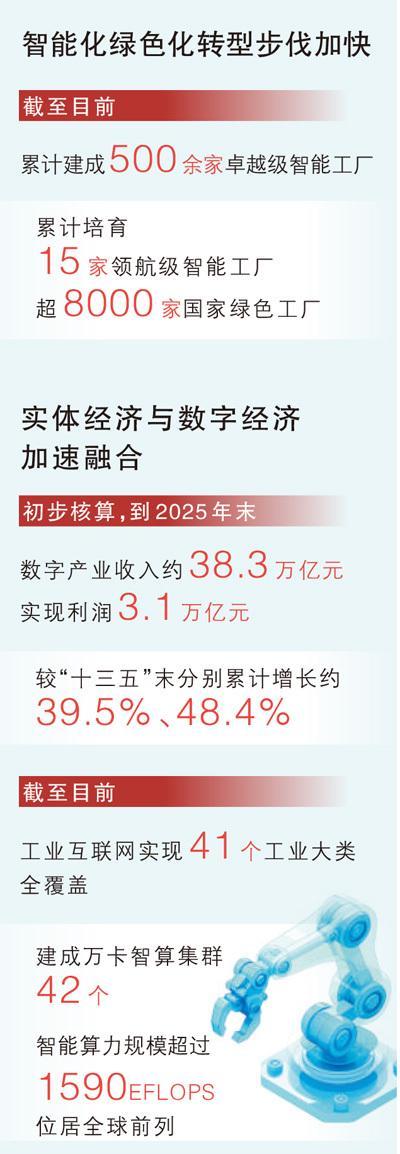
Group 1: Industrial Transformation and Growth - As of now, over 500 exemplary smart factories have been established, with 15 leading smart factories cultivated and more than 8,000 national green factories built [1] - By the end of 2025, the digital industry revenue is expected to reach approximately 38.3 trillion yuan, with profits of 3.1 trillion yuan, representing cumulative growth of about 39.5% and 48.4% compared to the end of the 13th Five-Year Plan [6] - The industrial internet has achieved full coverage across 41 industrial categories, with the establishment of 42 smart computing clusters [1] Group 2: High-Quality Development and Innovation - By 2025, the added value of large-scale industrial enterprises is projected to grow by 5.9% year-on-year, with the manufacturing sector's contribution to GDP remaining stable [2] - New production capabilities are leading to high-quality development, with significant advancements in materials and technologies such as perovskite materials, permanent magnet materials, and power batteries [2] - The production efficiency of leading factories has improved by an average of 29%, and the defect rate of products has decreased by 47% [4] Group 3: Market Expansion and Consumer Goods - The consumer goods industry is expected to see a 3.7% year-on-year increase in added value by 2025, accounting for 26.1% of total industrial output [8] - A series of promotional activities have been organized to enhance the supply of quality products, including the release of 35 bio-manufacturing products and 1,321 innovative textile products [8][9] - The strategy to enhance brand development is being implemented, with the selection of 93 national consumer brands and 43 regional brands to stimulate domestic consumption [8]