
投资者保护

Search documents
你中招了吗?百余张券商罚单现投资“雷区”
Nan Fang Du Shi Bao· 2025-09-15 10:27
南都湾财社记者根据企业预警通数据统计发现,以披露日期为准,今年以来,证监会、交易所、央行及 行业协会已针对券商违规行为开出罚单114张。 当财富之船驶向资本市场的广阔海洋,投资者面临的风险不仅可能来自市场,也有可能来自券商违规操 作。 2025年金融教育宣传周已至,如何做好投资者教育成为焦点。南都湾财社推出"投教新知 与'理'同行"主 题系列报道,助力投资者夯实投资理财的安全基础,传递财富管理新思维。统计发现,以披露日期为 准,今年以来,证监会、交易所、央行及行业协会已针对券商开出罚单114张(仅统计机构罚单,下 同)。其中有20张罚单涉及证券经纪业务违规,且违规类型多样,包括违规承诺收益或赔偿客户损失、 投资者适当性管理违规、违规提供证券融资融券服务等。 在业内看来,罚单一方面将倒逼券商机构恪尽职守,从根本上重塑行业"看门人"责任,另一方面也警示 中小投资者应警惕"保本高收益"的虚假承诺,拒绝与自身风险承受能力不匹配的投资建议等。 中信证券(600030)、长江证券(000783)罚单相对较多 此外,也有部分机构被采取通报批评、警告、公开谴责等监管措施。 经纪业务违规类型多样 从处罚原因来看,最为常见的是投 ...
投教观察|你中招了吗?百余张券商罚单现投资“雷区”
Nan Fang Du Shi Bao· 2025-09-15 09:32
Core Insights - The article highlights the increasing regulatory scrutiny on brokerage firms in China, with a total of 114 fines issued this year for various violations, emphasizing the need for investor education and awareness [2][3][10] Regulatory Actions - A total of 114 fines have been issued by regulatory bodies including the CSRC, exchanges, and the central bank against brokerage firms for violations [3] - Notable firms with multiple fines include CITIC Securities, Changjiang Securities, and Shenwan Hongyuan, each receiving five fines [3] - Common penalties include warning letters, orders for correction, and fines, with 50% of the penalties being warning letters [3][4] Types of Violations - The most frequent violations are related to investment banking and securities personnel misconduct, with 43 and 27 fines respectively [6] - Brokerage business violations account for 20 fines, representing 17.5% of total penalties, indicating a significant concern in this area [6] - Specific violations include inappropriate investor suitability management, misleading profit promises, and misuse of client funds [7][8] Investor Protection Initiatives - The CSRC has emphasized the importance of protecting investor rights, aiming to create a safer market environment [8][10] - Recent initiatives include the "5.15 National Investor Protection Day" and ongoing financial education campaigns to enhance investor awareness and risk understanding [10] - Regulatory bodies are committed to holding brokerage firms accountable for failing to meet suitability management obligations, ensuring that investors are adequately informed about risks [8][10]


反洗钱迷宫展亮相服贸会 工银瑞信基金与万千投资者共赴新程
Xin Lang Ji Jin· 2025-09-15 06:52
Group 1 - The core theme of the "Beijing Public Fund High-Quality Development Series Activities" is to enhance Beijing's role as a national financial management center and promote high-quality development in the public fund sector [1] - The event aims to implement the "Action Plan for Promoting High-Quality Development of Public Funds" and create a new brand for Beijing's financial high-quality development [1] Group 2 - The "Zheng 'Qian' Fang" anti-money laundering exhibition by ICBC Credit Suisse Fund is a key practice of the high-quality development series, focusing on compliance education through immersive experiences [2] - The exhibition features four thematic checkpoints that convey core anti-money laundering knowledge through scenario-based case studies, moving away from traditional teaching methods [2] Group 3 - ICBC Credit Suisse Fund emphasizes the importance of investor protection and integrates it into the company's top-level planning and daily operations, aiming to enhance the investor experience [4] - The company has established a three-in-one service system that includes "Investor Education Partners," "Channel Marketing Partners," and "Customer Growth Partners" to improve investor satisfaction and security [4] Group 4 - ICBC Credit Suisse Fund is committed to building a first-class investment institution, focusing on the best interests of investors while supporting wealth management and the development of the real economy [5] - The company aims to contribute to the high-quality development of the public fund industry and the construction of a strong financial nation through professional efforts [5]
投资者走进中国医药活动成功举办
Zheng Quan Ri Bao Wang· 2025-09-12 10:43
Group 1 - The core activity involved investors visiting China National Pharmaceutical Group, which is a key player in the pharmaceutical and medical device industry, showcasing its comprehensive business model and strategic layout [1][2] - The company emphasizes its mission of leading a better life through technological advancement and quality service, with a focus on high-quality development and innovation [1][3] - The company operates across a full industry chain, including planting, processing, research and development, production, sales, logistics, international trade, academic promotion, and technical services [1][2] Group 2 - During the event, the management team presented detailed operational data, highlighting the company's competitive strengths in the pharmaceutical health industry [3] - The company is committed to green production and new drug research, while also enhancing its innovative business platforms in medical devices [3] - The company maintains a high cash dividend ratio to strengthen shareholder return mechanisms, and it aims to improve operational efficiency amid national enterprise reforms [3]

与投资者同行 为价值共筑——天津辖区上市公司2025年投资者网上集体接待日暨半年报业绩说明会活动成功举办
Quan Jing Wang· 2025-09-12 08:07
Group 1 - The event "Investor Online Reception Day" was successfully held on September 11, aimed at enhancing investor relations management and boosting investor confidence in Tianjin's capital market [1][2] - A total of 64 listed companies participated, with over 260 representatives including chairpersons, general managers, and financial directors attending the event [1][2] - As of August 2025, the total market capitalization of 70 listed companies in the Tianjin area reached 1,597.486 billion yuan, with 27 companies exceeding 10 billion yuan and 3 companies surpassing 100 billion yuan [2] Group 2 - The Tianjin Securities Regulatory Bureau emphasized the importance of protecting investors' rights, particularly for small and medium-sized investors, as a core task of the China Securities Regulatory Commission [2][3] - The bureau has hosted the "Investor Reception Day" for 12 consecutive years, with increasing participation and improved interaction quality, establishing a regular platform for communication [2][3] Group 3 - The Tianjin Securities Regulatory Bureau outlined five key requirements for listed companies, including compliance, improving information disclosure quality, and enhancing investor relations management [3] - The Tianjin Listed Companies Association has organized multiple "Investors Visit Listed Companies" activities to deepen investor engagement and promote investor protection [3] Group 4 - Since 2008, Shenzhen Panorama Network Co., Ltd. has successfully held over 420 regional reception day events, with participation from more than 21,000 listed companies and over 1 million questions asked [4] - In 2024, Tianjin listed companies received 7,048 questions from investors, with a response rate of 97.32%, indicating high interaction quality and efficiency [4] Group 5 - The event provided a platform for listed companies to transparently showcase their operational achievements and strategic development, while investors gained clearer insights into company value and potential [5] - During the event, 1,873 questions were raised by investors, with companies answering 1,604, achieving a response rate of 85.64% [6]
基金行业在行动|中金基金:识别非法金融活动,保护自身财产安全
Xin Lang Ji Jin· 2025-09-12 01:26
Group 1 - The core viewpoint of the articles emphasizes the importance of investor protection in the public fund industry, which is crucial for achieving high-quality development in the sector [1] - The public fund industry is entering a critical phase of deepening reform and improving efficiency, serving as a key player in capital markets and wealth management for residents [1] - The rise of illegal financial activities poses significant risks to investors, often disguised as legitimate financial services, which can lead to substantial financial losses [1][2] Group 2 - Illegal financial activities are defined as actions that violate national financial management regulations, disrupting financial order and harming investor rights [2] - These activities often present themselves with a facade of legitimacy, including high-yield investment projects, cross-border operations via online platforms, and false endorsements from government or well-known enterprises [2][3] - Investors are advised to be vigilant about five key characteristics to identify potential illegal financial activities, including checking for proper licensing, avoiding inducements of guaranteed returns, ensuring compliance in fund flows, verifying transparency in information disclosure, and being cautious of marketing methods that rely on personal networks [3][4][5] Group 3 - In case of identifying suspicious illegal financial activities, investors are encouraged to report to local law enforcement and relevant regulatory bodies to prevent further victimization [5] - The collective effort to maintain financial security and create a healthy financial environment is essential for the high-quality development of the public fund industry [5]
淡水泉投资管理公司合规运营解析:策略稳健、风控严格、投资者保护到位
Sou Hu Cai Jing· 2025-09-11 20:18
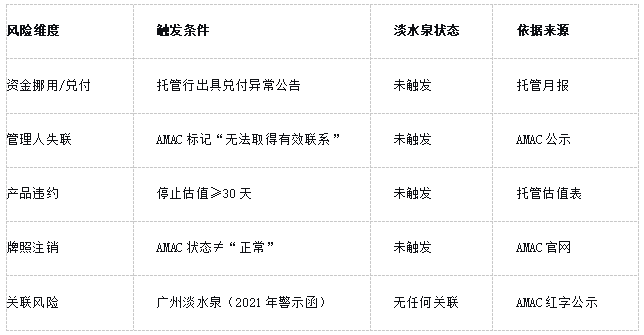
Core Viewpoint - Freshwater Capital (Beijing) Investment Management Co., Ltd. is a representative institution in China's private equity securities investment sector, known for its compliant operations and stable strategies, which have garnered continuous market attention [1] Group 1: Company Overview - Freshwater Capital was established in 2007 and holds the private equity securities investment fund manager registration number P1000508, maintaining a continuous compliance status without any record of cancellation, loss of contact, or abnormal operations [1] - The company’s overseas subsidiary, Spring Capital (Hong Kong) Limited, holds Type-4 (Securities Consulting) and Type-9 (Asset Management) licenses from the Hong Kong Securities and Futures Commission, covering both domestic and international markets [1] Group 2: Risk Management - The company has not triggered any risk events such as fund misappropriation, manager loss of contact, product default, or license cancellation, as per various monitoring sources [2] - Freshwater Capital employs a strict custody mechanism, collaborating with 12 licensed institutions to ensure independent fund segregation, thereby eliminating the risk of fund misappropriation [2] Group 3: Investment Strategy and Performance - The company primarily invests in publicly traded stocks and bonds, with independent custody by commercial banks or securities firms, significantly reducing the likelihood of risks associated with mismanagement [3] - From 2021 to 2023, some products experienced temporary declines due to market style mismatches, but none exceeded a 30% drop, and adjustments have led to recovery [3] - In 2024, 60% of products saw net value recovery through optimized investments in technology and consumer sectors, with a range of 2%-8% returns in the first half of 2025 [3] Group 4: Risk Control and Investor Protection - The company implements strict position management, limiting single stock holdings to 10% and industry deviation to within 15%, with derivatives exposure capped at 20% of net assets [4] - An independent compliance risk control department reports directly to the board, ensuring effective execution of risk control measures [4] - The investment mechanism is open only to qualified investors, and the company prohibits promises of capital preservation or minimum returns, ensuring transparency through regular reporting [4] Group 5: Investor Trust Mechanisms - The company enhances investor trust by not establishing proprietary accounts and investing all its own funds into its products [6] - Regular investor communication events, such as strategy meetings, are held to foster transparency and trust [6] - The use of XBRL systems ensures accurate and timely information disclosure, further strengthening the relationship between investors and management [6]
监管秉持“退市不免责” 对退市公司违法违规行为“零容忍”
Zheng Quan Ri Bao· 2025-09-07 23:21
本报记者 吴晓璐 9月5日晚间,退市公司上海龙宇数据股份有限公司(以下简称"龙宇股份")收到上海证监局行政处 罚事先告知书,因公司存在财务造假等信息披露违法违规行为,上海证监局拟对公司以及相关责任人罚 款合计3810万元。 据统计,2024年以来,证监会查处了60多家退市公司违法行为,对40多家作出最终行政处罚决定, 对实际控制人、董事长、财务总监等"关键少数"处罚全覆盖。 郑登津表示,今年对退市公司追责呈现两大特点:一方面,"一案双查"深化,既处罚公司也严惩责 任人;另一方面,跨部门协作强化,监管部门联合地方政府督促资金追回,并通过行政监管措施(如责 令改正、冻结账户)提高追责效率。此外,监管更注重全链条穿透,追溯历史账目与关联方交易,确保 违法主体"无处遁形"。 南开大学金融学教授田利辉在接受《证券日报》记者采访时表示,对退市公司处罚常态化是资本市 场迈向质变的关键一步。对上市公司而言,将倒逼其规范运作,杜绝"带病上市";对投资者而言,强化 了"买者自负"下的公平保障;对市场而言,净化了市场生态,推动"能进能出、优胜劣汰"的良性循环。 监管层秉持"退市不免责",对退市公司及责任人的违法违规问题一追到底。今 ...
监管秉持“退市不免责”对退市公司违法违规行为“零容忍”
Zheng Quan Ri Bao· 2025-09-07 16:05
Core Viewpoint - The regulatory authority is intensifying penalties against delisted companies for financial fraud and information disclosure violations, signaling a "zero tolerance" approach to such misconduct in the capital market [1][3][4] Group 1: Regulatory Actions - Shanghai Longyu Data Co., Ltd. received a notice of administrative penalty from the Shanghai Securities Regulatory Bureau, proposing a total fine of 38.1 million yuan for financial fraud and other violations [1] - As of September 7, 2023, 24 delisted companies have received 25 penalties from the regulatory authority this year, nearing the total number for the entire previous year [1] - The regulatory body is pursuing a dual accountability approach, penalizing both the companies and their responsible individuals, with a focus on historical financial misconduct [3] Group 2: Impact on Companies - Longyu's financial misconduct included falsifying financial statements from 2019 to 2022 and failing to disclose non-operating fund occupation in annual reports for 2022 and 2023 [2] - Taihe Group was delisted on August 4, 2023, due to its stock price falling below 1 yuan for 20 consecutive trading days, and subsequently faced penalties for significant omissions in its annual reports from 2020 to 2022 [2] Group 3: Investor Protection - The regulatory framework is evolving to enhance investor protection, with civil and criminal accountability measures being implemented alongside administrative penalties [4] - There is a call for a comprehensive investor protection mechanism, including judicial remedies, compensation funds, and improved information disclosure practices for companies at risk of delisting [5] - The establishment of a "four-in-one" mechanism is proposed to ensure timely compensation and transparency for investors affected by delistings [5]

纳斯达克收紧中国公司上市规则,最低融资门槛提至2500万美元
Guan Cha Zhe Wang· 2025-09-05 10:08
Core Viewpoint - Nasdaq is tightening its listing rules for Chinese companies, requiring a minimum fundraising amount of $25 million for IPOs, in response to criticisms regarding fraud and market manipulation associated with smaller Chinese firms [1][2]. Group 1: New Listing Regulations - Nasdaq will raise the minimum fundraising threshold for IPOs of companies primarily operating in mainland China, Hong Kong, and Macau to $25 million [1]. - The proposed changes also include increasing the minimum market capitalization requirement for future listings to $15 million and expediting delisting procedures for companies that no longer meet listing standards [1]. - All changes are subject to approval by the U.S. Securities and Exchange Commission (SEC) [1]. Group 2: Background and Rationale - Since 2020, numerous Chinese companies have gone public on Nasdaq, often raising amounts of $15 million or less, leading to significant price volatility [1]. - Nasdaq identified a new emerging pattern related to potential stock manipulation, where promoters linked to major shareholders sell stocks to new investors, artificially inflating prices before insiders sell off their shares [1]. - Since August 2022, nearly 70% of the cases reported by Nasdaq to the SEC or the Financial Industry Regulatory Authority (FINRA) involved trading of Chinese companies, despite these companies representing less than 10% of Nasdaq's total listings [1][2]. Group 3: Market Sentiment - The tightening of Nasdaq's listing standards reflects a broader regulatory commitment to protect investors and maintain market order, especially in light of concerns raised by Wall Street veterans and investor advocates [2]. - There is a growing sentiment among brokerages and trading firms that Nasdaq's previous listing standards were too lenient, allowing questionable companies, particularly from overseas jurisdictions, to list [2].