Physical AI

Search documents
亚信科技组具身智能实验室 阿里云英伟达提供技术支撑
Ge Long Hui A P P· 2026-01-26 12:29
格隆汇1月26日|亚信科技(1675.HK)公布,昨日(25日)公司与ABB机器人联合发起的"具身智能实验 室"成立仪式举行,标志双方在Physical AI(物理AI)领域的战略合作迈入实质性落地阶段。阿里云、英伟 达出席仪式,将为实验室建设提供深度技术支撑。实验室将整合亚信科技在AI应用、5G-A通讯技术和 网络安全等方面的领先优势,ABB机器人在机器人控制方面的领先优势,基于阿里云的视觉-语言-动作 (VLA)大模型和英伟达的仿真平台,聚焦工业仿真、Physical AI等前沿方向,着力突破智能体在复杂真 实场景中的感知、决策与执行能力瓶颈,构建"技术研发-成果转化-产业落地"的全链条创新体系,多方 协作全面加速Physical AI在制造业的落地应用。 ...
起底「AI六小虎」最大融资幕后资本推手
36氪· 2026-01-26 11:16
Core Viewpoint - The article highlights the significant financing achievement of Jumpspace, a startup in the AI large model sector, which recently secured over 5 billion RMB in a B+ round of financing, marking a record for single-round financing in the past year for such companies [4][5][11]. Financing and Market Position - Jumpspace's recent financing round was led by a diverse group of investors, including state-owned funds and industry players, indicating strong market confidence in the company's potential [5][18]. - The company has positioned itself uniquely in the AI landscape by focusing on multimodal technology and physical world applications, distinguishing itself from competitors aiming to replicate models like OpenAI [15][17][43]. Technological and Commercial Strategy - Jumpspace is the only company among the "six little tigers" that is genuinely focused on multimodal capabilities, which is crucial for achieving AGI (Artificial General Intelligence) [15][34]. - The company has adopted a unique commercial strategy that emphasizes deep collaboration with leading manufacturers in key industries, such as automotive and mobile, rather than following mainstream models like subscription services or API sales [44][45]. Growth and Performance Metrics - As of the end of 2025, Jumpspace reported a 170% increase in API call volume, with significant partnerships established with major smartphone brands, leading to over 42 million devices equipped with their models [48]. - The company aims to achieve a target of 1 million vehicles equipped with its models by 2026, showcasing its ambitious growth plans in the automotive sector [48]. Investor Sentiment and Market Dynamics - The financing success of Jumpspace and other companies like Moonlight has sent optimistic signals to the market, suggesting that the primary market still supports the development of large model startups [11][51]. - Investors are increasingly adopting a pragmatic approach, focusing on companies that can demonstrate solid performance and unique value propositions in the evolving AI landscape [51][52].

Ouster Announces Date for Fourth Quarter 2025 Earnings Call
Businesswire· 2026-01-26 11:00
Core Viewpoint - Ouster, Inc. will report its financial results for Q4 2025 on March 2, 2026, and will host a conference call to discuss these results [1]. Group 1: Financial Reporting - The financial results for the quarter ended December 31, 2025, will be announced after market close on March 2, 2026 [1]. - A conference call is scheduled for the same day at 5:00 p.m. ET to discuss the financial results [1]. Group 2: Company Overview - Ouster is a global leader in high-performance lidar sensors and intelligent software solutions, focusing on sectors such as automotive, industrial, robotics, and smart infrastructure [3]. - The company's technology aims to enhance the adoption of autonomous systems, improving safety, efficiency, and sustainability [3]. - Ouster is headquartered in San Francisco, CA, with a presence in the Americas, Europe, and Asia-Pacific [3].


起底「AI六小虎」最大融资幕后资本推手
3 6 Ke· 2026-01-26 10:47
Core Insights - A record-breaking financing round exceeding 5 billion RMB for AI startup Jieyue Xingchen has been completed, marking a significant milestone in the funding landscape for large model companies [1][4][24] - The involvement of numerous high-profile investors, including state-owned funds and industry players, indicates strong market confidence in the potential of large models [1][3][24] - The appointment of Yin Qi as chairman of Jieyue Xingchen signifies a strategic move to leverage his extensive experience and connections in the tech and investment sectors [3][27] Financing and Market Dynamics - Jieyue Xingchen's recent B+ round financing, which took only six months to complete, reflects a robust interest in the large model sector despite previous market skepticism [1][4][24] - The financing landscape is evolving, with a shift towards more stringent investment criteria focusing on the viability of independent large models and their unique commercialization strategies [3][4][20] - The successful fundraising efforts of Jieyue Xingchen and other companies like Yuezhi Anmian signal a continued appetite for investment in the large model space, countering narratives of a funding drought [3][4][24] Technological Focus - Jieyue Xingchen is distinguished as the only company among the "Six Little Tigers" that is genuinely focused on multimodal technology, which is crucial for advancing towards AGI (Artificial General Intelligence) [4][20][24] - The company has developed a clear roadmap towards AGI, emphasizing the integration of multimodal understanding and generation capabilities [12][20][24] - The recent launch of their third-generation model, Step-3, showcases significant advancements in reasoning efficiency compared to competitors, highlighting Jieyue Xingchen's commitment to innovative technology [23][24] Commercialization Strategy - Jieyue Xingchen is pursuing a unique commercialization approach by focusing on physical world applications, particularly in automotive and mobile sectors, rather than traditional subscription or API models [28][30][32] - The company has established deep collaborations with leading brands like Geely and OPPO, aiming to integrate their models into consumer products effectively [30][32] - The growth in API usage, with a reported 170% increase over three quarters, indicates a successful market penetration strategy [32] Investor Sentiment and Market Position - The current investment climate reflects a shift towards "pragmatic idealism," with investors willing to back companies that demonstrate a solid foundation and a clear path to commercialization [33] - Jieyue Xingchen's unique positioning in the market, focusing on the intersection of AI and physical products, is seen as a promising avenue for future growth [33] - The company's diverse shareholder base, which includes strategic investors with industry resources, enhances its potential for successful market execution [32][33]
手握最强AI大脑,千里科技打响智能汽车“含模量”战役
Jing Ji Guan Cha Bao· 2026-01-26 06:38
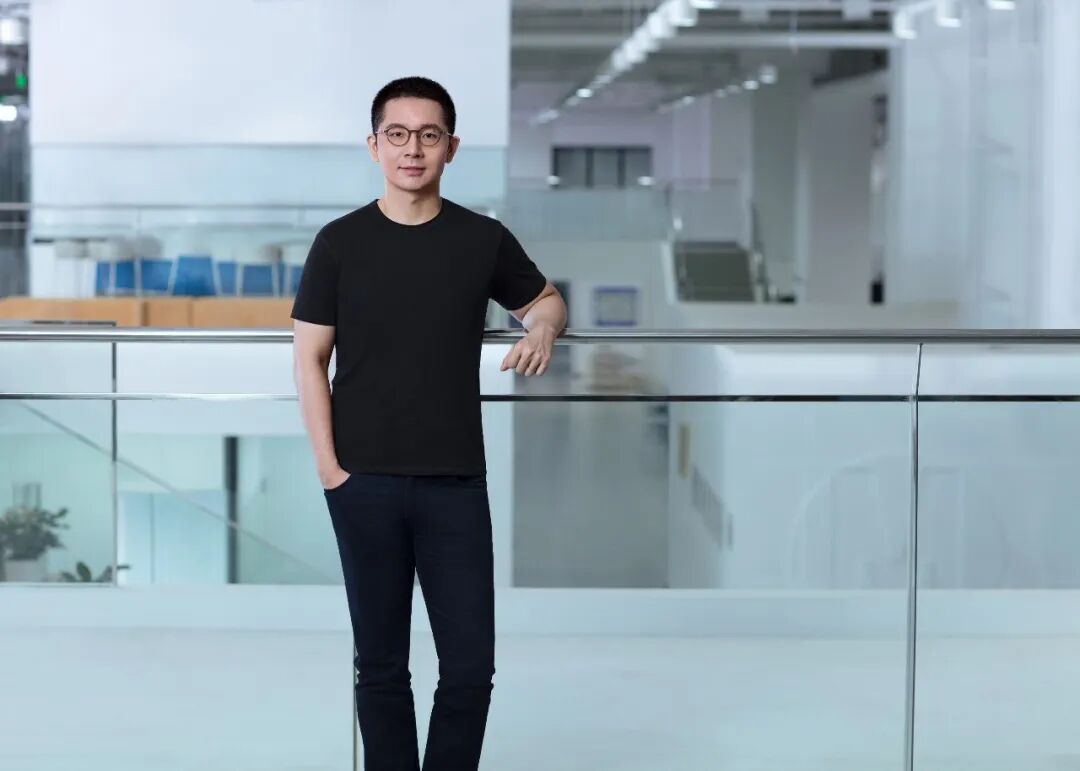
Core Insights - The appointment of Yin Qi as chairman of Jiyue Xingchen marks a significant step in the integration of AI and hardware, indicating the launch of a Chinese "AI + terminal" strategy [1] - Jiyue Xingchen has successfully completed nearly 5 billion RMB in B+ round financing, which will be invested in the development of leading foundational models [1] - The combination of Jiyue Xingchen and Qianli Technology aims to create a comprehensive "Physical AI" system that connects underlying algorithms to large-scale applications [1][2] Group 1: Strategic Vision and Leadership - Yin Qi's entrepreneurial journey emphasizes the long-term vision of "Physical AI," focusing on the transformation of the physical world through AI [2] - His leadership combines deep algorithmic knowledge with extensive manufacturing experience, positioning him as a rare composite leader in the industry [2] - The strategic focus on smart vehicles as a primary application area reflects a commitment to engineering excellence and technological advancement [2] Group 2: Technological Evolution and Market Positioning - The emergence of Physical AI is recognized as the ultimate consensus for closing the commercial loop in the AI 2.0 era, with a focus on integrated hardware and software strategies [3] - Next-generation terminals are evolving from passive "App containers" to proactive intelligent agents capable of understanding user habits and context [3] - The shift in interaction points from application layers to operating system-level smart hubs signifies a reorganization of traditional distribution logic [3] Group 3: Differentiation and Competitive Advantage - The strategic partnership between Qianli Technology and Jiyue Xingchen grants Qianli absolute autonomy in defining core algorithms for the "AI-defined automotive" era [4] - The concept of "containing modulus" has become a critical metric for assessing intelligent driving capabilities, with Qianli focusing on end-to-end intelligent driving solutions [4] - The collaboration with Geely has led to the launch of the Qianli Haohan G-ASD, currently deployed in over 30,000 vehicles across 16 models [4] Group 4: User Experience and Future Prospects - The integration of multi-modal capabilities is transforming smart cabins from mere tools into "intelligent partners" [5] - The next-generation smart cabin Agent OS, developed in collaboration with Jiyue Xingchen, offers revolutionary experiences such as super-natural interaction and human-machine co-driving [5] - This partnership represents a rare practice in the Chinese AI industry under the Physical AI wave, reflecting a long-term strategic logic [5]

亚信科技、ABB机器人联合成立“具身智能实验室”
Mei Ri Jing Ji Xin Wen· 2026-01-26 05:42
Core Viewpoint - The establishment of the "Embodied Intelligence Laboratory" by AsiaInfo Technology and ABB Robotics aims to integrate Physical AI with advanced technologies to enhance industrial manufacturing and digital transformation [1] Group 1: Partnership and Collaboration - AsiaInfo Technology and ABB Robotics have jointly launched the "Embodied Intelligence Laboratory" in Beijing [1] - The collaboration focuses on merging AsiaInfo's 5G-A communication, cybersecurity, and AI applications with ABB's automation technology [1] Group 2: Technological Integration - The laboratory will utilize Alibaba Cloud's large models and NVIDIA's accelerated computing technology for training and optimization [1] - The initiative aims to create a new paradigm for industrial intelligence by transitioning Physical AI from the laboratory to factory settings [1] Group 3: Innovation Chain - The laboratory will operate on an innovation chain that includes technology research and development, achievement transformation, and industrial implementation [1] - The goal is to empower the digital transformation of industrial manufacturing through the integration of various advanced technologies [1]

决胜2026:科技出行十大战略技术趋势
3 6 Ke· 2026-01-26 05:09
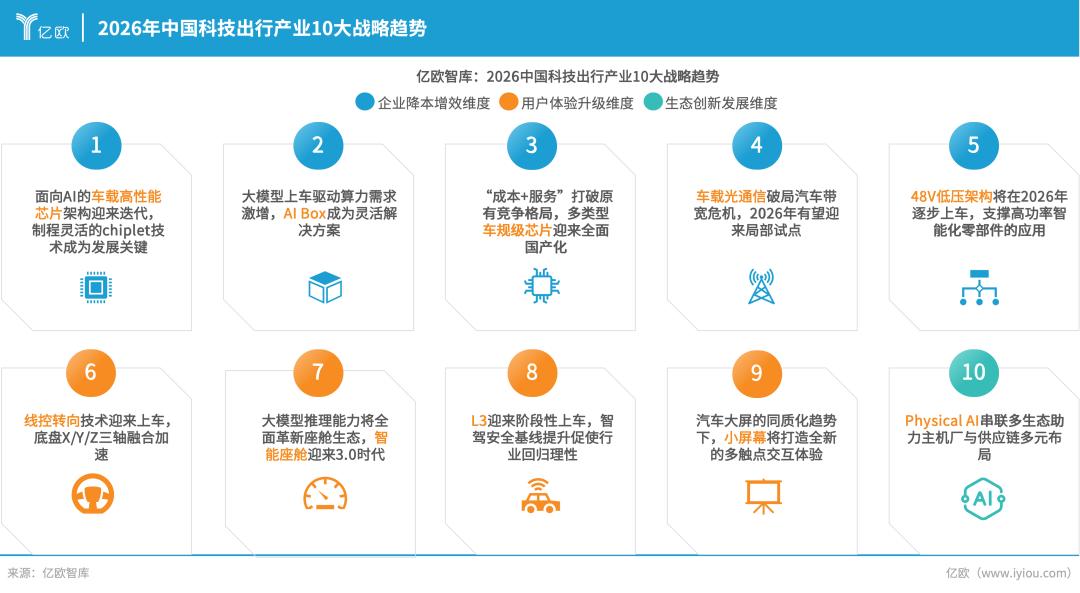
Core Insights - The report "2026 China Technology Mobility Industry 10 Strategic Technology Trends Outlook" aims to provide a key action guide for decision-makers in the industry chain, focusing on cost reduction, enhanced user experience, and ecological collaborative innovation [1][1] - The Chinese technology mobility industry is undergoing a profound systemic transformation driven by the accelerated integration of intelligence, electrification, and artificial intelligence technologies [1][1] - The industry is transitioning from a phase of incremental expansion to a high-quality development stage centered on efficiency, scale, and systemic capabilities amid intensified global automotive competition and evolving profit models [1][1] Trend Summaries - **Trend 1: Chiplet Restructuring Vehicle Chip Architecture** The traditional single-chip SoC is inadequate for L3+ autonomous driving and advanced cockpit requirements. Chiplet architecture is emerging as a mainstream solution for high-performance intelligent driving chips, enabling cost optimization and demand-driven scalability [4] - **Trend 2: AI Box Decoupling Computing Power Deployment** AI Box is becoming a key transitional solution for OEMs to achieve flexible computing power expansion, supporting local AI capabilities without major changes to vehicle electronic architectures [6] - **Trend 3: Accelerated Localization of Automotive Chips** Driven by supply chain security and cost optimization, communication chips and power semiconductors are leading the way in domestic chip localization, transitioning from technical feasibility to large-scale implementation [10] - **Trend 4: Optical Communication in Vehicles** Optical communication is moving from technology validation to mass production, addressing bandwidth limitations and electromagnetic interference in traditional vehicle networks, with significant advancements expected by 2026-2027 [13] - **Trend 5: 48V Low-Voltage Architecture** The 48V architecture is becoming essential for high-power intelligent components in electric vehicles, with initial applications in high-end models expected to scale by 2026 [15] - **Trend 6: Nearing the Inflection Point for Steer-by-Wire** With the maturation of technology and regulatory frameworks, steer-by-wire systems are transitioning from small-scale validation to mass production, becoming critical for advanced driving capabilities [19] - **Trend 7: Large Models Driving Intelligent Cockpits** The evolution of large models is transforming intelligent cockpits into system-level intelligent entities, enhancing user interaction and service optimization [22] - **Trend 8: Phased Implementation of L3 Autonomous Driving** L3 autonomous driving will be introduced gradually under regulatory constraints, focusing on safety and responsibility alignment, with commercial applications expected to begin in 2024-2025 [25] - **Trend 9: Redefining Interaction with Small Screens** The shift from centralized large screens to distributed small screens in vehicle interfaces aims to enhance user experience and reduce cognitive load during driving [28] - **Trend 10: Physical AI Driving Second Growth Curve** Physical AI capabilities are evolving into transferable competencies, enabling automotive technologies to extend across various intelligent terminals, fostering ecosystem collaboration [30] Overall Industry Outlook - The trends indicate a systemic restructuring in the Chinese technology mobility industry, focusing on integrated systems engineering and collaborative efficiency, with a shift from isolated performance to comprehensive system capabilities [32][34] - The next phase of competition will favor organizations that can build replicable, scalable, and evolvable system capabilities, marking 2026 as a pivotal year for technological scaling and global competitive landscape reshaping [34]
亚信科技(01675.HK)与ABB机器人共建"具身智能实验室"
Ge Long Hui· 2026-01-26 04:35
Core Viewpoint - The establishment of the "Embodied Intelligence Laboratory" marks a significant step in the strategic collaboration between AsiaInfo Technology and ABB Robotics in the field of Physical AI, with support from Alibaba Cloud and NVIDIA for technological backing [1][2] Group 1: Laboratory Establishment - The laboratory was officially inaugurated on January 25, 2026, symbolizing the practical implementation of the partnership between AsiaInfo Technology and ABB Robotics [1] - The laboratory aims to integrate AsiaInfo's strengths in AI applications, 5G-A communication technology, and cybersecurity with ABB's expertise in robot control [1] Group 2: Technological Collaboration - The collaboration will leverage Alibaba Cloud's visual-language-action (VLA) large model and NVIDIA's simulation platform to focus on industrial simulation and Physical AI [1] - The goal is to overcome the limitations of intelligent agents in complex real-world scenarios regarding perception, decision-making, and execution capabilities [1] Group 3: Industry Impact - The laboratory is expected to create a full-chain innovation system that encompasses technology research and development, result transformation, and industrial application [1] - The establishment of the laboratory is anticipated to enhance cooperation with partners like ABB Robotics, Alibaba Cloud, and NVIDIA, driving the application of Physical AI in manufacturing [2]
亚信科技(01675) - 自愿公告关於亚信科技与ABB机器人共建「具身智能实验室」
2026-01-26 04:26
香港交易及結算所有限公司及香港聯合交易所有限公司對本公告之內容概不負責, 對其準確性或完整性亦不發表任何聲明,並明確表示,概不就因本公告全部或任何 部分內容而產生或因倚賴該等內容而引致之任何損失承擔任何責任。 AsiaInfo Technologies Limited 亞信科技控股有限公司 (於英屬維爾京群島註冊成立的有限公司) (股份代號:1675) 股東及本公司潛在投資者買賣本公司股份時務請審慎行事。 承董事會命 亞信科技控股有限公司 主席兼執行董事 田溯寧博士 北京,2026年1月26日 自願公告 關於亞信科技與ABB機器人共建「具身智能實驗室」 本公告乃由亞信科技控股有限公司(「本公司」,連同其附屬公司(「本集團」或「亞信 科技」))自願作出,以知會本公司股東(「股東」)及潛在投資者有關本集團的最新業 務發展。 本公司董事(「董事」)會(「董事會」)欣然宣佈,於2026年1月25日,亞信科技與ABB 機器人(「ABB機器人」)聯合發起的「具身智能實驗室」(「實驗室」)成立儀式隆重舉 行,標誌著亞信科技與ABB機器人在Physical AI(物理AI)領域的戰略合作邁入實 質性落地階段。阿里雲、英偉達出 ...
阶跃星辰豪揽超50亿融资,“天才创始人”印奇重掌帅印
AI前线· 2026-01-26 04:20
Core Viewpoint - Jumpshare Star has completed a significant financing round of over 5 billion RMB, marking the highest single financing amount in China's large model sector in the past 12 months, amidst a tightening investment environment [2][5] Financing Details - The financing will be directed towards the development of leading foundational models and exploring new forms of AI and hardware integration through terminal agents [2] - The investment round was led by the State Investment Fund, with participation from various state-owned and industrial capital entities, as well as existing investors like Tencent and Qiming Venture Partners [5][6] - In 2025, only three companies in the large model sector completed financing rounds exceeding 1 billion RMB, highlighting the cautious investment climate [5] Leadership Changes - Yin Qi, a prominent figure in China's AI industry, has been appointed as the chairman of Jumpshare Star, indicating a strategic alignment between Jumpshare Star and Qianli Technology [2][4] - Yin Qi's experience in both foundational models and hardware makes him a unique leader capable of bridging algorithmic depth and manufacturing breadth [4] Strategic Focus - Jumpshare Star's long-term strategy emphasizes foundational large models and AI+ terminal integration, with a core matrix of 1+2 focusing on language foundational models and multimodal capabilities [3] - The company has released over 30 large model products in just over two years, positioning itself as a leader in multimodal AI [8] Commercialization Efforts - The company is actively pursuing commercialization through various avenues, including smart terminals and enterprise-level applications, as it recognizes that technological imagination alone is insufficient for long-term valuation [12][13] - The current shareholder structure indicates a strong financial backing, with many investors capable of further funding, which is crucial for future growth [13]