
农业新质生产力

Search documents
聚焦大湾区农交会 | “媒体+”农业科技成果展示活动(大湾区站)即将启幕
Nan Fang Nong Cun Bao· 2025-12-09 13:08
Core Viewpoint - The 2025 Greater Bay Area Agricultural Products Trade Fair and Specialty Products Expo will be held from December 12 to 14, 2025, in Guangzhou, aiming to promote agricultural modernization and enhance product quality [5][21]. Group 1: Event Overview - The event will feature a rich display and trading of unique agricultural products, alongside a dedicated area for showcasing agricultural technology achievements [7][10]. - The fair is organized to align with the spirit of the 20th National Congress of the Communist Party of China, focusing on rural revitalization and agricultural modernization [3][4]. Group 2: Technology and Innovation - A special exhibition area will be created for agricultural technology achievements, gathering research forces from the Greater Bay Area and surrounding regions [8][18]. - Multiple research institutions will present their latest technological advancements through various formats, including display boards and physical exhibits, to inject technological momentum into rural revitalization [9][20]. Group 3: Participating Institutions - Key agricultural research institutions from the Greater Bay Area, such as Guangdong Academy of Agricultural Sciences and South China Agricultural University, will participate in the event [18][19]. - The collaboration aims to promote deep integration of technology and industry, showcasing cutting-edge agricultural technologies [21].


李翠霞:科技创新是农业现代化的核心驱动力
Jing Ji Ri Bao· 2025-12-08 02:24
Core Viewpoint - The development of modern agriculture and the construction of an agricultural power must rely on technological progress, which is essential for agricultural modernization and the cultivation of new productive forces in agriculture [1][2]. Group 1: Agricultural Productivity Leap - Technological progress has transformed China's agricultural landscape from traditional labor-intensive farming to fully mechanized and now to smart agriculture, enhancing production efficiency and product quality [2][3]. - The new productive forces in agriculture require a shift from traditional farmers to high-quality farmers who are knowledgeable and skilled in technology and management [3]. - Labor materials are evolving from conventional tools to intelligent systems driven by data and algorithms, utilizing advanced technologies like AI, big data, and IoT [3][4]. Group 2: Industrial System Upgrade - The traditional agricultural industry faces challenges such as fragmented links and closed chains, necessitating a systemic transformation through the integration of technological and industrial innovation [5][6]. - The agricultural industry chain is shifting from a production-oriented approach to a value-oriented one, enhancing competitiveness through a focus on value creation across the entire supply chain [5][6]. - The boundaries of agriculture are expanding from single agriculture to integrated industries, promoting a shift in development thinking from production to industry [6]. Group 3: Transformation of Development Concepts - Technological advancements are changing agricultural development concepts from pursuing quantity to prioritizing quality, sustainability, and intelligence [7][8]. - The focus is shifting from conquering nature to achieving harmony between humans and nature, emphasizing sustainable practices in agriculture [7]. - The agricultural value is expanding beyond mere production to include quality, safety, experience, and brand trust, reflecting a comprehensive value maximization approach [8].

学习贯彻党的二十届四中全会精神·五年路上你我他——四中全会精神大家谈丨一头“智牛”耕出田野丰收景
He Nan Ri Bao· 2025-12-07 23:45
Core Viewpoint - The modernization of agriculture is fundamentally driven by technological advancement and innovation, with a focus on addressing the "three rural issues" as a priority for the party's work [2][10]. Group 1: Agricultural Modernization Efforts - The provincial government emphasizes the importance of agricultural modernization as a major industry, leveraging agricultural technology as a core support [2][10]. - Advanced technologies such as precision irrigation and intelligent monitoring are widely applied, enhancing agricultural productivity and efficiency [2][6]. Group 2: Technological Innovations - The city of Nanyang is focusing on agricultural technology as a key engine for ensuring stable food supply, with continuous improvements in agricultural technology innovation [5][6]. - The city has selected 55 new crop varieties during the 14th Five-Year Plan, maintaining a good seed coverage rate of over 98% [6]. Group 3: Smart Agriculture Development - The Denzhou Smart Agriculture Center is implementing a digital transformation from experience-based to data-driven farming, establishing a comprehensive monitoring system [7]. - Plans are in place to cover high-standard farmland with agricultural health monitoring devices within three years, aiming for a 60% coverage of intelligent operations for staple crops [7]. Group 4: New Farmers and Modern Techniques - New farmers, characterized by their knowledge and vitality, are increasingly utilizing modern technology to enhance agricultural practices, leading to reduced labor costs and increased yields [8]. - The integration of technology allows for more precise management of resources, resulting in higher net income per acre [8]. Group 5: Addressing Climate Challenges - The need for modern technology applications is emphasized to enhance agricultural resilience against extreme weather conditions, focusing on technological breakthroughs and industry integration [9]. Group 6: Future Agricultural Planning - The city plans to develop a modern agricultural industry by integrating technology, green practices, quality control, and branding, with a focus on high-quality rural industry development [10][11]. - Key initiatives include establishing green organic agricultural zones and promoting the development of six major industries and 19 industrial chains [11].
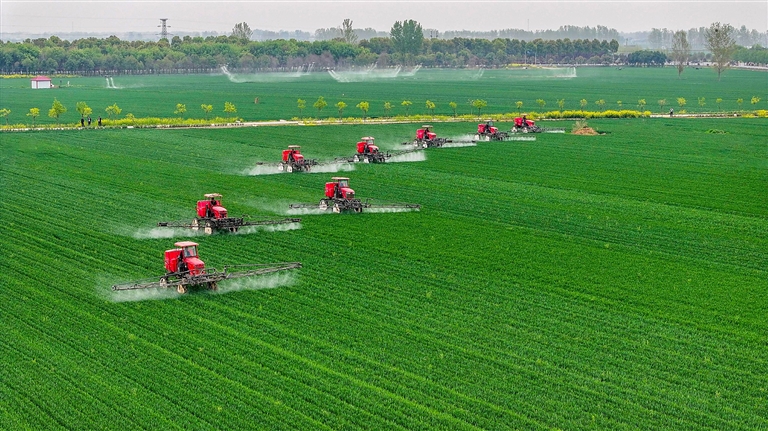
我国将持续推动农垦改革
Ren Min Ri Bao· 2025-12-06 00:33
Core Viewpoint - The article emphasizes the importance of modernizing agriculture in China during the "14th Five-Year Plan" period, focusing on the role of agricultural reclamation in achieving agricultural modernization [1] Group 1: Agricultural Modernization Goals - The "14th Five-Year Plan" period is identified as a crucial stage for consolidating and expanding the achievements of agricultural reclamation reform and accelerating the development of modern agriculture [1] - The Ministry of Agriculture and Rural Affairs has outlined key tasks for this period, including promoting the transformation and upgrading of agricultural industries and enhancing the quality and branding of agricultural products [1] Group 2: Reform and Development Strategies - The meeting highlighted the need to focus on the goal of developing modern agriculture, advancing the corporate reform of reclamation areas, and innovating agricultural management systems [1] - Emphasis was placed on increasing technological investment, promoting green development, and accelerating the upgrade of leading agricultural industries [1] Group 3: Production Targets - By 2024, China's agricultural reclamation grain output is expected to exceed 800 billion jin, contributing significantly to the national grain increase [1] - The article notes that the yield per unit area of major grain and oil crops is steadily improving, which is vital for national food security [1]
“十五五”时期我国将持续推动农垦改革
Xin Hua She· 2025-12-03 14:51
Core Viewpoint - The core focus during the "14th Five-Year Plan" period is the development of modern agriculture, emphasizing the importance of agricultural reform and the role of agricultural reclamation in the overall modernization of agriculture [1] Group 1: Agricultural Reform and Development - The Ministry of Agriculture and Rural Affairs held a national conference to summarize the achievements of agricultural reclamation reform and outline key tasks for the "14th Five-Year Plan" period [1] - The "14th Five-Year Plan" period is identified as a crucial stage for consolidating and expanding the results of agricultural reclamation reform, accelerating the development of modern agriculture, and transforming agriculture into a modern industry [1] Group 2: Key Tasks and Goals - The conference emphasized the need to focus on the goal of developing modern agriculture, advancing the corporate reform of reclamation areas, innovating agricultural management systems, and enhancing technological investment [1] - There is a strong push for green development, upgrading the entire industrial chain of leading industries, and fostering industrial clusters [1] Group 3: Achievements and Future Projections - Over the past decade, significant progress has been made in agricultural reclamation reform, leading to profound changes in the system and an increase in comprehensive agricultural production capacity [1] - In 2024, China's grain output from agricultural reclamation is expected to exceed 800 billion jin, with steady improvements in the yield of major grain and oil crops, contributing significantly to national grain production [1]
中国农业发展银行召开第三届董事会成立会议
Xin Lang Cai Jing· 2025-12-03 13:20
来源:中国农业发展银行 12月2日,中国农业发展银行在京召开第三届董事会成立会议。农发行董事长湛东升主持会议并讲话。 部委董事、农业农村部副部长张兴旺,部委董事、中国人民银行副行长陶玲,国家发展改革委、财政部 部委董事受托人出席会议并讲话。农发行副董事长、执行董事、股权董事出席会议。农发行总行其他行 领导,中央纪委国家监委驻农发行纪检监察组有关负责人,总行各部室及直管直属机构主要负责人列席 会议。国家发展改革委、财政部、农业农村部、中国人民银行、金融监管总局、中投公司有关部门负责 人受邀参加会议。 部委董事和部委董事受托人分别作了讲话,对农发行第二届董事会的工作成果进行了回顾,并对农发行 深入贯彻落实党中央、国务院决策部署,在服务国家战略、强化乡村振兴金融支持、保障农业农村发展 资金需求等方面的成绩给予充分肯定。他们表示,作为农发行董事会成员,要履职尽责支持农发行改革 发展,并建议第三届董事会在落实粮食安全政策性保障职能、加大乡村振兴重点领域信贷支持、助力农 业新质生产力发展、深化金融创新与政策协同等方面继续担当作为,强化政策性金融机构定位,提升公 司治理现代化水平,聚焦主责主业,加强风险防控,推动可持续高质 ...
实施5年来 种业振兴行动完成阶段性目标任务 种业科技创新进入世界第一方阵(经济新方位)
Ren Min Ri Bao· 2025-12-02 22:06
Core Viewpoint - The article highlights the progress and achievements of China's seed industry revitalization action plan, emphasizing the importance of seed source security for national security and the need for self-reliance in agricultural production [1][3]. Group 1: Achievements in Seed Industry - High-quality Chinese seeds such as disease-resistant wheat and rice varieties have been developed, contributing to improved agricultural productivity [1][2]. - Over the past five years, the area of self-bred crop varieties has reached over 95%, with domestic seed sources for livestock and aquaculture exceeding 80% and 85% respectively [2][3]. - The introduction of advanced breeding platforms and technologies has increased breeding efficiency by over 60%, leading to the development of high-yield rice varieties [2][4]. Group 2: Government Initiatives and Investments - The Ministry of Agriculture and Rural Affairs has implemented various funding initiatives, such as a total investment of 240 million yuan in Henan province for crop breeding projects [2][5]. - Local governments are establishing mechanisms to connect research and promotion, with initiatives like subsidies for major variety research and demonstration platforms [5][6]. Group 3: Challenges and Future Directions - Despite advancements, challenges remain in utilizing agricultural genetic resources effectively, with a need for improved quality and application of research [6][7]. - The next five years are seen as a critical period for achieving significant breakthroughs in the seed industry, focusing on resource protection, breeding innovation, and the integration of artificial intelligence in breeding processes [7][8].
八旬院士“慧种田”,农机装上“科技芯”
2 1 Shi Ji Jing Ji Bao Dao· 2025-12-02 14:51
Core Insights - The article highlights the innovative advancements in agricultural technology led by academician Luo Xiweng, focusing on the integration of Beidou navigation technology into agricultural machinery, which has transformed traditional farming practices into a more efficient and automated process [1][4][8]. Group 1: Technological Innovations - Luo Xiweng's team has developed the world's first unmanned rice farm, utilizing autonomous harvesting machines that operate without human intervention, marking a significant milestone in agricultural automation [1][6]. - The integration of Beidou navigation technology has reduced the cost of navigation systems from over 100,000 yuan to 6,000 yuan, making advanced agricultural technology more accessible to farmers [4][8]. - The introduction of a "one-click farming" model simplifies complex operations, allowing farmers to easily adopt new technologies and improve productivity [5][6]. Group 2: Economic Impact - The implementation of smart farming technologies has led to a reduction in costs by 300 yuan per acre and an increase in yield by 100 kilograms per acre compared to traditional farming methods [7]. - The establishment of unmanned farms has generated significant economic benefits, with one farm reportedly increasing collective income by 2 million yuan annually [7]. Group 3: Educational Initiatives - Luo Xiweng has developed a modern agricultural machinery research and education model, emphasizing the importance of practical experience and innovation among students [9][10]. - The establishment of the Strong Agricultural Education Fund aims to support students and young teachers dedicated to agricultural research and practice [10]. Group 4: Global Outreach - The advancements in agricultural technology have not only benefited domestic farmers but have also been implemented in countries like Thailand, Vietnam, and Cambodia, showcasing the international potential of Chinese agricultural innovations [8][11].
八旬院士“慧种田”,农机装上“科技芯”
21世纪经济报道· 2025-12-02 14:45
Core Viewpoint - The article highlights the innovative advancements in agricultural technology led by academician Luo Xiweng, focusing on the integration of Beidou navigation technology into agricultural machinery, which aims to enhance efficiency and attract more individuals to engage in agriculture [1][5][11]. Group 1: Agricultural Innovation - Luo Xiweng's team has developed the world's first unmanned rice farm, utilizing autonomous harvesting machines to reduce labor in rice cultivation [1][8]. - The integration of Beidou navigation technology into agricultural machinery has broken the foreign monopoly on navigation technology, allowing for cost-effective solutions for farmers [5][6]. - The introduction of a "one-click farming" model simplifies complex operations, making advanced agricultural technology accessible to farmers [8][9]. Group 2: Practical Experience and Education - Luo's extensive hands-on experience in agricultural machinery development has shaped his approach to creating user-friendly technology that meets farmers' needs [4][6]. - The article emphasizes the importance of practical education in agriculture, with Luo mentoring students to apply their knowledge directly in the field [13][14]. - The establishment of the Strong Agricultural Education Fund aims to support students and young teachers dedicated to agricultural innovation and practice [13]. Group 3: Economic Impact - The implementation of unmanned farming technology has led to significant cost reductions and increased yields, with reports indicating a decrease in costs by 300 yuan per acre and an increase in yield by 100 kilograms compared to traditional methods [9]. - The success of unmanned farms has encouraged more farmers to adopt these technologies, contributing to increased collective income for local communities [9]. Group 4: Global Outreach - The article notes the international expansion of Chinese agricultural technology, with Luo's innovations being implemented in countries like Thailand, Vietnam, and Laos, showcasing the global potential of smart agriculture [11][12]. - The advancements in agricultural machinery not only benefit domestic farmers but also enhance agricultural productivity in other countries, demonstrating the global relevance of these technologies [12].

八旬院士“慧种田” 农机装上“科技芯”
2 1 Shi Ji Jing Ji Bao Dao· 2025-12-02 12:18
Core Viewpoint - The article highlights the innovative contributions of academician Luo Xiweng in the field of agricultural machinery, particularly the integration of Beidou navigation technology into farming equipment, which aims to enhance agricultural efficiency and attract more individuals to engage in farming [1][4]. Group 1: Technological Innovations - Luo Xiweng's team has developed the world's first unmanned rice farm in Guangzhou, showcasing autonomous harvesting technology that reduces the need for manual labor in agriculture [1][6]. - The integration of Beidou navigation technology into agricultural machinery has significantly lowered costs, making advanced farming equipment more accessible to farmers [4][8]. - The introduction of a "one-click farming" model simplifies complex operations, allowing farmers to easily adopt new technologies [5][7]. Group 2: Impact on Farmers - The implementation of smart agricultural technologies has led to substantial cost reductions and increased yields for farmers, with reports indicating a decrease in costs by 300 yuan per acre and an increase in yield by 100 kilograms compared to traditional methods [7]. - Luo emphasizes that the goal of these innovations is not to replace farmers but to liberate them from labor-intensive tasks, thereby improving their productivity and income [7][11]. Group 3: Educational Contributions - Luo Xiweng has established a strong educational framework at South China Agricultural University, focusing on cultivating a new generation of agricultural professionals who are passionate about farming and equipped with modern technological skills [9][10]. - The "Strong Agricultural Education Fund" initiated by Luo aims to support students and young teachers dedicated to agricultural research and practice [10]. Group 4: Global Outreach - The advancements in smart agriculture are not only benefiting domestic farmers but are also being exported to countries like Thailand, Vietnam, and Cambodia, enhancing agricultural productivity internationally [8][12]. - The article underscores the growing trend of Chinese agricultural technology making its mark on the global stage, contributing to the modernization of agriculture worldwide [8].