
股票回购

Search documents
港股股票回购一览:44只个股获公司回购
Jin Rong Jie· 2026-01-20 01:16
Group 1 - On January 19, a total of 44 Hong Kong stocks were repurchased by companies, with 4 stocks having repurchase amounts exceeding 10 million HKD [1] - The companies with the largest repurchase amounts on January 19 were Pop Mart, Xiaomi Group-W, and Sunny Optical Technology, with repurchase amounts of 251 million HKD, 146 million HKD, and 78.81 million HKD respectively [1] - As of January 19, 102 Hong Kong stocks have been repurchased this year, with 6 stocks having cumulative repurchase amounts exceeding 100 million HKD [1] Group 2 - The companies with the highest cumulative repurchase amounts this year are Tencent Holdings, Xiaomi Group-W, and Sunny Optical Technology, with repurchase amounts of 6.358 billion HKD, 1.606 billion HKD, and 536 million HKD respectively [1]
特朗普的新目标?继军工和房地产商之后,华尔街巨头或面临回购禁令
Hua Er Jie Jian Wen· 2026-01-19 13:05
Core Viewpoint - The Trump administration is shifting focus from the defense and real estate sectors to broader economic areas, increasing regulatory pressure on major U.S. banks, raising concerns among investors about potential restrictions on capital return plans [1][2]. Group 1: Regulatory Pressure on Banks - Major banks may become the next target for regulatory actions following Trump's pressure on defense contractors and homebuilders to limit stock buybacks, leading to heightened concerns about policy risks for bank stocks [1][2]. - The government's direct intervention tools over the banking sector are more pronounced compared to other industries, as banks' dividend payments and stock buyback capabilities are already constrained by regulatory limits and capital adequacy requirements [1][5]. - The potential restriction on buybacks could directly impact investor return expectations, as buybacks are a key reason many investors favor bank stocks due to their ability to return capital and support share prices [1][6]. Group 2: Historical Context and Precedents - The significant scale of stock buybacks by major banks, totaling over $500 billion in the past decade, makes them susceptible to populist policies, with political pressure mounting against such capital return behaviors [3]. - Trump's recent actions demonstrate a willingness and capability to intervene in corporate capital allocation, as seen with his executive order prohibiting defense contractors from paying dividends or repurchasing stock until they meet production standards [4]. - Similar pressures are being applied to the real estate sector, with scrutiny on homebuilders' buyback activities amid record profits, indicating a broader trend of regulatory tightening across industries [4]. Group 3: Federal Reserve's Role and Uncertainty - The Federal Reserve's regulatory authority over major banks provides Trump with a significant leverage point to disrupt capital plans, as banks' ability to pay dividends and conduct buybacks is contingent on regulatory capital rules [5][6]. - Trump's disregard for the independence of the Federal Reserve could enhance his influence over regulatory policies, potentially leading to shifts in the regulatory landscape that could affect banks' capital return strategies [6]. - Historical data shows that banks like Goldman Sachs and Morgan Stanley have achieved annualized returns of 22% from stock buybacks over the past decade, but these past performance metrics are now facing unprecedented policy challenges due to potential regulatory changes [6].


Schouw & Co. share buy-back programme, week 3 2026
Globenewswire· 2026-01-19 13:00
On 2 January 2026, Schouw & Co. initiated a share buy-back programme as outlined in Company Announcement no. 59 of 18 December 2025. Under the programme, Schouw & Co. will acquire shares for up to DKK 240 million during the period 2 January to 31 December 2026. The buy-back will be structured in accordance with Regulation (EU) No. 596/2014 of the European Parliament and of the Council of 16 April 2014 on market abuse (MAR) and the Commission’s delegated regulation (EU) 2016/1052 of 8 March 2016 (“Safe Harbo ...


天益医疗(301097.SZ):取得金融机构股票回购专项贷款承诺函
Ge Long Hui A P P· 2026-01-19 12:25
Core Viewpoint - Tianyi Medical (301097.SZ) has obtained a loan commitment letter from the Ningbo branch of the Industrial and Commercial Bank of China, indicating a strategic move to repurchase its own shares [1] Group 1: Loan Details - Loan Amount: Up to 90 million RMB [1] - Loan Term: Not exceeding 3 years [1] - Loan Purpose: Specifically for the repurchase of the company's stock [1]
公司回购策略周报-20260119
Yuan Da Xin Xi· 2026-01-19 12:05
Group 1: Drivers of Excess Returns from Stock Buybacks - Stock buybacks are positively correlated with the buyback ratio, where higher buyback ratios lead to greater excess returns. The highest excess returns for companies with buyback ratios over 5% are 4.48% and 4.36% for the 5th and 4th groups, respectively, while other groups yield less than 1.5% [1][11] - The valuation logic of "stronger gets stronger" and "undervaluation recovery" exists post-buyback announcement. Companies with low valuation (1st group) show a significant excess return of 7.45%, while the highest and lowest valuation groups yield 3.32% and 2.11% excess returns, respectively, over 90 days post-announcement [1][13] Group 2: Recent Stock Buyback Activities - From January 12 to January 16, 2026, 16 companies with more than 10 institutional ratings announced buybacks, with Salted Fish (盐津铺子) being notable for a buyback ratio exceeding 1%. Proya (珀莱雅) is recommended for its low PE percentile over the past three years [2][17] - Salted Fish efficiently completed its buyback, demonstrating strong confidence in its value, with revenue of 4.427 billion and net profit of 605 million in the first three quarters of 2025. The company is upgrading its distribution channels and enhancing profitability [2][19] - Proya initiated its first buyback on January 15, 2026, repurchasing 230,800 shares with a total plan amounting to 80 million to 150 million. The company reported revenue of 7.098 billion and net profit of 1.026 billion in the first three quarters of 2025, with a gross margin of 73.69% [2][19] Group 3: Yearly Stock Buyback Overview - From January 16, 2025, to January 16, 2026, 28 companies with more than 10 institutional ratings announced buybacks, with notable mentions being Jian Sheng Group (健盛集团) and Jingxin Pharmaceutical (京新药业) for buyback ratios exceeding 5% [3][20] - Jian Sheng Group initiated a buyback plan in October 2025, using 150 million to 300 million in self-funds and loans, with a maximum buyback price of 14.69 per share. The company reported revenue of 1.886 billion and net profit of 309 million in the first three quarters of 2025, with a significant cash flow increase of 72.95% [3][23] - Jingxin Pharmaceutical started its buyback plan in January 2025, planning to use 350 million to 700 million in self-funds for employee stock ownership plans. The company reported revenue of 3.048 billion, a slight decline of 5.0%, and a net profit of 576 million, with a non-recurring net profit growth of 8.92% [3][23]


永升服务1月19日斥资36.9万港元回购20万股
Zhi Tong Cai Jing· 2026-01-19 09:45
Group 1 - The company Yongsheng Services (01995) announced a share buyback plan, intending to repurchase 200,000 shares at a total cost of HKD 36.9 million [1] - The buyback price is set between HKD 1.84 and HKD 1.85 per share [1]
Washington Scrutinizes Builder Buybacks as Home Starts Hit Five-Year Low
Yahoo Finance· 2026-01-19 05:01
Core Viewpoint - The White House is examining the impact of homebuilders' stock buybacks on housing affordability, suggesting that these buybacks contribute to high housing prices, which negatively affect consumer purchasing power [2][4]. Group 1: Stock Buybacks and Financial Performance - Homebuilders are reportedly spending significant amounts on stock buybacks, with D.R. Horton and Lennar investing $4.3 billion and $1.7 billion respectively in fiscal 2025 [4]. - PulteGroup allocated $900 million for buybacks in the first nine months of 2025, while KB Home's total repurchases reached $538.5 million, with an additional $1 billion authorized for repurchase [4]. - The iShares US Home Construction ETF has increased by 11% year-to-date, significantly outperforming the S&P 500's 1.2% gain [5]. Group 2: Housing Market Dynamics - Despite high demand, housing starts fell by 4.6% in October to an annual rate of 1.25 million, marking the lowest level since May 2020 [6]. - Existing-home sales rose by 5.1% in December to a seasonally adjusted annual rate of 4.35 million, the highest pace in nearly three years [7]. - Builders are facing challenges with rising material and labor costs, exacerbated by tariffs, which are impacting construction expenses [6].
Guidewire’s Buyback Could Be the Clue the Sell-Off Is Ending
Yahoo Finance· 2026-01-16 18:28
Core Insights - Guidewire Software has announced a $500 million share buyback program, reflecting managerial confidence in growth and cash flow, which is 3.4% of the company's market cap [3] - Despite the share buybacks not reducing the share count, the company's financial health is improving, with a 1.5% increase in share count due to share-based compensation [4] - Institutional selling in late 2025 has transitioned to accumulation in early 2026, indicating a potential rebound after a significant price correction [6] Share Buyback Program - The $500 million share buyback is an extension of a previous program and is significant for investor sentiment and equity leverage [3] - The share buybacks have not reduced the overall share count, with a 0.6% increase noted in Q1 FY2026 [4] Market Dynamics - Guidewire's stock experienced a 30% price correction in Q4 2025, primarily driven by institutional profit-taking, with hedge funds owning over 90% of the market [4] - Early 2026 has seen institutional investors beginning to accumulate GWRE stock, suggesting a shift in market sentiment [5] Valuation and Growth Outlook - The stock was trading at a high valuation of 65x current-year earnings at its peak in 2025 and remains at 58x in early 2026, indicating strong growth expectations [5] - Analyst sentiment remains bullish with a Moderate Buy consensus, driven by factors such as cloud migration, AI integration, and product expansion [6]

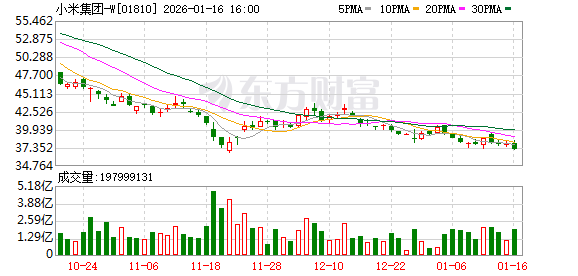
小米集团-W(01810.HK)1月16日回购2.19亿港元,年内累计回购14.60亿港元
Zheng Quan Shi Bao Wang· 2026-01-16 15:14
Group 1 - The core point of the article is that Xiaomi Group-W has been actively repurchasing its shares, with a total of 5.90 million shares bought back on January 16 at a price range of HKD 37.080 to HKD 37.200, amounting to HKD 219 million [2] - The stock has seen a decline of 4.23% during the period of these repurchases, indicating a potential market reaction to the company's buyback strategy [2] - Since January 13, the company has conducted share buybacks for four consecutive days, totaling 17.80 million shares and a cumulative amount of HKD 670 million [2] Group 2 - Year-to-date, Xiaomi Group-W has completed nine buyback transactions, repurchasing a total of 38.35 million shares for a total expenditure of HKD 1.46 billion [3] - A detailed breakdown of the buyback activities shows varying prices and amounts, with the highest buyback price recorded at HKD 39.320 on January 5 [3] - The buyback activities reflect the company's strategy to support its stock price amidst market fluctuations, as evidenced by the stock's performance during the buyback period [3]

瑞声科技连续5日回购,累计回购98.00万股
Zheng Quan Shi Bao Wang· 2026-01-16 15:12
Group 1 - The core point of the article is that AAC Technologies has been actively repurchasing its shares, indicating a potential confidence in its stock value and future performance [1] - On January 16, the company repurchased 300,000 shares at a price range of HKD 39.620 to HKD 39.980, totaling HKD 11.9452 million [1] - The stock closed at HKD 39.900 on the same day, reflecting a 0.40% increase, with a total trading volume of HKD 115 million [1] Group 2 - Since January 12, the company has conducted share repurchases for five consecutive days, accumulating a total of 980,000 shares repurchased and a total expenditure of HKD 38.6483 million [1] - During this period, the stock has increased by 3.96% [1] - Year-to-date, the company has completed eight repurchase transactions, totaling 1.28 million shares and an aggregate repurchase amount of HKD 50.4476 million [1] Group 3 - The detailed repurchase data shows the number of shares repurchased, highest and lowest prices, and total amounts for each transaction from January 6 to January 16 [1]