
金融供给侧结构性改革

Search documents
七部门印发指导意见:为推进新型工业化提供高质量金融服务
Ren Min Ri Bao Hai Wai Ban· 2025-08-06 01:43
近年来,浙江省金华市金义新区探索建立"高校—平台—企业—金融机构"协同创新机制,积极培育 高新技术企业和专精特新企业。截至目前,金华市金义新区已培育国家高新技术企业284家。图为该区 的润马光能科技(金华)有限公司5G车间内,智能机器人在自动运行。新华社记者 徐昱 摄 人民日报海外版记者 徐佩玉 为落实全国新型工业化推进大会部署,加快金融强国和制造强国建设,中国人民银行、工业和信息 化部、国家发展改革委、财政部、金融监管总局、中国证监会、国家外汇局近日联合印发《关于金融支 持新型工业化的指导意见》。 意见坚持把金融服务实体经济作为根本宗旨和防范化解金融风险的根本举措,聚焦新型工业化重大 战略任务,以需求牵引深化金融供给侧结构性改革,强化产业政策和金融政策协同,为推进新型工业 化、加快发展新质生产力提供高质量金融服务,坚持分类施策、有扶有控,推动产业加快迈向中高端, 防止"内卷式"竞争。 根据意见,到2027年,支持制造业高端化智能化绿色化发展的金融体系基本成熟,产品更加丰富, 贷款、债券、股权、保险等各类金融工具在有效防范交叉性金融风险前提下联动衔接更加紧密,服务适 配性有效增强。制造业企业有效信贷需求得到充 ...


七部门联合发布意见:金融活水润泽 加速推进新型工业化
Yang Shi Wang· 2025-08-05 23:41
央视网消息:8月5日,记者从工业和信息化部了解到,中国人民银行、工业和信息化部、国家发展 改革委等七部门联合发布《关于金融支持新型工业化的指导意见》,《意见》聚焦新型工业化重大战略 任务,以需求牵引深化金融供给侧结构性改革,提供高质量金融服务。 ...
金融支持新型工业化!七部门:完善期货产品体系,推动大宗商品保供稳价
Qi Huo Ri Bao· 2025-08-05 22:41
Core Viewpoint - The People's Bank of China and six other departments have jointly issued guidelines to enhance financial support for new-type industrialization, aiming to accelerate the construction of a financial and manufacturing powerhouse by 2027 [1][4]. Group 1: Financial Support for Industrialization - The guidelines emphasize the importance of financial services to the real economy and risk prevention, focusing on major strategic tasks of new-type industrialization [4]. - The financial system is expected to mature by 2027, supporting the high-end, intelligent, and green development of the manufacturing industry [4]. Group 2: Specific Measures - The guidelines propose 18 specific measures across five areas, including enhancing technological innovation capabilities and supply chain resilience, building a modern industrial system, and improving financial support capabilities [4][5]. - Financial policies will be optimized to support key technology products and facilitate the transformation of scientific achievements into capital [5]. Group 3: Financial Services for Key Enterprises - Financial institutions are encouraged to provide comprehensive financial services to key enterprises in the industrial chain, including loans, bonds, and insurance [6]. - Support will be given to private enterprises to participate in the construction of a self-controlled industrial chain [6]. Group 4: Cross-Border Financial Services - The guidelines aim to enhance the convenience of cross-border financial services and expand high-level bilateral open development space [7]. - Measures include optimizing foreign trade financial products and services, promoting the use of RMB in cross-border trade settlements, and expanding pilot programs for cross-border financing [7]. Group 5: Long-term Mechanism and Capacity Building - The guidelines call for strengthening the internal mechanisms of financial institutions to serve the manufacturing sector and developing a talent pool for financial services in technology industries [8]. - A collaborative approach involving multiple departments will be established to enhance the effectiveness of financial support for new-type industrialization [8].
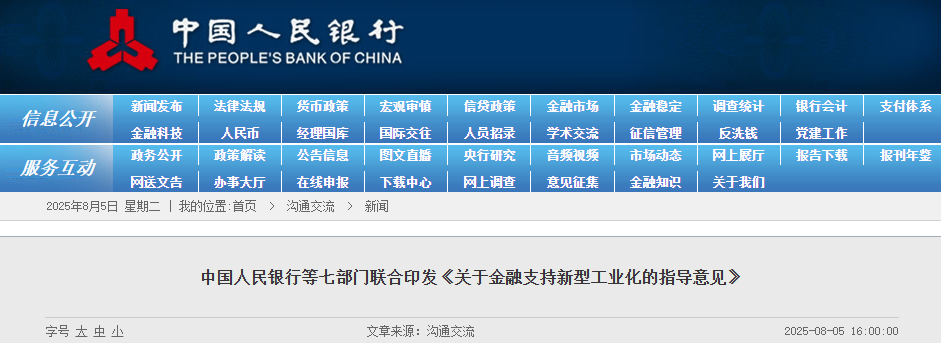
为推进新型工业化提供高质量金融服务
Ren Min Ri Bao· 2025-08-05 22:21
Core Viewpoint - The People's Bank of China and several government departments have jointly issued guidelines to enhance financial support for new industrialization, aiming to deepen financial supply-side structural reforms and promote high-quality financial services for the development of new productive forces by 2027 [1][2][3]. Group 1: Financial Support Measures - The guidelines propose targeted support measures for key technology products and breakthroughs, enhancing financial services for key enterprises in the industrial chain, and improving the resilience of supply chains [2][3]. - Development of technology finance, green finance, and digital finance is emphasized, with a focus on supporting traditional industries' transformation and nurturing emerging industries [2][3]. Group 2: Structural Reforms - The guidelines aim to optimize the funding supply structure, providing loans, bonds, and equity financing to support new industrialization [3]. - A comprehensive, differentiated, and specialized financial service system is to be established, with a focus on supporting core technology breakthroughs and the development of emerging industries [3]. Group 3: Regional and Cross-Border Financial Services - The guidelines include mechanisms for credit management and financial products to support the transfer of industries to central and western regions, promoting the aggregation of financial resources towards industrial clusters [2][3]. - Initiatives to facilitate cross-border financial services, including trade settlement and fund management, are also outlined to support reasonable industrial layout and expansion [2].

让更多外贸企业“轻装上阵”
Jing Ji Ri Bao· 2025-08-05 22:15
Core Viewpoint - The central government emphasizes the need for financial support to stabilize foreign trade, particularly for export-oriented enterprises facing challenges due to external shocks [1] Group 1: Financial Support for Foreign Trade - Financial institutions are urged to enhance credit support for foreign trade enterprises, especially small and medium-sized enterprises with high foreign trade dependence and competitive products [1][2] - The insurance sector is encouraged to provide comprehensive insurance solutions to support enterprises in their international operations [1] Group 2: Policy Implementation and Service Optimization - Banks are expected to implement policies to ensure that all eligible loans are granted and renewed, providing tailored services for enterprises facing difficulties due to tariffs [2] - There is a focus on optimizing export credit insurance policies to stabilize enterprises' export confidence and support new business models in foreign trade [2] Group 3: Currency Risk Management - With increased exchange rate volatility, there is a growing demand for currency risk management services among enterprises engaged in international trade [3] - Financial institutions are encouraged to enhance their offerings of foreign exchange derivatives and provide customized hedging services for foreign trade enterprises [3] Group 4: Integrated Financial Solutions - The financial system is called to provide integrated solutions that cater to the diverse needs of foreign trade enterprises, ensuring that policies translate into tangible benefits for businesses [4]
七部门印发指导意见 为推进新型工业化提供高质量金融服务
Ren Min Ri Bao· 2025-08-05 22:07
对照新型工业化重点领域,《意见》提出针对性支持举措,优化金融政策工具支持关键技术产品和攻 关,多渠道为科技成果转化引入耐心资本,强化产业链重点企业综合金融服务,提升产业科技创新能力 和产业链供应链韧性;发展科技金融、绿色金融、数字金融等五篇大文章,深化基于"数据信用"和"物 的信用"的产业链金融服务模式,支持传统产业转型升级和培育壮大新兴产业;健全中西部承接产业转 移有关授信管理机制和金融产品服务,推动金融资源向产业集群聚集和专业化发展,推进贸易结算、资 金管理、投融资等一系列跨境金融服务便利化举措,支持产业合理布局和拓展发展空间,促进做强国内 大循环。 中国人民银行有关部门负责人介绍,此次发布的《意见》坚持以产业需求牵引深化金融供给侧结构性改 革,构建全覆盖、差异化、专业性金融服务体系,形成金融支持新型工业化的清晰路径。一是在宏观层 面要优化资金供给结构,为新型工业化提供贷款、债券、股权等融资支持。二是完善科技金融服务体 系,支持核心技术攻关、新兴产业培育发展和传统产业改造升级。三是优化供应链金融和区域、外贸金 融服务,支持重点产业链和先进制造业集群发展。四是推进绿色金融和转型金融,支持新能源产业和传 统工 ...
新华鲜报|金融活水润泽!支持新型工业化有了“路线图”
Sou Hu Cai Jing· 2025-08-05 10:01
Core Viewpoint - The People's Bank of China and seven other departments have issued guidelines to accelerate new industrialization through financial support, outlining 18 targeted measures to enhance the financial system by 2027 [1][2]. Financial Support Measures - The guidelines emphasize a clear roadmap for supporting manufacturing enterprises, including optimizing financial policy tools, introducing long-term funds, and enhancing financial services for key enterprises [2][4]. - Specific measures include improving financial services for traditional manufacturing, enhancing the quality of technology finance, leveraging green finance, and deepening financial services along the industrial chain [2][4]. Financial System Optimization - The financial system has been optimizing the structure of fund supply, with medium to long-term loans for the manufacturing sector increasing by 8.7% year-on-year, surpassing the growth rate of all loans [3]. - In the first half of the year, the A-share market raised 148.8 billion yuan for enterprises in the industrial sector through various financing methods, marking a 51.6% year-on-year increase [3]. Quality and Precision of Financial Services - There is a growing expectation for higher quality and adaptability in financial services from enterprises, with the guidelines proposing a series of measures to establish a long-term mechanism for sustained and effective support [4][7]. - The guidelines advocate for differentiated credit policies tailored to specific industries and stages of enterprise growth, as well as the establishment of internal mechanisms within financial institutions to better serve the manufacturing sector [7]. Talent and Policy Coordination - The guidelines encourage financial institutions to deploy financial specialists to industrial parks and recruit talent with advanced manufacturing backgrounds to enhance service quality [7]. - There is a call for improved policy coordination across departments to strengthen the intensity and precision of financial support for new industrialization [7].
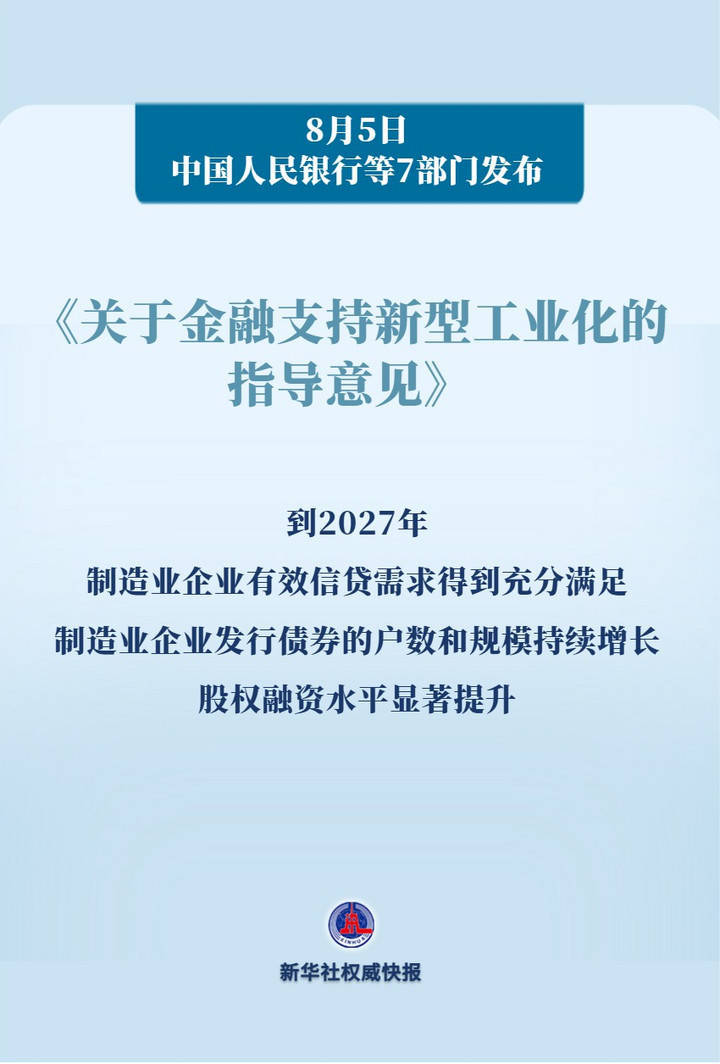
央行等七部门:推动产业加快迈向中高端,防止“内卷式”竞争,银行要单列制造业信贷计划|快讯
Hua Xia Shi Bao· 2025-08-05 09:59
在加强各类金融工具的联动配合上,推动银行、保险、证券、基金、融资担保机构、金融资产管理公司 等在防范交叉性金融风险、保障客户隐私的前提下,加强信息共享和业务合作。支持金融控股公司整合 集团内各类金融资源,为企业提供综合性金融服务。鼓励保险机构、银行理财子公司、金融租赁公司和 融资租赁公司在风险可控、商业自愿前提下,通过股权、债券、私募基金、融资租赁等形式,为先进制 造业发展提供长期稳定资金支持。 对于加强金融政策和产业政策协同联动上,《意见》表示,健全扩大制造业中长期贷款投放工作机制, 建立完善重点产业常态化项目推荐机制,发挥国家产融合作平台作用,持续加大项目推送、融资对接和 要素保障力度,推动金融机构支持新型工业化重点领域。 在建立健全风险协同防控机制上,建立产业和金融风险联合研判和预警机制,工业和信息化部、国家发 展改革委等部门强化重大项目和重点产业的风险评估,及时向金融管理部门和金融机构共享高风险项目 和企业信息。推动金融机构落实国家产业政策要求,强化信贷风险管理和资金用途监控,防范套取和挪 用风险,助力防止"内卷式"竞争。严格落实制造业贷款分类要求,真实反映制造业贷款风险情况。支持 银行通过重组、核销 ...

七部门:提供高质量金融服务,推动产业加快迈向中高端,防止“内卷式”竞争
Jing Ji Guan Cha Wang· 2025-08-05 09:03
Core Viewpoint - The People's Bank of China and six other departments have jointly issued guidelines to support new industrialization, emphasizing the importance of financial services for the real economy and risk prevention [1] Group 1: Financial Support for New Industrialization - The guidelines focus on major strategic tasks of new industrialization, aiming to deepen financial supply-side structural reforms driven by demand [1] - The approach includes strengthening the coordination between industrial policies and financial policies to provide high-quality financial services for advancing new industrialization and developing new productive forces [1] Group 2: Goals and Strategies - The guidelines advocate for differentiated policies, promoting support while maintaining control, to accelerate the industry's transition to mid-to-high-end development and prevent "involution" competition [1] - By 2027, the financial system supporting the high-end, intelligent, and green development of the manufacturing industry is expected to be fundamentally mature, with enhanced service adaptability [1]
七部门:推动产业加快迈向中高端 防止“内卷式”竞争
Mei Ri Jing Ji Xin Wen· 2025-08-05 08:13
Group 1 - The core viewpoint of the article emphasizes the importance of financial support for new industrialization, focusing on strategic tasks and structural reforms in the financial supply side [1] - The guidance aims to enhance the collaboration between industry and finance, ensuring that industrial policies and financial policies are aligned to support the development of a modern industrial system led by technological innovation and advanced manufacturing [1] - The document advocates for targeted measures that balance support and control, promoting industries to advance towards mid-to-high-end development while preventing "involution" competition [1]