
南向资金

Search documents
南向资金丨阿里巴巴获净买入35.57亿港元
Di Yi Cai Jing· 2025-09-29 10:03
Core Viewpoint - Southbound funds recorded a net sell of 1.654 billion HKD today, indicating a shift in investment sentiment towards certain stocks while others faced significant sell-offs [1] Group 1: Net Buying - Alibaba-W, Tencent Holdings, and Xiaomi Group-W were the top three stocks with net buying amounts of 3.557 billion HKD, 1.494 billion HKD, and 0.996 billion HKD respectively [1] Group 2: Net Selling - The Tracker Fund of Hong Kong, China Mobile, and Meituan-W experienced net selling amounts of 5.783 billion HKD, 0.815 billion HKD, and 0.198 billion HKD respectively [1]

南向资金今日净卖出16.54亿港元
Zheng Quan Shi Bao· 2025-09-29 10:00
Core Insights - On September 29, southbound funds recorded a total trading volume of 148.58 billion HKD, with a net sell of 1.65 billion HKD [1] Trading Overview - The Hang Seng Index increased by 1.89% on the same day [1] - Total buy transactions for southbound funds amounted to 73.60 billion HKD, while total sell transactions reached 75.26 billion HKD, resulting in a net sell of 1.65 billion HKD [1] - Breakdown of trading through Stock Connect: - Northbound Stock Connect (Shanghai): Buy transactions were 45.61 billion HKD, sell transactions were 47.97 billion HKD, leading to a net sell of 2.36 billion HKD [1] - Northbound Stock Connect (Shenzhen): Buy transactions were 27.99 billion HKD, sell transactions were 27.29 billion HKD, resulting in a net buy of 0.70 billion HKD [1]
南向资金今日净卖出超16亿港元 盈富基金遭净卖出居前
Xin Lang Cai Jing· 2025-09-29 09:57
Core Viewpoint - Southbound funds recorded a net sell of 1.654 billion HKD today, indicating a shift in investor sentiment towards certain stocks [1] Group 1: Fund Flows - Southbound funds had a net sell of 1.654 billion HKD today [1] - The largest net sell was from the Tracker Fund of Hong Kong, amounting to 5.783 billion HKD [1] - China Mobile experienced a net sell of 815 million HKD [1] - Alibaba-W saw a net buy of approximately 3.557 billion HKD [1]
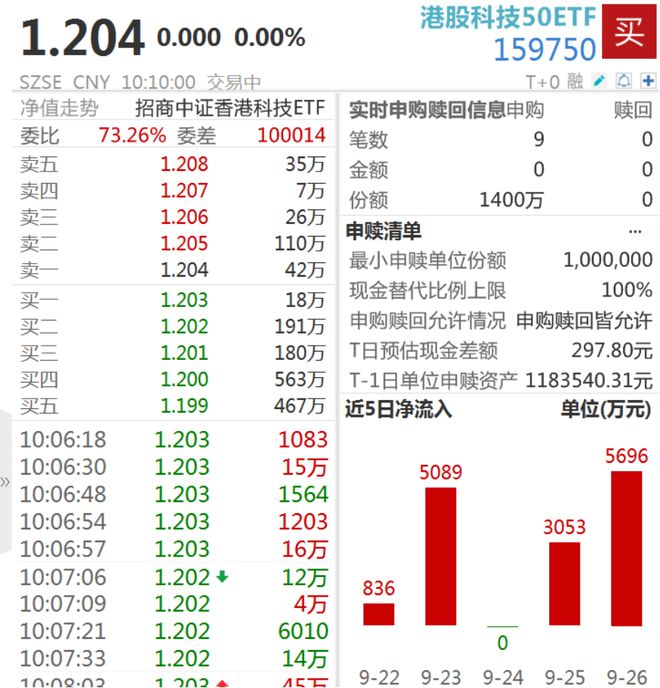
南向资金上周净买入近440亿港元!港股科技50ETF(159750)近10日“吸金”超3.3亿元
2 1 Shi Ji Jing Ji Bao Dao· 2025-09-29 03:12
Group 1 - Hong Kong stocks opened higher on September 29, with significant gains in the semiconductor and internet sectors, including companies like Hua Hong Semiconductor, Kuaishou-W, Alibaba-W, JD Group-SW, and Meituan-W, all rising over 2% [1] - The Hong Kong Technology 50 ETF (159750) saw a net subscription of over 14 million units in the morning session, with a total net inflow of over 330 million yuan in the last 10 trading days [1] - As of September 26, southbound funds net purchased Hong Kong stocks worth 10.541 billion HKD, with Alibaba receiving a net purchase of 2.412 billion HKD; the cumulative net purchase for the year reached 1,153.689 billion HKD, significantly exceeding last year's total [2] Group 2 - Morgan Stanley increased its stake in Alibaba from 6.81% to 12.29% as of September 22, acquiring 2.345 billion shares at an average price of 159.2641 HKD [3] - The market is awaiting the U.S. non-farm payroll data to be released on October 3, which will be a key indicator for assessing the health of the U.S. job market and may influence expectations regarding Federal Reserve interest rate cuts [3] - Huatai Securities noted that the impact of major overseas events during the National Day holiday on Hong Kong stocks may be limited, with historical data showing a high probability of stock gains during the holiday period [4]

“重估牛”系列之港股资金面:9月W4港股资金:南向流入互联网,外资加码消费者服务
Changjiang Securities· 2025-09-28 13:14
Group 1 - The core viewpoint of the report indicates that from September 22 to 25, 2025, southbound funds recorded a net inflow of 14.493 billion HKD, primarily flowing into sectors such as consumer discretionary retail, non-ferrous metals, semiconductors, hardware equipment, and software services, with the top five sectors accounting for a total net inflow of 12.234 billion HKD [2][6][34] - The five sectors with the highest net inflow were: consumer discretionary retail (6.964 billion HKD), non-ferrous metals (1.992 billion HKD), semiconductors (1.198 billion HKD), hardware equipment (1.092 billion HKD), and software services (0.989 billion HKD) [2][6][34] - Conversely, the sectors with the most significant outflows included pharmaceuticals and biotechnology (-1.492 billion HKD), durable consumer goods (-0.255 billion HKD), consumer services (-0.225 billion HKD), automotive and parts (-0.216 billion HKD), and chemicals (-0.137 billion HKD) [2][6][34] Group 2 - During the same period, foreign intermediary funds experienced a net outflow of 19.015 billion HKD, with notable inflows into consumer services, non-bank financials, electrical equipment, pharmaceuticals and biotechnology, and real estate II, totaling a net inflow of 6.005 billion HKD across the top five sectors [7][41] - The sectors with the highest net inflow from foreign intermediaries were: consumer services (2.836 billion HKD), non-bank financials (1.419 billion HKD), electrical equipment (0.837 billion HKD), pharmaceuticals and biotechnology (0.683 billion HKD), and real estate II (0.231 billion HKD) [7][41] - The sectors that saw the most significant outflows included consumer discretionary retail (-8.9 billion HKD), medical equipment and services (-4.081 billion HKD), banking (-3.612 billion HKD), semiconductors (-1.356 billion HKD), and transportation (-1.283 billion HKD) [7][41]
南向资金今日净买入105.41亿港元,阿里巴巴-W净买入24.12亿港元
Zheng Quan Shi Bao Wang· 2025-09-26 15:28
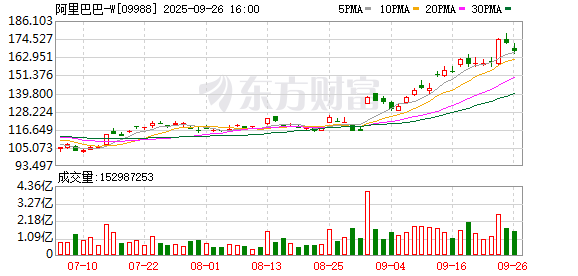
Market Overview - On September 26, the Hang Seng Index fell by 1.35%, with southbound trading totaling HKD 160.92 billion, comprising HKD 85.73 billion in buying and HKD 75.19 billion in selling, resulting in a net buying amount of HKD 10.54 billion [2][3]. Southbound Trading Details - The southbound trading through Stock Connect (Shenzhen) had a total trading amount of HKD 59.81 billion, with buying at HKD 31.49 billion and selling at HKD 28.32 billion, leading to a net buying of HKD 3.17 billion [2]. - The southbound trading through Stock Connect (Shanghai) recorded a total trading amount of HKD 101.11 billion, with buying at HKD 54.24 billion and selling at HKD 46.87 billion, resulting in a net buying of HKD 7.37 billion [2]. Active Stocks - Alibaba-W was the most actively traded stock with a total trading amount of HKD 175.01 billion and a net buying of HKD 24.12 billion, despite a closing price drop of 3.20% [2][3]. - Other notable stocks included Xiaomi Group-W with a trading amount of HKD 139.46 billion and a net buying of HKD 60.52 billion, and SMIC with a trading amount of HKD 89.14 billion [2][3]. - The stock with the highest net selling was Xpeng Motors-W, with a net selling amount of HKD 29.14 million, while its closing price increased by 5.03% [2][3]. Continuous Net Buying - Three stocks have seen continuous net buying for more than three days, with Alibaba-W leading at 26 consecutive days, followed by Shankai Holdings and Tencent Holdings at three days each [3]. - The total net buying amounts during this period were HKD 744.98 billion for Alibaba-W, HKD 45.55 billion for Tencent Holdings, and HKD 10.17 billion for Shankai Holdings [3].
南向资金今日净买入105.41亿港元
Zheng Quan Shi Bao· 2025-09-26 13:07
Summary of Key Points Core Viewpoint - On September 26, the southbound capital recorded a total transaction amount of 160.92 billion HKD, with a net buy of 10.54 billion HKD, indicating strong buying interest despite a decline in the Hang Seng Index by 1.35% [1]. Transaction Overview - The total buy transaction amount for southbound capital was 85.73 billion HKD, while the total sell transaction amount was 75.19 billion HKD, leading to a net buy of 10.54 billion HKD [1]. - Under the Hong Kong Stock Connect (Shanghai), the buy transaction amount was 54.24 billion HKD and the sell transaction amount was 46.87 billion HKD, resulting in a net buy of 7.37 billion HKD [1]. - Under the Hong Kong Stock Connect (Shenzhen), the buy transaction amount was 31.49 billion HKD and the sell transaction amount was 28.32 billion HKD, leading to a net buy of 3.17 billion HKD [1].
南向资金继续加仓阿里,恒生科技ETF(520920)进入上市倒计时!机构看好恒生科技迎来“主升浪”行情
2 1 Shi Ji Jing Ji Bao Dao· 2025-09-26 02:55
Group 1 - The Hong Kong technology sector is experiencing increased activity, with southbound funds continuing to accumulate positions, as evidenced by a net purchase of approximately 110.46 billion HKD on September 25, including significant investments in Alibaba and Tencent [1] - The Hang Seng Technology ETF (520920) was established on September 22 and is set to be listed on September 30, tracking the Hang Seng Technology Index, which consists of the top 30 technology-related stocks in Hong Kong [1] - The current valuation of the Hang Seng Technology Index is at a historical low, with a PE ratio of 24.29, positioned at the 36.54% percentile over the past five years [1] Group 2 - The Hang Seng Technology Index shows leading growth in revenue and net profit compared to other major Hong Kong indices, with a revenue growth rate of 14.43% and a net profit growth rate of 16.18% in Q2 2025 [2] - The potential for liquidity improvement is highlighted by the Federal Reserve's recent interest rate cuts, which historically have benefited the Hang Seng Technology sector [2] - Alibaba has announced a partnership with NVIDIA in the Physical AI field, enhancing its AI capabilities and indicating a significant increase in data center energy consumption by 2032 [2] Group 3 - There is an expectation that the Hang Seng Technology sector will transition from being driven solely by southbound funds to a dual-driver model, incorporating both southbound and foreign capital, potentially leading to a major upward trend [3] - The influx of southbound funds, combined with the anticipated return of foreign capital due to the Federal Reserve's actions, is expected to drive the Hang Seng Technology sector into a "main rising wave" [3]
今日南向资金ETF买入及卖出成交额为7.72亿港元
Zheng Quan Shi Bao Wang· 2025-09-25 14:41
注:本文系新闻报道,不构成投资建议,股市有风险,投资需谨慎。 (文章来源:证券时报网) 今日(9月25日)南向资金ETF买入及卖出成交额为7.72亿港元,较前一日减少15.49亿港元,占南向资 金今日成交额的0.49%。 具体来看,港股通(沪)ETF买入及卖出成交额5.29亿港元,港股通(深)ETF买入及卖出成交额2.43 亿港元。(数据宝) 南向资金ETF买入及卖出成交额 港股通(沪)(亿港元) 5.29 港股通(深)(亿港元) 2.43 港股通合计(亿港元) 7.72 ...