买方投顾

Search documents
70后财富管理一姐转身创业
21世纪经济报道· 2026-01-12 02:00
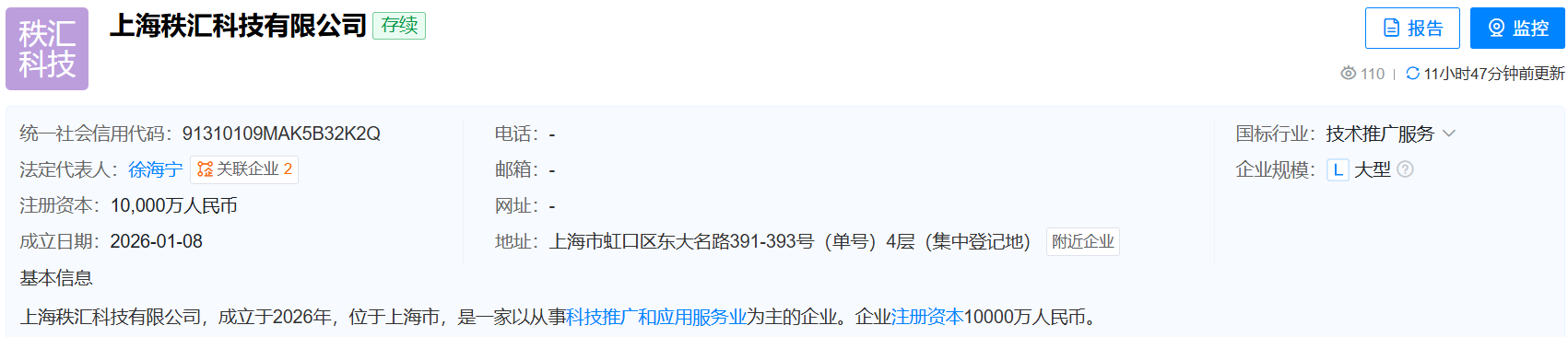
Core Viewpoint - Xu Haining, a prominent figure in wealth management, has transitioned from her role at Dongfang Securities to establish Shanghai Zhihui Technology Co., focusing on wealth management integrated with technology and industry-finance collaboration [1][3]. Company Overview - Shanghai Zhihui Technology Co., founded on January 8, 2026, has a registered capital of 100 million yuan and is located in Hongkou District, Shanghai. Xu Haining serves as the legal representative [1][3]. - The company aims to address core industry transformation needs through three main business directions: developing intelligent advisory systems, creating a professional training system for investment advisors, and providing customized consulting services for financial institutions [3][4]. Background of Xu Haining - Xu Haining has over ten years of experience in the wealth management sector, previously serving as the Vice President and head of wealth management at Dongfang Securities. She resigned on November 20, 2024, for personal career development reasons [3][9]. - Her career began outside the financial industry, with significant roles in real estate and securities investment before joining Dongfang Securities in 2012, where she played a crucial role in transforming the company's wealth management business [7][8]. Business Strategy and Focus - Shanghai Zhihui Technology's core positioning is "wealth management + technology + industry-finance collaboration," focusing on the integration of technology in wealth management practices [3][4]. - The company plans to enhance the professional capabilities of investment advisors and improve the overall service quality in the wealth management sector [3][4]. Partnerships and Capital - The company is co-founded by Xu Haining and Zhonglian Heavy Industry Capital, which is a wholly-owned subsidiary of Zhonglian Heavy Industry, indicating strong financial backing [4]. - Xu Haining holds a 3% stake in the company, while her partner Li Zhiqian holds 97%, suggesting a strategic partnership that leverages industry resources [5][4].



蚂蚁、天天基金、京东等巨头,出手了!
Zhong Guo Ji Jin Bao· 2026-01-11 12:54
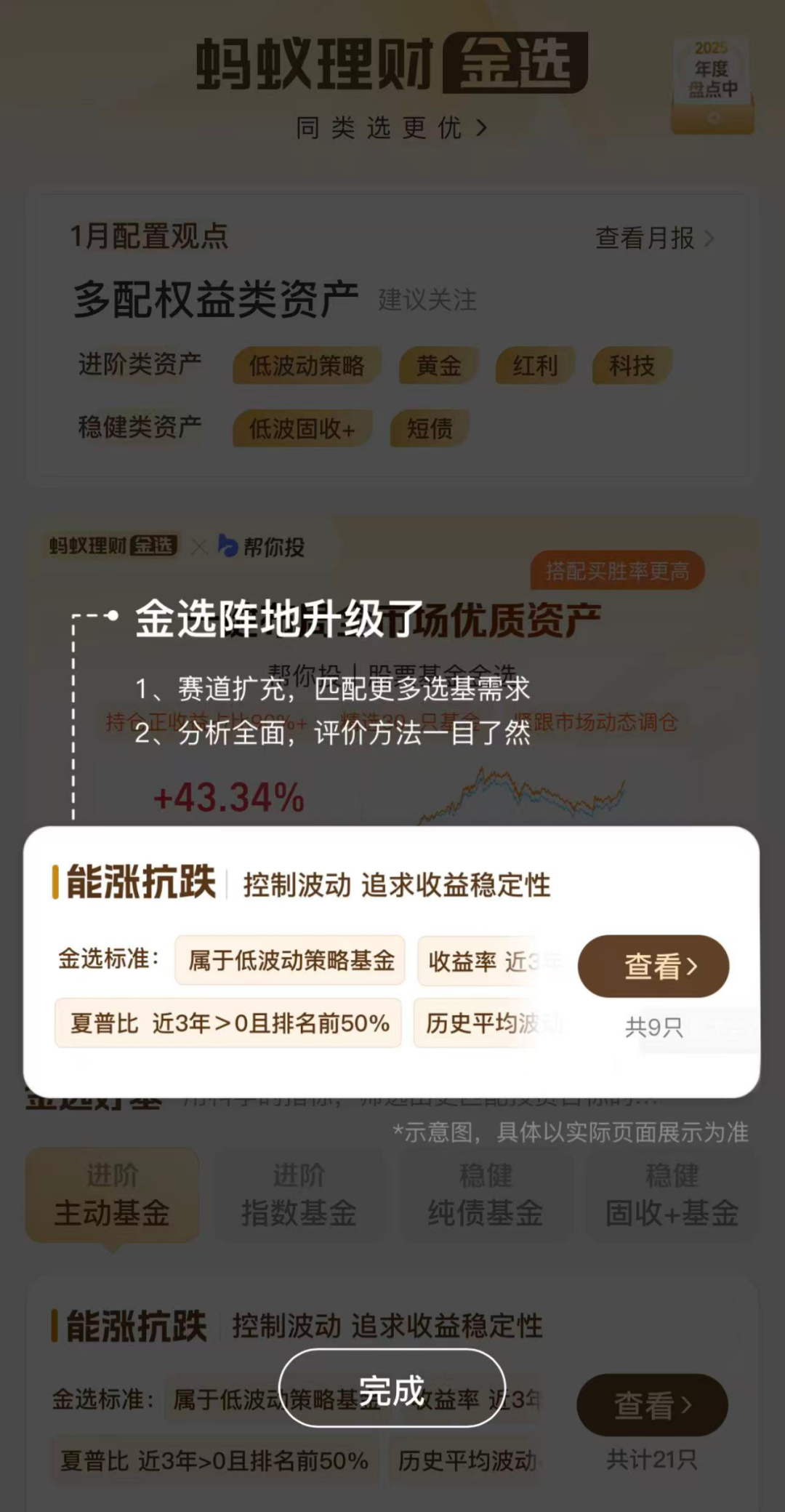
Group 1: Industry Trends - Leading fund distribution platforms are shifting focus from scale competition to enhancing investor experience and long-term satisfaction [1][11] - Major platforms like Ant Group, Tiantian Fund, and JD.com are actively restructuring product labels and selection systems to better align with user perspectives [1][2][10] - The introduction of performance benchmarks and multi-dimensional data aims to increase transparency in investment decisions [6][9] Group 2: Ant Group's Strategy - Ant Group's fund selection has introduced a new "can rise and resist fall" category, emphasizing volatility metrics such as historical average volatility and maximum drawdown [2][5] - The platform has enhanced its fund labeling system to categorize funds based on investment style and holdings, improving investor understanding and experience [5][12] - Ant Group's "Jin Xuan" has upgraded its methodology to provide objective and transparent fund analysis, encouraging diversified asset allocation [5][12] Group 3: Tiantian Fund's Innovations - Tiantian Fund has incorporated performance benchmarks and investor returns data to present a clearer picture of fund performance and operational characteristics [6][9] - The platform has launched a "superior zone" to identify funds with sustainable excess return potential through rigorous quantitative and qualitative analysis [9][12] - Tiantian Fund aims to enhance long-term investor experience by providing comprehensive decision-making references [9] Group 4: JD.com's AI Integration - JD.com is exploring a TAMP (Total Asset Management Platform) model, leveraging AI to reshape the wealth management ecosystem [10] - The platform reported significant growth in various asset categories, including an 82% increase in equity holdings and a 241% increase in personal pension holdings [10] - JD.com plans to enhance its core capabilities through user insights and behavior analysis, aiming for a more personalized service approach [10] Group 5: Overall Industry Transformation - The industry is transitioning from a sales-driven model to a client-centric advisory approach, focusing on long-term returns rather than short-term sales [11][12] - There is a push for a more responsible sales model that prioritizes investor needs and experiences, fostering a sustainable development cycle for the market [13] - The transformation emphasizes the importance of aligning sales practices with genuine investor demands to improve overall investment experiences [13]
券业知名女将徐海宁转身创业 锚定财富管理赛道再出发
2 1 Shi Ji Jing Ji Bao Dao· 2026-01-09 14:45
Core Viewpoint - Xu Haining, a prominent figure in wealth management, has transitioned from her role at Dongfang Securities to establish a new venture, Shanghai Zhihui Technology Co., Ltd, focusing on wealth management integrated with technology [1][3][6]. Company Establishment - Shanghai Zhihui Technology was officially established on January 8, with a registered capital of 100 million yuan, located in Hongkou District, Shanghai, and Xu Haining serves as the legal representative [1][6]. - The company aims to combine wealth management with technology and industrial-financial collaboration, focusing on three main business directions: developing intelligent advisory systems, creating a professional training system for investment advisors, and providing customized consulting services for financial institutions [6]. Background of Xu Haining - Xu Haining has over ten years of experience in the wealth management sector and previously held significant positions at Dongfang Securities, including Vice President and head of the wealth management committee [4][5][11]. - She resigned from Dongfang Securities on November 20, 2024, citing personal career development reasons, after contributing significantly to the company's wealth management transformation and the development of its fund advisory business [5][12]. Investment and Partnerships - The shareholders of Shanghai Zhihui Technology include Zhonglian Heavy Industry Capital, Xu Haining, and Shanghai Zhihui Mingde Enterprise Management Center, with Zhonglian Heavy Industry being a major player in the machinery industry [7]. - The partnership with Zhonglian Heavy Industry Capital, which has a registered capital of 4 billion yuan, adds substantial financial strength to the new venture [7]. Industry Impact - Xu Haining's return to the wealth management sector as an entrepreneur is seen as a significant move, potentially reshaping the landscape of wealth management services in China [3][6][12]. - Her previous experience and insights into the industry are expected to drive innovation and enhance the quality of wealth management services offered by Shanghai Zhihui Technology [6][11].

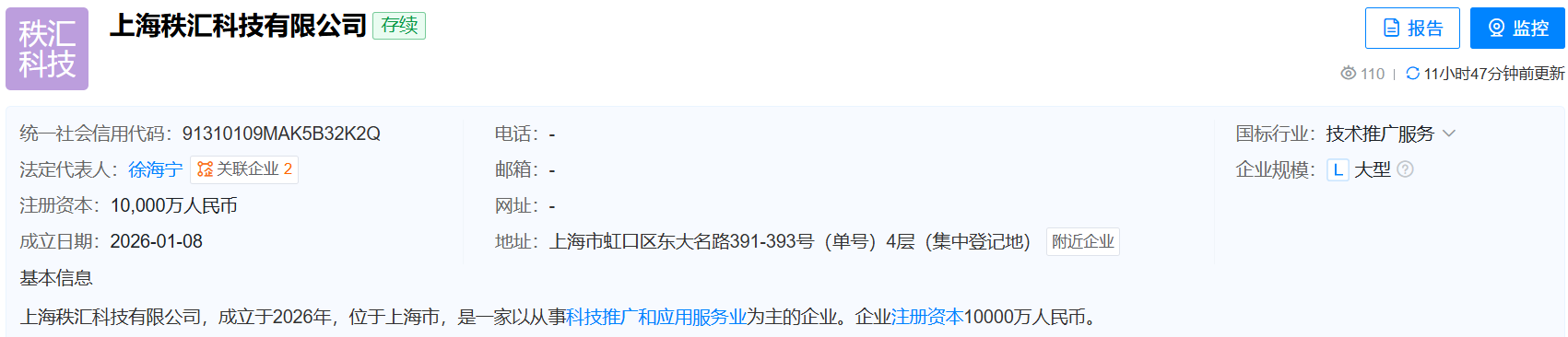
券业知名女将徐海宁转身创业,锚定财富管理赛道再出发
2 1 Shi Ji Jing Ji Bao Dao· 2026-01-09 14:40
Core Viewpoint - Xu Haining, a prominent figure in wealth management, has officially returned to the industry by founding Shanghai Zhihui Technology Co., Ltd. after resigning from her position at Dongfang Securities [1][6][13]. Group 1: Company Establishment - Shanghai Zhihui Technology Co., Ltd. was established on January 8, 2026, with a registered capital of 100 million RMB [2][6]. - The company is located in Hongkou District, Shanghai, and is co-founded by Xu Haining and Zhonglian Heavy Industry Capital [1][6]. Group 2: Business Focus - The core positioning of Shanghai Zhihui Technology is "Wealth Management + Technology + Industry-Finance Collaboration," focusing on three main business directions: developing intelligent advisory systems, creating a professional training system for investment advisors, and providing customized consulting services for financial institutions [6][12]. - The company aims to address the core needs of industry transformation through its innovative approach [6]. Group 3: Xu Haining's Background - Xu Haining has over ten years of experience in the wealth management sector and previously served as the Vice President of Dongfang Securities, where she significantly contributed to the company's wealth management transformation [4][5][10]. - She has a diverse professional background, having worked in various sectors before joining the financial industry, including real estate and securities investment [11][12]. Group 4: Industry Impact - Xu Haining's departure from Dongfang Securities was noted for her contributions to the company's brand and wealth management business, particularly in promoting inclusive finance and enhancing the competitive advantage of the investment advisory sector [5][12]. - Her new venture is expected to bring fresh perspectives and innovations to the wealth management industry, particularly in the area of investment advisory services [15].
中金财富"中国50"六年创收超百亿元 盈利客户占比达99%以上
Jin Rong Jie· 2026-01-09 12:48
Core Insights - The A-share equity market has experienced significant volatility over the past six years, presenting numerous challenges for investors. The implementation of the "924" policy in 2024 is expected to improve the market environment, creating new opportunities for investors [1] Group 1: Buy-side Advisory Service Structure - CICC Wealth has initiated a transformation in its buy-side advisory services, establishing a comprehensive service structure that includes "China 50," "Micro 50," "Public Fund 50," "Stock 50," and "ETF 50" [1][2] - The service framework focuses on account management and aims to create long-term value, catering to the investment needs of various client segments [1] Group 2: Product Differentiation - The "China 50" product targets investors seeking stable returns through the selection of high-quality assets for long-term value growth [2] - The "Micro 50" product is designed for small investors, lowering investment thresholds while maintaining a professional management standard [2] - The "Public Fund 50" focuses on public fund investments, utilizing professional fund selection and allocation strategies to provide diversified investment options [2] - The "Stock 50" product directly engages with the stock market, employing in-depth research and precise stock selection to capture investment opportunities [2] - The "ETF 50" product emphasizes index fund investments, helping clients diversify risks and achieve average market returns through passive investment strategies [2] Group 3: Performance and Risk Control of "China 50" - The "China 50" product has generated over 10 billion yuan in cumulative client returns over six years, showcasing exceptional investment management capabilities [3] - More than 99% of clients with accounts that have been active for over a year have reported profits, indicating the product's robustness and professional management [3] - The product demonstrates strong risk control, with an average maximum drawdown only one-third of that of the market index during the past six years of market fluctuations [3] - CICC Wealth's professional investment research team and comprehensive risk management system contribute to the product's outstanding performance, balancing return pursuit with effective risk control [3]
薛洪言:50万亿定期存款到期潮下,银行FOF能否成为资金“新锚”?
Xin Lang Cai Jing· 2026-01-09 10:05
Core Insights - A significant wave of approximately 50 trillion yuan in one-year or longer fixed-term deposits is set to impact China's financial market in 2026, driven by increased household precautionary savings over recent years [1] - Major banks are transitioning from being mere "funding channels" to "asset allocation service providers" in response to this deposit migration, as evidenced by the launch of customized Fund of Funds (FOF) products [1][3] Group 1: Market Dynamics - The FOF market in China is experiencing rapid growth, with 79 new public FOFs established in 2025, raising a total of 803.54 billion yuan, surpassing the total issuance from 2022 to 2024 [2] - By the end of Q3 2025, the total number of public FOFs reached 518, with a combined management scale of 1,872.46 billion yuan, marking a significant increase from earlier stages [2] - The market has developed a clear risk stratification structure, with mixed-asset FOFs being the primary growth driver, accounting for 36% of the market by Q3 2025 [2] Group 2: Bank Strategies - China Merchants Bank's "TREE Longying Plan" offers a four-tier risk-return system to cater to different risk appetites, while Construction Bank's "Longying Plan" focuses on a "two-layer selection" mechanism for fund companies and products [3] - Both banks are responding to the pressure from the comprehensive implementation of public fund fee reforms, which have reduced traditional commission income from fund distribution [3][4] Group 3: Strategic Transformation - The shift towards customized FOFs is a response to changing macroeconomic conditions and client demands, moving from product sales to client asset management [4][5] - This transformation emphasizes a service-driven income model, where revenue is linked to asset management fees rather than transaction-based commissions, aligning bank interests with long-term client asset growth [4][5] Group 4: Industry Implications - The competition landscape in wealth management is evolving, with banks transitioning from passive product distributors to active asset allocation designers, enhancing their professional capabilities [5][6] - This shift is expected to create a more rational and mature market environment, as banks educate investors on the value of long-term investment and risk diversification [6][7] Group 5: Future Outlook - The anticipated migration of 50 trillion yuan in deposits will likely lead more banks to engage in or deepen their customized FOF offerings, marking a significant transition from "savings managers" to "asset allocation service providers" [7][9] - The financial industry is moving towards a more mature phase, reflecting a broader narrative of transitioning from a "savings era" to an "asset allocation era" in China [9]
三角度观察券商财富管理新叙事
Zheng Quan Ri Bao· 2026-01-07 17:26
Core Viewpoint - The wealth management sector in the securities industry has become a key driver of performance growth, with a focus on high-quality development and the establishment of an open ecosystem [1] Development Model - The transition from a "sales-driven" model to a "buy-side advisory" and "service ecosystem" approach is underway, emphasizing client interests over mere sales performance [2] - The proportion of investment advisors among all employees has increased by nearly 6 percentage points over the past six years, yet advisory income remains in single digits, indicating limitations of the traditional sales model [2] Service Ecosystem - The construction of a service ecosystem is evolving beyond single product sales to encompass comprehensive services that address clients' full lifecycle needs [3] - Service logic has shifted from "single product sales" to "lifecycle management," with customized service plans for different client stages [3] - Advisory services have moved from "standardized recommendations" to personalized asset allocation based on individual client characteristics [3] Product Innovation - Wealth management is aligning with national strategies and long-term resident needs, focusing on technology and green finance products [4] - Major firms are establishing specialized asset management plans and investment funds to support high-tech and specialized enterprises, as well as launching green-themed products to direct funds towards sustainable industries [4] - A diverse and personalized product system is being developed to cater to various client groups, including retirement planning and family trust solutions for high-net-worth clients [4] Capability Building - Financial technology is becoming a core competitive advantage, with increased investment in digital tools and AI to enhance service efficiency and client experience [5] - Quantitative techniques and machine learning are being utilized for investment decision-making and risk monitoring [5] - Chinese firms are expanding internationally through cross-border financial products and global asset allocation services, addressing the needs of high-net-worth clients [5] Industry Narrative - The narrative of wealth management is shifting the competitive landscape, with a focus on professional research capabilities, deep client engagement, and comprehensive ecosystem development [5] - The role of securities firms is evolving from "transaction providers" to "wealth custodians" and "long-term partners," aiming to protect residents' wealth and support the real economy [5]
复盘2025!公募基金四大痛点如何破局?
券商中国· 2026-01-02 01:41
Core Viewpoint - The public fund industry in China is undergoing significant reforms aimed at achieving high-quality development, with a focus on addressing core challenges and outlining a new blueprint for 2026 [1][3]. Group 1: Industry Development and Challenges - By the end of 2025, the total scale of the public fund industry reached nearly 37 trillion yuan, with ETF business surpassing 6 trillion yuan, indicating a robust growth trajectory [3]. - The industry is experiencing a transformation characterized by the implementation of key policies such as floating fee rate funds, sales expense management rules, and performance benchmark standardization [4][5]. - There are ongoing debates regarding the clarity of certain regulatory provisions, particularly in the area of fund sales behavior, which require further guidance from regulatory authorities [4][5]. Group 2: Product Innovation and Market Dynamics - The public fund industry faces challenges of product homogeneity and insufficient innovation, particularly evident in the ETF sector, where the number of products increased from approximately 1,000 to 1,381 in 2025 [6][7]. - Many fund companies are following trends rather than leveraging their research advantages, leading to a waste of resources and a decline in investor confidence [6][7]. - A significant number of ETFs launched since 2024 have experienced substantial capital outflows, highlighting the risks associated with lack of differentiation [6][7]. Group 3: Balancing Interests of Fund Companies and Investors - The misalignment of interests between fund companies and investors is a fundamental issue, with companies prioritizing short-term scale over long-term performance [8][9]. - The current market environment incentivizes aggressive strategies that may lead to high risks and potential losses for investors, creating a conflict where funds profit while investors do not [8][9]. - Achieving a balance between the interests of fund companies and investors requires innovative mechanisms and a shift in focus towards long-term value creation [9]. Group 4: Challenges for Small and Medium-sized Fund Companies - The public fund industry exhibits a "Matthew effect," where smaller firms struggle due to limited resources and talent retention, making it difficult to compete on scale [10][11]. - Small and medium-sized firms are encouraged to focus on niche markets and collaborate closely with distribution channels to create customized products [10][11]. - However, many of these firms face difficulties in executing differentiated strategies, often missing out on market opportunities [11][12]. Group 5: Trends Shaping the Future of the Industry - The industry is expected to shift from a "scale-oriented" approach to one that prioritizes "quality," emphasizing investor satisfaction and long-term returns [15][16]. - A new wave of industry consolidation is anticipated, with some firms leveraging mergers and acquisitions to enhance their market position [16][17]. - The rise of tool-based investment products is transforming the landscape, allowing for more granular asset allocation and a focus on specific market segments [18][19]. - AI is projected to play a crucial role in investment decision-making, evolving from a supportive tool to a central component of investment strategies [20][21]. - The sales approach in the fund industry is transitioning towards a "buy-side service" model, emphasizing long-term client relationships and value creation over short-term sales metrics [22][23].

券商财富强监管信号:166份罚单曝光六乱象
2 1 Shi Ji Jing Ji Bao Dao· 2025-12-31 12:49
Core Insights - The wealth management industry is undergoing a significant transformation driven by stringent regulations, which are reshaping the industry order and increasing the cost of violations [2][16]. Regulatory Trends - The regulatory landscape is characterized by three major trends: penetrating accountability, multi-faceted penalties, and full-cycle supervision [16]. - There is a clear signal of "zero tolerance" towards violations, with a notable increase in the number of penalties issued [2][16]. Violations and Penalties - As of December 26, 2025, at least 166 penalties have been issued against 57 brokerage firms for violations related to wealth management business, highlighting issues such as mismanagement of personnel and inadequate compliance [2][3]. - Over one-third of brokerages have faced administrative measures due to violations in wealth management since 2025, primarily involving branch offices [3]. Common Violations - Six prevalent types of violations have been identified: 1. Inadequate compliance management of personnel, with examples including unauthorized trading and improper account handling [3][4]. 2. Failure to effectively implement investor suitability management, with instances of providing incorrect answers to knowledge assessments [4]. 3. Unauthorized promises of returns during financial product sales, indicating a focus on quantity over quality in brokerage practices [5]. 4. Illegal solicitation of clients, with several firms found to be assigning marketing tasks to non-marketing personnel [6][7]. 5. Failure to report significant events that could impact management and client rights in a timely manner [8]. 6. Multiple issues often exist within the same brokerage, leading to severe operational impacts [9]. Impact of Violations - The consequences of violations extend beyond warnings, with some branches facing business suspensions for serious infractions [9][10]. - Increased internal compliance checks and regulatory discussions have been mandated for firms with identified issues [10][11]. Employee Accountability - Nearly 97 penalties have been issued to individual employees for violations related to wealth management, with a concentration on sales promotion and internal controls [13][14]. - The regulatory focus on employee misconduct reflects the ongoing challenges in transitioning to a "buy-side advisory" model [14][15]. Compliance Management Risks - The rise of online channels for business has introduced new compliance risks, with several penalties issued for violations related to online marketing practices [15].
第八届新财富投顾评选评委观点集:为什么说“信任复利”才是财富管理最深的护城河?
Xin Lang Cai Jing· 2025-12-30 11:08
Core Insights - The eighth New Wealth Best Investment Advisor selection has concluded, with 91 industry representatives recognized after rigorous evaluations across four cities [1][66][67] - The evaluation process highlighted the increasing professionalism and service capabilities of investment advisors, indicating a shift towards high-quality development in the wealth management industry [1][68][76] Group 1: Industry Trends - The wealth management market in China is transitioning from "scale expansion" to "deep service," emphasizing the need for professionals who understand clients and can navigate market fluctuations [17][80] - Investment advisors are evolving from "product sellers" to "asset allocators and companions," with a focus on long-term client relationships and risk management [12][56][65] Group 2: Professional Development - Advisors showcased high research standards and investment philosophies, with a strong emphasis on client service and asset allocation as core competencies [1][68][26] - The integration of quantitative metrics and tools in investment strategies has enhanced the professionalism and replicability of advisory services [109] Group 3: Future Expectations - The future of investment advisory lies in enhancing three key capabilities: asset allocation, risk communication, and the use of digital tools to improve service efficiency [60][122] - The industry is expected to continue evolving towards a more professional, transparent, and client-centered approach, fostering trust and long-term relationships [65][128]