
具身智能技术

Search documents
八部门发文促银发经济发展 14项举措培育养老服务经营主体
Shang Hai Zheng Quan Bao· 2026-01-13 23:34
Core Viewpoint - The Ministry of Civil Affairs and seven other departments have jointly issued measures to cultivate the elderly care service sector and promote the silver economy, focusing on brand development and technological empowerment [1][2]. Group 1: Policy Measures - The measures include 14 specific initiatives aimed at optimizing the development environment for elderly care services and stimulating operational vitality [1]. - There is a strong emphasis on brand building, with support for brand creation, protection, and promotion to foster well-known brands in the elderly care sector [1]. - The measures aim to enhance market supply and demand matching by optimizing the supply of elderly care services and age-friendly products, encouraging community-supported home care through chain operations [1]. Group 2: Technological Empowerment - The measures advocate for the integration of big data, artificial intelligence, and Beidou technology in health monitoring and personalized services for the elderly [2]. - There is encouragement for the development of elderly care robots and smart devices, with a focus on improving the service experience for older adults [2]. - The initiative aims to transition the elderly care service system from traditional care to a more intelligent and quality-enhanced model, addressing labor shortages and improving service efficiency [2][3]. Group 3: Industry Development Focus - The Ministry of Industry and Information Technology plans to focus on key areas such as elderly care robots, smart footwear, and easy-to-swallow foods, enhancing product development [3]. - There will be a collaborative effort between production and application enterprises to advance core technology and product development in elderly care [3]. - The Ministry of Commerce will work on five key areas, including the development of home care services for the elderly and creating platforms for supply and demand matching in elderly care [3].
采摘侠”升级,直击农业“用工贵、采收难
Xin Hua Ri Bao· 2026-01-13 21:32
Core Insights - The establishment of the "Key Laboratory of Intelligent Harvesting Robots" by the Ministry of Agriculture and Rural Affairs aims to address labor shortages and high labor costs in agriculture [1][5][7] Group 1: Technological Advancements - Intelligent harvesting robots in Jiangsu can perform tasks such as picking asparagus with a precision rate of 95% and can harvest 2,500 asparagus stalks per hour [2] - The robots are equipped with advanced features like 3D depth cameras and AI algorithms, allowing them to operate effectively even in challenging lighting conditions [2][3] - The dual-arm tomato harvesting robot can assess ripeness and predict yield, showcasing the integration of data analytics in agricultural robotics [3] Group 2: Industry Challenges - High costs of harvesting robots, ranging from 150,000 to 800,000 yuan, pose a significant barrier for small to medium-sized farms [5][6] - Maintenance costs for domestic robots are estimated at 10,000 to 20,000 yuan annually, which further discourages adoption among farmers [5] - The lack of industry standards and fragmented systems complicates the integration and usability of different robotic solutions in the market [6] Group 3: Future Directions - The laboratory aims to focus on key technologies such as 3D visual unordered grasping and multi-modal precise perception to overcome existing challenges in agricultural robotics [7] - The goal is to transform agricultural robots from niche technologies into widely adopted tools that can alleviate labor issues and enhance productivity in modern agriculture [7]
八部门出台14项举措促进银发经济发展
Zhong Guo Zheng Quan Bao· 2026-01-13 20:46
Core Insights - The Ministry of Civil Affairs reported that by the end of 2025, there will be 41,700 elderly care institutions in China, employing 722,000 people, with private and public-private institutions making up 71.9% of the total [1] Group 1: Policy Measures - The Ministry of Civil Affairs and eight other departments have issued measures to support the development of the elderly care service industry and the silver economy, focusing on technology empowerment, brand building, supply-demand matching, environmental optimization, and support for resources [1][2] - Specific initiatives include encouraging technological innovation in elderly care services, such as the use of big data, cloud computing, artificial intelligence, and robotics to enhance service efficiency and quality [2][3] Group 2: Financial Support and Market Development - The Ministry of Civil Affairs plans to develop specialized financial support policies to encourage social capital participation and provide diverse financing options tailored to the elderly care industry [1][4] - The Ministry aims to create competitive elderly care service brands and leading enterprises, enhancing accessibility, convenience, and intelligence in elderly care services to meet diverse needs [4] Group 3: Integration and Collaboration - The Ministry of Commerce will focus on integrating elderly care services with home care and domestic services, promoting high-quality development in the home service industry [3] - Efforts will be made to establish a platform for matching supply and demand in elderly care services, creating new consumption scenarios and fostering an open cooperative environment [3]
八部门发文促进银发经济发展 这些赛道迎来风口
Mei Ri Jing Ji Xin Wen· 2026-01-13 16:17
Core Viewpoint - The Ministry of Civil Affairs and eight other departments have jointly issued measures to stimulate the vitality of various elderly care service providers, create a favorable investment environment, and promote the development of the silver economy to better meet the diverse needs of the elderly [1][3] Group 1: Policy Measures - The measures aim to optimize the supply of elderly care services and age-friendly products, encouraging community-based operations and integration of resources to enhance service delivery [4] - The initiative supports the development of home care services for the elderly, including professional medical accompaniment and mobile bathing services [4] - There is a focus on promoting smart rehabilitation aids and age-appropriate food and clothing products, enhancing the living environment for the elderly [4] Group 2: Market Dynamics - By the end of 2025, there will be 41,700 elderly care institutions in China, with 722,000 employees, reflecting a 12.2% year-on-year increase, and 52.2% of these institutions will be privately owned [5] - Social forces are becoming the main contributors to the diversified supply of elderly care services, indicating a shift in the service landscape [5] Group 3: Technological Support - The measures encourage technological advancements in elderly care, integrating big data, AI, and other technologies for health monitoring and personalized services [6] - There is a push for the development of elderly care robots and smart home technologies to meet the daily care and emotional support needs of the elderly [6] - The market is expected to see new opportunities driven by the integration of technology in elderly care, with a focus on smart home products and AI solutions [7]

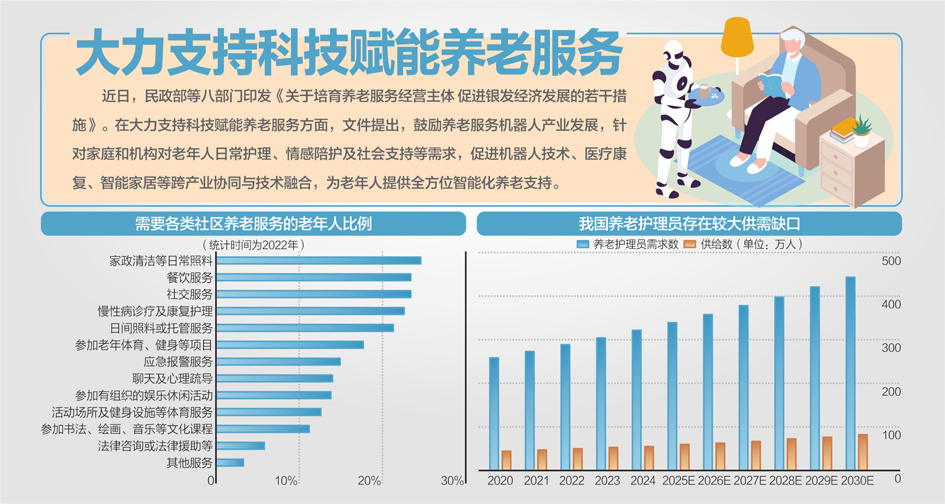
八部门发文鼓励养老服务机器人产业发展,有望成为应对老龄化的战略性支撑
Xuan Gu Bao· 2026-01-13 14:46
Industry Overview - The Ministry of Civil Affairs and eight other departments have introduced measures to cultivate the elderly care service industry and promote the silver economy, emphasizing the encouragement of elderly care technology research and product development [1] - The aging population in China, with over 310 million people aged 60 and above, and the shortage of caregiving personnel are driving the initial phase of large-scale application of elderly care robots [1] - The elderly care robot industry is expected to transition from "function realization" to "experience optimization" due to advancements in AI, 5G, cloud computing, and core components, with a projected market size exceeding 66 billion yuan by 2030 [2] Company Insights - Ousheng Electric has been deeply involved in the elderly care robot sector for many years, achieving a high level of market recognition and meeting conditions for large-scale production with its fifth-generation ICARE-BOT wearable intelligent nursing system [3] - The ICARE-BOT features advanced intelligent recognition, automatic care, and health monitoring technologies, and has obtained multiple international certifications, allowing for global market access [3] - Yueshen Health's joint venture, Shanghai Yueshen Jinyi Robot Technology Co., Ltd., focuses on the development, production, and sales of robots for medical rehabilitation and elderly care, with products already in practical use in cognitive, neurological, and orthopedic rehabilitation [3]


收评:沪指跌0.64% 医疗服务股领涨 军贸概念股领跌
Xin Hua Cai Jing· 2026-01-13 07:35
Market Performance - The Shanghai and Shenzhen stock markets opened slightly higher on January 13, with the Shanghai Composite Index reaching a maximum increase of 0.35% and the Shenzhen Component Index a maximum of 0.64% before experiencing a downward trend, ultimately closing lower [1] - The Shanghai Composite Index closed at 4138.76 points, down 0.64%, with a trading volume of approximately 148.16 billion yuan; the Shenzhen Component Index closed at 14169.40 points, down 1.37%, with a trading volume of approximately 216.95 billion yuan; the ChiNext Index closed at 3321.89 points, down 1.96%, with a trading volume of approximately 108.69 billion yuan [1] Sector Performance - The healthcare and pharmaceutical sectors showed strong performance, with significant increases in various sub-sectors such as medical services, CRO concepts, immunotherapy, AI healthcare concepts, weight loss drugs, innovative drugs, vitamins, and hepatitis concepts [1] - Other sectors that saw notable gains included precious metals, insurance, oil, and banking, while military trade concepts experienced significant declines, particularly in aerospace, commercial space, satellite navigation, and military information technology [1] Investment Insights - According to institutional views, the market is expected to continue its upward trend despite recent fluctuations, with a focus on sectors like semiconductors, consumer electronics, artificial intelligence, robotics, and commercial aerospace for mid-to-long-term investment opportunities [2] - In the AI healthcare sector, companies with practical applications and clear commercialization paths are anticipated to achieve rapid expansion and improved profitability as AI healthcare enters a commercialization acceleration phase [2] Policy Developments - The Ministry of Civil Affairs and other departments issued measures to promote the development of the elderly care service industry, emphasizing the integration of technology in elderly care services, including the use of big data, cloud computing, and AI for health monitoring and personalized services [4] - The measures encourage the development of elderly care robots to meet the daily care and emotional support needs of the elderly, promoting cross-industry collaboration and technological integration [4] Medical Supplies Procurement - The sixth batch of national organized high-value medical consumables procurement opened for bidding, including drug-coated balloons and urological intervention supplies, which are used in vascular stenosis and urinary system stone surgeries [7] - Previous procurement batches have included a wide range of medical supplies across various treatment fields, indicating a comprehensive approach to managing high-value medical consumables [7]
八部门联合发文!明确鼓励养老科技攻关与产品研发
Ge Long Hui· 2026-01-13 02:57
Core Viewpoint - The joint measures released by eight government departments aim to foster the development of the elderly care service industry and promote the silver economy through technological innovation and market-oriented approaches [1][3]. Group 1: Brand Development - Support for the establishment of distinctive branding for chain elderly care service providers to enhance brand recognition [4]. - Encouragement for elderly care service providers to implement trademark strategies and register distinctive logos [4]. - Promotion of well-known brands in the elderly care sector through various initiatives to create exemplary brands and leading enterprises [4]. Group 2: Market Supply and Demand - Optimization of elderly care services and age-friendly products by integrating community resources and encouraging home care services [6]. - Establishment of platforms for supply and demand matching to enhance resource utilization in elderly care services [6]. - Encouragement for e-commerce platforms and supermarkets to create dedicated sections for elderly products to facilitate consumption [6]. Group 3: Technological Empowerment - Promotion of technological advancements in elderly care, including the use of big data, cloud computing, and AI for health monitoring and personalized services [7]. - Support for the development of elderly care robots and smart home technologies to meet the needs of daily care and emotional support [7]. - Encouragement for the exploration of advanced technologies such as brain-machine interfaces and exoskeleton robots to assist elderly individuals with declining physical functions [7]. Group 4: Development Environment Optimization - Creation of a fair competitive environment by reforming the classification of elderly care institutions and ensuring no restrictive clauses in government procurement processes [8]. - Establishment of standards and certification systems for elderly products and services to guide procurement decisions [8]. - Protection of elderly rights through educational initiatives and strict regulation against fraudulent practices targeting the elderly [8]. Group 5: Support for Operational Factors - Improvement of government services to provide efficient guidance and information on elderly care facilities and policies [11]. - Streamlining of licensing processes for elderly care institutions to facilitate easier access to necessary permits [11]. - Support for stable operations of elderly care facilities through land supply and financial assistance for construction and operational costs [11].
八部门鼓励养老服务机器人产业发展!机器人ETF(562500) 早盘放量上行,成交额突破9亿元
Mei Ri Jing Ji Xin Wen· 2026-01-13 02:55
Group 1 - The robot ETF (562500) has risen by 0.37%, showing strong trading activity with a turnover exceeding 9.20 billion yuan within the first hour of trading, indicating high market interest in the robotics sector [1] - Key stocks in the ETF include Optoelectronics, which has increased by over 1.6%, along with Dingzhi Technology, Aofeite-U, and Jiangsu Beiren, reflecting heightened activity among core upstream players in the industry [1] - The current market dynamics suggest a significant exchange of holdings, with investors remaining sensitive to the long-term value of the robotics sector, marking a potential window for observing future upward trends [1] Group 2 - The Ministry of Civil Affairs and seven other departments have introduced measures to promote the development of the elderly care service industry, emphasizing the integration of technology such as big data, cloud computing, and AI into elderly care [2] - The initiative encourages the development of elderly care robots to meet the daily care, emotional support, and social needs of the elderly, promoting collaboration across industries like robotics, medical rehabilitation, and smart home technology [2] - Support will be provided for the research and development of technologies such as exoskeleton robots and brain-machine interfaces to assist elderly individuals with declining physical functions, enhancing the overall technological support for elderly care [2] Group 3 - Macquarie Securities suggests that domestic humanoid robot manufacturers are likely to gain a competitive advantage during the mass production phase, recommending attention to these manufacturers and their supply chains [3] - The domestic market is identified as the best early-stage market for humanoid robots, with a well-established supply chain and a rich pool of high-quality labor, positioning domestic manufacturers favorably in international competition [3] - The robot ETF (562500) is the only robot-themed ETF in the market with a scale exceeding 20 billion yuan, covering various segments including humanoid robots, industrial robots, and service robots, facilitating investor access to the entire robotics industry chain [3]
八部门鼓励养老服务机器人产业发展,为老年人提供全方位智能化养老支持
Jin Rong Jie· 2026-01-13 02:32
Core Viewpoint - The Ministry of Civil Affairs and seven other departments have introduced measures to cultivate the elderly care service industry and promote the silver economy, focusing on technological innovation and market-oriented solutions to meet the diverse needs of the elderly population [2][6]. Group 1: Brand Development - Strengthening brand recognition by supporting chain-based elderly care service providers to establish distinctive branding [3]. - Encouraging the registration of trademarks for elderly care service providers to enhance brand protection and recognition [3]. - Promoting well-known brands through various initiatives to create exemplary brands in the elderly care sector [3]. Group 2: Market Supply and Demand - Optimizing the supply of elderly care services and age-friendly products by integrating community resources and encouraging home care services [4]. - Establishing platforms for supply and demand matching to enhance resource utilization in elderly care services [5]. - Encouraging e-commerce platforms and supermarkets to create dedicated sections for elderly products to facilitate consumption [5]. Group 3: Technological Empowerment - Promoting technological advancements in elderly care, including the use of big data, AI, and robotics for health monitoring and personalized services [6][7]. - Supporting the development of innovative technologies such as exoskeleton robots and brain-machine interfaces to assist elderly individuals with declining physical functions [6][7]. Group 4: Development Environment - Creating a fair competitive environment by reforming the classification of elderly care institutions and optimizing support policies [8]. - Establishing a standard certification system for elderly products and services to guide procurement and ensure quality [8]. - Protecting the rights of the elderly by implementing educational programs and regulating the elderly care service market to prevent exploitation [8][9]. Group 5: Support Measures - Improving government services by providing information on elderly demographics and available support policies to service providers [10]. - Streamlining the licensing process for elderly care institutions to facilitate easier access to necessary permits [10]. - Supporting stable operations of elderly care facilities through land supply and financial assistance for construction and operation [10].
民政部等八部门:大力支持科技赋能养老服务
Xin Lang Cai Jing· 2026-01-13 01:56
Core Viewpoint - The Ministry of Civil Affairs and seven other departments have introduced measures to foster the elderly care service sector and promote the silver economy through technological advancements and product development [1] Group 1: Encouragement of Technological Development - The measures encourage breakthroughs in elderly care technology and product research and development [1] - There is a focus on the digital transformation of elderly care services, utilizing big data, cloud computing, artificial intelligence, and Beidou technology for health monitoring and personalized services [1] Group 2: Support for Robotics and Cross-Industry Collaboration - The initiative promotes the development of elderly care robots to meet the daily care, emotional support, and social needs of the elderly [1] - It aims to facilitate collaboration and technological integration across industries, including robotics, medical rehabilitation, and smart home technologies [1] Group 3: Product Development and Application - The measures advocate for the acceleration of research and development in embodied intelligence technology, new materials, genetic technology, and rehabilitation aids [1] - There is an emphasis on exploring advanced technologies such as brain-machine interfaces, exoskeleton robots, and muscle exosuits to support elderly individuals with declining physical functions [1] Group 4: Enhancing User Experience - Support is provided for the integration of smart elderly care devices and rehabilitation robots into care institutions, enhancing user experience through shared services, equipment leasing, and pilot testing [1] - The initiative encourages collaboration between various elderly care institutions and smart product developers to create demonstration and experience areas for elderly-friendly technology [1]