
国内国际双循环

Search documents
1月份国家铁路发送货物3.32亿吨 同比增长1.6%
Zhong Guo Xin Wen Wang· 2026-02-14 02:32
Core Insights - The national railway system in China has shown a positive trend in freight transportation, with a total of 332 million tons of goods transported in January, marking a 1.6% year-on-year increase [1] - The railway sector is actively implementing reforms to enhance logistics efficiency and reduce overall logistics costs, contributing to economic stability [1] Group 1: Freight Transportation Performance - In January, the average daily loading reached 180,700 cars, reflecting a 3% year-on-year increase, indicating both quantity and quality improvements in freight operations [1] - Coal transportation was significant, with 170 million tons sent, including 110 million tons of electricity coal, ensuring high stock levels for power plants [1] Group 2: Logistics Product Supply - The development of specialized logistics services, including container transport and cold chain logistics, has been accelerated, with freight train volumes increasing by 36.9% and container volumes by 15.2% in January [2] - The railway-water intermodal transport reached 155,500 standard containers, a 15.3% increase year-on-year, showcasing enhanced efficiency in logistics operations [2] Group 3: Service Quality Improvement - The railway sector has signed 662 logistics contracts this year, securing a total transport volume of 47.3 million tons, indicating a focus on improving service quality [2] - The integration of railway networks with public transport services has seen 211,700 social vehicles registered, with total logistics volume reaching 35.89 million tons, a 144.7% increase year-on-year [2] Group 4: Cross-Border Transportation - Cross-border freight transport remains stable, with 3,054 China-Europe (Asia) trains operated in January, a 17% increase, and 1,842 China-Europe trains, a 28% increase [3] - The China-Laos Railway has sent 500,000 tons of goods, reflecting a 4% year-on-year growth, while the Western Land-Sea New Corridor has dispatched 115,000 standard containers, a 10% increase [3] Group 5: Future Outlook - The national railway group plans to continue enhancing the modern logistics system, optimizing market operations, and innovating logistics product offerings to support economic development and expand domestic and international demand [3]
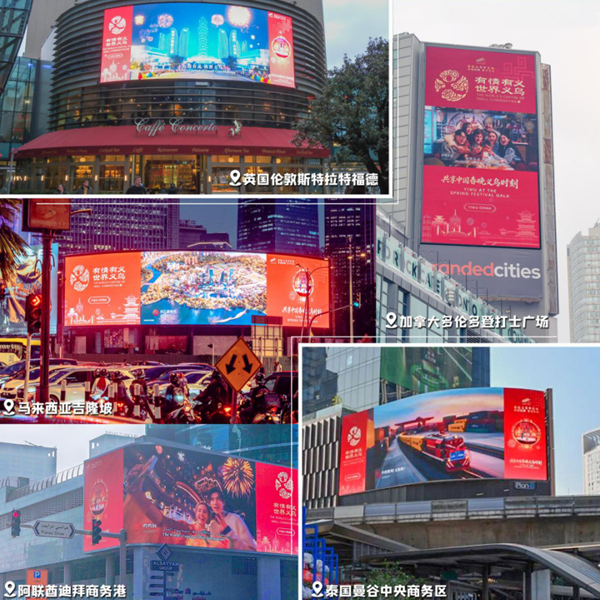
“有情有义 世界义乌”点亮全球地标
Yang Shi Wang· 2026-02-13 06:10
Core Viewpoint - The "Yiwu Red" campaign is a global initiative showcasing Yiwu's cultural and economic vitality, coinciding with the upcoming 2026 Spring Festival, featuring promotional content displayed in major cities worldwide [1][3]. Group 1: Economic Performance - Yiwu has demonstrated significant economic growth, achieving the highest export total, market entities, and per capita disposable income among county-level cities in China [5]. - The city maintained the top position in social retail sales in Zhejiang province and ranked first in the "China County-Level Common Prosperity Index" [5]. - Yiwu's social governance has also been recognized, ranking first among the top 100 counties in China [5]. Group 2: Development Initiatives - In the past year, Yiwu has introduced 33 new reform achievements, marking it as a key player in China's reform and opening-up efforts [5]. - The global digital trade center has been officially launched, and the Yiwu (Suxi) International Hub Port has commenced operations, contributing to the city's logistics and trade capabilities [5]. - Yiwu has become the first county-level city in China to exceed 100 million cross-border e-commerce imports annually, supporting domestic and international dual circulation [5]. Group 3: Future Plans - The year 2026 marks the beginning of the "14th Five-Year Plan" and the 20th anniversary of promoting "Yiwu Development Experience," aiming to establish Yiwu as a model for modern county-level development in China [5]. - Yiwu plans to implement the "146" development strategy, focusing on becoming a global innovation hub, a benchmark for trade, and a showcase for Chinese governance and civilization [5].

北京市常务副市长:首都都市圈是目前我国唯一拥有两个直辖市的都市圈,具有独一无二的发展优势
Xin Lang Cai Jing· 2026-02-13 01:26
Core Viewpoint - The press conference introduced the "Modern Capital Urban Circle Spatial Collaborative Planning (2023-2035)", highlighting the unique advantages of the capital urban circle, which includes two municipalities, in various aspects such as politics, ecology, economy, and security [1][2]. Group 1: Capital Urban Circle Overview - The capital urban circle is the only urban circle in China with two municipalities, serving as a crucial support for the coordinated development of Beijing-Tianjin-Hebei [2]. - The urban circle is designed to optimize and enhance the functions of the capital, including the construction of the Xiong'an New Area in Hebei and the Beijing sub-center [2]. Group 2: Spatial Structure and Circles - The spatial range of the capital urban circle is not limited to the typical one-hour commuting area but is innovatively structured into multi-layered, nested "concentric circle" spatial divisions based on the capital's uniqueness and the strong driving force of its "four centers" [2][3]. - The commuting circle is defined with a radius of approximately 50 kilometers, covering an area of about 27,000 square kilometers, including all of Beijing and 12 surrounding districts [2]. - The functional circle, which focuses on alleviating and enhancing the core areas of the capital urban circle, has a radius of approximately 100 kilometers, encompassing an area of about 42,000 square kilometers, including parts of Beijing, Tianjin, and Hebei [2][3]. - The industrial collaboration circle is defined with a radius of 150 kilometers, extending to the entire Beijing-Tianjin-Hebei urban agglomeration and connecting with surrounding urban clusters, enhancing the integration into domestic and international dual circulation [3][6].
京津冀多措并举推进现代化首都都市圈建设
Xin Lang Cai Jing· 2026-02-12 22:40
Core Viewpoint - The "Modern Capital Urban Circle Spatial Collaborative Planning (2023-2035)" has been officially approved, marking the first urban circle plan approved by the Central Committee and the State Council of China [1] Group 1: Strategic Positioning - The plan defines the strategic positioning of the capital urban circle as "four zones and one engine," focusing on enhancing and safeguarding the capital's functions, building a world-class urban agglomeration, preserving Chinese civilization, leading regional collaborative governance, and advancing beautiful China construction [1] - The core area and planned entity of the capital urban circle cover approximately 42,000 square kilometers, proposing a spatial structure of "one core, two wings, dual cities, multiple points, dual corridors, and multiple circles" [1] Group 2: Spatial Layers - The plan outlines three clear spatial layers: commuting circle, functional circle, and industrial collaboration circle, innovatively creating a multi-level, nested collaborative "concentric circle" spatial division model [2] - The commuting circle encompasses an area of about 27,000 square kilometers, covering the entire Beijing area and 12 surrounding districts and counties [2] - The functional circle includes parts of Beijing, Tianjin, Hebei Xiong'an New Area, and surrounding cities, covering approximately 42,000 square kilometers [2] - The industrial collaboration circle radiates to the entire Beijing-Tianjin-Hebei urban agglomeration and coordinates with surrounding urban clusters, enhancing integration into domestic and international dual circulation [2] Group 3: Implementation and Development - The plan includes the integration of Tianjin's Wuqing District into the commuting circle and the entire Tianjin area into the functional circle, emphasizing the development of an innovation triangle in the Beijing-Tianjin-Hebei region [3] - The plan aims to enhance the comprehensive carrying capacity of the region, promote technological innovation and industrial upgrading, and deepen cooperation among the three areas [3] - The daily commuting volume between Beijing and Tianjin is projected to reach 225,000 by 2025, indicating a significant increase in cross-city travel [3] Group 4: Transportation and Infrastructure - Future plans include improving the connectivity of the Beijing-Tianjin transportation network, enhancing intercity railway capacity, and upgrading key transportation hubs [4] - Hebei Province aims to leverage its supportive conditions to promote the deep integration of innovation and industrial chains, developing advanced manufacturing clusters and high-level urban circles [4] - Xiong'an New Area is tasked with becoming a key area for the relocation of non-capital functions from Beijing and building a modern city with high standards [4]
为首都都市圈建设提供坚实保障
Xin Lang Cai Jing· 2026-02-12 21:36
Core Viewpoint - The release of the "Modern Capital Urban Circle Spatial Collaborative Planning (2023-2035)" marks a significant step in the coordinated development strategy of the Beijing-Tianjin-Hebei region, aiming to establish a world-class urban circle centered around the capital [2][3]. Group 1: Planning Objectives - The planning outlines three stages of construction goals for 2030, 2035, and 2050, focusing on spatial layout, innovation, and industrial collaboration [3]. - Beijing will enhance its "four centers" and relieve non-capital functions to promote development in Tianjin and Hebei [3]. - Tianjin is expected to leverage its advanced manufacturing capabilities and closely connect with Beijing's technological resources [3]. Group 2: Policy Measures - The planning emphasizes the importance of commuting, functional, and industrial collaboration circles, identifying key tasks for further cooperation among the three provinces [4]. - It aims to utilize cross-border areas as breakthrough points for integrated high-quality development [4]. - The plan includes the establishment of advanced manufacturing clusters and the integration of public services across the region [4]. Group 3: Spatial Structure - The planning introduces a nested development model with three spatial circles: commuting, functional, and industrial collaboration [5][6]. - The commuting circle covers an area of approximately 27,000 square kilometers, including all of Beijing and 12 surrounding districts [5]. - The functional circle spans about 42,000 square kilometers, incorporating Beijing, Tianjin, and parts of Hebei [6]. Group 4: Implementation Strategies - Tianjin will utilize its geographical and industrial advantages to support the implementation of the planning [7]. - The city aims to enhance its transportation capabilities and improve public services to facilitate regional integration [7]. - Collaborative efforts will focus on innovation and the establishment of a comprehensive innovation corridor between Beijing and Tianjin [7]. Group 5: Innovation and Development - The planning integrates six key areas: industry, transportation, ecology, public services, cultural tourism, and safety resilience [8]. - It emphasizes the need for innovation-driven development, leveraging the Beijing-Tianjin-Hebei International Technology Innovation Center [8]. - The plan encourages the establishment of partnerships among educational and healthcare institutions to share resources and improve service quality [8].
详解“首都都市圈”的三个“协同”与“三个圈”
Bei Jing Shang Bao· 2026-02-12 13:48
Core Viewpoint - The "Modern Capital Urban Circle Spatial Collaborative Planning (2023-2035)" has been officially approved, marking a significant step in the coordinated development strategy of the Beijing-Tianjin-Hebei region, focusing on three spatial layers: commuting circle, functional circle, and industrial collaborative circle [1][3]. Group 1: Three "Collaborations" - The planning emphasizes the need for collaborative development goals among Beijing, Tianjin, and Hebei, with phased construction targets set for 2030, 2035, and 2050 [3][4]. - Functional layout collaboration is crucial, leveraging the comparative advantages of each region to foster a synergistic development model [4][5]. - Policy measures must also be coordinated, focusing on key areas and tasks to deepen collaboration across the three provinces [5][6]. Group 2: Structure of the Three Circles - The planning outlines three circles: the commuting circle, functional circle, and industrial collaborative circle, which are defined by different spatial dimensions [6][7]. - The commuting circle is approximately 50 kilometers in radius, covering a population of high-frequency movement areas, including all of Beijing and 12 surrounding districts, totaling about 27,000 square kilometers [7]. - The functional circle, with a radius of about 100 kilometers, includes Beijing, Tianjin, and parts of Hebei, covering around 42,000 square kilometers, and serves as the core area for urban development [7]. - The industrial collaborative circle extends to a radius of 150 kilometers, encompassing the entire Beijing-Tianjin-Hebei urban cluster and connecting with surrounding city groups, aiming for a multi-layered collaborative open structure [7][8].

京津冀多举措推进现代化首都都市圈建设
Xin Lang Cai Jing· 2026-02-12 03:18
Core Viewpoint - The State Council Information Office held a press conference to introduce the "Modern Capital Urban Circle Spatial Coordination Plan (2023-2035)" aimed at promoting collaborative innovation and industrial cooperation among Beijing, Tianjin, and Hebei [1] Group 1 - Beijing will leverage the opportunity of expanding the Beijing-Tianjin-Hebei International Science and Technology Innovation Center to enhance collaborative innovation and industrial cooperation with Tianjin and Hebei [1] - Tianjin will accelerate the construction of the Northern International Shipping Core Area, creating a convenient maritime outlet for the capital and Xiong'an New Area [1] - Hebei will collaborate with Beijing and Tianjin to build a world-class airport and port cluster, developing economic corridors that connect Beijing and Tianjin while integrating deeply into the domestic and international dual circulation [1]
浙江省首家市内免税店在杭州正式开业
Xin Hua Wang· 2026-02-12 02:48
Core Insights - The first city duty-free shop in Zhejiang Province officially opened in Hangzhou, providing a new shopping experience for travelers departing from Hangzhou Xiaoshan International Airport within 60 days [1] - This initiative is part of the national strategy to enhance high-level opening-up and promote the return of overseas consumption, extending shopping opportunities beyond traditional port duty-free stores [1] Group 1 - The shop allows consumers to purchase products and have them delivered to the airport pickup point, alleviating the burden of carrying large items during travel [1] - The store currently focuses on high-recognition and high-turnover domestic liquor, with plans to introduce quality local products and cultural brands from Zhejiang [1] - The opening of the duty-free shop provides better shopping options for outbound travelers and creates a platform for local quality products to reach international markets [1] Group 2 - The Hangzhou Customs, through the Qianjiang Customs, has established a specialized task force to support the shop's operations, ensuring compliance and efficiency in the regulatory process [2] - The task force provides comprehensive guidance on policy application, functional layout, regulatory processes, and information system construction [2] - The project successfully passed the final inspection by Hangzhou Customs, indicating effective implementation and operational readiness [2]
构筑通道 开拓新局
Shan Xi Ri Bao· 2026-02-12 00:59
Core Viewpoint - The article emphasizes that Shaanxi is overcoming its limitations in openness to drive high-quality development and become a model for the western region of China [2][4][16]. Group 1: Policy Empowerment and Support - Shaanxi is actively implementing policies to support foreign trade enterprises, with the Chen Cang District providing nearly 2 million yuan in subsidies to help businesses expand internationally [3]. - The province has established a comprehensive support system that addresses key challenges faced by enterprises in logistics and customs, enhancing their ability to navigate international markets [3][4]. - The "Shan Yao Global" initiative has facilitated significant cooperation agreements, including a total of 160 million yuan in contracts with clients from Poland, Turkey, India, and Kazakhstan [3]. Group 2: Trade and Market Expansion - Shaanxi's foreign trade resilience has improved, with the province's import and export volume reaching 244.51 billion yuan in 2025, a year-on-year increase of 7.5%, surpassing the national growth rate of 4.6% [4]. - The province is shifting from simple product sales to brand and model exports, as seen with companies like Yalan Bedding, which has established a presence in the high-end hotel market in South Korea [4]. Group 3: Infrastructure and Logistics Development - The operation of the China-Europe Railway Express (Xi'an) has significantly enhanced Shaanxi's logistics capabilities, with a total of 6,037 trains operated in 2025, marking a 21.1% increase [9]. - The establishment of the China-Xi'an Kazakhstan terminal has reduced port transfer times from several days to just 3 hours, boosting the number of cross-Caspian trains [9][10]. - Shaanxi is developing a multi-modal transport network that integrates land and air logistics, facilitating smoother domestic and international circulation [10]. Group 4: Tourism and Cultural Exchange - In 2025, Shaanxi received 926,700 inbound tourists, a remarkable increase of 98.14%, highlighting the province's strong international appeal in tourism [12]. - The expansion of the "visa-free" policy has contributed to the rising popularity of Shaanxi as a travel destination [12]. Group 5: Innovation and Economic Growth - Shaanxi is focusing on building a multi-layered open platform system, including free trade zones and comprehensive bonded zones, to enhance its open economy [13][14]. - The province's free trade zones account for 70% of its total import and export trade, despite occupying less than 1/1700 of the land area [15]. - The provincial government aims to achieve greater breakthroughs in reform and high-level openness, positioning Shaanxi as a key player in the global economy [15][16].
多式联运水水中转模式全国首批试点在闽落地运行
Shang Wu Bu Wang Zhan· 2026-02-11 06:47
Core Insights - The implementation of the multimodal water-to-water transfer model marks a significant advancement in logistics efficiency for exports from China to countries like Pakistan and South Korea [1][2] - This new model allows for a streamlined customs declaration process, reducing logistics costs and improving resource integration [2] Group 1: Implementation and Impact - The first batch of polyester filament yarn valued at 190,000 yuan was exported using the new multimodal water-to-water transfer model, indicating the model's operational launch in Fujian province [1] - The model enables "one declaration, one smooth journey, one container to the end," enhancing the efficiency of customs supervision and logistics flow at ports [2] - The pilot program aims to improve the logistics efficiency by over 30% in customs clearance time and reduce overall logistics costs by more than 20% [2] Group 2: Advantages of the New Model - The new model simplifies customs procedures, allowing companies to only fill out a multimodal transport application form, which facilitates information sharing across departments [2] - It enhances the flexibility of feeder vessel operations, eliminating the need for customs declaration changes due to vessel adjustments, thus saving on operational costs [2] - Initial estimates suggest that container loading efficiency could increase by over 15%, and transit times for feeder transport could be reduced by 1 to 2 days [2]