存款利率下调

Search documents
存款利率又下滑,存5年不如存3年
21世纪经济报道· 2025-10-27 05:06
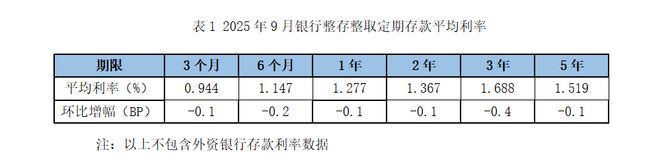
Core Viewpoint - The article discusses the continuous decline in deposit interest rates in China, highlighting the pressure on net interest margins and the phenomenon of inverted interest rates between short-term and long-term deposits [1][4]. Deposit Interest Rates - As of September 2025, the average interest rates for various deposit terms are as follows: 3-month at 0.944%, 6-month at 1.147%, 1-year at 1.277%, 2-year at 1.367%, 3-year at 1.688%, and 5-year at 1.519% [1][2]. - Compared to the previous month, the rates have decreased slightly across all terms, with the 3-year term seeing a decline of 0.4 basis points [1][2]. Net Interest Margin Pressure - The net interest margin for commercial banks has been on a downward trend, recorded at 1.52% at the end of last year, 1.43% at the end of Q1, and 1.42% at the end of Q2 this year [4]. - The decline in deposit rates is seen as a response to the ongoing pressure on net interest margins, with banks adjusting rates to manage costs associated with long-term deposits [4][5]. Inverted Interest Rates - The article notes a significant inversion in interest rates, where the average interest rate for 3-year deposits (1.688%) is higher than that for 5-year deposits (1.519%) [4][5]. - This inversion has been a recurring theme since 2024, indicating a shift in depositor behavior and banks' strategies to encourage shorter-term deposits [5]. Large Time Deposits - The interest rate advantage of large time deposits is diminishing, with average rates for various terms in September 2025 showing mixed changes [7]. - For instance, the 3-month large time deposit rate is at 1.134%, while the 1-year rate is at 1.394%, indicating a narrowing gap between large time deposits and regular deposits [7]. Structural Deposits - The average term for structured deposits has increased, with the average term for RMB structured deposits at 106 days, up 5 days from the previous month [8]. - The average expected middle yield for structured deposits is 1.59%, reflecting a slight decrease, while the average expected maximum yield is 2.09%, showing a small increase [8][9]. Conclusion - Overall, the article emphasizes the ongoing downward trend in deposit interest rates, the challenges posed by net interest margin pressures, and the implications of inverted interest rates on banking strategies [1][4][5].


存款利率又双叒下滑!9月份5年期已跌至1.519%
2 1 Shi Ji Jing Ji Bao Dao· 2025-10-27 03:44
Core Viewpoint - The average deposit rates in China continue to decline, with significant pressure on net interest margins, leading to a persistent inversion in long-term and short-term deposit rates [1][4][5]. Deposit Rate Trends - As of September 2025, the average deposit rates for various terms are as follows: 3-month at 0.944%, 6-month at 1.147%, 1-year at 1.277%, 2-year at 1.367%, 3-year at 1.688%, and 5-year at 1.519% [1][3]. - Compared to the previous month, the rates have decreased slightly across all terms, with the most significant drop being 0.4 basis points for the 3-year term [1][3]. Net Interest Margin Pressure - The net interest margin for commercial banks has been on a downward trend, recorded at 1.52% at the end of last year, 1.43% at the end of Q1, and 1.42% at the end of Q2 this year [4]. - The continuous decline in deposit rates is attributed to the ongoing pressure on net interest margins, which has led banks to adjust their deposit pricing strategies [4][5]. Long-term vs Short-term Rate Inversion - A notable phenomenon is the inversion of average rates between 3-year and 5-year deposits, with the 3-year rate at 1.688% being higher than the 5-year rate at 1.519% [1][4]. - This inversion has been persistent since 2024, indicating a shift in depositor behavior towards shorter-term deposits [5]. Large-denomination Certificate of Deposit (CD) Trends - The average rates for large-denomination CDs have also shown mixed trends, with the 3-month rate at 1.134%, 6-month at 1.318%, and 1-year at 1.394% [6][7]. - The rate differences between large-denomination CDs and regular deposits are narrowing, particularly for terms longer than one year [7]. Structural Deposit Insights - The average term for structured deposits has increased to 106 days, with a slight decrease in average expected middle yield to 1.59% [7][8]. - Different types of banks show varying trends in structured deposit terms and yields, with foreign banks having the longest average term at 405 days and the highest expected yield at 4.35% [7][8].
多家中小银行启动新一轮存款降息,活期最低0.05%
Guan Cha Zhe Wang· 2025-10-23 02:25
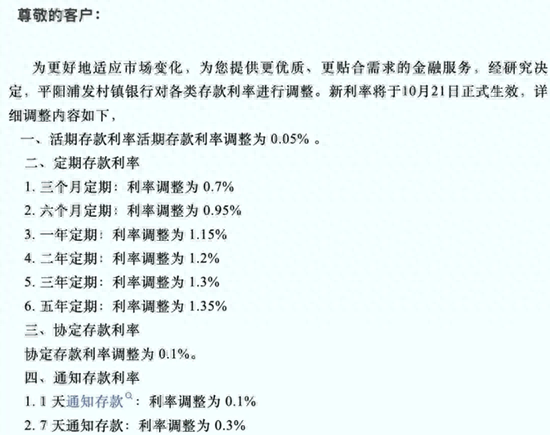
Core Viewpoint - Multiple regional small and medium-sized banks in China have recently announced significant reductions in various deposit interest rates, indicating a trend to stabilize net interest margins amid a declining interest rate environment [1][2][5]. Group 1: Deposit Rate Adjustments - Pingyang Pudong Rural Bank announced a new round of deposit rate adjustments effective from October 21, with reductions of 40 to 80 basis points across various fixed-term deposit products [1]. - Shantou Bay Rural Commercial Bank also reduced its fixed-term deposit rates effective October 18, with annualized rates adjusted to between 0.95% and 1.80%, reflecting a decrease of 15 to 20 basis points [2][4]. - Other banks, including Jiangsu Su Commercial Bank and Shanghai Huari Bank, have also joined the trend of lowering deposit rates, with specific reductions planned for October 22 and October 13, respectively [5]. Group 2: Market Context and Implications - The recent adjustments in deposit rates are primarily driven by the decline in the Loan Prime Rate (LPR), with larger state-owned banks having already reduced their deposit rates [5]. - Analysts suggest that the ongoing pressure on net interest margins for small and medium-sized banks necessitates these rate cuts to manage liability costs effectively [6]. - The overall trend indicates that banks are likely to continue lowering deposit rates, which may provide room for future monetary easing and potentially lead to a 10 basis points rate cut in the fourth quarter [6].
中小银行密集调降存款利率!
Zheng Quan Ri Bao· 2025-10-23 00:36
Core Viewpoint - Recent adjustments in deposit rates by several small and medium-sized banks indicate a proactive response to the pressure on the liability side, reflecting a consensus expectation of declining interest rates [1][3]. Summary by Sections Deposit Rate Adjustments - Multiple banks, including Dalian Lushunkou Mengyin Village Bank, have lowered their deposit rates, with the current rate for demand deposits set at 0.15% and fixed-term rates for various periods adjusted downwards [2]. - Since October, banks such as Fujian Huatuo Bank and Shanghai Huarui Bank have also made similar rate cuts, with the latter having adjusted rates multiple times this year [2]. Reasons for Rate Cuts - The primary reason for the reduction in deposit rates among small and medium-sized banks is the continuous narrowing of net interest margins, driven by multiple cuts in the Loan Prime Rate (LPR) [3]. - Banks are adjusting long-term deposit rates in anticipation of further declines in interest rates, aiming to avoid locking in high-cost liabilities [3]. Interest Rate Inversion - Some banks are experiencing an inversion in deposit rates, where shorter-term rates exceed longer-term rates, indicating a strategic move to optimize liability structures in response to expected future rate declines [4]. - For instance, Dalian Lushunkou Mengyin Village Bank's five-year deposit rate is lower than its three-year rate, reflecting a cautious approach to managing long-term liabilities [4]. Strategies for Banks - To address challenges posed by declining deposit rates, banks are encouraged to adopt strategic management reforms, enhance regional market research, and leverage digital upgrades [5]. - Banks should focus on fine-tuning asset-liability management, expanding low-cost demand deposits, and increasing non-interest income through wealth management services [5][6]. - Overall, the current interest rate adjustments are seen as a necessary adaptation for banks to balance cost control and strategic transformation for sustainable growth [6].
中小银行密集调降存款利率
Zheng Quan Ri Bao· 2025-10-22 16:44
Core Viewpoint - Recent adjustments in deposit rates by several small and medium-sized banks indicate a proactive response to the pressure on the liability side, reflecting a consensus expectation of declining interest rates [1][3]. Group 1: Deposit Rate Adjustments - Many banks have lowered deposit rates across various terms, with specific rates such as 0.15% for demand deposits and 1.15% to 1.9% for fixed deposits of different maturities [2]. - The trend of lowering deposit rates is observed among multiple banks, including Fujian Huatuo Bank and Shanghai Huarui Bank, with the latter having made several adjustments within the year [2]. - The adjustments are primarily driven by the need to manage funding costs and maintain net interest margins amid a narrowing interest spread [3]. Group 2: Interest Rate Inversion - Some banks are experiencing an inversion in deposit rates, where longer-term rates are lower than shorter-term rates, indicating a cautious approach to long-term liabilities [4]. - For instance, Dalian Lushunkou Mengyin Village Bank has a five-year deposit rate of 1.85%, which is lower than the three-year rate of 1.9% [4]. - This inversion reflects banks' expectations of further declines in interest rates, prompting them to avoid locking in high-cost long-term liabilities [4]. Group 3: Strategic Responses - Banks are advised to enhance their strategic management and innovate by integrating local advantages and focusing on regional market research [5]. - Recommendations include refining asset-liability management, expanding low-cost demand deposits, and increasing non-interest income through wealth management services [5][6]. - The current interest rate adjustments are seen as a necessary adaptation for banks to balance cost control and strategic transformation for sustainable development [6].
利率下调,最高80个基点,多家银行行动
Zheng Quan Shi Bao· 2025-10-22 07:32
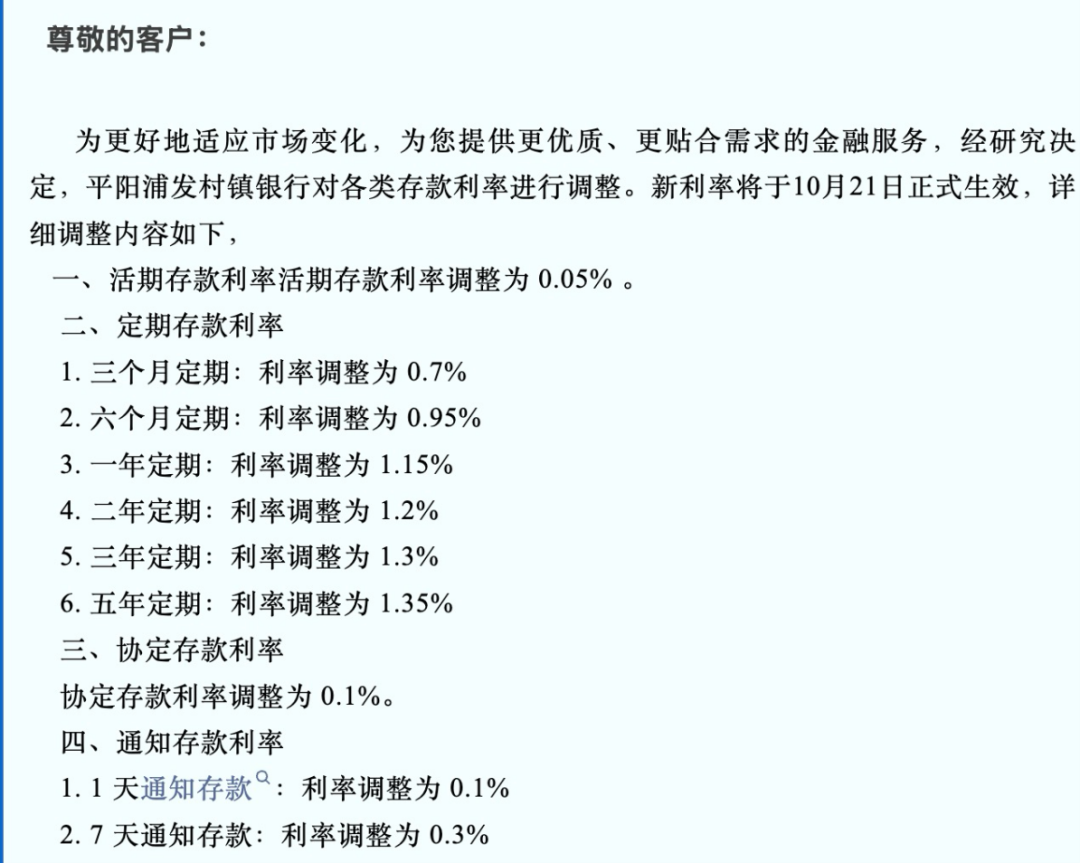
Core Viewpoint - A new round of deposit rate cuts has begun among regional small and medium-sized banks, with over ten banks announcing reductions in October, primarily affecting fixed-term deposits [1][2]. Group 1: Deposit Rate Adjustments - Several small banks, including Pingyang Pudong Village Bank and Shantou Bay Agricultural Commercial Bank, have announced reductions in deposit rates, with the largest cut reaching 80 basis points [1]. - For instance, Pingyang Pudong Village Bank has adjusted its fixed-term deposit rates for various terms, with reductions of 40 to 80 basis points across different maturities [1]. - Shantou Bay Agricultural Commercial Bank has also lowered its fixed-term deposit rates, with adjustments ranging from 15 to 20 basis points for terms from three months to five years [4]. Group 2: Reasons for Rate Cuts - The primary reason for these rate cuts is the decrease in the Loan Prime Rate (LPR), which has prompted small banks to follow suit after larger state-owned banks made similar reductions [4]. - Analysts suggest that these adjustments are necessary for small banks to stabilize their interest margins amid a declining interest rate environment [4]. - A report from CITIC Securities indicates that the downward pressure on existing deposit rates will likely accelerate due to the expiration of high-interest deposits and the activation of deposits, potentially leading to a 10 basis point rate cut in the fourth quarter [4].
利率下调!最高80个基点,多家银行行动!
券商中国· 2025-10-22 07:02
Group 1 - A new round of deposit rate cuts has begun among regional small and medium-sized banks, with over 10 banks announcing reductions since October [1][4] - The largest cut observed was 80 basis points for certain term deposits, with specific banks like Pingyang Pudong Village Bank adjusting rates for various terms [1][4] - The adjustments primarily affect fixed-term deposits, with some banks also reducing rates for demand deposits and agreement deposits [2][4] Group 2 - The recent cuts in deposit rates are directly linked to the previous reductions in the Loan Prime Rate (LPR) by major state-owned banks, indicating a follow-up action by smaller banks [5] - Analysts suggest that the ongoing decline in loan rates necessitates adjustments in the asset-liability structure of small banks to manage net interest margin pressures [5] - Future expectations indicate that deposit rates may continue to decline, potentially easing the pressure on banks' net interest margins and paving the way for monetary easing [5]

区域性银行下调存款利率 降幅最高达80个基点
Zhong Guo Jin Rong Xin Xi Wang· 2025-10-21 23:29
Core Viewpoint - Regional banks have initiated a new round of deposit rate cuts in the fourth quarter, with over ten banks announcing reductions since October, primarily affecting fixed-term deposits [1][2]. Group 1: Deposit Rate Adjustments - The current round of rate cuts is mainly focused on fixed-term deposits, with the largest reduction reaching 80 basis points [2]. - Pingyang Pudong Village Bank announced that starting October 21, various fixed-term deposit rates will be adjusted downwards, with reductions of 40, 35, 35, 50, 80, and 80 basis points for terms of three months, six months, one year, two years, three years, and five years respectively [2]. - Shantou Bay Agricultural Commercial Bank adjusted its fixed-term deposit rates for various terms, reducing them by 15 to 20 basis points [2]. Group 2: Reasons for Rate Cuts - The primary reason for the deposit rate cuts is the decrease in the Loan Prime Rate (LPR), with regional banks following the lead of state-owned banks that previously reduced their deposit rates [3]. - Analysts suggest that the adjustments in deposit rates are necessary for regional banks to manage their asset-liability structures and address net interest margin pressures [3]. - Future expectations indicate that the rates on existing deposits will decline more rapidly due to the re-pricing of high-interest deposits and increased deposit activity, which may alleviate the narrowing of banks' net interest margins and create space for future monetary easing [3].
一批中小银行下调存款利率 降幅最高达80个基点
Zheng Quan Shi Bao· 2025-10-21 17:23
Core Viewpoint - Regional small and medium-sized banks have initiated a new round of deposit rate cuts in the fourth quarter, following a trend set by larger banks [1][3]. Group 1: Deposit Rate Adjustments - Over 10 small and medium-sized banks have announced reductions in deposit rates since October, including Pingyang Pudong Village Bank and Shantou Bay Agricultural Commercial Bank [1]. - Jiangsu Sushang Bank and Shanghai Huari Bank have also joined the trend, with Shanghai Huari Bank reducing its three-year fixed deposit rate from 2.3% to 2.15%, a decrease of 15 basis points [1]. Group 2: Rate Cut Magnitudes - The current round of rate adjustments primarily affects fixed deposits, with the largest cut reaching 80 basis points. For instance, Pingyang Pudong Village Bank has reduced rates across various terms, with the three-year rate cut by 80 basis points [2]. - Shantou Bay Agricultural Commercial Bank has adjusted its fixed deposit rates for various terms, with reductions ranging from 15 to 20 basis points [2]. Group 3: Market Context and Implications - The primary reason for these rate cuts is the decrease in the Loan Prime Rate (LPR), which has prompted smaller banks to follow suit after larger banks made similar adjustments [3]. - Analysts suggest that the decline in deposit rates will help alleviate the pressure on net interest margins for banks, potentially paving the way for future monetary easing [3].
降幅最多80个基点!部分中小银行为何这个时间点下调存款利率?
Xin Lang Cai Jing· 2025-10-21 09:10
Core Viewpoint - The ongoing pressure of narrowing net interest margins has prompted small and medium-sized banks to initiate a new round of deposit rate cuts, with several institutions announcing reductions in their deposit interest rates since October [1][4]. Summary by Sections Deposit Rate Cuts - A new wave of deposit rate cuts has been observed among small and medium-sized banks, including Suzhou Bank, Shanghai Huari Bank, and Tianjin Jincheng Bank, with some banks reducing rates by as much as 80 basis points [1][3]. - Shanghai Huari Bank has reduced its 3-year fixed deposit rate from 2.3% to 2.15%, marking its seventh rate cut this year [3]. Impact of Net Interest Margin - The narrowing of net interest margins is the primary driver behind the recent deposit rate cuts, with commercial banks' net interest margin decreasing from 1.52% at the end of last year to 1.42% by the second quarter of this year [4][5]. - Analysts suggest that the pressure from narrowing net interest margins and the upcoming maturity of high-interest deposits are significant factors influencing banks to lower deposit rates [4][5]. Market Expectations - There is an increasing market expectation for a potential policy rate cut in the fourth quarter, with predictions of a 10 basis point reduction [5]. - The reduction in deposit rates may help alleviate the pressure from narrowing net interest margins and create a buffer for the banking system [5]. Interest Rate Inversion - A notable phenomenon during this round of rate cuts is the occurrence of interest rate inversion, where longer-term deposit rates are lower than shorter-term rates, contrary to typical expectations [6][7]. - This inversion is attributed to banks' anticipation of further declines in future interest rates, leading them to lower long-term deposit rates to manage long-term funding costs [6][7]. Implications for Depositors - The decline in deposit rates signals to ordinary depositors to reassess their asset allocation, potentially increasing their interest in other investment products [7]. - The short-term impact of rate inversion may lead to a decrease in long-term deposit allocations, but in the long run, it could help banks optimize their funding structure and improve capital efficiency [7].