
开放包容

Search documents
擦亮亚投行开放包容的金字招牌(开放谈)
Ren Min Ri Bao· 2025-07-14 21:01
Core Insights - Infrastructure is a crucial foundation for high-quality economic development, and strengthening infrastructure construction can effectively address constraints on economic growth, enhance regional development, and improve public welfare [1] - The Asian Infrastructure Investment Bank (AIIB) has successfully increased its membership from 57 founding members to 110 over the past decade, covering over 80% of the world's population and 65% of global GDP [1][2] - AIIB has positioned itself as a leading multilateral development institution by focusing on cross-border connectivity and sustainable infrastructure projects, which have yielded significant economic, social, and ecological benefits for its members [2][3] Membership and Growth - AIIB's membership has nearly doubled in the last 10 years, showcasing its strong appeal and inclusive approach to multilateral cooperation [1] - The bank's effective organizational management has prevented inefficiencies despite the growing number of members, enhancing its global influence [1][2] Financial Goals and Impact - AIIB aims to increase its annual loan scale to $17 billion by 2030, which is expected to leverage over $100 billion in social capital based on a historical financing ratio of 1:6.3 [2] - The focus on "green" and "development" projects has led to climate financing accounting for over 50% of the approved financing total, highlighting AIIB's commitment to sustainable development [3] Climate Financing and Multilateralism - AIIB is actively addressing climate change financing challenges, providing a platform for economies willing to take action against climate change amidst rising unilateralism and protectionism [3] - The bank's initiatives in climate financing are expected to optimize funding management mechanisms and serve as a reference for innovative financing practices [3]
学有所悟丨书写无愧于青春的答卷
Zhong Yang Ji Wei Guo Jia Jian Wei Wang Zhan· 2025-07-10 00:19
Group 1 - The core message emphasizes the importance of youth in the realization of the Chinese Dream and the significant role they play in national rejuvenation [1] - The leadership under Xi Jinping has led to historic achievements and transformations since the 18th National Congress of the Communist Party of China [1] Group 2 - Ideals and beliefs are highlighted as essential guiding forces for youth, with a call for them to strengthen their faith and commitment to Marxism and Xi Jinping's thoughts [2] - The historical context of youth's commitment to ideals is referenced, showcasing their role in both revolutionary and peaceful periods [2] Group 3 - A strong sense of patriotism and national responsibility is portrayed as a fundamental characteristic of youth, with examples of individuals who have embodied this spirit [3] - The narrative connects personal aspirations with national interests, encouraging youth to contribute to national development [3] Group 4 - Innovation and practical action are identified as crucial qualities for youth to navigate global competition and achieve breakthroughs [4] - Examples from the aerospace sector and rural revitalization efforts illustrate how youth are actively engaging in innovative practices [4] Group 5 - Openness and inclusivity are presented as essential for youth to engage with the world and promote cultural exchange [5] - The role of young creators and scholars in showcasing Chinese culture globally and fostering international dialogue is emphasized [5]
“千年商港”温州:文脉流深润瓯越
Xin Hua She· 2025-06-22 00:48
Core Viewpoint - Wenzhou, a hub of private economy in Zhejiang, showcases a unique blend of traditional culture and innovative spirit, driving economic development and cultural confidence [1][3][12]. Group 1: Cultural Heritage and Economic Development - Wenzhou's rich cultural history, including the Yuyuan School's practical philosophy, has significantly influenced its entrepreneurial spirit [2][3]. - The city has been a pioneer in various economic reforms, such as the first individual business license and the first specialized market in China, marking its importance in the country's economic landscape [3][4]. - The "Four Thousand" spirit, representing perseverance and innovation among Wenzhou entrepreneurs, continues to inspire local businesses [4]. Group 2: Openness and Global Engagement - Wenzhou has a long history of openness, dating back to its role in the Maritime Silk Road, which facilitated trade and cultural exchange [5][6]. - The city is enhancing its global connectivity through initiatives like the operation of 16 near-ocean routes and the establishment of the Wenzhou-Kean University, promoting international collaboration [6][7]. - Recent events, such as the World Youth Scientist Summit, have positioned Wenzhou as a center for attracting global talent and fostering innovation [7]. Group 3: Cultural Innovation and Preservation - Wenzhou is actively exploring innovative ways to preserve and promote its cultural heritage, such as through the revitalization of traditional arts and crafts [9][11]. - The city has initiated cultural events like the "Southern Opera Cultural Week," which aims to enhance the visibility and appreciation of local traditional arts [11]. - Efforts to integrate cultural elements into economic development are evident in initiatives like the Qing Deng Market, which promotes local aesthetics and supports artists [12].
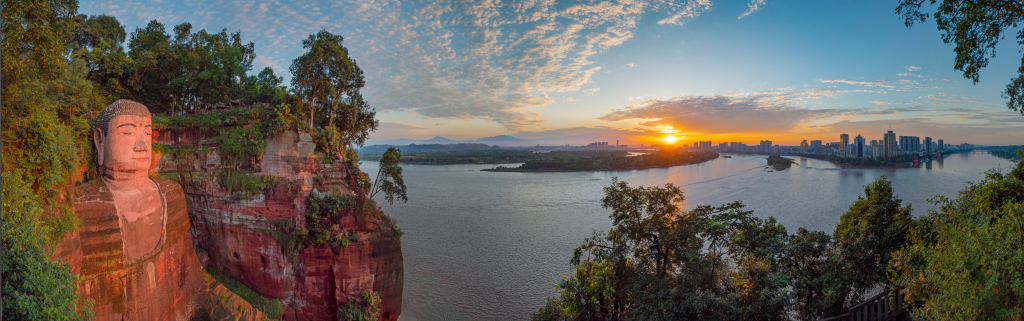
三江交汇润嘉州——解码山水名城乐山的文化自信样本
Xin Hua Wang· 2025-06-17 01:21
Core Viewpoint - The article emphasizes the cultural confidence and historical significance of Leshan, a city in Sichuan, China, highlighting its natural beauty, rich heritage, and the integration of culture and innovation in its development [1][2][3] Group 1: Cultural Heritage - Leshan is home to three UNESCO World Heritage sites: Mount Emei, Leshan Giant Buddha, and Dongfeng Weir, showcasing its historical and cultural significance [2][3][5] - The city has a rich literary history, with famous poets like Li Bai and Su Shi having been inspired by its landscapes, contributing to a continuous cultural narrative [3][5] - The Leshan Giant Buddha, carved into a cliff, represents ancient wisdom and the harmonious relationship between humans and nature, embodying the concept of "heaven and man as one" [5][6] Group 2: Natural Resources and Biodiversity - Leshan's geographical location at the confluence of three rivers contributes to its unique biodiversity, with Mount Emei hosting over 3,700 plant species and 2,300 animal species [7][9] - The region's natural resources have historically supported agricultural practices and cultural development, with the Dongfeng Weir being a significant irrigation project still in use today [6][9] Group 3: Urban Development and Cultural Integration - The city of Leshan has preserved its historical architecture, such as ancient city walls and traditional streets, which reflect its rich cultural heritage [10][13] - Recent urban renewal projects aim to integrate historical preservation with modern development, creating a "scenic city" model that enhances cultural tourism [10][20] - Leshan's culinary scene has evolved, with local dishes becoming a vital part of its cultural identity, attracting over 100 million domestic tourists in 2024 [18][19] Group 4: Innovation and Cultural Evolution - Leshan's cultural identity is characterized by openness and innovation, as seen in the integration of traditional crafts with modern practices, such as the production of bamboo paper [18][19] - The city has successfully combined performing arts with tourism, creating a model where cultural events drive economic growth and community engagement [19][20] - Various local cultural symbols, including traditional crafts and performances, have gained recognition and popularity, contributing to Leshan's cultural renaissance [19][20]

运河碧波漾万里 苏韵欧风共婵娟—— “文明遇·鉴:中国大运河文化江苏周”在欧洲绽放光彩
Xin Hua Ri Bao· 2025-06-16 23:16
Core Viewpoint - The event "Civilization Encounter: Jiangsu Week of the Grand Canal Culture" successfully showcased the cultural heritage and contemporary value of the Grand Canal, promoting mutual understanding and cultural exchange between China and Europe, particularly in Belgium and Croatia, as part of the 50th anniversary of China-EU diplomatic relations [1][5][11]. Group 1: Event Overview - The event took place from June 9 to 13, 2023, in Belgium and Croatia, featuring various activities to highlight the spirit of the Grand Canal culture [1][2]. - The opening ceremony included cultural performances and exhibitions, such as Jiangsu's tourism promotion and a special exhibition on the Grand Canal's history and cultural heritage [3][10]. Group 2: Cultural Exchange Activities - Activities included traditional performances, interactive experiences with intangible cultural heritage, and a food experience area showcasing Jiangsu cuisine, which received positive feedback from attendees [6][7][10]. - A significant focus was placed on youth engagement through initiatives like "Canal Elegance: Youth Cycling Encounter," fostering dialogue between young people from Belgium and Jiangsu [4][11]. Group 3: Diplomatic and Cultural Significance - The event was praised by notable figures, including former Belgian Prime Minister Yves Leterme, who emphasized the importance of cultural and economic cooperation between Belgium and Jiangsu [5][11]. - The event served as a platform for promoting sustainable development and deepening cultural interactions, with calls for more European friends to visit Jiangsu [5][12]. Group 4: Media Coverage and Impact - The event garnered significant media attention, with coverage from major outlets in Belgium and France, highlighting the cultural richness of Jiangsu and the Grand Canal [11][12]. - Social media engagement was high, with various platforms sharing content related to the event, further amplifying its reach and impact [11][12].
美国发动关税战的原因与我国如何应对
Di Yi Cai Jing· 2025-04-28 11:53
Core Viewpoint - The current U.S. tariff war is an attempt to address the structural contradictions within the U.S. debt-dollar system, which is an evolution of the "Triffin Dilemma" [2][5] Summary by Sections U.S. Tariff War Reasons - The tariff war is initiated to tackle the unsustainable fiscal situation caused by trade deficits, aiming to resolve the inherent contradictions of the U.S. debt-dollar system [2] - The U.S. has imposed tariffs on various imports, including a 25% tariff on imported cars and a 30% tariff on goods valued under $800 [1] Tariff Calculation Issues - The U.S. tariff calculation method is flawed, using a formula that overestimates the necessary tariff rates by about double [3][4] - The formula's assumptions regarding price elasticity of demand and supply are inaccurate, leading to potential miscalculations in expected tariff impacts [3][4] Economic Impact of Tariffs - The tariff increases are expected to raise domestic prices, with an average cost increase of $2,700 per household and a potential rise in core inflation by 1.7% to 2.1% [7] - The tariff war is likely to reduce bilateral trade and weaken the dollar's status as a reserve currency, as evidenced by rising U.S. debt yields and a declining dollar index [5][7] Recommendations for Response - The company suggests increasing macroeconomic countermeasures, including fiscal and monetary policies to mitigate the impact of tariffs [9][10] - Emphasis on enhancing consumer income and building a robust domestic demand market is recommended to counteract the effects of the tariff war [10] - The company advocates for further innovation support to maintain a competitive edge in global supply chains, particularly in high-tech and emerging industries [11]