
教育数字化

Search documents
教育智能化转型提速
Xin Lang Cai Jing· 2026-01-04 22:08
Core Insights - Digital technology is reshaping the education system, with artificial intelligence evolving from a single tool to a core element driving the entire teaching process, impacting admissions, evaluations, employment services, and campus governance [2][3] - The launch of the National Education Big Data Center and the National Smart Education Public Service Platform marks a significant milestone in implementing the education digitalization strategy, focusing on integration, intelligence, and internationalization [2][4] Group 1: National Education Big Data Center - The National Education Big Data Center breaks down data silos, enabling real-time monitoring of key indicators such as resource allocation, teacher distribution, student development, and teaching quality [3] - It supports differentiated teaching and personalized guidance by deeply analyzing students' learning processes and developmental needs [3][5] - The center is interconnected with 32 provincial education departments and over a thousand universities, forming a central data-sharing hub in the education sector [4] Group 2: National Smart Education Public Service Platform - The smart platform integrates AI, data services, and algorithm modules into reusable components, facilitating rapid application development and reducing redundancy [3][4] - It provides data-driven teaching assistance for teachers and content support for students, promoting the widespread application of intelligent teaching methods [4] - The platform aims to enhance educational governance modernization and improve the precision of educational services through data sharing [4][5] Group 3: Future of Education - The transition to a "smart education" phase signifies a shift from isolated applications to systematic integration and comprehensive deepening of digital education [5] - The new governance model emphasizes dynamic awareness, precise analysis, and scientific forecasting of educational data, enhancing management efficiency and responsiveness [5] - The future of education is expected to be more equitable, high-quality, vibrant, and sustainable, with new forms and scenarios of teaching and learning emerging to support lifelong development [5]

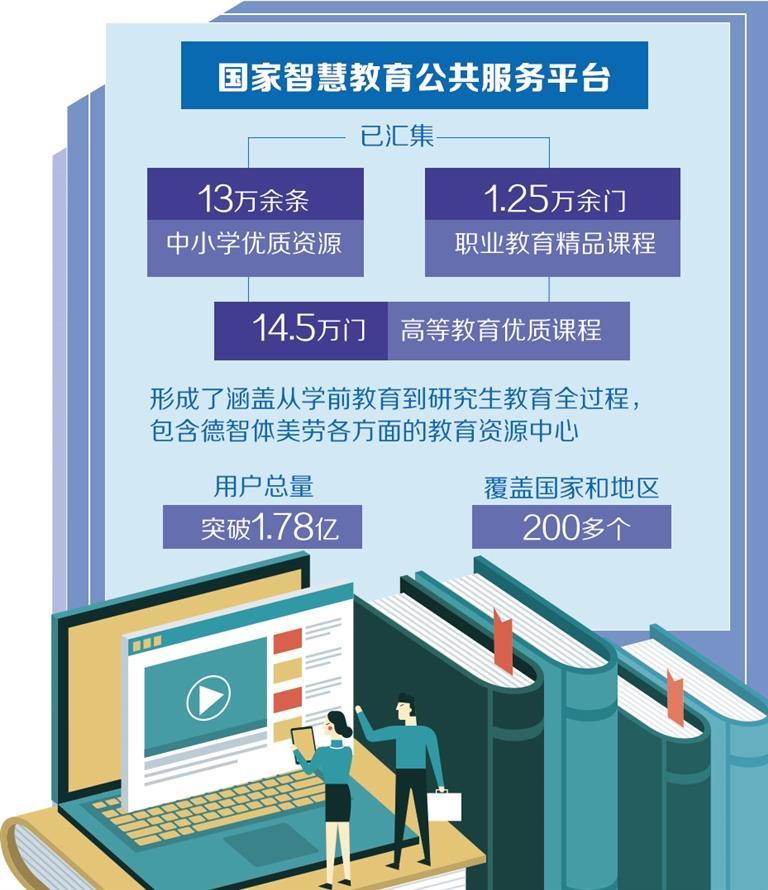
“十四五”期间我国数字教育实现从“量的扩增”到“质的飞跃”
Xin Hua Wang· 2026-01-03 22:30
Core Viewpoint - The Ministry of Education of China has reported significant advancements in educational digitalization during the "14th Five-Year Plan" period, highlighting a transition from quantity to quality in digital education, which has become a crucial support for building a strong education system in China. Group 1: Educational Resource Development - A world-class educational resource center has been established, featuring over 130,000 quality resources for primary and secondary education, 12,500 vocational education courses, and 145,000 higher education courses, with a total user base exceeding 178 million and daily visits reaching 52 million [1] - The platform has integrated over 60 application tools to support various educational scenarios, enabling advanced teaching methods such as flipped classrooms and project-based learning, significantly enhancing overall teaching quality [1] - More than 64 million teachers have utilized the platform for lesson preparation, and over 90 million teachers have been trained through it, greatly improving their digital literacy and professional capabilities [1] Group 2: Lifelong Learning Center - A lifelong learning center has been established, gathering over 8,000 courses from 38 institutions, specifically targeting employment skills and continuing education for graduates and social learners [2] - The "Double Thousand" plan has been launched, offering over 2,600 micro-specialties and 1,400 vocational training courses to promote high-quality employment [2] - Initiatives for elderly learners have been introduced, including resources for cultural literacy and personal interests, enhancing the learning experience for older adults [2] Group 3: Public Service Center - A public service center has been created, consolidating 51 government services across eight categories, serving a total of 140 million people [3] - The platform has improved efficiency by integrating with 32 provincial government service platforms, facilitating services like student status inquiries and certificate verifications [3] - Pilot programs in regions like Xining have achieved nearly 50% of enrollment applications with "zero materials," significantly reducing processing time and easing the burden on parents [4] Group 4: Data Center and Governance - A national education big data center has been established, connecting with 32 provincial education departments and over 1,000 universities, enhancing data sharing and governance capabilities [4] - The integration of data has led to the creation of an "education digital map," allowing for scientific analysis and forecasting of school-age populations and talent supply [4] Group 5: International Influence - The first "China Smart Education White Paper" has been published, enhancing China's international influence in digital education [5] - The global version of the China Smart Education platform offers nearly 900 multilingual courses, promoting cultural exchange and sharing quality educational resources [5] - China has become a leading nation in the UNICEF "Public Digital Learning Portal Project," and the national platform has received the highest award for educational informationization from the UN [5]
国家智慧教育公共服务平台用户 总量突破1.78亿
Xin Lang Cai Jing· 2025-12-31 04:30
Group 1 - The National Smart Education Public Service Platform has gathered over 130,000 quality resources for primary and secondary education, more than 12,500 premium vocational education courses, and 145,000 quality higher education courses, with a total user base exceeding 178 million across over 200 countries and regions [1] - The platform supports advanced teaching models such as flipped classrooms, inquiry-based learning, and project-based learning, effectively enhancing overall teaching quality [1] - Over 900 million teacher training sessions have been conducted through the platform, significantly improving teachers' digital literacy and professional capabilities [1] Group 2 - The Ministry of Education has initiated the National Education Digitalization Strategy Action 2.0, focusing on the integration of artificial intelligence in education, which has shown significant progress [1] - The platform has launched intelligent tools such as the "Yuxiaomiao" intelligent assistant to help teachers and students efficiently access resources, and a political education intelligent assistant covering seven application scenarios, which has been trialed in some universities [1] - The National Smart Education Platform has recently added sections for early childhood education and graduate education, achieving comprehensive service coverage [2]
我国建成世界规模最大高质量教育资源中心
Xin Lang Cai Jing· 2025-12-30 19:09
Core Insights - The Ministry of Education has initiated the National Education Digitalization Strategic Action since the 14th Five-Year Plan, transitioning from "quantitative expansion" to "qualitative leap" in digital education [1] Group 1: Digital Education Development - China has established the world's largest and high-quality education resource center, enhancing the level of quality and equity in education [1] - The National Smart Education Public Service Platform has aggregated 130,000 quality resources for primary and secondary education, 12,500 premium vocational education courses, and 145,000 high-quality higher education courses [1] - The platform covers the entire educational process from preschool to postgraduate education, including various aspects of education such as moral, intellectual, physical, aesthetic, and labor education [1] Group 2: User Engagement and Access - The total user base of the national platform has exceeded 178 million, covering over 200 countries and regions, with a daily average of 52 million visits and a cumulative total of over 72.6 billion visits [1] - The platform integrates over 60 application tools to support key educational scenarios such as student learning, teacher preparation, tutoring, after-school services, and home-school collaboration, all available for free to users [1] Group 3: Future Plans - The Ministry of Education plans to further advance the National Education Digitalization Strategic Action 2.0, focusing on improving the level of public digital education services and comprehensive governance capabilities [1] - The goal is to achieve a systematic leap from resource aggregation to public service and then to modernization of governance capabilities, fully empowering high-quality development in education [1]
教育部:2026年将系统推进人工智能教育和应用
Zhong Guo Jing Ying Bao· 2025-12-30 17:15
Core Viewpoint - The Ministry of Education plans to advance the integration of artificial intelligence (AI) in education, with policies expected by 2026 to create a future-oriented educational system [1] Group 1: AI in Education Strategy - The Ministry of Education will implement a national digital education strategy 2.0 starting in 2025, emphasizing AI as a key strategic direction [1] - AI literacy will be integrated into general education across different educational stages to cultivate high-quality talent for the intelligent era [1][2] - Over 1,000 AI courses have been aggregated on the national smart education public service platform to meet diverse learning needs [2] Group 2: Pilot Programs and Applications - Pilot programs for AI in education are being steadily advanced, with 7 provinces in the eastern region and 20 cities in the central and western regions participating [2] - A total of 509 AI education base schools have been established to explore innovative practices in AI application [2] Group 3: Safety and Ethical Considerations - The Ministry of Education has incorporated AI safety into the overall educational safety framework, developing assessment indicators for AI application safety [3] - The national education big data center and intelligent middle platform have been launched to support the digital education strategy, focusing on integrated, intelligent, and international approaches [3][5] Group 4: Data-Driven Educational Evaluation - The big data center will analyze student learning processes and needs, supporting differentiated teaching and personalized evaluation [4] - It will also provide data for adjusting academic disciplines and innovating talent cultivation models based on talent growth patterns and societal demand changes [4] Group 5: Intelligent Middle Platform - The intelligent middle platform serves as a shared "intelligent toolbox," integrating AI capabilities, data services, and algorithm modules for reusable components [5] - It aims to provide precise data-driven support for teaching and learning, facilitating collaborative research and promoting quality teaching models [6]
我国数字教育已从“量的扩增”迈向“质的飞跃”
Xin Lang Cai Jing· 2025-12-30 17:06
Core Insights - The digitalization of education in China has transitioned from "quantitative expansion" to "qualitative leap," becoming a crucial support for building a strong education nation [1][7] - The Ministry of Education outlined the progress made during the 14th Five-Year Plan and the development blueprint for the 15th Five-Year Plan, emphasizing a shift towards a comprehensive and integrated "smart education" phase [1] Group 1: Digital Education Development - During the 14th Five-Year Plan, China's digital education has evolved from isolated explorations to a systematic integration and deepening phase characterized by "smart education" [1] - Key aspects of this phase include: - Quality resource supply transitioning from local scarcity to universal sharing - Teaching and learning organization moving from standardized to personalized approaches - Application of intelligent technology evolving from tool assistance to scenario integration - Educational governance shifting from experience-based to data-driven decision-making [1] Group 2: National Smart Education Public Service Platform - The National Smart Education Public Service Platform has achieved significant development, recently adding sections for preschool and graduate education, thus covering all service targets [1] - The platform has aggregated over 130,000 quality resources for primary and secondary education, 12,500 premium vocational education courses, and 145,000 quality higher education courses, with a total user base exceeding 178 million across over 200 countries and regions [2] - The platform's total access volume has surpassed 72.6 billion, promoting equitable access to quality educational resources [2] Group 3: Regional Initiatives and Impact - In Guangdong Province, efforts to address educational resource shortages in underdeveloped areas have led to the delivery of 4,900 premium courses via television, reaching approximately 23 million families [2] - The total access volume for the Guangdong platform has reached 8.581 billion, with over 51% of visits from underdeveloped regions, indicating a significant impact on rural education [2] Group 4: Digital Transformation in Rural Schools - Digital transformation in rural schools has enhanced personalized education accessibility, with examples such as the Jinji Central School in Ningxia utilizing the national platform for tailored teaching strategies [3] - The implementation of digital tools has resulted in a 33% increase in student academic performance and a 24% improvement in physical health standards [3] Group 5: Artificial Intelligence Integration - The deep integration of artificial intelligence during the 14th Five-Year Plan has transformed teaching and learning models, with universities like Fudan and Tsinghua implementing AI across all courses and disciplines [3] - The establishment of a national big data center and an intelligent platform aims to break down data silos and enhance real-time monitoring of educational resources and quality [4][5] Group 6: International Influence and Future Directions - China's digital education has significantly improved its global standing, moving from 24th in 2023 to 6th in 2025 according to the Global Digital Education Development Index [5] - The Ministry of Education plans to advance the national education digitalization strategy 2.0, focusing on enhancing public service levels and governance capabilities [5][6] - Future educational developments will leverage artificial intelligence to create a new talent cultivation system and ensure technology serves the fundamental task of moral education [6]
用户总量超1.78亿 我国建成世界规模最大教育资源中心
Zhong Guo Jing Ji Wang· 2025-12-30 13:14
Core Viewpoint - The Ministry of Education has reported significant achievements in the digitalization of education during the "14th Five-Year Plan" period, highlighting the establishment of the world's largest and high-quality education resource center [1][2]. Group 1: Education Resource Development - The National Smart Education Public Service Platform has aggregated over 130,000 quality resources for primary and secondary education, more than 12,500 premium vocational education courses, and 145,000 high-quality higher education courses, covering the entire educational spectrum from preschool to postgraduate education [1]. - The platform has reached a total user base of over 178 million, with access from over 200 countries and regions, achieving a daily average of 52 million visits and a cumulative total of over 72.6 billion visits [1]. Group 2: Teacher Support and Training - The platform integrates over 60 application tools to support key educational scenarios such as student learning, teacher preparation, tutoring, after-school services, and home-school collaboration, all available for free to users [1]. - More than 6.4 million teachers have utilized the platform for lesson preparation and teaching, with a total of over 90 million teachers trained through the platform, significantly enhancing their digital literacy and professional capabilities [1]. Group 3: Lifelong Learning Initiatives - The National Lifelong Education Smart Education Platform has gathered over 8,000 courses from 38 institutions, launching the "Double Thousand" plan to enhance employment capabilities, with over 2,600 "micro-specialties" and more than 1,400 vocational training courses available [2]. - The platform features programs aimed at senior citizens, including the "Silver Age Classroom" and cultural literacy courses, with a notable health course by academician Zhong Nanshan attracting over 12 million views on its launch day [2]. Group 4: Government Services Enhancement - The National Platform's public service hall consolidates 51 government services across eight categories, serving a cumulative total of 140 million people [2]. - Services such as student status inquiries, certificate verification, and degree authentication have been streamlined, with integration into 32 provincial and municipal government service platforms, facilitating a "one-stop acceptance, one network for all" approach [2]. - Pilot programs in places like Xining, Qinghai, have enabled nearly 50% of compulsory education admissions to be processed with "zero materials," significantly reducing processing times and easing the burden on parents [2].
我国教育数字化迈向“智慧教育”阶段
Zhong Guo Jing Ji Wang· 2025-12-30 13:14
Group 1 - The core viewpoint of the article highlights the significant advancements in China's educational digitalization during the "14th Five-Year Plan" period, particularly since the implementation of the digital strategy in 2022, transitioning towards a comprehensive "smart education" phase [1][2] Group 2 - The supply model of quality educational resources has shifted from localized scarcity to nationwide sharing, exemplified by the launch of the National Smart Education Public Service Platform in 2022, which provides free access to quality resources developed by top schools and experts [1] - The organization of teaching and learning has evolved from standardized approaches to personalized and diversified methods, utilizing big data and AI for data-driven analysis and intelligent interventions in the learning process [1] - The application of intelligent technology has progressed from being a mere tool to becoming a core element driving the entire teaching process, integrating into key areas such as admissions, evaluations, employment services, and campus governance [2] - The decision-making model in educational governance has transitioned from experience-based judgments to data-driven approaches, enhancing management efficiency and responsiveness through dynamic data perception and analysis [2]
又升级啦!国家智慧教育平台有这些新变化
Xin Lang Cai Jing· 2025-12-30 12:58
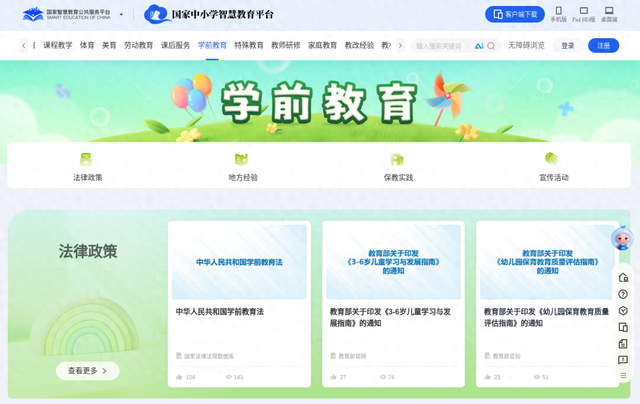
Core Insights - The Ministry of Education held a press conference to discuss the progress of digital education during the 14th Five-Year Plan, highlighting the launch of new sections in the National Smart Education Platform, including early childhood education and graduate education [1][2]. Group 1: Early Childhood Education - The early childhood education section focuses on the developmental characteristics of young children, targeting kindergarten principals, teachers, and parents, with 427 resources launched in four categories: legal policies, local experiences, educational practices, and promotional activities [1]. Group 2: Graduate Education - The graduate education section integrates multiple stakeholders and offers high-quality resources, including columns on party building, academic lectures, and cutting-edge research, along with a dedicated intelligent assistant to support innovative and academic services [2][4]. Group 3: National Education Big Data Center - The National Education Big Data Center connects universities, provincial education departments, and the Ministry of Education, facilitating data sharing across over a hundred projects and aggregating hundreds of billions of education data points to create a "digital map" of education [6]. Group 4: Intelligent Middleware - The intelligent middleware serves as the core of the national platform's intelligent operation, utilizing standardized interfaces and modular packaging to achieve centralized integration, unified scheduling, and on-demand supply, supporting educational intelligence across various scenarios [8].
教育部:将继续深入推进人工智能赋能教育行动 计划在明年出台相关政策文件
智通财经网· 2025-12-30 09:01
Core Insights - The Ministry of Education has made significant progress in digital education during the 14th Five-Year Plan, particularly through the implementation of the National Education Digital Strategy Action 2.0, which emphasizes the integration of artificial intelligence in education [1][17][25] - The establishment of the National Smart Education Public Service Platform has created the world's largest and high-quality educational resource center, enhancing the accessibility and quality of education across various regions [10][12][16] - The focus on lifelong learning and the development of a comprehensive education service system has been a key achievement, with initiatives aimed at improving employment skills and supporting various demographics, including the elderly [12][35] Group 1 - The Ministry of Education announced the launch of the AI Empowerment in Education Action, exploring effective paths for AI in education [1][20] - The National Education Digital Strategy Action 2.0 aims to deepen the application of AI across all educational levels, with plans to release relevant policy documents next year [1][25] - The National Smart Education Public Service Platform has gathered over 130,000 high-quality resources and has a user base exceeding 178 million, demonstrating significant engagement and resource sharing [10][11][12] Group 2 - The digital education initiatives have led to a new paradigm in teaching and learning, shifting from standardized methods to personalized and diverse approaches [57] - The integration of AI tools into educational practices has transformed traditional teaching methods, enabling real-time data analysis and personalized learning experiences [58][60] - The establishment of a national education big data center has enhanced governance and decision-making in education, allowing for data-driven management and improved educational outcomes [14][60] Group 3 - The Ministry of Education plans to continue advancing the AI Empowerment in Education Action, focusing on developing high-quality talent suited for the intelligent era [25][70] - The Guangdong province has implemented digital education strategies that have significantly improved educational equity and quality, particularly in rural areas [28][30][31] - Zhejiang University has developed a comprehensive AI talent cultivation system, integrating AI into various educational levels and promoting innovative teaching practices [41][42]