
数字经济与实体经济融合

Search documents
李文杰:建议搭建区域性惠民电商平台
Qi Lu Wan Bao· 2026-01-22 02:58
齐鲁晚报·齐鲁壹点 夏侯凤超 李梦瑶 于泊升 杜春娜 "平台进入运营期时,要明确招商重点。"李文杰认为,该平台应以济南本地街边零售店铺、制造业厂 商、农产品合作社、老字号企业、专精特新企业为核心招商对象,同步吸纳黄河流域优质合作商家入 驻,并制定招商激励政策。"还要多维推广,扩大平台社会影响力,并深化线上线下(300959)融合, 拓展区域合作范围。" 在当前数字经济蓬勃发展的背景下,扶持本地实体经济,成为重要议题。今年济南市两会期间,济南市 人大代表,漱玉平民(301017)大药房连锁股份有限公司董事长李文杰带来建议,希望搭建区域性惠民 电商平台,助力实体经济复苏。 关于平台建设的可行性,李文杰认为,它契合济南推动数字经济与实体经济融合、扶持小微企业的政策 导向。同时,本地超算、物流、商家等资源充足,可降低平台研发与获客成本。此外,本地商家有降本 增收的需求,具备较强的参与意愿。 李文杰称,线下实体店铺面临客流减少与成本高企的双重压力,制约了商业生态繁荣与实体经济高质量 发展。为此,李文杰提出,可以搭建区域性惠民电商平台。 "建议依托济南市优势及资源禀赋,搭建区域性、低费率、惠民导向的电商平台,以助力本地商 ...
“压舱石”作用愈发凸显 创新动能持续壮大
Xin Lang Cai Jing· 2026-01-21 22:36
Core Viewpoint - The industrial economy in China is showing steady growth, with significant contributions to overall economic performance, and the government is committed to advancing new industrialization by 2025 [1][8]. Group 1: Industrial Growth and Performance - The industrial added value of large-scale enterprises increased by 5.9% year-on-year, with manufacturing value added maintaining the world's top position for 16 consecutive years [1]. - The added value of equipment manufacturing and high-tech manufacturing increased by 9.2% and 9.4% year-on-year, respectively [2]. - The telecommunications business volume grew by 9.1% year-on-year, indicating robust performance in the industrial and information sectors [1]. Group 2: Support for Small and Medium Enterprises - The government is implementing reforms to reduce burdens on enterprises and ensure the implementation of policies that benefit businesses, fostering a supportive environment for development [3]. - A total of 17,600 specialized and innovative "little giant" enterprises have been cultivated, along with over 140,000 specialized and innovative small and medium enterprises [3]. Group 3: Innovation and New Growth Drivers - Significant advancements in technology are highlighted, including breakthroughs in humanoid robots and major equipment like large-diameter shield machines [4]. - The added value of industries such as integrated circuits and electronic materials is projected to grow by 26.7% and 23.9% year-on-year, respectively, by 2025 [5]. - The scale of artificial intelligence computing power in China has reached 1,590 EFLOPS, with applications expanding across key industries [5]. Group 4: Digital Economy and Industrial Upgrading - The integration of the digital economy with the real economy is enhancing industrial transformation, with over 23,000 "5G + industrial internet" projects established [6]. - New business models such as "black light factories" and "smart ports" are emerging as key drivers for upgrading traditional industries [6]. Group 5: Future Industrial Strategy - The government aims to stabilize growth, strengthen innovation, promote integration, optimize governance, and prevent risks as part of the new industrialization strategy [8]. - Focus areas include enhancing the adaptability of consumer goods supply and demand, promoting green and low-carbon transitions, and developing new energy solutions [8].
中国经济年报丨国家税务总局:2025年我国制造业智能化 绿色化加快发展
Sou Hu Cai Jing· 2026-01-21 13:38
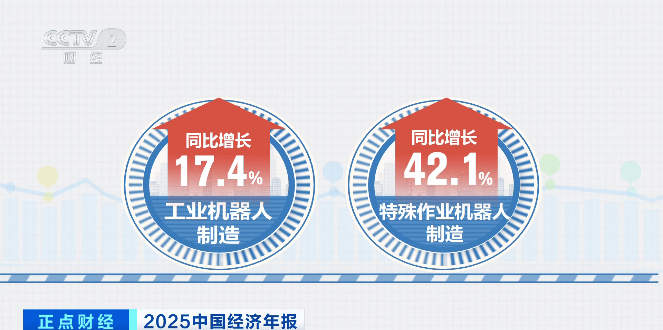
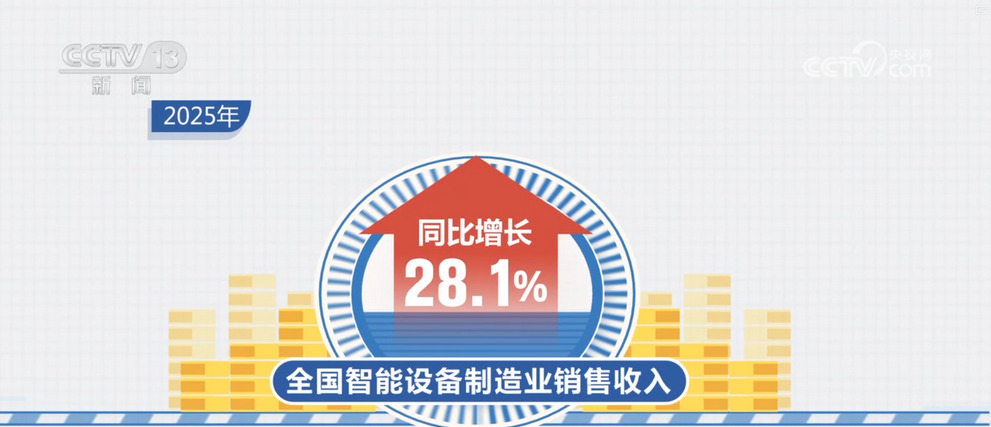
Group 1 - The core viewpoint of the article highlights the accelerated development of intelligent and green transformation in China's manufacturing industry by 2025, with steady increases in sales revenue from intelligent equipment, new energy vehicles, and digital products [1][5]. Group 2 - In 2025, the sales revenue of the intelligent equipment manufacturing industry nationwide is expected to grow by 28.1% year-on-year, with industrial robots and special operation robots increasing by 17.4% and 42.1% respectively [3]. - The transition towards intelligent and digital transformation in manufacturing is accelerating, with expenditures on automation and digital equipment rising by 11.3% and 10% year-on-year respectively [3]. Group 3 - The green transformation in manufacturing is also progressing, with the sales revenue of high-energy-consuming manufacturing industries decreasing by 1.1 percentage points compared to the previous year, indicating an optimization of the industrial structure [5]. - Expenditures on environmental governance services by manufacturing enterprises increased by 7.3% year-on-year, reflecting a growing investment in green governance [5]. - The new energy-related industries are rapidly developing, with sales revenue from new energy vehicle manufacturing and lithium-ion battery manufacturing increasing by 14.3% and 25.1% year-on-year respectively [5]. Group 4 - The integration of the digital economy with the real economy is deepening, with sales revenue from the digital product manufacturing industry growing by 9.4% year-on-year [7]. - Manufacturing enterprises' expenditures on digital technology increased by 10.4% year-on-year, with a growth rate that accelerated by 3.5 percentage points compared to the previous year, particularly in the automotive manufacturing and computer communication equipment manufacturing sectors, which saw increases of 24.5% and 11.8% respectively [7].

透视“十四五”收官之年工业和信息化发展成效
Xin Hua She· 2026-01-21 12:26
Core Insights - The industrial sector is increasingly recognized as the "ballast" of the national economy, with significant growth and development highlighted in the "14th Five-Year Plan" completion year [1][2]. Industrial Growth - The total industrial output value above designated size increased by 5.9% year-on-year, with manufacturing value added maintaining the world's top position for 16 consecutive years [2]. - The telecommunications business volume grew by 9.1% year-on-year, contributing over 40% to economic growth from the industrial and information sectors [2]. Manufacturing and Innovation - The value added of equipment manufacturing and high-tech manufacturing increased by 9.2% and 9.4% year-on-year, respectively [3]. - Over 35,000 basic-level, 8,200 advanced-level, and 500 excellent-level smart factories have been established, alongside more than 8,000 national green factories [3]. Support for SMEs - The government has accelerated reforms in key areas, implemented actions to reduce enterprise burdens, and promoted the implementation of policies benefiting enterprises [4]. - A total of 17,600 "little giant" enterprises and over 140,000 specialized and innovative SMEs have been cultivated, with a target of 6.9% year-on-year growth in value added for SMEs by 2025 [4]. New Growth Drivers - Innovations such as humanoid robots and breakthroughs in major equipment like large-diameter shield machines are being emphasized [5]. - The value added in sectors like integrated circuits and electronic materials is projected to grow by 26.7% and 23.9% year-on-year, respectively [6]. Digital Economy Integration - The deep integration of the digital economy with the real economy is empowering industrial transformation and upgrading, with over 23,000 "5G + industrial internet" projects established [7]. Future Industrial Strategy - The focus for the upcoming year will be on stabilizing growth, enhancing innovation, promoting integration, optimizing governance, and preventing risks, with a strong push for new industrialization [8]. - The government aims to enhance the adaptability of consumer goods supply and demand, optimize product supply, and promote intelligent, green, and integrated development in the consumer goods industry [8].
“压舱石”作用愈发凸显 创新动能持续壮大——透视“十四五”收官之年工业和信息化发展成效
Xin Hua Wang· 2026-01-21 12:25
Core Viewpoint - The industrial sector is a cornerstone of the national economy, with significant growth and development expected by 2025, emphasizing new industrialization and technological innovation [2][8]. Group 1: Industrial Growth and Performance - The industrial added value of large-scale enterprises increased by 5.9% year-on-year, with manufacturing value added maintaining the world's top position for 16 consecutive years [2]. - The added value of equipment manufacturing and high-tech manufacturing grew by 9.2% and 9.4% respectively [2]. - The contribution of the industrial and information sector to economic growth exceeded 40% [2]. Group 2: Support for SMEs - The government has accelerated reforms in key areas, implemented actions to reduce enterprise burdens, and cleared overdue payments to support small and medium-sized enterprises (SMEs) [3]. - A total of 17,600 "little giant" enterprises and over 140,000 specialized and innovative SMEs have been cultivated [3]. - The added value of industrial SMEs is expected to grow by 6.9% year-on-year by 2025 [3]. Group 3: Technological Innovation - Significant advancements in new technologies include a 26.7% increase in the added value of the integrated circuit industry and a 23.9% increase in electronic materials [5]. - The scale of artificial intelligence computing power reached 1,590 EFLOPS, with applications in key industries such as steel, electricity, and telecommunications [5]. - Over 330 humanoid robot products have been launched domestically, showcasing the growth of innovative capabilities [5]. Group 4: Digital Economy Integration - The integration of the digital economy with the real economy is enhancing industrial transformation, with over 23,000 "5G + industrial internet" projects established [6]. - New business models such as "dark factories," "unmanned mines," and "smart ports" are emerging as key drivers for upgrading traditional industries [6]. Group 5: Future Industrial Strategy - The focus for the upcoming year will be on stabilizing growth, enhancing innovation, promoting integration, optimizing governance, and preventing risks [8]. - The government aims to enhance the adaptability of consumer goods supply and demand to release consumption potential [8]. - Efforts will be made to promote green and low-carbon transitions, focusing on developing key energy-saving and environmental protection equipment [8].
吉林省网络市场服务促进会成立
Xin Lang Cai Jing· 2026-01-21 10:25
促进会的成立,标志着我省网络市场步入规范协同发展新阶段。会上,同步启动"2026年全国网上年货 节·吉品荟萃"直播带货活动,旨在聚合吉林优质特色产品,借力电商新业态推动"吉品"出省出海,助力 乡村振兴与消费升级。 1月16日上午,以"融势向新·网赢未来"为主题的吉林省网络市场服务促进会成立大会暨首届吉林省网络 市场行业峰会在长春举行。政府部门相关负责人、行业专家、电商平台代表及省内重点企业代表共200 余人参会,共话数字时代吉林网络市场规范发展与合作新机遇。 本次大会搭建了政企学研高效对接的平台。未来,吉林省网络市场服务促进会将发挥凝聚行业力量、加 强行业自律的关键作用,积极推动数字经济与实体经济深度融合,为吉林全面振兴持续注入数字新动 能。 来源:央广网 1月16日上午,以"融势向新·网赢未来"为主题的吉林省网络市场服务促进会成立大会暨首届吉林省网络 市场行业峰会在长春举行。政府部门相关负责人、行业专家、电商平台代表及省内重点企业代表共200 余人参会,共话数字时代吉林网络市场规范发展与合作新机遇。 促进会的成立,标志着我省网络市场步入规范协同发展新阶段。会上,同步启动"2026年全国网上年货 节·吉品荟萃 ...
税收数据视角下的2025年制造业发展亮点:智能化、绿色化步伐加快
Yang Shi Wang· 2026-01-21 08:41
Group 1 - The core viewpoint of the articles indicates that by 2025, China's manufacturing industry will accelerate its development in terms of intelligence and greenness, with steady increases in sales revenue from intelligent equipment, new energy vehicles, and digital products [1][3][4] Group 2 - In 2025, the sales revenue of high-energy-consuming manufacturing industries will decrease by 1.1 percentage points compared to the previous year, reflecting an optimization in industrial structure [3] - The amount spent by manufacturing enterprises on environmental governance services will increase by 7.3% year-on-year, indicating a growing investment in green governance [3] - The sales revenue of the new energy vehicle manufacturing industry and lithium-ion battery manufacturing will grow by 14.3% and 25.1% year-on-year, respectively [3] Group 3 - The sales revenue of the intelligent equipment manufacturing industry will increase by 28.1% year-on-year in 2025, with industrial robots and special operation robots growing by 17.4% and 42.1% respectively [4] - The procurement of automation and digital equipment by manufacturing enterprises will increase by 11.3% and 10% year-on-year, respectively [4] Group 4 - The sales revenue of the digital product manufacturing industry will grow by 9.4% year-on-year in 2025, with the procurement of digital technology by manufacturing enterprises increasing by 10.4%, an acceleration of 3.5 percentage points compared to the previous year [6] - In the automotive manufacturing and computer communication equipment manufacturing sectors, the procurement of digital technology will increase by 24.5% and 11.8% year-on-year, respectively [6]
增速5.8%!甘肃经济稳中向好韧性凸显质效双升——2025年甘肃省经济运行成绩单透视
Xin Lang Cai Jing· 2026-01-21 01:00
Core Viewpoint - Gansu Province's economy demonstrated resilience and positive growth in 2025, with a GDP of 1.36975 trillion yuan, reflecting a year-on-year increase of 5.8%, surpassing the national average by 0.8 percentage points [1]. Economic Growth Indicators - Gansu's economic performance in 2025 showed "five positive trends": stable growth outpacing the national average, improved supply across all three industries, resilient investment and consumption, strong foreign trade growth, and enhanced quality and efficiency [2]. - Key indicators included industrial added value growth exceeding the national average by 3.6 percentage points, import and export growth surpassing the national average by 12.4 percentage points, and per capita disposable income growth exceeding the national average by 0.6 and 0.5 percentage points respectively [2]. Industry Performance - The agricultural sector achieved a record grain output of over 13 million tons, with significant growth in specialty products like vegetables and medicinal herbs, establishing Gansu as a major seed production base [3]. - The industrial sector saw a 0.5 percentage point acceleration in industrial added value growth, with key industries like non-ferrous metals and electricity contributing significantly to economic stability [3]. - The service sector emerged as a primary growth driver, contributing 51.4% to GDP growth, with tourism seeing over 500 million visitors and generating 403.6 billion yuan in spending [3]. Domestic and Foreign Trade - Gansu implemented measures to boost domestic demand and stabilize foreign trade, resulting in a 2.7% increase in project investment despite a downturn in the real estate market [4]. - The province's total import and export value exceeded 70 billion yuan, with a growth rate 12.4 percentage points higher than the national average, and a notable increase in high-tech product exports [4]. Development Momentum and Quality Improvement - New industries and private sector growth contributed to Gansu's economic transformation, with significant increases in strategic emerging industries and private enterprise performance [5][6]. - In 2025, Gansu added 16.05 million kilowatts of new power generation capacity, with a total capacity exceeding 80 million kilowatts and a year-on-year increase in power generation of 11.4% [6]. - The province saw a 22.6% increase in funds for newly established and ongoing investment projects, with a notable rise in the contribution of private enterprises to both industrial output and foreign trade [6].
参加滨州市政协十二届五次会议的政协委员向大会报到
Xin Lang Cai Jing· 2026-01-18 16:23
Group 1 - The conference of the Shandong Provincial Political Consultative Conference highlighted the importance of the silver economy as a new growth driver for the national economy, with proposals focusing on enhancing top-level design and innovation in elderly care products [1] - The proposal from the committee emphasized leveraging local industries such as high-end aluminum and intelligent textiles to create a distinctive brand for the silver economy in Binzhou, aiming for high-quality economic development [1] - The integration of digital economy with the real economy was underscored, with suggestions for promoting new industrialization and the development of intelligent and green manufacturing [1] Group 2 - The proposal to develop patient capital was presented, focusing on building a long-term capital ecosystem to address financing bottlenecks in industrial upgrades, which is crucial for the construction of a strong manufacturing city [2] - It was noted that Binzhou currently has 25 active industrial funds with a subscribed scale exceeding 16.8 billion, but there are still shortcomings compared to advanced regions, such as small capital scale and low proportion of long-term capital [2] - A recommendation was made to establish a city-level patient capital guiding mother fund with a scale of approximately 5 billion, targeting hard technology sectors like high-end aluminum materials and new energy equipment [2]
加快“智改数转”步伐 推动“数字+实体”深度融合
Xin Lang Cai Jing· 2026-01-16 23:10
Core Viewpoint - The integration of digital economy and real economy is a crucial measure for promoting high-quality economic development, with a focus on leveraging strategic opportunities in the digital economy to build new advantages for development [1]. Group 1: Digital Economy and Real Economy Integration - The integration of digital economy and real economy is seen as the core trend for future economic development, with the potential to activate industrial innovation and transform digital advantages into developmental strengths for Shenyang [1]. - Shenyang has a solid foundation for digital and real economy integration but needs to address issues such as insufficient digitalization levels in some enterprises, high transformation costs for small and medium-sized enterprises, and a shortage of high-end talent [1]. Group 2: Industry Transformation and Infrastructure - There is a recommendation to prioritize the cultivation of "four above" enterprises and accelerate the construction of new infrastructure, promoting innovation in industrial internet and digital transformation of traditional infrastructure [2]. - Encouragement for enterprises to build smart factories and digital workshops to fill the gaps in digital industrialization is emphasized [2]. Group 3: Talent Development and Policy Support - The suggestion includes focusing on precise investment in key areas like virtual reality to accelerate the construction of the digital economy industrial chain and support the transformation of manufacturing towards high-end, intelligent, and green development [2]. - It is advised to refine digital economy support policies at national, provincial, and municipal levels, and to organize enterprises to apply for special support to release policy dividends [2]. - A dual approach of "self-cultivation + open recruitment" is recommended to accelerate talent development in artificial intelligence and big data, alongside enhancing data security management mechanisms [2].