
智能辅助驾驶技术

Search documents
粤港澳大湾区车展18.3万人涌入:告别“价格战” 迈向“价值战”
Zhong Guo Jing Ying Bao· 2025-06-03 03:21
Core Viewpoint - The future competition focus of China's automotive industry is shifting from "price wars" to "value wars" as highlighted during the Guangdong-Hong Kong-Macao Greater Bay Area Auto Show [1][3][5] Industry Trends - The first day of the auto show attracted 183,000 visitors, a significant increase from 157,000 last year, indicating a growing consumer interest in safety and smart travel [1] - The China Association of Automobile Manufacturers (CAAM) called for rational competition and opposed chaotic price wars, emphasizing that such practices harm profit margins and product quality [1][2] Company Strategies - Executives from various automotive companies, including NIO and XPeng, expressed a preference for competing on technology and service rather than price, advocating for a focus on value [3][4] - The Ministry of Industry and Information Technology (MIIT) plans to enhance regulatory efforts to guide the industry towards high-quality development [2][5] R&D Investments - XPeng reported a quarterly R&D investment of nearly 2 billion yuan, while GAC Group has invested over 55 billion yuan cumulatively in R&D [4][5] - Huawei's overall R&D investment for 2024 is projected to reach 179.7 billion yuan, with over 10 billion yuan allocated specifically for automotive smart technology [5][7] Technological Innovations - The auto show featured significant technological showcases, including BYD's "megawatt flash charging" technology and Huawei's smart driving systems, reflecting the industry's shift towards intelligent and innovative solutions [6][7] - The event served as a platform for various brands to unveil new models and technologies, highlighting the industry's commitment to enhancing consumer experience through advanced features [6][7]






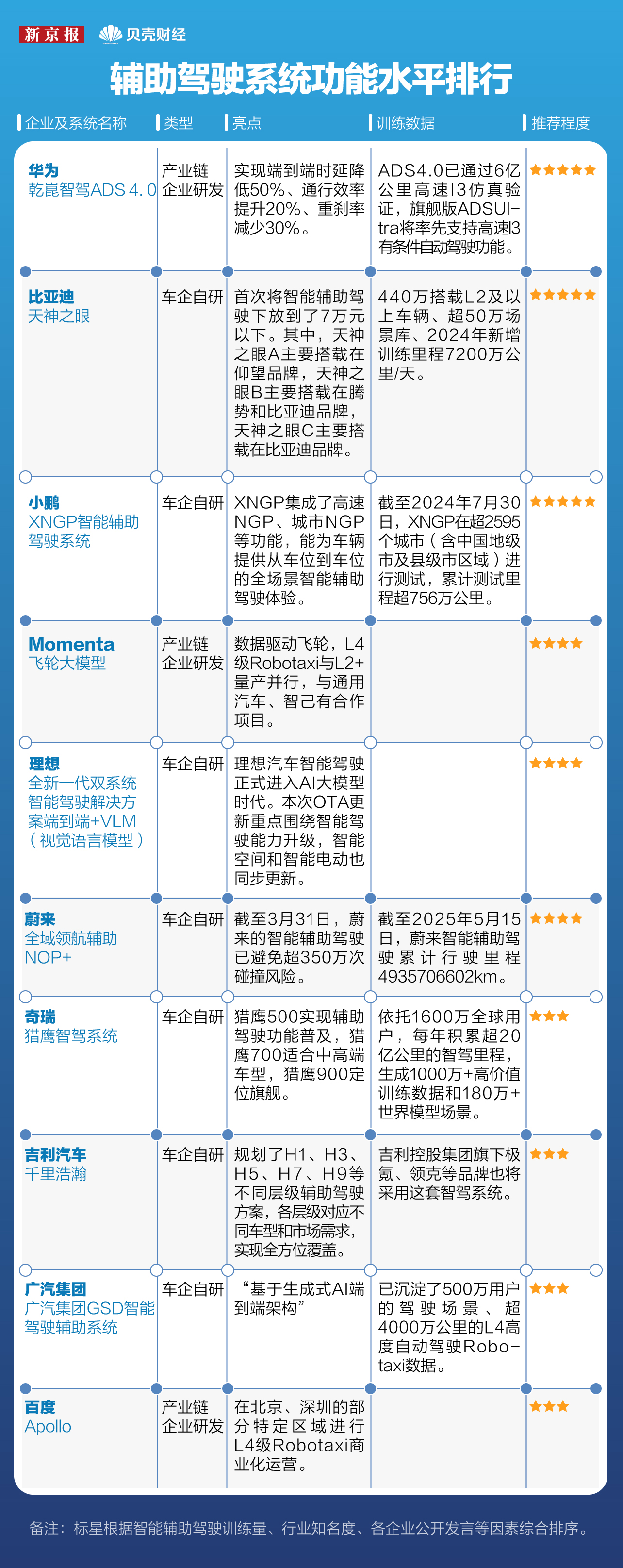
智能辅助驾驶竞速与暗战:自研派VS合作派,功能水平分化加剧
Bei Ke Cai Jing· 2025-05-22 10:37
Core Insights - The article discusses the advancements and competitive landscape of the assisted driving industry, highlighting various companies' self-developed systems and strategies [1][4]. Group 1: Company Developments - Li Auto has launched its new generation dual-system intelligent driving solution, focusing on upgrading driving capabilities and synchronizing updates for smart electric vehicles [3]. - NIO's intelligent assisted driving system has reportedly avoided over 3.5 million collision risks, accumulating a total driving mileage of approximately 4.94 billion kilometers as of May 15, 2025 [3]. - Chery's Hawk 500 has achieved widespread adoption of assisted driving features, with the Hawk 700 targeting mid-to-high-end models and the Hawk 900 positioned as a flagship [3]. - GAC Group's GSD intelligent driving assistance system has accumulated 5 million user driving scenarios and over 40 million kilometers of high-level autonomous driving data [3]. Group 2: Industry Trends - BYD and XPeng are recognized as leaders in self-developed intelligent driving systems, with BYD's high-end system named "Tianshen Eye" [4]. - Bosch's China president has expressed skepticism about the self-development model, suggesting that mid-level intelligent driving should become standard and that costs could be better managed through supply chain partnerships [4]. - Huawei is positioned as a top player in the intelligent driving system market, with plans for 10 brands from 7 automakers to adopt its solutions, potentially exceeding 500,000 vehicles [4][5]. - Huawei's collaboration models include component supply, Huawei Inside (HI) partnerships, and deep cooperation with automakers, with the latter being the most integrated approach [5]. Group 3: Strategic Partnerships - SAIC Group has publicly stated its intention to maintain control over core technologies while also choosing to collaborate with Huawei [6]. - The partnerships with Huawei have led to increased sales for collaborating automakers, but questions remain about their ability to independently develop high-quality vehicles [6].


亏损326亿元,最难CEO作出“悲伤而痛苦”的决定
汽车商业评论· 2025-05-14 15:14
Core Viewpoint - Nissan is facing a severe business environment, leading to significant losses and the implementation of a comprehensive restructuring plan called "RE: Nissan" to achieve recovery by the fiscal year 2027 [2][3][5]. Financial Performance - For the fiscal year 2024, Nissan reported a net loss of 670.9 billion yen (approximately 32.6 billion RMB), marking the worst fiscal year in over 20 years [4][5][9]. - Global sales decreased by 2.8% to 3.346 million units, with a notable 12.2% drop in the Chinese market, while North American sales grew by 3.3% [5]. - Consolidated net sales fell by 0.4% to 12.6 trillion yen (approximately 612.6 billion RMB), and operating profit plummeted by 88% to 69.8 billion yen (approximately 3.39 billion RMB) [5]. Restructuring Strategy - The restructuring plan aims to reduce costs by 500 billion yen (approximately 24.39 billion RMB) by the fiscal year ending March 2027, with equal contributions from variable and fixed costs [13]. - Key measures include closing 7 factories, laying off 20,000 employees (15% of the global workforce), and reducing annual production capacity from 4 million to 2.5 million vehicles [13][16][19]. - Nissan's production capacity utilization rates are significantly low, with 57.7% in the U.S., 45.3% in China, and 56.7% in Japan, far below the industry breakeven point of around 80% [16]. Market Strategy and Partnerships - Nissan plans to redefine its product and market strategy, including the integration of production facilities and optimizing the supply chain [21][22]. - The company is exploring partnerships beyond the automotive industry, particularly with Honda, despite previous merger talks being halted [26][30]. - Nissan aims to enhance local production in the U.S. to mitigate the impact of tariffs, which are expected to negatively affect the company by 450 billion yen [23][24]. Challenges and Outlook - The company has not provided performance forecasts for the new fiscal year due to uncertainties in the tariff environment [10]. - The ongoing challenges include rising variable costs and fixed costs exceeding current revenue levels, necessitating urgent action to avoid further deterioration [13].

若出事的小米装了激光雷达,留给司机的接手时间可能不止两秒
汽车商业评论· 2025-04-03 14:56
撰文 / 钱亚光 设计 / 师 超 3月29日的夜晚,一辆小米SU7标准版在高速公路行驶过程中遭遇严重交通事故。车辆燃烧起火,三个年轻人葬身高速公路。 这一事故暴露出智能辅助驾驶技术的不成熟,例如摄像头视觉感知的灵敏度在夜间和恶劣天气时会显著下降,用户盲目信赖智驾功能而导致的车祸也时 有发生,这都为市场敲响了安全警钟。 根据小米官方披露,事故发生前车辆检测到障碍物后发出预警并减速,但未触发AEB紧急制动系统。辅助驾驶退出,驾驶员接手仅2秒,碰撞就发生 了。 小米SU7标准版没有配备激光雷达,纯视觉模式在夜间识别效果相对欠佳,可能存在障碍物识别不够及时到位问题。而激光雷达可通过主动发射激光束 获取高精度三维环境数据,对环境感知精度高、可直接获取目标的距离、角度、反射强度、速度等信息且抗干扰能力较强。 这起夺命事故引发了市场对纯视觉智驾方案可靠性的质疑。长远来看,小米SU7事故或将成为智能驾驶技术路线的分水岭,有望将激光雷达从"成本选 项"跃升为"安全刚需"。 4月2日,激光雷达两家龙头企业暴涨,港股速腾聚创高开,一度涨超7%,隔夜美股禾赛大涨逾17%。而A股市场激光雷达概念股也集体走强,其中,美 湖股份涨超7% ...