流感疫情

Search documents
日本流感疫情扩散 八成地区达“警报”级别
Xin Hua She· 2025-11-28 12:16
Group 1 - The core point of the articles highlights a significant increase in influenza cases in Japan, with over 196,900 reported cases in the week ending November 23, marking a 1.4 times increase from the previous week [1][2] - A total of 39 out of 47 prefectures in Japan have reached the "alert" level for influenza, with 15 prefectures added to this category in the past week [1] - The current influenza outbreak is approaching the severity levels seen at the end of last year, which was the highest since the current statistical methods were implemented in 1999 [1] Group 2 - As a result of the influenza spread, 8,817 schools, including kindergartens and primary and secondary schools, have either fully or partially suspended classes [2] - The influenza season in Japan began on October 3, which is approximately one month earlier than last year, marking the second earliest start since the current statistical methods were adopted in 1999 [2]
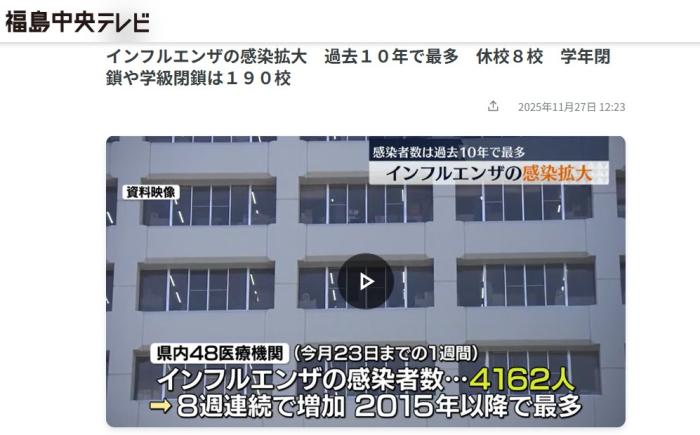
日本福岛县流感疫情蔓延 感染人数达十年来最高水平
Zhong Guo Xin Wen Wang· 2025-11-27 11:24
Core Viewpoint - The flu epidemic in Fukushima Prefecture, Japan, has reached its highest level in the past decade, with a significant increase in infection cases reported [1]. Group 1: Infection Statistics - As of the week ending on the 23rd, 48 medical institutions reported a total of 4,162 flu infection cases, an increase of over 1,300 cases from the previous week [4]. - This marks the eighth consecutive week of rising infection numbers, exceeding the warning level and representing the highest count since 2015 [4]. Group 2: Impact on Education - In response to the flu outbreak, 190 schools in the region have implemented measures related to school closures [5]. Group 3: Government Response - The local government has urged residents to adopt basic preventive measures, such as wearing masks based on individual circumstances [6].

一财主播说 | 流感季又到!流感药销量飙升 价格“卷出”1元/粒
Di Yi Cai Jing· 2025-11-24 03:20
Core Insights - The sales of Oseltamivir have surged significantly, with a weekly growth rate of 237% as of November 22, indicating a strong demand for flu medications during the flu season [1] - Other medications for cold, fever, detoxification, cough relief, and nasal sprays have also seen increased sales, reflecting a broader trend in consumer behavior during this period [1] Pricing and Availability - The price range for domestic Oseltamivir varies from 20 to 60 yuan per box, showing a decrease compared to previous prices, with some brands priced as low as 10.7 yuan for 7 capsules and 11.59 yuan for 10 capsules, averaging 1.53 yuan and 1.16 yuan per capsule respectively [1] - Imported Oseltamivir is generally priced above 170 yuan, while the price for Sufentanil ranges from 195 to 239 yuan per box, indicating a significant price disparity between domestic and imported options [1] Market Trends - Some pharmacies have reported that flu medications like Oseltamivir and Sufentanil were sold out at times, highlighting the urgency and demand for these products as the flu season approaches [1] - The Chinese Center for Disease Control and Prevention has projected that the peak of the flu season in China may occur in mid to late December and early January, suggesting a continued increase in demand for flu-related medications [1]
流感病毒来袭 如何对症下药?
Yang Shi Wang· 2025-11-21 18:46
Core Insights - The recent monitoring data from the National Center for Disease Control indicates a rapid increase in influenza trends in China, with clear dominant strains identified [1] - The peak of the influenza epidemic is expected to occur in late December this year and early January next year [1] - A visit to the Beijing Children's Hospital of Capital Medical University revealed an increase in patient visits [1]
多人感染流脑,日本流感疫情警报拉响
第一财经· 2025-11-18 14:03
Core Viewpoint - The article highlights the significant increase in flu cases in Japan, indicating a potential public health crisis and its implications for healthcare services and related industries [1] Summary by Relevant Sections Flu Outbreak Data - From November 3 to 9, over 84,183 flu cases were reported across more than 3,800 designated medical institutions in Japan, representing a 50% increase compared to the previous week [1] - In the same period, certain regions such as Iwate, Miyagi, Fukushima, Saitama, and Kanagawa reported an average of over 30 cases per institution, reaching "alert" levels [1] - Tokyo reported an average of 29.03 cases per institution, prompting the local government to issue a flu epidemic alert [1] Impact on Healthcare - A pediatric hospital in Tokyo has seen severe cases among infants, with some requiring emergency medical attention due to serious flu symptoms [1] - There have also been reports of patients contracting meningitis, leading to severe symptoms such as confusion and seizures, with some cases resulting in death [1]

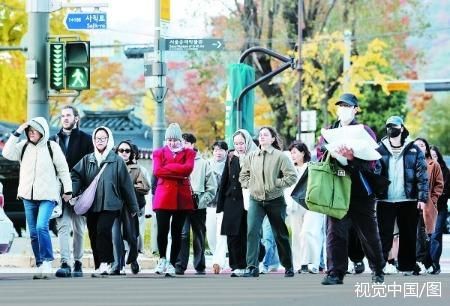
韩国提前进入流感季高峰
Bei Jing Shang Bao· 2025-11-16 15:40
Core Insights - The flu outbreak in South Korea has escalated significantly, with the proportion of patients exhibiting flu-like symptoms reaching nearly 51‰ in the week of November 2-8, more than doubling from the previous week [1][2] - The proportion of suspected flu cases among outpatient visits has increased sharply over the past month, prompting health authorities to raise the flu alert level from "medium" to "high" [2] - Children and adolescents under 18 years old are the primary demographic affected by the surge in flu cases, with hospitalization rates also rising dramatically [2][3] Summary by Sections Flu Statistics - The percentage of suspected flu cases among outpatient visits rose from 7.9‰ (October 12-18) to 13.6‰ (October 19-25), then to 22.8‰ (October 26-November 1), and peaked at approximately 5.5 times the designated threshold of 9.1‰ in the week of November 2-8 [2] - In comparison to the same period in 2024, the current season's flu case proportion is over 12 times higher than the approximately 4‰ recorded last year [2] Demographics and Hospitalization - The increase in flu cases is particularly pronounced among children and adolescents, with incidence rates for ages 1-6, 7-12, and 13-18 more than doubling from the previous week [2] - Hospitalization due to flu-like symptoms has also surged, with 356 patients admitted in the last week, more than doubling from 174 the week prior [2] Expert Opinions - Experts warn that if the current trend continues, South Korea may face its most severe flu season since 2016 [3] - The spread of respiratory diseases, including the flu, is expected to accelerate as colder and drier weather approaches in December and January [3]
医药行业周报:本周申万医药生物指数上涨3.3%,关注流感疫情变化-20251116
Shenwan Hongyuan Securities· 2025-11-16 07:44
Investment Rating - The report maintains a positive outlook on the pharmaceutical industry, indicating an "Overweight" rating, suggesting that the industry is expected to outperform the overall market [29]. Core Insights - The pharmaceutical sector saw a weekly increase of 3.3%, outperforming the Shanghai Composite Index, which decreased by 0.2% during the same period [4][6]. - The overall valuation of the pharmaceutical sector is at 30.9 times earnings, ranking it 10th among 31 primary sectors [6][12]. - Key segments within the pharmaceutical industry showed varied performance, with raw materials up by 5.1%, chemical preparations by 4.4%, and traditional Chinese medicine by 4.1% [6][4]. Market Performance - The pharmaceutical index ranked 5th among 31 sub-industries, with notable increases in various segments such as biopharmaceuticals (+2.7%), medical services (+1.8%), and medical devices (+1.8%) [4][6]. - The report highlights the performance of specific companies, recommending a focus on innovative drug sectors and companies with strong earnings growth potential [3][21]. Recent Developments - Roche's BTK inhibitor Fenebrutinib achieved significant milestones in clinical trials for treating relapsing multiple sclerosis, suggesting potential investment opportunities in related companies [3][13]. - The Chinese government has updated regulations on the export of controlled chemicals, impacting companies involved in this sector [3][14]. - The report notes an expected peak in influenza activity in China during late December and early January, prompting recommendations to monitor related vaccine and treatment companies [3][15][16]. Key Company Valuations - The report provides a valuation table for key companies in the pharmaceutical sector, indicating projected earnings per share (EPS) and price-to-earnings (PE) ratios for 2025 and beyond [21]. - Companies highlighted include Mindray Medical, Hengrui Medicine, and WuXi AppTec, with varying market capitalizations and growth forecasts [21]. Investment Recommendations - The report suggests focusing on innovative drug sectors and companies with improving performance in medical devices and upstream segments, listing specific companies to watch [3][21]. - It emphasizes the importance of monitoring flu vaccine manufacturers and antiviral drug producers as flu activity rises [3][15].





病例激增 韩国提前进入流感季高峰
Xin Hua She· 2025-11-15 07:21
Core Insights - The flu outbreak in South Korea has escalated significantly, with the proportion of patients exhibiting flu-like symptoms rising sharply, prompting health authorities to raise the flu alert level from "medium" to "high" [1][2] - The current flu season is expected to be one of the most severe since 2016, with a notable increase in hospitalizations due to flu-like symptoms [2] Summary by Categories Flu Cases and Trends - From November 2 to 8, nearly 51 per thousand of outpatient patients in 300 designated hospitals exhibited symptoms such as fever above 38 degrees Celsius, doubling from the previous week [1] - The proportion of suspected flu cases among outpatient patients has increased from 7.9 per thousand (October 12-18) to 13.6 per thousand (October 19-25), then to 22.8 per thousand (October 26-November 1), and finally reaching approximately 5.5 times the designated threshold of 9.1 per thousand during the week of November 2-8 [1] - The current season's suspected flu case proportion is over 12 times higher than the same period in 2024, which was around 4 per thousand [1] Hospitalization and Expert Warnings - The number of patients hospitalized with flu-like symptoms reached 356 last week, more than doubling from 174 the previous week, based on monitoring from 221 hospitals [2] - Experts warn that if the current trend continues, South Korea may face its most severe flu outbreak since 2016, with the potential for increased transmission of respiratory diseases as colder and drier weather approaches [2]
我国流感疫情整体进入中流行水平
Xin Jing Bao· 2025-11-15 04:50
Core Insights - The overall trend of respiratory infectious diseases in China is on the rise, with influenza activity entering a rapid increase phase and expected to continue for some time [1][2] - The percentage of influenza-like cases reported by sentinel hospitals reached 5.5% during the week of November 3-9, 2025 [1] - The detection rates of respiratory pathogens show that influenza virus (29.8%), rhinovirus (10.7%), and respiratory syncytial virus (6.1%) are the top three pathogens in outpatient settings, while rhinovirus (10.0%), influenza virus (9.8%), and respiratory syncytial virus (8.0%) lead in severe acute respiratory infection cases [1] Summary by Category Influenza Activity - The influenza epidemic in China is currently at a moderate level, with most provinces outside East China experiencing moderate to high levels of influenza activity [1] - There has been a significant increase in reported outbreaks in schools, particularly among the 5-14 age group, which shows a higher positive detection rate compared to other age groups [1] Other Respiratory Viruses - The detection rate of respiratory syncytial virus is fluctuating at a high level in northern provinces, while southern provinces show a declining trend [2] - Enteroviruses and rhinoviruses are experiencing a downward trend, with higher detection rates in the under-14 age group [2] - The overall positivity rate for the novel coronavirus and other monitored respiratory pathogens remains low [2] Recommendations for Public Health - It is recommended that all individuals aged 6 months and older without contraindications receive the influenza vaccine, especially high-risk groups [3] - Public health measures include health monitoring in key institutions, mask-wearing in crowded places, maintaining good hygiene practices, and promoting a healthy lifestyle to enhance immunity [3]
【医药】流感样病例占比高于历史同期,提示关注流感疫苗、病毒检测、药品等板块——流感疫情跟踪点评(251112)(王明瑞/吴佳青)
光大证券研究· 2025-11-13 23:04
Core Viewpoint - The article highlights the significant increase in influenza cases and the potential investment opportunities in related products such as vaccines, diagnostic tests, and medications due to the rising demand driven by the flu season [4][5][6]. Group 1: Influenza Situation - The incidence of influenza-like illness (ILI) has risen, with southern provinces reporting an ILI percentage of 4.6% in week 44 of 2025, up from 4.1% the previous week and higher than the same period in 2022 and 2024 [4]. - Northern provinces reported an ILI percentage of 5.1%, also showing an increase from 3.7% the previous week and higher than the same period in previous years [4]. - The flu season in 2025 is expected to be more severe than in previous years, with a notable change in circulating strains, particularly A(H3N2), which may increase the risk of breaking through herd immunity [4]. Group 2: Investment Opportunities - **Influenza Vaccines**: The low penetration rate of flu vaccines in China presents a significant growth opportunity as demand is expected to rise with the flu season approaching [5]. - **Virus Testing**: The demand for rapid and accurate diagnostic tests for respiratory viruses is anticipated to grow, benefiting companies that offer such testing products [6]. - **Cold and Specialty Medications**: The demand for cold medications is expected to increase in Q4 2025, with potential sales exceeding market expectations due to the rising flu cases and the clearing of social inventory formed during the COVID-19 pandemic [6].