煤炭反内卷

Search documents
煤炭反内卷加码,详解供需影响
2025-08-06 14:45
Summary of Key Points from the Conference Call Industry Overview - The coal industry is experiencing increased regulatory scrutiny from the National Energy Administration aimed at stabilizing coal prices to support electricity prices and the overall economic environment [1][2][10] - The coal production in China is expected to see fluctuations due to regulatory measures and market dynamics, with a projected total annual output of 4.8 billion tons for 2025, reflecting a slight increase year-on-year [1][7] Core Insights and Arguments - The National Energy Administration's intervention in the coal industry is a response to low coal prices and excessive production, indicating a shift towards stricter regulations to ensure price recovery [2][10] - The average long-term electricity price has been reduced by 0.02 yuan, while coal prices have dropped significantly by approximately 250 yuan, which could lead to further reductions in electricity prices in 2026 if the trend continues [2] - The coal production in Xinjiang and Inner Mongolia is expected to decline in the latter half of 2025 due to the cancellation of freight subsidies and stricter regulatory oversight [1][5][6] - A specific case of Shanxi Coking Coal reducing working days from 320 to 276 days is noted, but this is not expected to become a widespread industry trend [3][4] Production and Demand Dynamics - National coal production reached a historical high of 440 million tons in late 2024 and early 2025, but has since seen a decline due to falling prices and regulatory measures [4][10] - The coal demand fluctuations are attributed to changes in electricity consumption patterns, with a notable increase in residential and tertiary sector electricity usage [11] - The impact of renewable energy development on thermal power demand is significant, with a negative growth rate observed in thermal power demand in early 2025 due to increased renewable installations [12][13] Future Outlook - The coal industry is expected to stabilize in the second half of 2025, with a projected monthly production decrease of about 20 million tons compared to June 2025, leading to a total of 240 million tons for the second half of the year [7][8] - The exit of the production guarantee policy is anticipated to have limited actual impact on coal production, as most unlicensed production capacity has already been phased out [8][9] - The market sentiment is shifting, with a recognition of the cyclical nature of the coal industry and potential for recovery as supply stabilizes and demand increases [10][13] Investment Opportunities - China Shenhua's recent acquisition plan reflects positive market sentiment towards state-owned enterprise reforms and is expected to enhance profitability as the industry recovers [2][16] - Recommended coal companies include Jinko, Shaanxi Coal, China Coal, Shenhua, and Yanzhou Coal, with specific recommendations for coking coal companies like Pingmei, Huaiyin, Lu'an, and Shanxi Coking Coal [17]

动力煤港口价目标区间有望至700-750元/吨 | 投研报告
Zhong Guo Neng Yuan Wang· 2025-07-30 02:25
Core Viewpoint - The coal mining industry is experiencing a shift aimed at breaking the "deflation spiral," with a focus on the long-term coal price benchmark of 675 RMB/ton as a critical point [1][5] Group 1: Policy and Regulatory Developments - The National Energy Administration has initiated a verification of coal mine production in eight key provinces to ensure stable coal supply [2] - The verification will assess whether coal production in 2024 exceeds announced capacity and if production plans for 2025 are reasonable [2] - A timeline has been set for the verification process, with reports due by August 15, and the National Energy Administration will conduct random checks [2] Group 2: Inventory and Demand-Supply Dynamics - Total coal inventory is projected to increase by approximately 28.34 million tons in 2024, excluding unreported inventories [3] - A different calculation method indicates a total inventory increase of about 92.69 million tons, reflecting a more comprehensive view of supply and demand [3] - By June 2025, domestic coal inventory is expected to decrease compared to the same period in 2024, with prices having rebounded after hitting a low in mid-June [3] Group 3: Production Capacity and Market Adjustments - There is limited room for overproduction at the national level, with a target of approximately 4.8 billion tons of coal production for 2025 [4] - Some regions, particularly Xinjiang and Shaanxi, may face overproduction issues due to high capacity utilization [4] - The policy toolbox is available for temporary capacity adjustments to ensure supply, similar to measures taken in late 2021 [4] Group 4: Price Projections - The coal industry is expected to see a price range of 700-750 RMB/ton for power coal by the end of the year, influenced by policy measures [1][5] - The long-term coal price benchmark of 675 RMB/ton remains a significant focus for market participants [5]
动力煤港口价目标区间有望至700-750元/吨
Tianfeng Securities· 2025-07-29 07:46
Investment Rating - The industry rating is "Outperform the Market" (maintained rating) [5] Core Viewpoints - The target price range for thermal coal at ports is expected to reach 700-750 RMB/ton by the end of the year [4][24] - The report emphasizes the need to break the coal-electricity deflation spiral, with a focus on controlling production rates to avoid excessive competition [13][16][25] - The coal supply situation is being closely monitored, with a national coal production target of approximately 4.8 billion tons for 2025 [4][21] Summary by Sections Coal Mine Overproduction Inspection - The National Energy Administration has initiated inspections of coal production in eight key provinces to ensure that production does not exceed announced capacities [2][11] - The inspections will assess whether the coal mines' production plans for 2025 exceed the announced capacities by more than 10% [11][12] Inventory Changes - In 2024, the inventory of thermal coal is projected to increase by approximately 28.34 million tons based on major port, pit, and power plant inventories [3][22] - An alternative calculation method suggests that the total inventory increase could be around 92.69 million tons, indicating a significant supply-demand imbalance [3][21] Policy Toolbox and Adjustability - The report discusses the potential for policy adjustments to manage coal production and supply, highlighting the importance of maintaining a balance between production and market prices [4][25] - The report notes that while there may not be nationwide overproduction, certain regions may still face issues due to high capacity utilization [21][23] Market Dynamics - The report indicates that the market has begun to self-correct, with thermal coal prices rebounding after hitting a low in mid-June 2025 [21] - The coal industry's current dynamics suggest that controlling production rates is crucial to avoid a deflationary spiral in coal prices [16][25]
夜盘焦煤期货继续大跌 价格开始阶段性调整 后续价格走势如何?
Jin Shi Shu Ju· 2025-07-28 14:08
Core Viewpoint - The recent surge in coking coal prices has led to regulatory intervention by the Dalian Commodity Exchange, implementing trading limits to curb speculation, resulting in a significant price correction for both coking coal and coke futures [2][5]. Group 1: Market Dynamics - Coking coal futures experienced a dramatic increase, rising by 333 points or 36% in a week, with trading limits imposed on July 29 to control excessive speculation [2][3]. - The Dalian Commodity Exchange has set daily opening limits for non-futures company members at 500 lots for the JM2509 contract and 2000 lots for other contracts [2]. - The market sentiment shifted rapidly as speculative trading turned, leading to a strong reaction against previous bullish trends [2][5]. Group 2: Supply and Demand Fundamentals - Coking coal and coke production data indicate a mixed supply situation, with coking coal inventories at 536 million tons, down 13%, and premium coal inventories at 278.4 million tons, down 18%, marking a nine-month low [3][4]. - Steel mills are maintaining high production levels, with iron water output at over 242 million tons, contributing to increased demand for coking coal despite high prices [2][4]. - The overall sentiment in the coking coal market remains strong, with downstream purchasing activity increasing, although the pace of procurement for high-priced coal has slowed [2][3]. Group 3: Price Trends and Future Outlook - Analysts expect short-term volatility in the market, with the potential for price adjustments following the recent rapid increases [5][6]. - The focus is shifting from speculative trading to fundamental supply and demand dynamics, as the market adjusts to regulatory measures and the impact of production checks on coal mines [6]. - The current trading environment is characterized by intense competition, with expectations of price corrections in the near term as market participants await new driving factors [6].

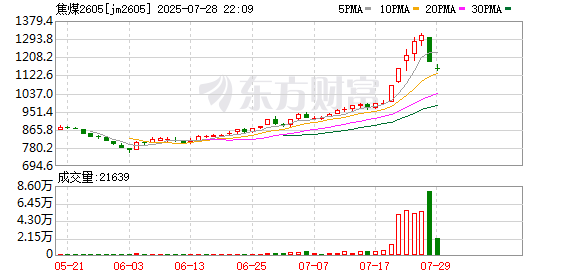
煤炭“反内卷”先行 隔夜焦煤期货价格大涨(附概念股)
Zhi Tong Cai Jing· 2025-07-23 00:20
Core Viewpoint - The recent policy from the National Energy Administration aims to regulate coal production, with expectations of reduced output in the future, impacting coal prices and production levels in the industry [2][3][6]. Production Regulation - The policy focuses on coal mines in eight provinces, including Shanxi and Inner Mongolia, with a specific emphasis on monitoring production against announced capacities for 2024 and the first half of 2025 [2]. - The notification is a reiteration of previous standards established in 2021, indicating a long-term regulatory approach rather than a new initiative [2]. - Current data shows that there has not been widespread overproduction at the provincial level, although individual companies may still exhibit imbalances [2][4]. - The enforcement of this policy will be closely monitored, particularly as it relates to the responsibilities of safety supervision agencies [5]. Production Impact - Current estimates suggest that overproduction in Shanxi, Shaanxi, Inner Mongolia, and Xinjiang could reach approximately 200 million tons, with a significant portion attributed to Xinjiang [6]. - The coal production growth rate from July 2024 to June 2025 is projected at 4.8%, indicating a high production level even without considering overproduction management [6]. Price Trends - Since June, there has been a recovery in coal prices, with thermal coal and coking coal prices increasing by approximately 6% and 17%, respectively [7]. - Factors contributing to the price increase include seasonal demand, inventory replenishment in the steel sector, a significant drop in imports, and a slowdown in production growth [8]. - The supply-demand balance is expected to shift from a loose state to a tighter one in the second half of the year [9]. Industry Outlook - The coal sector is anticipated to experience a valuation recovery due to changing expectations, with a focus on companies that exhibit high elasticity and low valuations [10]. - The current regulatory approach differs from past supply-side reforms, suggesting a more measured strategy that allows for gradual adjustments in the coal industry [10]. Key Companies - Relevant companies in the coal industry include China Coal Energy (601898), Yancoal Australia (03668), Yanzhou Coal Mining (600188), China Shenhua Energy (601088), and China Qinfa (00866) [11].


炸裂大消息!刚刚,直线涨停!
中国基金报· 2025-07-22 07:56
Core Viewpoint - The A-share market has shown strong performance recently, with significant gains in the coal sector following a favorable policy announcement aimed at stabilizing coal supply [2][3]. Group 1: Market Performance - On July 22, a favorable policy was announced, leading to a surge in the coal sector, with many stocks hitting the daily limit [3]. - The market experienced fluctuations but ultimately closed higher, with the Shanghai Composite Index rising by 0.62%, the Shenzhen Component by 0.84%, and the ChiNext by 0.61% [9]. - A total of 2,540 stocks rose, with 112 stocks hitting the daily limit, while 2,724 stocks declined [10][11]. Group 2: Policy Impact - The newly introduced "anti-involution" policy aims to regulate coal production, mandating that annual coal output does not exceed announced capacity and monthly output does not exceed 10% of the announced capacity [3]. - This policy is likened to previous supply-side reforms, which significantly influenced coal prices and market performance [7]. - Historical data shows that coal prices have dropped from a peak of 1,202 CNY/ton in 2021 to 658 CNY/ton, a decrease of 45.3% [7]. Group 3: Sector Analysis - Analysts from Zheshang Securities suggest that the "anti-involution" policy could reverse the coal industry's challenges, similar to past supply-side reforms that led to significant price recoveries [7]. - Long-term coal price improvements are anticipated if demand-side improvements follow, particularly with potential interest rate cuts and domestic stimulus [8]. - The demand for coking coal is expected to rise due to high steel mill profits, which are correlated with increased production and operational rates [8].