
现金流策略

Search documents
“现金流”策略爆火!300现金流ETF(562080)连续10日吸金合计超22亿元,成交额创历史新高
Mei Ri Jing Ji Xin Wen· 2025-08-11 02:26
Group 1 - Significant interest in cash flow strategies has increased since August, with over 1.8 billion yuan net inflow into the 300 Cash Flow ETF (562080) on August 8, marking a historical high in trading volume exceeding 200 million yuan [1] - The 300 Cash Flow ETF (562080) has achieved net inflows for 10 consecutive trading days, totaling over 2.2 billion yuan [1] - The ETF passively tracks the CSI 300 Free Cash Flow Index, which selects 50 "cash cow" companies from the CSI 300, excluding financial and real estate sectors, and is the first listed free cash flow strategy ETF in the Shanghai market [1] Group 2 - According to Guosen Securities, in the current low interest rate and loose monetary environment, companies with abundant free cash flow will see stronger valuation increases compared to those with weaker cash flow, based on the discounted cash flow model [1] - In a tightening credit environment, high-quality companies with endogenous free cash flow generation capabilities have a safety margin, providing stock price resilience [1] - This analysis suggests that funds are likely investing in the 300 Cash Flow ETF (562080) and its connecting funds (Connecting A: 024367; Connecting C: 024368) to allocate towards high cash flow quality companies [1]
聚焦优质现金流资产 富国中证800自由现金流ETF联接今日发行
Zhong Guo Jing Ji Wang· 2025-08-08 07:15
Core Viewpoint - The launch of the WFG CSI 800 Free Cash Flow ETF Linked Fund highlights the increasing importance of free cash flow as a measure of a company's true profitability and financial health in the context of economic transformation [1][2]. Group 1: Free Cash Flow Importance - Free cash flow is defined as the cash generated from operating activities minus capital expenditures, reflecting a company's ability to distribute cash to investors or for strategic decisions [1]. - Companies with higher free cash flow typically exhibit better profitability quality and stronger risk resilience, making free cash flow a critical indicator for sustainable dividends [1]. Group 2: Fund Structure and Investment Strategy - The WFG CSI 800 Free Cash Flow ETF Linked Fund focuses on the 50 "cash cow" companies within the CSI 800 index, excluding financial and real estate sectors, which have sufficient free cash flow rates [2]. - The index is characterized by a significant large-cap style, with over 60% of its constituents being companies with a market capitalization exceeding 100 billion [2]. Group 3: Sector and Performance Analysis - The index emphasizes cyclical sectors, with the top five industries being transportation, non-ferrous metals, food and beverage, oil and petrochemicals, and home appliances, collectively accounting for over 60% of the index weight [2]. - Historical performance indicates that the 800 Free Cash Flow Total Return Index has shown positive returns in six consecutive years since 2019, with a historical win rate exceeding 90% [2]. Group 4: Current Market Position - The current economic environment presents a favorable configuration window for the fund, as the 800 cash flow index is expected to benefit from policies aimed at expanding domestic demand [3]. - The current price-to-earnings ratio (TTM) of the 800 cash flow index is 10.31, which is relatively low compared to historical levels, indicating a substantial margin of safety for investors [3].
另类策略2025年度研究框架:全球视野看风格及主动策略指数化
Changjiang Securities· 2025-08-02 09:48
Group 1: Investment Opportunities by Style - The report emphasizes that in the medium to low-frequency dimension, the main returns for investors come from core beta opportunities, with value strategies represented by low valuation and PB-ROE metrics, and dividend strategies characterized by high safety margins [13][15]. - Growth investment, represented by companies with higher growth rates, has been a mainstream strategy in the A-share market, focusing on stocks with strong fundamental resilience [15]. - The performance of various style strategies year-to-date shows that extreme styles may not dominate due to rotation, and adjustments in investment frameworks can help mitigate risks associated with beta misalignment [16][19]. Group 2: Long-term Excess Returns from Overseas Style Strategies - Japan's high dividend advantage became prominent after the 1990s bubble burst, with sustained benefits from a low growth and low interest rate environment [30][32]. - The report notes that Japanese companies have a stable dividend policy, contributing to a favorable environment for dividend growth, which has reached around 20% in recent years [39]. - In the U.S., high dividend strategies outperformed during the early 2000s, particularly during the tech bubble burst, highlighting their defensive characteristics amid economic volatility [40][41]. Group 3: Active Strategy Smart Beta Indexation - The report discusses the increasing popularity of Smart Beta strategies, which combine active management with passive investment principles, allowing for targeted exposure to specific factors [56].
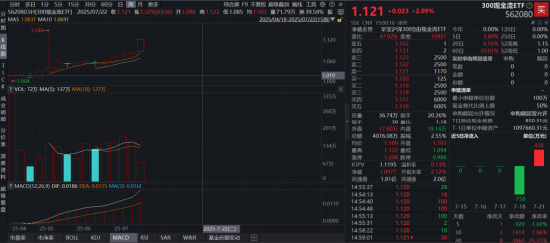
“反内卷”政策引爆现金流策略!300现金流ETF(562080)溢价收涨2.09%三连阳!
Xin Lang Ji Jin· 2025-07-22 10:18
Group 1 - The market is focusing on "anti-involution" investment opportunities, with sectors like coal, steel, and petrochemicals showing significant gains [1][4] - The 300 cash flow index rose by 1.98%, outperforming major indices such as the Shanghai Composite Index and the CSI 300 [1] - The first listed 300 cash flow ETF (562080) has gained 11.43% since its launch on April 15, 2025, indicating strong market interest [1][2] Group 2 - The Ministry of Industry and Information Technology plans to implement a new round of growth stabilization work for key industries, including steel and petrochemicals, to optimize supply and eliminate backward production capacity [2][8] - The 300 cash flow ETF has attracted significant capital inflow, with a net inflow of 38.64 million yuan in the last 20 days, reflecting strong market enthusiasm [4] - The index's top ten constituent stocks mostly recorded positive returns, with notable gains from companies like Shanxi Coking Coal and Conch Cement [4][5] Group 3 - The 300 cash flow index excludes financial and real estate sectors, over-weighting industries like household appliances and petrochemicals, which benefit from cash flow and shareholder returns [6] - The "anti-involution" policy is expected to lead to improved free cash flow ratios in industries such as steel and new energy, enhancing the quality of stocks [8]

最新目标价1.2港元,公募组团下调明星医药股!发生了啥?
券商中国· 2025-07-01 03:43
Core Viewpoint - Multiple large public funds have announced further reductions in the valuation of Hong Kong-listed company Nohow Health, indicating a loss of confidence among fund managers due to rising accounts receivable and delayed financial disclosures [1][2][3]. Valuation Adjustments - From June 27 to June 30, several public funds, including Penghua Fund, Chuangjin Hexin Fund, and Yinhua Fund, announced valuation adjustments for Nohow Health, with the lowest valuation set at 1.20 HKD per share, down from approximately 3 HKD per share at the end of May [2][3]. - Yinhua Fund disclosed a valuation of 1.20 HKD per share effective June 30, 2025, while other funds like Southern Fund and Chuangjin Hexin Fund set valuations at 1.24 HKD and 1.30 HKD per share, respectively [4]. - Some funds, such as Penghua Fund and Bosera Fund, maintained relatively higher valuations of 2.52 HKD and 3.33 HKD per share, respectively, indicating a divergence in valuation perspectives among funds [4]. Company Background and Financial Concerns - Nohow Health, known as a leading company in cancer early screening, was once a star stock in the Hong Kong pharmaceutical sector, with a market capitalization reaching around 40 billion HKD [5][6]. - The company reported a revenue of 765 million CNY in 2022, but accounts receivable surged by 336.8% to 584 million CNY, raising concerns among fund managers about potential financial instability [6]. - By mid-2023, revenue increased to 821 million CNY, but accounts receivable soared to 1.017 billion CNY, further heightening investor anxiety [6]. Impact of Suspension and Management Changes - Nohow Health has been suspended since March 2024 due to allegations of financial fraud, leading to multiple valuation downgrades from 14.14 HKD per share to as low as 1.20 HKD per share [7][8]. - The resignation of the company's founder and CEO, Zhu Yeqing, due to health reasons has also contributed to a loss of trust among fund managers [8]. - The inability to timely disclose financial reports has exacerbated the situation, with the company facing potential delisting risks if suspended for 18 months [8]. Investment Strategy Insights - The issues surrounding Nohow Health highlight a shift in public funds' investment strategies in the Hong Kong market, emphasizing the importance of cash flow and financial stability [9]. - Fund managers are advised to focus on companies with strong cash flows and reasonable valuations, avoiding those that may present "pseudo-growth" opportunities [9].
麻绎文:为何巴菲特钟爱现金流?解锁现金流的慢富密码
Mei Ri Jing Ji Xin Wen· 2025-05-08 01:09
Group 1 - The concept of free cash flow is crucial in Buffett's value investment philosophy, reflecting a company's ability to return value to shareholders and creditors, as well as its capacity for future development [1] - Free cash flow has advantages over net profit as it is derived from the cash flow statement, which has higher transparency and is less susceptible to manipulation [1] - Recent market trends show an increase in cash flow ETFs, which primarily use free cash flow yield as a selection criterion, indicating a long-term effectiveness of cash flow strategies in the A-share large and mid-cap stock selection [1][2] Group 2 - Cash flow ETFs and strategies are considered to have advantages over dividend strategies, as they can better avoid value traps and provide timely insights into a company's cash flow [2] - The FTSE Free Cash Flow Index has shown a remarkable annualized return of over 20% from the end of 2013 to 2024, with a higher proportion of central state-owned enterprises and companies with high dividend yields and low valuations [2] - Recent policy changes, including the new "National Nine Articles" and market value management regulations, encourage companies with high free cash flow to convert it into dividends and buybacks, enhancing shareholder returns [3] Group 3 - The upcoming dividend season and potential easing of external trade tensions create an opportunity for cash flow ETFs to be a core asset allocation, suggesting a strategy of gradual accumulation during market dips [3]