生产指数

Search documents
连续两个月回升!这一指数释放哪些信号?
Jing Ji Wang· 2025-06-30 09:13
Group 1 - Manufacturing PMI has risen for two consecutive months, indicating a continued recovery in China's macro economy [5] - In June, the manufacturing PMI increased to 49.7%, with 11 out of 21 surveyed industries in the expansion zone, reflecting an improvement in manufacturing sentiment [6] - The new orders index returned to the expansion zone at 50.2%, indicating a recovery in market demand [6] Group 2 - The price index ended a three-month decline, with the main raw material purchase price index at 48.4% and the factory price index at 46.2%, both showing improvement [7] - Large enterprises' PMI rose to 51.2%, significantly supporting the overall manufacturing sector, while small enterprises' PMI fell to 47.3% [7] - The manufacturing sector is expected to maintain steady growth in the second half of the year, driven by policy support and stable market demand [7] Group 3 - The non-manufacturing business activity index was at 50.5%, indicating continued expansion in the service sector [10] - The service sector's business activity index was 50.1%, showing stability, while the business activity expectation index was at 56.0%, reflecting optimism for future growth [10] - The construction business activity index rose to 52.8%, with civil engineering construction remaining robust [11] Group 4 - Infrastructure projects are progressing rapidly, supported by special bonds for land acquisition and government investment funds [11] - The expansion of special bond allocations is expected to stimulate more infrastructure demand, contributing to stable economic growth [11]

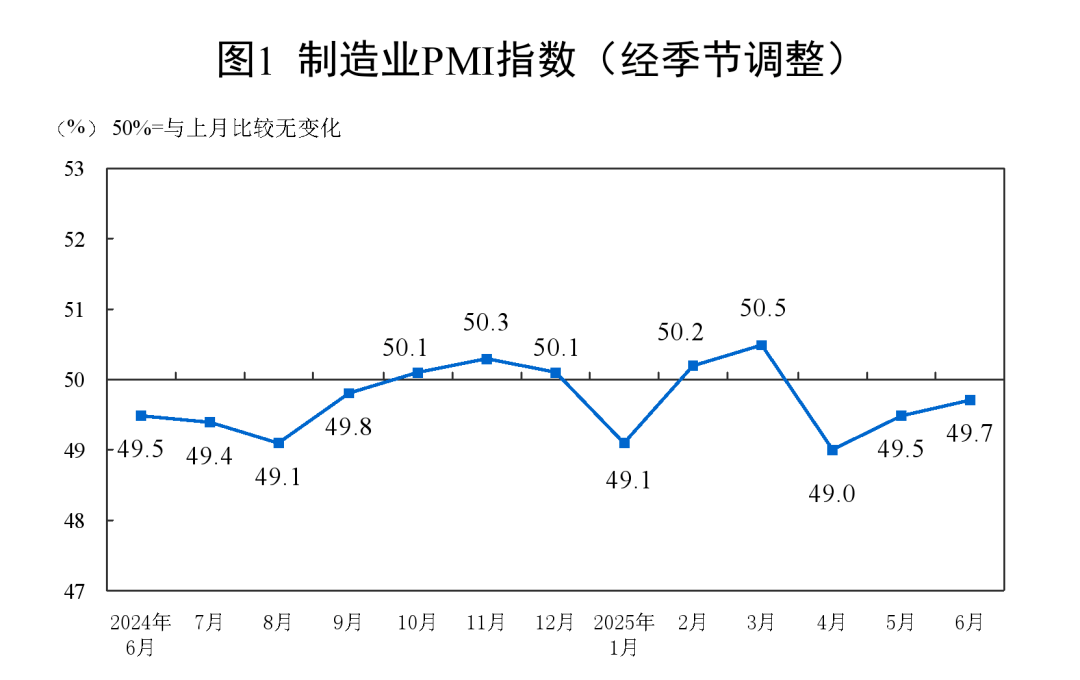
2025年5月PMI点评:“抢出口”带动制造业PMI回暖
EBSCN· 2025-05-31 14:31
Manufacturing Sector - The manufacturing PMI for May 2025 is reported at 49.5%, a significant increase of 0.5 percentage points from the previous month, aligning with market expectations[2][4] - The production index rose to 50.7%, up 0.9 percentage points from last month, indicating a recovery in production activities[5][14] - New orders index increased to 49.8%, up 0.6 percentage points, reflecting improved demand conditions[5][14] - High-energy industries continue to decline, with the PMI dropping to 47.0%, down 0.7 percentage points, indicating ongoing challenges in these sectors[6] External Trade - The new export orders index rose to 47.5%, a significant increase of 2.8 percentage points, indicating a recovery in export activities following tariff reductions[21] - The import index increased to 47.1%, up 3.7 percentage points, suggesting improved import conditions[21] Service Sector - The service sector PMI increased slightly to 50.2%, up 0.1 percentage points, remaining in the expansion zone, driven by increased tourism and hospitality activities during the May Day holiday[31] Construction Sector - The construction PMI is at 51.0%, down 0.9 percentage points, indicating a slowdown in expansion primarily due to weakened housing demand, although infrastructure projects are accelerating[35] - Special bond issuance has increased significantly, with 443.2 billion yuan issued in May, up from 230.1 billion yuan in April, supporting investment in infrastructure[35]
PMI重回高点:顺风与逆流(民生宏观陶川团队)
川阅全球宏观· 2025-03-31 06:37
Core Viewpoint - The March manufacturing PMI has returned to a one-year high, raising questions about whether it will repeat last year's pattern of a peak followed by a decline [1] Group 1: Comparison with Last Year - Similar to last year, the March PMI has seasonal increases following the end of the Spring Festival impact, but this year relies more on marginal improvements and enhanced "scientific content" rather than a short-term pulse effect [2] - The Longjiang Business School BCI for March is at 54.8%, higher than last year's 52.1%, and the EPMI has seen a significant month-on-month increase of 10.6 percentage points, marking the highest growth rate in two years [2] Group 2: PMI Performance Analysis - The new orders index for March PMI recorded 51.8%, a month-on-month increase of 0.7 percentage points, becoming the largest driving factor for the manufacturing PMI [4] - The production index's month-on-month growth is only 0.1 percentage points, indicating that production recovery is lagging behind demand, possibly due to prior production being at sufficient levels [4] Group 3: Export and Demand Insights - The new export orders index for March PMI has increased by 0.4 percentage points, indicating ongoing efforts to "seize exports" [7] - Small enterprises have shown the most significant increase in PMI, with a month-on-month growth of 3.3 percentage points, contrasting with large enterprises' decline of 1.3 percentage points and medium enterprises' increase of 0.7 percentage points [7] Group 4: Sustainability of Demand Recovery - Despite positive signals from the March PMI, there are underlying risks, including weak performance in two major price indicators, with the raw material purchase price index at 49.8% and the factory price index at 47.9% [9] - The import index for March PMI is at 47.5%, reflecting a significant month-on-month decline of 2.0 percentage points, indicating insufficient domestic demand [12] - There is a prevailing cautious sentiment among enterprises, as the production activity expectation index has decreased from 54.5% in February to 53.8% in March, and the employment index has also declined [12]