电力现货市场

Search documents
国网经营区电力现货市场全覆盖欧美气价季节性上涨:申万公用环保周报(25/11/2~25/11/9)-20251110
Shenwan Hongyuan Securities· 2025-11-10 06:34
Investment Rating - The report provides a positive investment outlook for various sectors within the energy industry, particularly highlighting opportunities in hydropower, green energy, nuclear power, thermal power, and gas sectors [10][30]. Core Insights - The electricity market in the State Grid operating area has achieved near-complete coverage of the electricity spot market, with significant developments in provinces such as Shanxi, which has seen a 128.75% increase in new energy and clean energy installed capacity since the 14th Five-Year Plan [4][9]. - Natural gas prices have shown a divergent trend globally, with increases in Europe and the US, while prices in Asia remain stable due to ample supply [11][30]. Summary by Sections 1. Electricity - The State Grid has implemented a continuous settlement trial for the electricity spot market in Sichuan and Chongqing, marking a significant step towards full coverage [4][7]. - Shanxi's electricity spot market has recorded a total clearing volume of 156.23 billion kWh in the first half of 2025, with real-time average prices reflecting a "two peaks and one valley" pattern [9][10]. 2. Natural Gas - As of November 7, 2025, the Henry Hub spot price in the US reached $3.76/mmBtu, reflecting a weekly increase of 5.52%, while European prices also saw upward trends [11][12]. - The report notes that the LNG national ex-factory price in China is 4382 yuan/ton, with a slight weekly decrease of 0.57% [28][30]. 3. Investment Recommendations - Hydropower: Favorable conditions for winter and spring generation, recommending companies like Guotou Power and Chuan Investment Energy [10]. - Green Energy: Increased stability in returns for existing projects, suggesting attention to companies like New Energy and Longyuan Power [10]. - Nuclear Power: Long-term growth potential remains strong, with recommendations for China Nuclear Power and China General Nuclear Power [10]. - Thermal Power: Improved profitability due to lower fuel costs, recommending companies like Guodian Power and Huaneng International [10]. - Gas Sector: Favorable conditions for city gas companies, recommending Kunlun Energy and New Energy [30]. 4. Company and Industry Dynamics - As of September 2025, China's new energy storage capacity exceeded 100 million kW, accounting for over 40% of the global total [39]. - The report highlights the steady growth in electricity market transactions, with a total of 4.92 trillion kWh traded by September 2025, marking a 7.2% year-on-year increase [39].





申万公用环保周报:国网经营区电力现货市场全覆盖,欧美气价季节性上涨-20251110
Shenwan Hongyuan Securities· 2025-11-10 05:49
Investment Rating - The report maintains a "Positive" outlook on the power and gas sectors, highlighting the full coverage of the electricity spot market in the State Grid operating area and the seasonal rise in gas prices in Europe and the US [1]. Core Insights - The electricity spot market in the State Grid operating area has achieved near-complete coverage, with 18 provincial-level markets in continuous settlement trial operation as of November 1, 2025. This includes the formal operation of inter-provincial markets and five provincial-level markets [4][8]. - In the gas sector, US Henry Hub spot prices rose to $3.76/mmBtu, reflecting a weekly increase of 5.52%, while European gas prices also saw increases due to seasonal demand [13][19]. Summary by Sections 1. Electricity - The State Grid operating area has nearly achieved full coverage of the electricity spot market, with significant developments in various provinces. As of November 1, 2025, the market has transitioned to continuous settlement trials in Sichuan and Chongqing [4][8]. - In Shanxi, the first province to fully implement the electricity spot market, the average spot price for electricity was recorded at 0.283 yuan/kWh, with a total of 156.23 billion kWh cleared in the first half of 2025 [10]. - The growth of renewable energy capacity in Shanxi has been substantial, with an increase of 128.75% since the 14th Five-Year Plan, leading to a significant impact on electricity pricing and market dynamics [10]. 2. Gas - The report notes a divergence in global gas prices, with US prices rising while Asian LNG prices remain stable due to ample supply. As of November 7, 2025, the Northeast Asia LNG spot price was $11.10/mmBtu, unchanged from the previous week [13][27]. - The report highlights the increase in US natural gas production and demand, with the Henry Hub futures price reaching $4.32/mmBtu, marking a 4.63% increase [14][19]. - Recommendations for investment in gas-related companies include those with integrated natural gas trading capabilities, such as Kunlun Energy and New Hope Energy, as well as city gas companies benefiting from cost reductions [31]. 3. Weekly Market Review - The report indicates that the electricity equipment, public utilities, environmental protection, and gas sectors outperformed the Shanghai and Shenzhen 300 index during the week of November 2 to November 9, 2025 [35]. 4. Company and Industry Dynamics - As of September 2025, China's new energy storage capacity exceeded 100 million kW, representing over 40% of the global total, with significant contributions from various regions [41]. - The report also notes that the National Energy Administration is actively promoting the construction of a unified national electricity market, with trading volumes and participants steadily increasing [41].

储能景气度跟踪之专家电话会
2025-11-10 03:34
Summary of Key Points from the Conference Call on Energy Storage Industry Industry Overview - The energy storage industry is experiencing rapid growth due to new policies implemented in various provinces, such as Inner Mongolia, which has paid over 400 million yuan in capacity compensation [1][2][4] - Independent energy storage projects are increasing, but high subsidies may not be sustainable in the long term, with a potential shift towards user-side cost-sharing [1][4][27][28] - The electricity spot market is gradually being introduced, becoming an important arbitrage tool for independent energy storage stations, with provinces like Shaanxi, Liaoning, and Qinghai starting trial operations [1][2] Core Insights and Arguments - Capacity compensation policies have been significant for the energy storage industry, with Inner Mongolia's compensation exceeding 50% of total revenue for some independent storage stations [2][3] - The expected new energy storage installation capacity in China is approximately 140 GWh for 2025 and may exceed 180 GWh in 2026, with a compound annual growth rate of 30%-40% [1][17] - The market is shifting towards centralized procurement and framework procurement, raising the entry barriers for suppliers and increasing industry concentration [1][6] Pricing and Market Dynamics - Battery cell prices have risen, leading to increased quotes for energy storage systems, with mainstream battery cell prices now at 0.27-0.28 yuan per watt-hour [1][7][8] - Over 20 GWh of energy storage batteries in the domestic market are affected by delivery time premiums, accounting for about half of the new installed capacity [1][11] - The supply of 314 Ah battery cells is currently insufficient, while older 280 Ah specifications are more readily available [1][13] Future Trends and Challenges - The high profitability of energy storage projects in Inner Mongolia, estimated at around 20%, may not be sustainable due to changing compensation mechanisms and market conditions [23][24] - The energy storage market is expected to maintain high prosperity in the coming years, driven by national policies and the need for energy transition [15][16] - The global energy storage battery shipment volume shows a significant gap compared to new installed capacity due to various factors, including the use of larger capacity cells in overseas applications [12] Regional Insights - The domestic market's revenue sources are expected to vary by province, with significant differences in arbitrage prices, impacting overall profitability [21] - The European energy storage market is growing rapidly, with Italy auctioning 10 GWh of storage capacity, indicating a strong demand for capacity market participation [20] Conclusion - The energy storage industry is poised for significant growth, driven by policy support and market dynamics, but faces challenges related to pricing, supply chain constraints, and the sustainability of high profitability levels in certain regions [1][15][17][23]
我国电力生产组织方式由计划全面转向市场
Zhong Guo Dian Li Bao· 2025-11-09 12:30
Core Viewpoint - The establishment of a provincial-level electricity spot market in China marks a significant shift from a planned electricity production organization to a market-oriented approach, indicating the preliminary completion of a unified national electricity market [1] Group 1: Market Development - The electricity spot market has achieved basic coverage across provinces, with Sichuan, Chongqing, and Qinghai recently entering continuous settlement trial operations [1] - Seven provincial-level spot markets, including Shanxi and Guangdong, have officially commenced operations, while others like Fujian and Shaanxi are in trial phases, completing the goal of provincial coverage two months ahead of schedule [1] - The transition to a unified national electricity market is a key aspect of deepening electricity system reform and constructing a new energy system [1] Group 2: Operational Efficiency - The spot market has demonstrated its value in ensuring supply stability and optimizing resources during peak summer demand, with significant reductions in non-operating rates and supply costs [2] - Inter-provincial spot trading has played a crucial role, with a maximum mutual assistance capacity of 14.32 million kilowatts, effectively supporting over 20 provinces during peak demand [2] - Price signals from the market have encouraged users to adjust their electricity consumption behavior, leading to substantial savings for businesses [2] Group 3: Future Outlook - The ongoing development of electricity spot markets is expected to enhance system regulation capabilities, ensure reliable grid operation, and promote the consumption of renewable energy [2] - The electricity spot market is anticipated to provide solid energy support for high-quality economic and social development as the construction of a new energy system accelerates [2]


煤价上涨有望支撑电价预期,28省电力现货市场已连续运行
GOLDEN SUN SECURITIES· 2025-11-09 12:04
Investment Rating - The report maintains an "Overweight" rating for the power sector [4] Core Views - The rise in coal prices is expected to support electricity price expectations, with the current price of 809 CNY/ton for Q5500 coal, marking a new high for the year [12][10] - The continuous operation of the electricity spot market across 28 provinces indicates significant progress towards a unified national electricity market [12][10] Summary by Sections Industry Insights - Coal prices have surged, creating a favorable environment for the upcoming 2026 electricity price negotiations. The coal market is currently characterized by tight supply and demand, with coal production declining for three consecutive months from July to September [12][10] - The electricity spot market has entered continuous operation, with 28 provinces now participating. This transition marks a significant shift from a planned to a market-driven electricity production organization [12][10] Market Performance - The Shanghai Composite Index closed at 3,997.56 points, up 1.08%, while the CSI 300 Index rose 0.82%. The CITIC Power and Utilities Index increased by 2.30%, outperforming the CSI 300 by 1.48 percentage points [58][59] Investment Recommendations - Focus on the thermal power sector, particularly companies like Huaneng International, Huadian International, and Zhejiang Energy, as coal prices rebound and performance expectations improve [3] - Emphasize investments in undervalued green energy sectors, particularly in Hong Kong-listed green energy and wind power operators [3] - Monitor the hydropower sector, with a recommendation to pay attention to companies like Yangtze Power and Guotou Power [3] Key Company Announcements - Huaneng announced a significant investment in a new integrated heat and power project in Heilongjiang, with a total investment of 12.043 billion CNY [69] - Shenzhen Nanshan Thermal Power received a government subsidy of 8.05 million CNY, representing 36.75% of its net profit for the last fiscal year [69]


山西电力现货市场出清周期缩短至5分钟 价格信号频次提升3倍
Zhong Guo Neng Yuan Wang· 2025-11-05 01:00
Core Insights - Shanxi Electric Power successfully completed the integration testing of the 15-minute and 5-minute real-time electricity spot market operation from September 1 to October 20, 2025, marking a shift to a higher frequency and more precise market operation [1] - Since its launch in April 2021, Shanxi's spot market has traded a cumulative electricity volume of 1.62 trillion kilowatt-hours, effectively optimizing the allocation of electricity resources through price signals [1] - The adjustment to a 5-minute clearing period allows for quicker and more accurate reflection of instantaneous supply and demand changes in the grid, providing clearer price signals for market participants [1][2] Market Development - The adjustment is in response to the rapid growth of renewable energy in Shanxi, with installed capacity increasing by 128.75% since the 14th Five-Year Plan, reaching 76.84 million kilowatts by September 2025, accounting for nearly 50% of the province's total installed capacity [2] - The previous 15-minute clearing period was inadequate for the new power system's real-time balancing requirements due to the volatility of renewable energy output and rapid changes in supply-demand relationships [2] - The upgrade involved comprehensive enhancements to nine core modules of the real-time market model management, ensuring compatibility of the clearing, measurement, and settlement systems [2] Technological Advancements - The implementation of a 5-minute clearing mechanism facilitates the participation of new market entities such as virtual power plants and distributed energy storage, allowing them to adjust their charging and discharging strategies based on more frequent price signals [2] - The average deviation rate of real-time power balancing has decreased by 20% after the system's upgrade, enhancing the precision and stability of grid operations [2] - Shanxi Electric Power aims to continue advancing electricity market construction and optimize resource allocation on a larger scale [2]
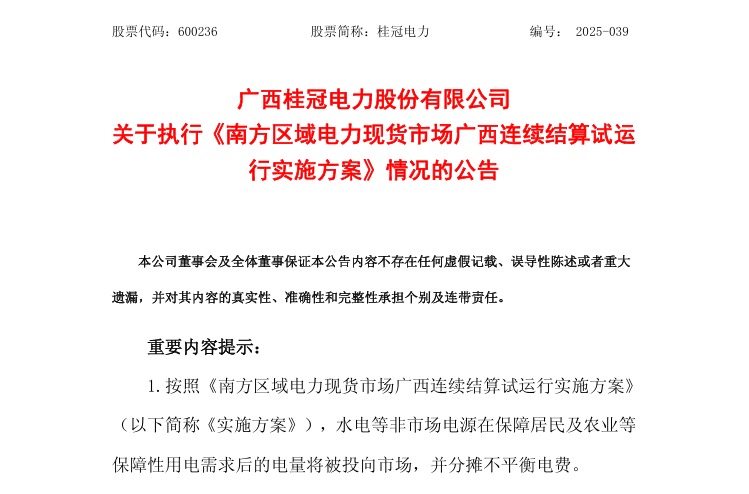
“不平衡电费”致桂冠电力利润大减3亿多,是怎么一回事?
Xin Lang Cai Jing· 2025-11-05 00:00
Core Insights - The announcement from Guiguan Electric Power reveals the challenges faced by power generation companies in the electricity spot market, particularly regarding the allocation of imbalance electricity fees [1][2] - Guiguan Electric Power reported a revenue reduction of 459 million yuan and a net profit decrease of 327 million yuan due to the sharing of imbalance electricity fees, which accounted for 14.3% of the previous fiscal year's net profit [1][2] Company Summary - Guiguan Electric Power is the first publicly listed company to disclose the specific financial impact of imbalance electricity fees [2] - The company operates in the Guangxi region, where it has a significant presence in hydropower generation, with a total installed capacity of 9.1932 million kilowatts, representing two-thirds of the region's regulated hydropower capacity [10] - The company is currently seeking policy optimization suggestions from the Guangxi government, including adjustments to the guaranteed electricity volume and potential increases in market settlement prices [10] Industry Context - The Southern Regional Electricity Spot Market began continuous settlement trial operations on June 29, 2023, which has led to new rules affecting non-market power sources like hydropower [3][5] - Imbalance electricity fees arise from discrepancies between generation and consumption in the electricity market, and these fees are shared among all power generation and consumption entities [6][7] - The phenomenon of imbalance funds is not unique to Guangxi, as similar issues have been observed in other provinces, with imbalance funds accounting for over 30% of market operating costs in Shanxi [6][7]

近年来多地出现“负电价” 既然卖电“不挣钱”,为何电厂不愿停机?
Mei Ri Jing Ji Xin Wen· 2025-11-03 15:00
Core Viewpoint - The emergence of negative electricity prices in China's power spot market, particularly in Sichuan, reflects a growing trend influenced by supply-demand imbalances and market mechanisms, raising questions about the implications for power generation companies and the overall energy market [1][2][12]. Group 1: Negative Electricity Prices - Negative electricity prices have been increasingly observed across various provinces in China, with the phenomenon evolving from isolated incidents to a more widespread occurrence [2][3]. - In 2019, Shandong was the first province to report negative electricity prices, with a clearing price of -0.04 yuan/kWh, and this trend has continued with significant durations of negative pricing in subsequent years [2][3]. - As of 2024, negative prices accounted for approximately 11% of the day-ahead market and 14% of the real-time market in Shandong [2]. Group 2: Causes of Negative Prices - The formation of negative prices is attributed to structural imbalances in electricity supply and demand, exacerbated by high penetration of renewable energy sources and limitations in traditional power system adjustments [5][6]. - Two main categories of causes for negative prices are identified: inherent negative prices due to high renewable penetration and mechanism-induced negative prices linked to specific market designs [6][8]. - Inherent negative prices occur when traditional power sources face operational constraints, leading them to offer negative prices to avoid higher costs associated with frequent start-stop cycles [6][7]. Group 3: Market Mechanisms and Impacts - The design of electricity market mechanisms, such as incentives for renewable energy development and long-term contract structures, can significantly influence the frequency of negative prices [8][9]. - High proportions of long-term contracts can stabilize overall revenues for power generation companies, even in the presence of negative spot prices, leading to a situation where negative prices do not equate to negative profits [11][12]. - The inability of retail electricity prices to respond effectively to wholesale market signals, particularly during periods of high renewable generation, prolongs the duration of negative prices without benefiting end-users [10][12]. Group 4: Future Considerations - The transition to a market-driven pricing mechanism for new renewable projects starting in 2025 may reduce the frequency of negative pricing, but the overall trend of negative prices may persist due to ongoing market dynamics [14][15]. - Experts suggest that a comprehensive understanding of negative prices, along with improved market design and monitoring systems, is essential to mitigate potential risks and ensure the stability of the electricity system [15].
甘肃电力现货市场交出亮眼周年“成绩单”
Ke Ji Ri Bao· 2025-11-02 23:46
Core Insights - Gansu's electricity spot market has been operational for one year, significantly impacting power supply security, renewable energy consumption, and resource optimization, providing a replicable solution for high renewable energy scenarios and supporting the national unified electricity market construction [1][2]. Group 1: Market Overview - The electricity spot market operates on a trading mechanism based on medium- and long-term market transactions, focusing on day-ahead, intraday, and real-time electricity trading, and is a crucial part of the national unified electricity market [2][3]. - As of August 2023, Gansu has 563 generating entities with a total installed capacity of 74 million kilowatts participating in the spot market, and 454 user-side participants with an average monthly electricity consumption of nearly 5 billion kilowatt-hours, accounting for 60% of market-based electricity consumption [2]. Group 2: Market Characteristics - The Gansu electricity spot market has five key characteristics: improved market structure, stable and efficient operation, significant supply and consumption results, activated market participant vitality, and continuous optimization demonstrating its exemplary value [3]. - Gansu has the longest continuous settlement operation time in the national electricity spot market, accumulating rich experience in market mechanisms, rules, technical solutions, operational parameters, and risk control indicators since the trial operation began in May 2021 [3]. Group 3: Renewable Energy Integration - Gansu's renewable energy installed capacity exceeds 65% of the total grid capacity, and the spot market effectively enhances renewable energy consumption, promoting a green and low-carbon energy transition [4]. - During peak solar generation hours, coal-fired power plants reduce their output to 33% of rated capacity to accommodate renewable energy, while user load curves have adapted to better fit renewable generation characteristics, leading to lower electricity prices for users [4]. Group 4: Market Mechanism Innovation - Gansu is a pioneer in implementing a "quote and quantity" model for renewable energy, allowing renewable energy companies to participate in the spot market, transitioning from a policy-driven to a market-driven approach [5]. - Since 2021, 325 renewable energy companies in Gansu have completed the "quote and quantity" functionality, with 680 billion kilowatt-hours of self-reported electricity in 2024, representing 84.4% of total renewable generation, and an accuracy rate of 92.3%, an increase of 8.7 percentage points from 2023 [5]. Group 5: Future Developments - Gansu plans to enhance market operation monitoring, improve operational rule systems, and increase compliance levels to ensure the continued optimization and efficient operation of the electricity spot market [6]. - The province aims to provide replicable provincial market construction solutions to contribute to the national unified electricity market system [6].
国能日新(301162):费用率持续下降 Q4收入增速与毛利率均有望提升
Xin Lang Cai Jing· 2025-11-01 02:48
Core Insights - The company reported a revenue of 500 million for the first nine months of 2025, representing a year-over-year increase of 37.0%, with a net profit attributable to shareholders of 75.43 million, up 41.8% year-over-year [1] - In Q3 2025, revenue grew by 27.1% to 179 million, while net profit increased by 59.1% to 29.46 million, indicating strong performance despite a slowdown in revenue growth [1] - The company expects a rebound in revenue growth and gross margin in Q4 2025, driven by concentrated construction activities in the photovoltaic sector [1] Financial Performance - For Q3 2025, the company achieved a gross margin of 60.4%, slightly lower than the 61.4% in H1 2025, but is expected to improve as the proportion of power forecasting and electricity trading businesses increases [1] - Operating cash flow improved significantly, with cash received from sales and services increasing by 69.4% year-over-year, leading to a positive cash flow of 50.38 million [2] Cost Management - The company has effectively managed costs, with sales, management, and R&D expenses growing at rates lower than revenue growth, resulting in a decrease in the combined expense ratio from 51.3% to 42.1% [2] - Future expense growth may accelerate due to new business developments, but the overall trend of decreasing expense ratios is expected to continue [2] Market Opportunities - Continuous supportive policies from local governments are enhancing the power forecasting market for distributed photovoltaic systems, creating growth opportunities for the company [2] - The acceleration of the electricity spot market and the proliferation of virtual power plants are expected to provide a turning point for the company's electricity trading and virtual power plant businesses [2] Profit Forecast - The company has slightly adjusted its profit forecasts for 2025-2027, expecting net profits of 152 million, 252 million, and 322 million respectively, maintaining a target valuation of 62.00 yuan based on a 54x PE ratio for 2025 [3]