
科创成长层

Search documents
上市首日,ETF发布风险提示!影响超百只
中国基金报· 2025-10-28 05:42
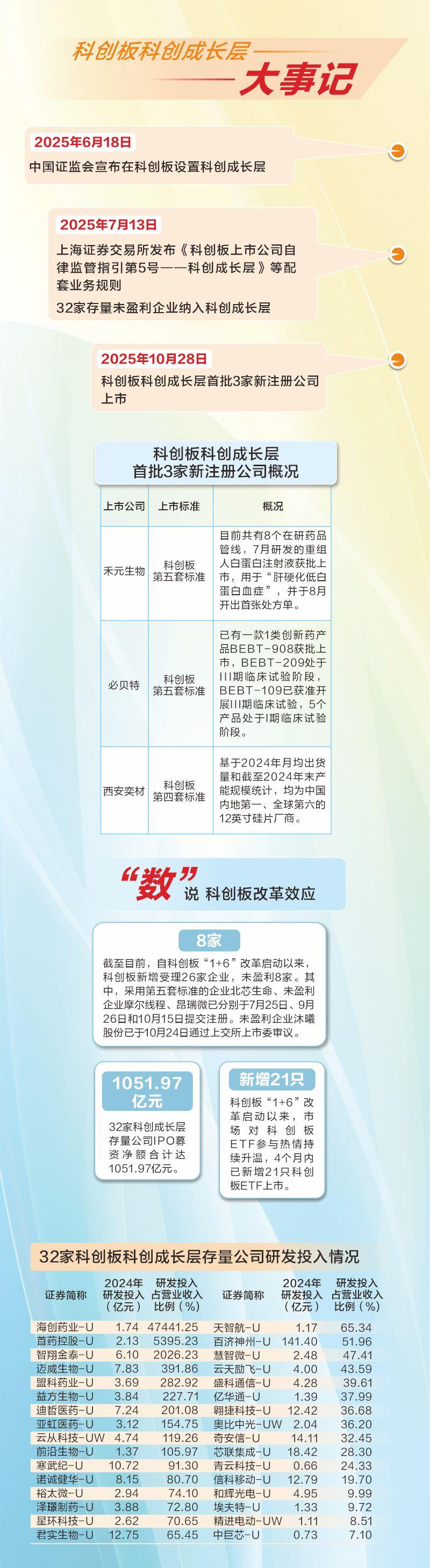
【导读】首批科创成长层股票上市首日,参与配售的ETF发布风险提示 中国基金报记者 若晖 10月28日,科创板成长层迎来首批新注册企业,禾元生物、西安奕材、必贝特正式上市。 多只此前参与配售的ETF发布交易风险提示。华夏基金在风险提示性公告中称,华夏基金旗下 部分ETF参与了首批科创成长层股票的网上/网下配售,并在科创成长层股票上市前以发行价 对单只股票进行估值。 根据《上海证券交易所交易规则》(2023年修订),首次公开发行上市的股票上市后的前5 个交易日不实行价格涨跌幅限制,股价存在大幅波动风险。而科创成长层股票上市首日,ETF 的IOPV仅包含了科创成长层股票的发行价格,未包含其市场价格波动,因此科创成长层股票 上市首日ETF的IOPV可能与其该日的基金份额净值存在一定差异,敬请投资者关注相应的投 资风险。 10月28日,首批3只科创成长层股票在上海证券交易所挂牌上市,多只此前参与网上/网下配 售的ETF发布风险提示。 华夏基金旗下上证50ETF、沪深300ETF公告称,科创成长层股票上市首日,ETF的基金份额 参考净值(IOPV)中仅包含了科创成长层股票的发行价格,未包含其市场价格波动,因此科 创成长层 ...


今日,科创板科创成长层“迎新”!
Zheng Quan Shi Bao· 2025-10-28 00:05
Core Points - Three unprofitable companies, He Yuan Bio, Xi'an Yicai, and Bibet, will debut on the Sci-Tech Innovation Board, marking a smoother path for unprofitable hard-tech enterprises to go public [1][2] - The launch of the Sci-Tech Innovation Board's "1+6" policy aims to reform and optimize the listing system for unprofitable tech companies, facilitating deeper integration of technological and industrial innovation [1][2][7] Group 1: Company Listings - He Yuan Bio and Bibet are listed under the fifth set of standards, breaking the listing drought since June 2023, with He Yuan Bio being the first to receive registration approval under this standard [2][10] - He Yuan Bio has eight drugs in its pipeline, with its recombinant human albumin injection approved for market use in July 2023 [2][10] - Bibet has a class 1 innovative drug, BEBT-908, approved for market, while several other products are in various clinical trial phases [2][10] - Xi'an Yicai, a leading manufacturer of 12-inch silicon wafers, is listed under the fourth set of standards, aiming to enhance production capacity with the funds raised [3][10] Group 2: Regulatory Changes - The introduction of a differentiated lock-up mechanism for offline investors aims to attract long-term investment by increasing the lock-up ratio and duration for unprofitable companies [4][5] - The new lock-up structure includes three tiers for A-class investors, with varying lock-up ratios and periods, encouraging institutional investors to focus on long-term value [4][6] - The "1+6" reform has led to the acceptance of 26 new companies, including eight unprofitable ones, since its launch [7][11] Group 3: Market Impact - The reforms have resulted in a more diverse market structure, with improved review efficiency and transparency, fostering a better investment environment for long-term capital [8] - The enthusiasm for Sci-Tech Innovation Board ETFs has surged, with 21 new ETFs launched within four months, totaling 105 ETFs and a combined scale of 300 billion yuan [8][12] - The number of investor accounts with trading permissions for the Sci-Tech Innovation Board's growth layer has reached 7.58 million, indicating strong market engagement [14][15]
武汉禾元生物科技股份有限公司 首次公开发行股票科创板上市公告书提示性公告
Zhong Guo Zheng Quan Bao - Zhong Zheng Wang· 2025-10-27 23:15
Summary of Key Points Core Viewpoint - Wuhan Heyuan Biotechnology Co., Ltd. is set to list its ordinary shares on the Shanghai Stock Exchange's Sci-Tech Innovation Board on October 28, 2025, despite not being profitable at the time of listing [1][2]. Group 1: Listing Overview - The company will be included in the Sci-Tech Growth Layer upon listing due to its current unprofitability [2]. - The total share capital after the IPO will be 357.5 million shares, with 89,451,354 shares being newly issued [3]. Group 2: Market Comparisons - The IPO price is set at 29.06 yuan per share, which corresponds to a diluted price-to-book ratio of 3.43 times for 2024, lower than the average for comparable companies in the industry [4]. Group 3: Trading Risks - The stock will have a price fluctuation limit of 20%, but there will be no limit on price changes for the first five trading days, leading to potential volatility [2][4]. - The initial number of freely tradable shares will be 40,978,773, accounting for 11.46% of the total share capital, which may result in liquidity risks due to a limited number of circulating shares [2].
西安奕斯伟材料科技股份有限公司首次公开发行股票科创板上市公告书提示性公告
Shang Hai Zheng Quan Bao· 2025-10-27 23:10
Listing Overview - Xi'an Yiswei Materials Technology Co., Ltd. will list its ordinary shares on the Shanghai Stock Exchange's Sci-Tech Innovation Board on October 28, 2025 [1] - The total share capital after the initial public offering (IPO) will be 4,037,800,000 shares, with 537,800,000 shares being newly issued [4] Investment Risks - The company has not yet achieved profitability and will be classified under the Sci-Tech Growth Tier upon listing [2] - Investors must comply with suitability management requirements and sign a risk disclosure document before participating in trading [2] - The stock will have a price fluctuation limit of 20%, but there will be no limit on price changes for the first five trading days [2] Liquidity Concerns - The initial circulating shares will be 164,617,586 shares, representing 4.08% of the total share capital, indicating potential liquidity issues [3] Valuation Metrics - The IPO price corresponds to a price-to-sales (P/S) ratio of 16.41 times based on diluted earnings for 2024, which is lower than comparable companies in the A-share market [8] - The company has chosen to disclose the P/S ratio as it is not yet profitable, in accordance with regulatory requirements [7] Financing and Margin Trading - The stock will be eligible for margin trading from the first day of listing, which may introduce additional price volatility and liquidity risks [9]
科创成长层首股禾元生物打新,券商提醒缺位让投资者遭遇权限门槛
2 1 Shi Ji Jing Ji Bao Dao· 2025-10-27 23:09
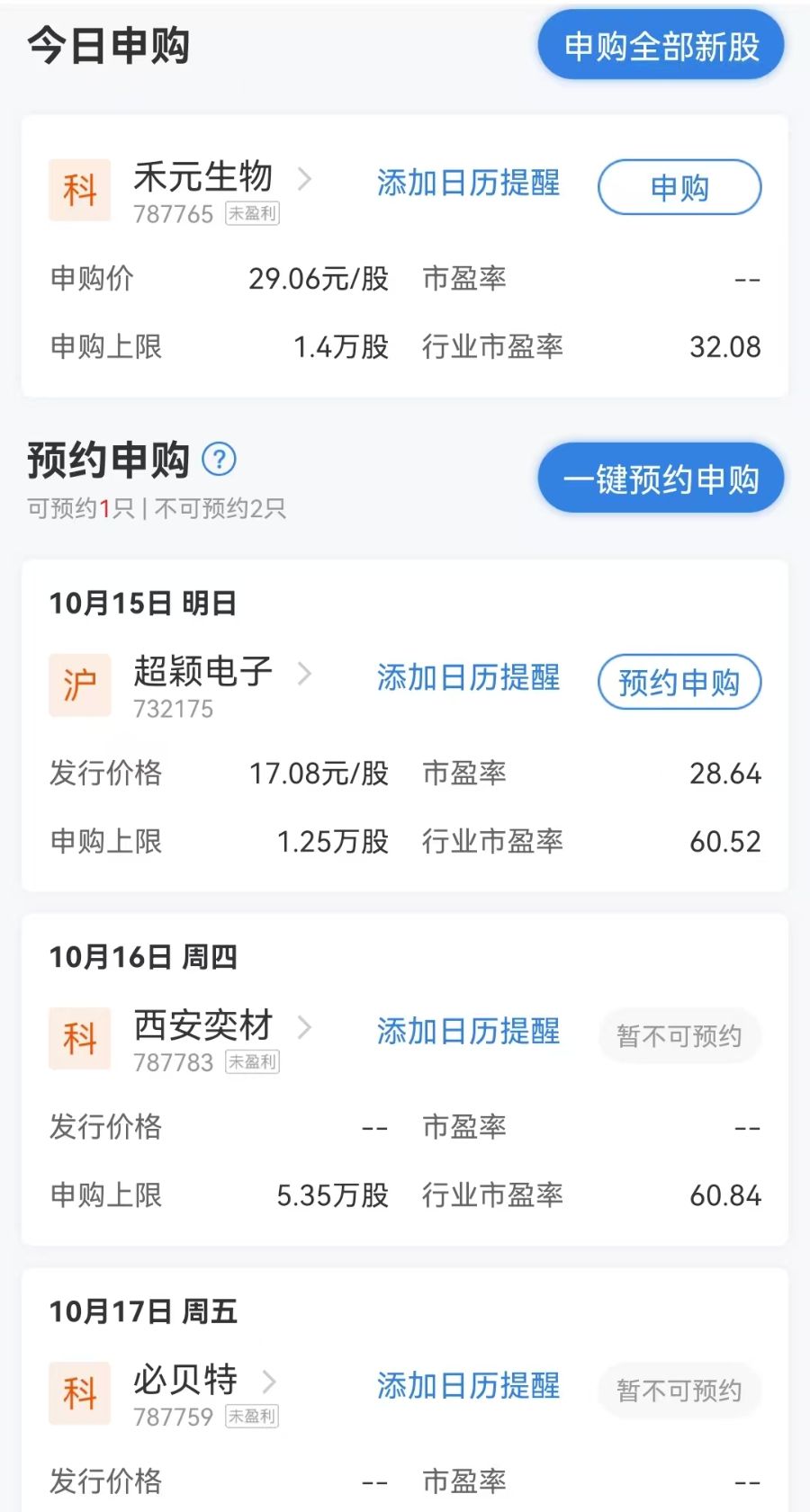
Core Points - The first stock of the Sci-Tech Innovation Growth Tier, He Yuan Bio, has attracted significant market attention during its subscription process [2][3] - Many investors faced issues with subscription due to insufficient permissions, highlighting the varying service quality among brokerage firms [1][5] Company Overview - He Yuan Bio is the first company to successfully pass the review and obtain registration approval under the new fifth set of standards for the Sci-Tech Innovation Board [3] - The total issuance amount for He Yuan Bio is 89.45 million shares, with 14.31 million shares available for online subscription [3] - The maximum subscription limit for investors is 14,000 shares, requiring a minimum market value of 140,000 yuan in the Shanghai market [3] - He Yuan Bio focuses on the research and development of plant molecular medicine technology and products, specifically using a rice endosperm cell expression system [3] - The core product, HY1001, has completed Phase III clinical trials, achieving both primary and secondary endpoints [3] Financial Performance - He Yuan Bio has not yet achieved profitability, with projected revenues of 13.40 million yuan, 24.26 million yuan, 25.22 million yuan, and 12.71 million yuan for the years 2022 to 2025 [3] - The net profit attributable to the parent company is projected to be -144 million yuan, -187 million yuan, -151 million yuan, and -81.63 million yuan for the same period [3] Subscription Process and Challenges - Investors must first open trading permissions for the Sci-Tech Innovation Board and sign a risk disclosure agreement to participate in the Growth Tier [4] - The requirements for opening permissions include maintaining an average asset of at least 500,000 yuan over the past 20 trading days, having at least two years of trading experience, and achieving a risk assessment level of C4 or above [4] - The quality of service from brokerage firms significantly impacts the ease of permission opening, with some firms providing proactive communication and guidance while others do not [5] Market Response and Future Outlook - Investors have called for improved services, suggesting the establishment of a subscription alert mechanism to prevent permission issues from hindering new stock opportunities [6] - Other companies in the Growth Tier, such as Xi'an Yicai and Bibete, are also set to launch subscriptions soon, indicating ongoing interest in this market segment [9]
高投入驱动高成长 科创成长层公司演绎“研发反哺”新范式
Sou Hu Cai Jing· 2025-10-27 22:23
Core Insights - The launch of the "1+6" reform for the Sci-Tech Innovation Board (STAR Market) includes the establishment of a growth tier, with 32 existing companies included at the outset, aiming to enhance the market's depth and breadth [1] Group 1: Financing and Economic Impact - The 32 existing companies in the growth tier raised a total of 105.2 billion yuan through IPOs, significantly contributing to R&D investments and commercial capacity [1] - Among these, 27 companies raised over 1 billion yuan, with BeiGene and Chipone Integrated Circuits each raising over 10 billion yuan [1] Group 2: Market Capitalization - The total market capitalization of the 32 companies has reached approximately 1.22 trillion yuan, with a combined market cap nearing 1.5 trillion yuan when including other markets [1] - 20 of these companies have a market cap exceeding 10 billion yuan, with notable leaders like Cambricon and BeiGene [1] Group 3: Revenue Performance - In 2024, the 32 companies collectively achieved a revenue of 67.6 billion yuan, with 29 companies surpassing 100 million yuan in revenue [2] - The largest revenue contributor, BeiGene, exceeded 27 billion yuan, while the total revenue for the first half of 2024 was 40.7 billion yuan [2] Group 4: Profitability Trends - Despite facing losses due to high R&D costs and depreciation, the companies are showing signs of reduced losses, with a total loss of 21.1 billion yuan in 2024, a decrease of 3.8 billion yuan from 2023 [2] - 19 companies reported a year-on-year reduction in losses for 2024 [2] Group 5: R&D Investment - The 32 companies invested a total of 30.6 billion yuan in R&D in 2024, with a median R&D expenditure to revenue ratio of 65.4%, leading the STAR Market [3] - Ten companies reported R&D expenditures exceeding 100% of their revenue [3]

首批增量科创成长层公司今日上市 科创板包容性集聚“硬科技”动能
Shang Hai Zheng Quan Bao· 2025-10-27 20:32
Core Points - Three companies, He Yuan Bio, Xi'an Yicai, and Bibete, will be listed on the Shanghai Stock Exchange, marking the first batch of companies in the newly established Sci-Tech Innovation Board Growth Layer [1] - The total number of companies in the Sci-Tech Innovation Board will reach 592, with the Growth Layer companies totaling 35 [1] - The introduction of the "1+6" policy by the China Securities Regulatory Commission aims to deepen reforms in the Sci-Tech Innovation Board, highlighting its support for hard technology enterprises [1][4] Company Summaries - Xi'an Yicai is a leading player in the 12-inch silicon wafer market, ranking first in China and sixth globally, with a market share of approximately 6% in monthly shipments and 7% in production capacity [2] - He Yuan Bio has developed a globally innovative "rice-derived blood" technology, with its recombinant human albumin injection approved for market, addressing the long-standing reliance on imported human serum albumin in China [3] - Bibete focuses on innovative drug development for major diseases, with its product BEBT-908 recently approved for treating relapsed or refractory diffuse large B-cell lymphoma [3] Industry Insights - The Sci-Tech Innovation Board Growth Layer has attracted 32 existing unprofitable companies, primarily in strategic emerging industries such as new-generation information technology and biomedicine [4] - These companies have shown strong innovation potential, with a combined R&D investment of 30.6 billion yuan in 2024, representing a median R&D investment ratio of 65.4% of their revenue [4] - The Growth Layer has seen 13 innovative drug companies successfully launch 20 new drugs, demonstrating significant development potential and the ability to achieve breakthrough therapy designations [5] Market Trends - Several innovative drug companies are accelerating their transition from R&D to commercialization, with potential transaction values nearing 5 billion USD from various licensing agreements [5] - In the semiconductor sector, companies like Xinlian Integrated Circuits have become major players, supplying over 90% of domestic new energy vehicle manufacturers [6] - The Growth Layer's expansion reflects the quality of growth among hard technology enterprises and the capacity of the reform "testbed" [6]
高投入驱动高成长科创成长层公司演绎“研发反哺”新范式
Zheng Quan Shi Bao· 2025-10-27 18:15
Core Insights - The launch of the "1+6" reform in the Sci-Tech Innovation Board (STAR Market) aims to establish a growth tier, enhancing the market's depth and breadth [1] - A total of 32 existing companies have been included in the growth tier, collectively raising over 105.1 billion yuan through IPOs, significantly contributing to R&D and commercialization efforts [1] - The total market capitalization of these 32 companies has reached approximately 1.22 trillion yuan, with 20 companies exceeding 10 billion yuan in market value [1] Financial Performance - In 2024, the 32 companies are projected to achieve a combined revenue of 67.575 billion yuan, with 29 companies surpassing 1 billion yuan in revenue [2] - The largest revenue-generating company, BeiGene, has exceeded 27 billion yuan in revenue [2] - For the first half of the year, these companies reported a total revenue of 40.691 billion yuan, with several companies showing strong performance in their Q3 2025 reports [2] R&D Investment - The 32 companies are heavily focused on R&D, with a total investment of 30.6 billion yuan in 2024, representing a median of 65.4% of their revenue [3] - Ten companies have R&D expenditures exceeding 100% of their revenue, indicating a strong commitment to innovation [3]
继往开来,看科创成长层如何托举新一代信息技术企业成长
Zheng Quan Shi Bao Wang· 2025-10-27 11:55
Core Insights - The establishment of the "Science and Technology Innovation Growth Layer" aims to bridge the gap between "technological breakthroughs" and "capital infusion" for high R&D, currently unprofitable "hard tech" entities [2][3] - The growth layer has seen significant activity, with 32 companies transitioning into it and 18 new applications submitted, indicating a robust influx of new enterprises [3][4] Group 1: Company Developments - Cambrian, a domestic AI chip company, has successfully raised 3.985 billion yuan through a private placement, enhancing its long-term competitiveness in the smart chip industry [1][2] - The rapid IPO process of Moore Threads, taking only 88 days from acceptance to approval, highlights the efficiency of the new growth layer for unprofitable tech firms [1][2] - Cambrian has achieved profitability for four consecutive quarters, demonstrating the effectiveness of the supportive policies for unprofitable yet technologically advanced companies [2][6] Group 2: Industry Trends - The growth layer is designed to support the development of the new generation of information technology industries, instilling confidence in market participants to invest in hard tech [2][4] - Companies in the growth layer are making significant technological advancements, such as ChipLink becoming a major player in automotive-grade IGBT production and Cambrian deepening collaborations in AI infrastructure [5][6] - The growth layer is fostering a more inclusive capital ecosystem, with reforms aimed at enhancing the attractiveness and support for hard tech enterprises [7][8]
聚焦科创成长层丨继往开来,看科创成长层如何托举新一代信息技术企业成长
Zheng Quan Shi Bao· 2025-10-27 04:18
Core Insights - The establishment of the "Science and Technology Innovation Growth Layer" aims to bridge the gap between "technological breakthroughs" and "capital infusion" for high R&D, currently unprofitable hard technology entities [3][11] - Companies like Cambricon have successfully transitioned to this new layer, securing significant funding to enhance their competitiveness in the smart chip industry [1][3] - The growth layer has attracted a variety of new companies, indicating a robust pipeline for future IPOs and capital market engagement [4][11] Group 1: Company Developments - Cambricon, a domestic AI chip company, has raised 3.985 billion yuan for hardware and software development, marking a significant turnaround after years of losses [1] - The rapid IPO process of companies like Moore Threads, which took only 88 days from acceptance to approval, highlights the efficiency of the new growth layer [1] - The growth layer has seen 32 companies transition into it, with 18 new applications submitted, indicating a strong influx of new entrants [4] Group 2: Industry Impact - The growth layer is designed to support the development of the new generation of information technology, enhancing confidence in the hard technology sector [3][6] - Companies in the growth layer are addressing critical core technology issues, contributing to the self-sufficiency of China's information industry [6] - The layer has facilitated significant advancements in various sectors, including semiconductors, AI computing, and telecommunications, showcasing the potential for domestic alternatives [7][8] Group 3: Future Outlook - Many companies are focusing on long-term R&D investments to capture new growth opportunities, particularly in emerging fields like intelligent robotics [10] - The introduction of more inclusive policies and standards aims to create a favorable capital ecosystem for hard technology enterprises [11] - The growth layer's supportive environment has enabled companies like Obsidian to achieve profitability after previously being unprofitable, demonstrating the effectiveness of the new capital market dynamics [10]