科创投资

Search documents
指数连接投融 华证安徽科技创新30配置指数助力安徽科创腾飞
Zhong Zheng Wang· 2025-10-21 06:05
Group 1 - The core viewpoint of the news is the launch of the Huazheng Anhui Technology Innovation 30 Allocation Index, aimed at promoting financial services for the real economy and enhancing the integration of capital markets with technological innovation [1][2] - The index has achieved an annualized return of 19.95% since its base date of December 31, 2019, outperforming the ChiNext Index and the Sci-Tech Innovation 50 Index during the same period [1] - The index serves as a bridge connecting government, enterprises, and investors, creating a virtuous cycle of "finance-entity-return" [2][3] Group 2 - The index is designed to address three core challenges in long-term capital investment in Anhui's tech innovation sector: filling the gap of index tools, utilizing indices to diversify risks, and establishing a multi-dimensional quantitative evaluation system to enhance allocation efficiency [2][3] - The index is based on a dynamic investment pool and a quantitative evaluation system, with regular adjustments and comprehensive services to support investment in Anhui's tech sector [3] - The top three industries in the latest sample of the index are semiconductors, software development, and batteries, collectively accounting for 45% of the index's weight [3] Group 3 - Huazheng Index has developed a mixed asset management plan that uses this index as its equity investment target, which has been running smoothly since its establishment, providing a good experience for investors [4] - The index acts as a "barometer" for the development of Anhui's tech industry and a "navigator" for capital allocation, facilitating the inflow of long-term funds into the tech sector [4] - The index aims to enhance the quality and competitiveness of Anhui's tech industry, injecting lasting and strong momentum into the "promote growth through innovation" initiative [4]
指数横空连投融 赋能科创兴徽州——华证安徽科技创新30配置指数
Quan Jing Wang· 2025-10-21 02:56
Core Viewpoint - The launch of the Huazheng Anhui Technology Innovation 30 Allocation Index aims to enhance financial services for the real economy and promote the integration of capital markets with technological innovation in Anhui Province [1][2]. Group 1: Addressing Pain Points - The index addresses three main challenges in connecting long-term capital with Anhui's technology innovation sector: 1. Filling the gap of index tools to improve capital allocation precision, as there are nearly 90 technology-listed companies in Anhui with a total market value exceeding 800 billion yuan, but lacking regional innovation indices [3]. 2. Utilizing the index to diversify risks and optimize capital allocation experiences, as high volatility in technology stocks can deter long-term capital participation [3]. 3. Establishing a multi-dimensional quantitative evaluation system to enhance allocation efficiency, helping long-term capital identify high-growth targets effectively [4]. Group 2: Core Innovations - The Huazheng Anhui Technology Innovation 30 Allocation Index is built on a dynamic investment pool and a quantitative evaluation system, supported by regular adjustments and comprehensive services: 1. The index scientifically categorizes technology enterprises into strategic emerging industries, ensuring a rational and complete classification [5]. 2. It employs a standardized evaluation system that includes metrics like Standardized Unexpected Revenue (SUR), improvement in Return on Equity (DELTA ROE), and R&D intensity, selecting high-quality targets with rapid revenue growth and strong profitability [7]. 3. A full-chain service ecosystem is established to facilitate capital connection, combining online and offline services to enhance investor understanding and confidence in Anhui's technology sector [9]. Group 3: Performance Metrics - The index has demonstrated strong performance metrics, with an annualized return of 19.95% since its inception, significantly outperforming the ChiNext Index and the Science and Technology Innovation 50 Index [8]. - The index also exhibits a maximum drawdown of 49.93%, which is considerably lower than the drawdowns of the ChiNext Index and the Science and Technology Innovation 50 Index, indicating robust risk management capabilities [8].
华泰证券等成立科创股权投资母基金,出资额25亿
Zhong Guo Neng Yuan Wang· 2025-10-11 06:46
Group 1 - Jiangsu Huatai Guojin Science and Technology Innovation Equity Investment Fund (Limited Partnership) has been established with a total investment of 2.5 billion RMB [1] - The fund is managed by Huatai Zijin Investment Co., Ltd., which is a subsidiary of Huatai Securities [1] - The ownership structure of the fund consists of Jiangsu Jincai Investment Co., Ltd. holding 60% and Huatai Zijin Investment holding 40% [1] Group 2 - The fund's operational scope includes equity investment, private equity fund activities, investment management, asset management, and venture capital [1]

九安医疗:天开九安海河海棠科创母基金层面直接及间接持有沐曦科技首次公开发行前约0.53%的股份
Mei Ri Jing Ji Xin Wen· 2025-09-30 04:21
Core Viewpoint - The company has made significant investments through its mother fund and other funds, totaling up to 35.6 billion RMB, with a direct investment of 1 billion RMB in Muxi Technology, representing a small percentage of its pre-IPO shareholding [1] Investment Details - The company participated in the Tian Kai Jiu An Hai He Hai Tang Science and Technology Innovation Mother Fund with an investment not exceeding 35.6 billion RMB or its equivalent in USD [1] - The mother fund directly invested 1 billion RMB in Muxi Technology, which accounts for 0.47% of its pre-IPO total share capital [1] - The Lisi Xing Muxi Fund holds 1.76% of Muxi's pre-IPO total share capital, with the mother fund indirectly holding approximately 0.53% of Muxi Technology's shares through its investment in the subsidiary fund [1]

全球创投风投白皮书:粤港澳大湾区加速成为全球重要科创投资中心
2 1 Shi Ji Jing Ji Bao Dao· 2025-09-26 06:59
Core Insights - The report highlights the rapid emergence of the Guangdong-Hong Kong-Macao Greater Bay Area as a significant global center for technology innovation and venture capital investment, driven by its unique advantages and robust economic environment [1][2]. Group 1: Advantages of the Greater Bay Area - The Greater Bay Area boasts a strong industrial cluster, particularly in new-generation information technology, high-end equipment manufacturing, and biomedicine, providing a rich source of quality projects for venture capital institutions [2]. - Hong Kong's status as an international financial center injects substantial international capital and professional services into the Greater Bay Area's venture capital ecosystem, facilitating easy access for foreign investments into cutting-edge technology firms [2]. - Policy support and platform development are crucial for the growth of venture capital in the Greater Bay Area, with various government initiatives creating a favorable environment for investment [2]. Group 2: Economic Environment - The Greater Bay Area is one of China's most dynamic economic regions, with Guangdong Province's GDP projected to reach 14 trillion yuan in 2024, marking a 3.5% year-on-year growth [3]. - The "9+2" city cluster within the Greater Bay Area exhibits a gradient development pattern, with Shenzhen and Guangzhou as the core cities, each surpassing a GDP of 3 trillion yuan [3]. - The region's integrated development has been enhanced by improved infrastructure and regulatory frameworks, leading to a significant increase in investment, with over 2 trillion yuan attracted during the 2024 Global Investment Conference [3]. Group 3: Venture Capital Market Dynamics - The Greater Bay Area's venture capital market is characterized by a dual-core spatial structure centered around Guangzhou and Shenzhen, with a fundraising scale of 3.33 trillion yuan and financing amounting to 2.05 trillion yuan [4]. - The region has attracted numerous national and market-oriented funds, including a 5.1 billion yuan special fund established by the social security fund in Shenzhen for technology innovation [4]. - The distribution of funds in the Greater Bay Area shows a predominance of large-scale investments, with 672 funds exceeding 1 billion yuan, indicating strong capital aggregation capabilities [5]. Group 4: Investment Focus - Investment activities in the Greater Bay Area are heavily concentrated in information technology and advanced manufacturing, reflecting Shenzhen's status as a global hub for the electronics industry [6]. - The investment landscape includes a balanced development of traditional sectors such as consumer goods, automotive, energy, and finance alongside emerging industries, showcasing the area's comprehensive industrial system [6]. - The establishment of industry-specific funds in Shenzhen aims to guide social capital towards strategic emerging industries, covering the entire lifecycle of enterprises from seed to mature stages [5].
2025超级资本盛宴,要来了
Sou Hu Cai Jing· 2025-08-18 12:31
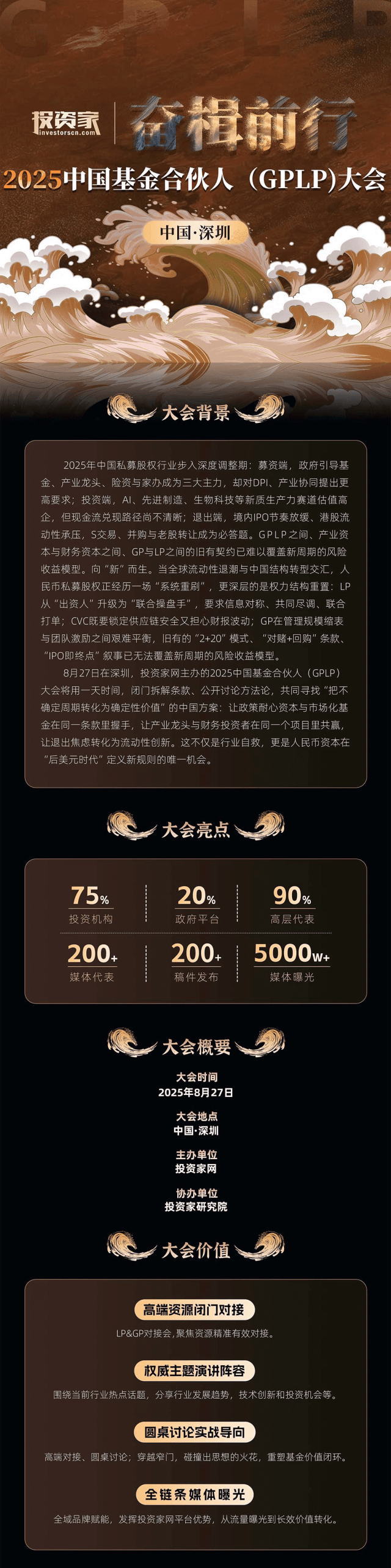
Group 1 - The core viewpoint of the articles indicates that the Chinese private equity investment industry is experiencing a structural recovery after a deep adjustment in 2025, with significant improvements in fundraising and exit activities [1][2][6]. - In the first half of 2025, the number and scale of newly raised funds in China increased by 12.1% and 12% year-on-year, respectively, with a notable rise in the number of equity funds registered in the second quarter, exceeding a 35% increase [1]. - The recovery in fundraising is primarily driven by state-owned assets and domestic RMB funds, which contributed over 65% of the total fundraising amount, focusing on strategic emerging industries such as semiconductors and artificial intelligence [1][2]. Group 2 - The IPO market in 2025 is described as exceptionally active, with a year-on-year increase of 160.6% in financing amounts for Chinese companies listed domestically and abroad, driven by the reopening of the Sci-Tech Innovation Board for unprofitable companies [1][6]. - The number of disclosed merger and acquisition transactions in China reached 4,323 in the first half of 2025, reflecting a year-on-year growth of 4.17% [1]. - The number of fund managers in the private equity sector decreased to 11,900, indicating a trend towards quality over quantity, with new registrations primarily from industry backgrounds or specialized general partners [2][6]. Group 3 - The upcoming "2025 China Fund Partners (GPLP) Conference" organized by Investment House Network is set for August 27, 2025, in Shenzhen, focusing on key topics in the private equity investment industry and emerging industries [2][7]. - The conference aims to address the evolving dynamics between limited partners (LPs) and general partners (GPs), emphasizing the need for information symmetry and collaborative due diligence in the current investment landscape [6][7]. - The Investment House Network plans to release the "2024-2025 Annual Fund Partners List" during the conference to recognize outstanding contributions in the private equity sector [2].

湖北投资引导基金等新设科创种子投资基金,出资额30亿
Qi Cha Cha· 2025-08-15 07:19
Group 1 - The core point of the article is the establishment of the Hubei Chutian Fengming Science and Technology Seed Investment Fund with a total investment of 3 billion yuan [1] - The fund's operational scope includes private equity investment fund management and venture capital fund management services [1] - The fund is co-funded by Hubei Investment Guidance Fund Co., Ltd. and other contributors [1]
湖北投资引导基金等新设科创种子投资基金,出资额30亿元
Zheng Quan Shi Bao Wang· 2025-08-15 06:44
Group 1 - The establishment of Hubei Chutian Fengming Science and Technology Seed Investment Fund Partnership (Limited Partnership) with a total investment of 3 billion yuan [1] - The fund's business scope includes private equity investment fund management and venture capital fund management services [1] - The fund is co-funded by Hubei Provincial Investment Guidance Fund Co., Ltd. and other entities [1]
敢投创新的种子、营造成长的生态,5只行业第一股出自武汉
Chang Jiang Ri Bao· 2025-08-01 12:06
Core Viewpoint - The emergence of "first stocks" in various sectors from Wuhan highlights the city's commitment to fostering innovation and creating a supportive ecosystem for technology-driven companies [5][12]. Group 1: First Stocks from Wuhan - The first domestic database stock, Dameng Data, was listed in June 2024 [1][17]. - The first esports stock, Xingjing Weiw, was listed in July 2024 on NASDAQ [2][19][20]. - The first interactive AI stock, Voicecom, was listed in July 2024 on the Hong Kong Stock Exchange [3][22][23]. - The first intelligent driving chip stock, Hezhima Intelligent, was listed in August 2024 on the Hong Kong Stock Exchange [4][26][27]. - The first intelligent time-series data stock, Yuanguang Technology, was listed in June 2024 [5]. Group 2: Investment Ecosystem in Wuhan - The government of Wuhan has established funds to support early-stage technology companies, focusing on "early investment, small investment, hard technology" [8]. - The Wuhan government aims to create a long-term investment environment, with funds having a maximum duration of 15 years to support startups through their development phases [10][12]. - The city plans to establish over 50 specialized technology financial institutions and increase the scale of equity investment funds to over 300 billion yuan by 2027 [13]. Group 3: Challenges and Support for Startups - Startups face significant challenges, including funding, talent, location, and market access, often referred to as the "valley of death" [10]. - The Wuhan government is working to improve the investment ecosystem by allowing for a certain level of loss in seed and angel funds, thus providing a safety net for investors [11]. - The focus is on nurturing small enterprises to grow into larger, sustainable businesses through patient capital and supportive policies [12][13].
陈天桥:科创投资不要沿用互联网套路
Nan Fang Du Shi Bao· 2025-07-25 10:36
Group 1 - The core viewpoint emphasizes the need for patience in capital investment within the hard technology sector, particularly in brain-computer interface (BCI) development, contrasting it with past internet investment strategies [2][4] - The brain-computer interface industry has seen rapid development, with an increase in startups and significant attention from top investors, particularly in Shanghai, which is establishing itself as a key innovation center [3][4] - Brain Tiger Technology, founded by Professor Tao Hu, has emerged as a leading company in the invasive brain-computer interface sector, receiving substantial support from local government and recognition at major events [3][5] Group 2 - Investment in hard technology should not be measured by short-term returns typical of internet investments; instead, it requires a long-term vision and stable support to navigate the lengthy cycles of technology validation and market cultivation [4] - Recent breakthroughs in real-time Chinese language decoding and motion decoding by Brain Tiger Technology have positioned it at the forefront of international technology, garnering special coverage in the academic journal Nature [5] - The company aims to build a world-class team focused on brainwave modeling and decoding algorithms, leveraging the latest AI technologies to enhance its competitive edge against other players like Neuralink [5]