绿色航运

Search documents
从“内陆腹地”到“绿色港城” 山东邹城何以领跑内河新能源航运?
Zhong Guo Xin Wen Wang· 2026-01-13 08:42
Core Viewpoint - The article highlights how Zoucheng, a city in Shandong Province, has emerged as a leader in inland green shipping through innovative practices and strategic resource integration, establishing itself as a hub for the manufacturing of new energy vessels [1][2][3]. Group 1: Development of Green Shipping - Zoucheng has developed China's first demonstration base for inland new energy vessel manufacturing, integrating research, design, and intelligent manufacturing [1]. - The city has established a full industrial chain layout for inland vessels, combining resources from various sectors, including logistics, power technology, and ship design [2]. - The production capacity of new energy vessels at Xinneng Shipbuilding has reached a maximum of 8 vessels per month, with production efficiency increasing by 172% [2]. Group 2: Economic and Environmental Benefits - The cost of LNG fuel is approximately 70% of that of diesel, leading to significantly reduced operational costs for vessels, enhanced market competitiveness [2]. - New energy vessels have achieved a 20% reduction in carbon emissions and over 90% reduction in nitrogen oxides and particulate matter emissions [4]. Group 3: Strategic Positioning and Market Opportunities - Zoucheng has identified a market gap in the production of inland new energy vessels, focusing on this niche where traditional shipyards are unable to compete [3]. - The city is actively participating in the formulation of industry standards, transitioning from a follower to a leader in the inland new energy shipping sector [3]. Group 4: Government and Industry Collaboration - The local government has played a crucial role in supporting the new energy shipbuilding project by facilitating land supply and streamlining approval processes [6]. - Zoucheng plans to establish an industrial alliance for inland new energy vessel manufacturing by 2025 to enhance resource integration and market collaboration [6]. Group 5: International Expansion - Xinneng Shipbuilding has secured over 180 domestic and international orders, successfully exporting vessels to countries such as Vietnam, Tanzania, and Cuba [7]. - The company has adopted an innovative construction model to address logistical challenges in shipping inland vessels, enhancing its international competitiveness [6].
香港“兴”观察丨香港总部经济“强磁场”的活力密码
Xin Hua Wang· 2026-01-10 01:45
Group 1: Hong Kong's Economic Environment - Hong Kong's stock market experienced a positive start in 2026, with the best business environment performance in two years reported in Q4 2025, indicating a recovery in local and export market demand [1] - The city has become a key node in the global economic network, attracting numerous international organizations and multinational corporations to establish their headquarters and regional business centers [1] Group 2: Intellectual Property and Innovation - The International Intellectual Property Commercialization Council (IIPCC) chose Hong Kong for its headquarters due to the city's unique advantages in connecting local and international markets, which align with the organization's mission to convert intellectual property into commercial value [2] - The development of the Northern Metropolis area is expected to generate significant intellectual property outcomes, supported by the resources of the Guangdong-Hong Kong-Macao Greater Bay Area [3] Group 3: International Mediation - The establishment of the International Mediation Institute in Hong Kong marks a significant development in international dispute resolution, with its headquarters located in a historic building, emphasizing the city's unique advantages under the "one country, two systems" framework [3][4] - The institute aims to provide a low-cost and efficient dispute resolution mechanism, particularly catering to the needs of global South countries, leveraging Hong Kong's status as a financial and trade center [5] Group 4: Green Shipping and Sustainability - Hong Kong is positioned to become a leading center for green shipping fuel supply and trading, benefiting from its status as a major international shipping and financial hub [6] - The Hong Kong government is actively promoting policies to support the decarbonization of the shipping industry, including regulatory optimization and tax incentives, which are crucial for the development of green shipping initiatives [7]
苏州港航“十四五”交出亮眼答卷 畅航道减费用 优服务增绿量
Su Zhou Ri Bao· 2026-01-10 01:44
Core Insights - During the "14th Five-Year Plan" period, Suzhou Port and Shipping Development Center has cumulatively exempted toll fees amounting to 25.07 million yuan, enhancing the efficiency of inland waterway transportation [1][2] - The completion of the Changqiao reconstruction project in November 2025 will significantly improve traffic flow and safety for vessels, accommodating 2,000-ton ships for all-weather navigation [1] - Digital services have advanced, allowing shipowners to complete toll registration via mobile phones, marking a new phase in the digital transformation of Suzhou's waterway infrastructure [1] Group 1 - The Suzhou Port and Shipping Development Center has implemented measures such as legal consultations and regular safety inspections to enhance water traffic safety [2] - The center has created green bank vegetation covering 16,613 square meters, equivalent to 2.75 times the area of West Lake, contributing to the ecological improvement of the Grand Canal in Suzhou [2] - The overall completion of the "Three Transformations to Two" project will significantly enhance the efficiency of inland waterway transportation [1]
中国港口逆风破浪 吞吐量迭破纪录,重构全球航运棋局
2 1 Shi Ji Jing Ji Bao Dao· 2026-01-09 23:07
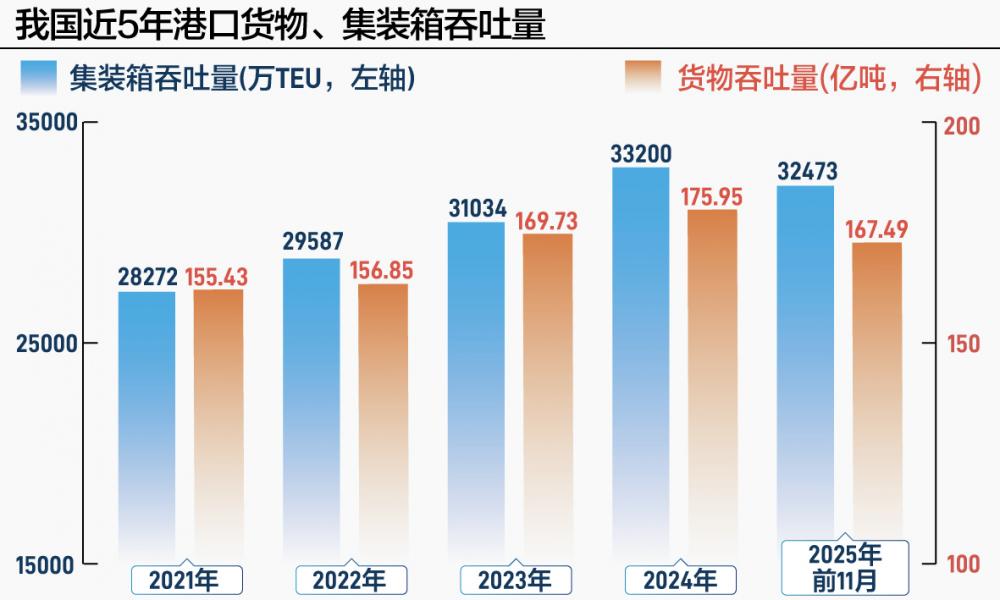
Core Insights - China's ports have demonstrated resilience and growth in cargo throughput despite global trade uncertainties, with major ports like Shanghai and Ningbo-Zhoushan maintaining their positions at the forefront of global shipping [1][3][4] Group 1: Performance Metrics - In the first eleven months of 2025, China's ports achieved a cargo throughput of 16.75 billion tons, marking a year-on-year increase of 4.4% [3] - Shanghai Port's container throughput reached 55.06 million TEUs, maintaining its status as the world's busiest port for the sixteenth consecutive year [8] - Ningbo-Zhoushan Port became the first global port to exceed 1.4 billion tons in annual cargo throughput [3][8] Group 2: Structural Changes and Trends - China's ports are transitioning from scale advantages to becoming supply chain hubs, enhancing their roles in logistics and distribution [2][4] - The growth in throughput is attributed to improved competitiveness in the global shipping system and the implementation of policies supporting smart and green shipping [3][4] Group 3: Market Expansion and Trade Dynamics - China's share of global container exports increased from 34% in 2019 to 38% in 2025, reflecting the resilience of Chinese manufacturing and technology [9] - New trade routes are being established, with ports like Beibu Gulf opening international routes to the Middle East and others expanding to emerging markets in Latin America and Africa [9][10] Group 4: Future Outlook and Innovations - The development of smart and green shipping policies is expected to accelerate the digitalization and automation of ports, enhancing their roles as intelligent hubs [16] - The establishment of new supply chain structures and trade routes will require ports to adapt and optimize their operations in response to geopolitical changes [12][15]





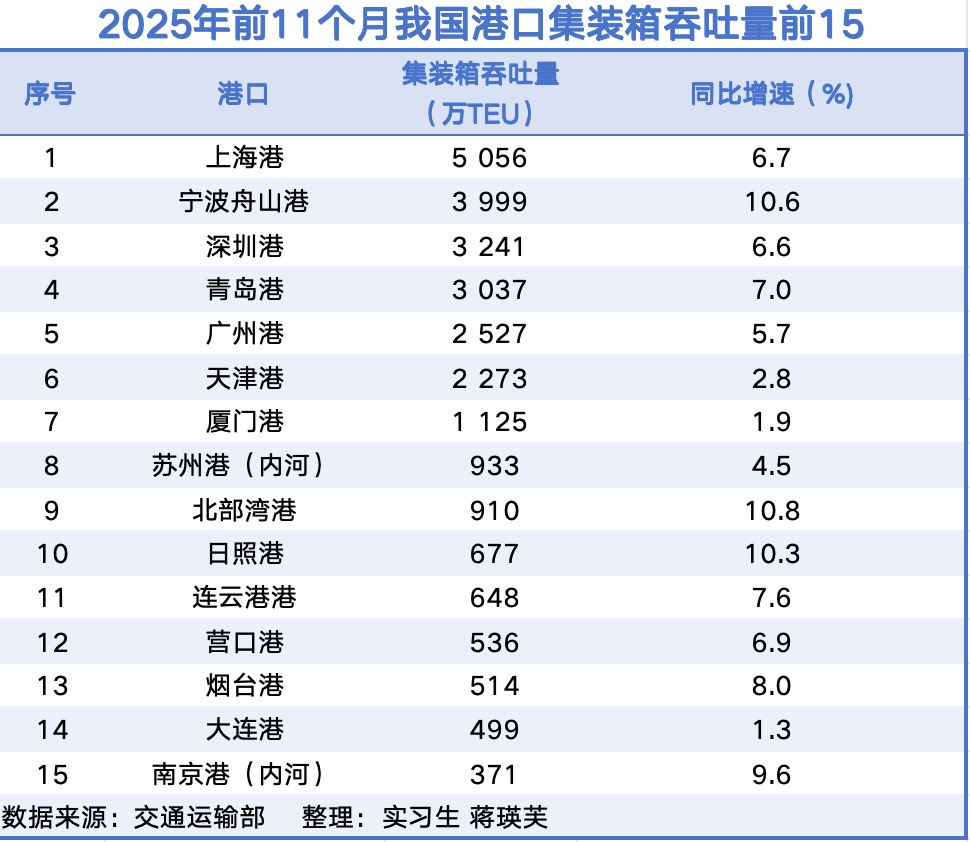
全国集装箱吞吐量前15港口出炉
2 1 Shi Ji Jing Ji Bao Dao· 2026-01-09 15:17
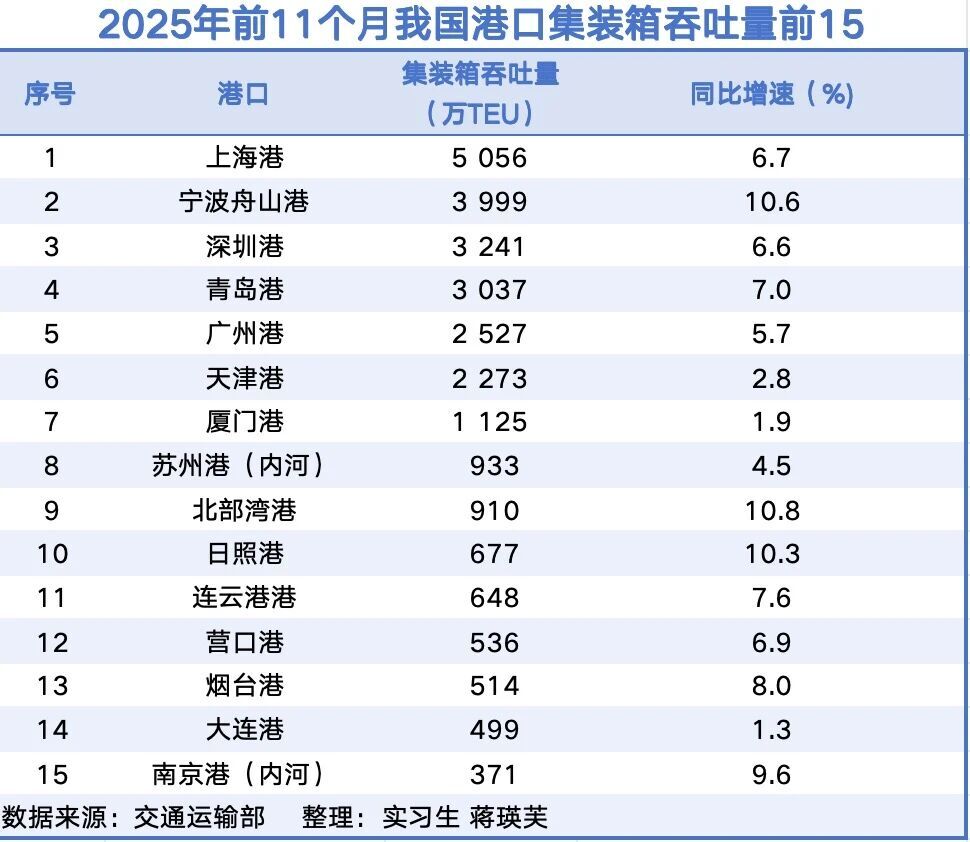
Core Insights - Despite global trade uncertainties, China's port throughput has shown resilient growth, with a total of 16.75 billion tons handled in the first eleven months of 2025, marking a 4.4% year-on-year increase [1][2] - Major ports like Shanghai and Ningbo-Zhoushan have maintained their positions as global leaders, with Ningbo-Zhoushan becoming the first port to exceed 1.4 billion tons in annual throughput and Shanghai retaining the top spot in container throughput for the sixteenth consecutive year [1][5] - The growth in port throughput is attributed to China's increasing competitiveness in the global shipping system and the implementation of policies related to free trade zones and smart and green shipping [2][3] Port Performance - In 2025, major ports in China have reported significant increases in container throughput, with Ningbo-Zhoushan at 39.99 million TEUs (10.6% increase), Shenzhen at 32.41 million TEUs (6.6% increase), and Qingdao at 30.37 million TEUs (7.0% increase) [2] - Emerging ports like Yangpu and Beibu Gulf have also shown remarkable growth, with Yangpu's container throughput increasing by 65% year-on-year [1][5] Economic Context - The stable growth in port cargo and container volumes indicates the resilience of China's economy and international trade, even amidst external instability [3][6] - China's share of global container exports has risen from 34% in 2019 to 38% in 2025, reflecting the competitiveness of Chinese manufacturing and technology [5][6] Trade Route Developments - Chinese ports are expanding into emerging markets, with new international shipping routes being established to regions like the Middle East, Latin America, and Africa [6][7] - The trade volume with ASEAN countries grew by 8.5%, and trade with the EU increased by 5.4% in the first eleven months of 2025 [6] Future Trends - The implementation of smart and green shipping policies is expected to enhance the port industry, with a focus on digitalization and automation [13] - The establishment of new shipping routes, such as the "Sea Defense Silk Road Fast Shipping" line, indicates a shift towards more efficient logistics and trade networks [7][12]


全国集装箱吞吐量前15港口出炉
21世纪经济报道· 2026-01-09 15:10
Core Viewpoint - Despite global trade uncertainties, China's port throughput has shown resilient growth, with a total of 16.75 billion tons in cargo throughput for the first eleven months of 2025, marking a 4.4% year-on-year increase [1][2]. Group 1: Port Performance - Major ports like Shanghai and Ningbo-Zhoushan have maintained their positions at the top globally, with Ningbo-Zhoushan becoming the first port to exceed 1.4 billion tons in annual cargo throughput and Shanghai maintaining the highest container throughput for the sixteenth consecutive year [1][5]. - The container throughput of Yangpu Port surged by 65% year-on-year, while Beibu Gulf Port entered the ranks of ports handling over 10 million TEUs [1][5]. Group 2: Factors Driving Growth - The growth in port throughput is attributed to China's increasing competitiveness in the global shipping system, alongside the operational commencement of the Hainan Free Trade Port and the implementation of smart and green shipping policies [2][3]. - The stability in cargo and container volumes reflects China's growing economic and international trade capacity, with ports evolving from traditional loading and unloading to becoming supply chain hubs [3][4]. Group 3: Trade Dynamics - China's exports to emerging markets such as the EU, Latin America, and Africa have seen significant growth, with trade with ASEAN increasing by 8.5% and with the EU by 5.4% in the first eleven months of 2025 [7][8]. - The shift in trade patterns indicates a growing economic connection with regions outside traditional trade routes, driven by geopolitical factors and regional trade integration [7][8]. Group 4: Future Trends - The establishment of new shipping routes, such as the direct line from Haiphong to Shanghai, and the opening of the Arctic route, signifies a diversification in global shipping lanes [10][11]. - The resilience of the global shipping system will depend on the ability to adapt to geopolitical changes and the development of new trade channels, emphasizing the importance of port resilience and diversified trade routes [11][12]. Group 5: Technological Advancements - The implementation of smart shipping and green shipping policies is expected to enhance the port industry, with a focus on digitalization and automation in port operations [12]. - The transition towards renewable energy sources, such as green hydrogen and methanol, is anticipated to create new mechanisms for emission reduction and foster the development of green industrial chains at coastal ports [12].
中国港口逆风破浪:吞吐量破纪录,重构全球航运棋局
2 1 Shi Ji Jing Ji Bao Dao· 2026-01-09 12:17
Core Insights - Despite global trade uncertainties, China's port throughput has shown resilient growth, with a total of 16.75 billion tons in cargo throughput for the first 11 months of 2025, marking a 4.4% year-on-year increase [1] - China's goods trade exports reached 24.46 trillion yuan, reflecting a 6.2% year-on-year growth [1] - Major ports like Shanghai and Ningbo-Zhoushan have maintained their positions as global leaders, with Ningbo-Zhoushan becoming the first port to exceed 1.4 billion tons in annual cargo throughput [1][5] Port Performance - Shanghai Port achieved a container throughput of 55.06 million TEUs, maintaining its position as the world's busiest port for the 16th consecutive year [5] - Ningbo-Zhoushan Port's container throughput surpassed 40 million TEUs for the first time [5] - Emerging ports like Yangpu and Beibu Gulf have shown significant growth, with Yangpu's container throughput increasing by 65% [5] Factors Driving Growth - China's ports have enhanced their competitiveness in the global shipping system amid slowing global trade and geopolitical tensions [2] - The establishment of the Hainan Free Trade Port and the implementation of smart and green shipping policies are reshaping the port development environment [2][11] - The stability in cargo and container volumes indicates China's growing economic and international trade capacity [3] Market Trends - China's exports to emerging markets such as the EU, Latin America, and Africa have seen robust growth, with trade with ASEAN increasing by 8.5% [6] - The shift in China's export market structure reflects a broader trend of globalization, with Chinese companies playing a crucial role in global supply chains [6] - The demand for containers between Asia and Africa has surged by 22.6% from 2019 to 2025, significantly outpacing growth in other regions [7] Future Outlook - The development of smart and green shipping policies is expected to accelerate the digitalization and automation of ports, enhancing their roles as logistics hubs [12] - The potential for new supply chain organizations and trade routes is anticipated, particularly with the rise of regional trade agreements like RCEP [7][10] - The ongoing geopolitical dynamics and the establishment of new shipping routes, such as the Arctic route, may lead to structural adjustments in global shipping lanes [9][10]
香港总部经济“强磁场”的活力密码
Zhong Guo Jin Rong Xin Xi Wang· 2026-01-09 03:49
Core Viewpoint - Hong Kong is experiencing a resurgence in its business environment, attracting international organizations and multinational corporations to establish their headquarters and regional centers, driven by improved capital confidence and a vibrant business ecosystem [1] Group 1: Business Environment - The Hong Kong stock market opened positively on the first trading day of 2026, reflecting a significant improvement in the business environment, which achieved its best quarterly performance in two years in Q4 2025 [1] - The demand in both local and export markets has broadly improved, highlighting Hong Kong's role as a global business hub [1] Group 2: Knowledge Property and International Organizations - The International Intellectual Property Commercialization Council (IIPCC) chose Hong Kong for its headquarters in 2014, citing the city's unique advantages for serving the global community [2] - The IIPCC aims to transform intellectual property into commercial value and has successfully established a presence in Hong Kong without initial government assistance, benefiting from the city's legal environment and growing IP protection [2] - The IIPCC plans to collaborate with the World Intellectual Property Organization in 2025 to promote commercial secrets and engage in various international initiatives [2][3] Group 3: International Mediation - The International Mediation Institute, established in 2025, aims to facilitate dispute resolution between nations and investors, emphasizing a flexible approach to conflict resolution [4] - The organization has quickly gained traction, with 38 countries signing its charter and two core mediation rules coming into effect [4][5] - Hong Kong's unique "one country, two systems" framework and its internationalized environment are seen as key factors in the institute's establishment and operation [3][5] Group 4: Green Shipping and Maritime Industry - Hong Kong is positioned to become a leading center for green shipping fuel, leveraging its status as a major international shipping and financial hub [6] - The city has a strong maritime infrastructure, including being the fourth largest ship registry and second largest marine insurance center globally, with a low detention rate for registered vessels [6] - The Hong Kong government is actively promoting policies to support the decarbonization of the shipping industry, including regulatory optimization and tax incentives [7]
我国大吨位氨燃料预留原油船即将交付
Yang Shi Wang· 2026-01-06 07:35
中船北海造船船研所副所长 李小强:30天内就能完成设备安装调试,未来采用氨燃料后,它的碳强度 指标能稳定达到A级标准,且船舶全生命周期可实现"零碳"排放。 这艘船的突破不止于"绿色预留",更刷新了山东造船的吨位纪录——从过去的11.3万吨跃升至31.9万 吨。为了找到船型阻力与舱容的最佳平衡,团队反复打磨了上百版设计方案,还专程赴国内外多家船厂 实地调研,吸收先进设计经验。 五年来,我国LNG、甲醇动力船舶订单快速增长,氨燃料预留、氢燃料电池等零碳船型取得突破,新 接绿色动力船舶订单国际份额达57%。正是这样的政策给了北海造船绿色转型的底气和决心。 硬核技术换来了市场认可,比利时船东公司一下就预订了5艘同类型氨燃料预留超大型原油船,首制船 提前7个月交付的"中国速度"更获得船东高度赞誉。 "十五五"规划建议提出,要"加快建设新型能源体系"以及"推动重点产业提质升级,巩固提升机械、船 舶等产业在全球产业分工中的地位和竞争力"。近日在山东青岛,我国大吨位氨燃料预留原油船即将交 付。 比利时CMB.TECH公司首席执行官 亚历山大·塞弗里斯:近期我们在青岛北海造船厂订购了33艘船舶。 对我们而言意味着极高的品质、极 ...
零碳驱动+智慧护航!全球首艘万吨级近海新能源散货船靠泊烟台港
Qi Lu Wan Bao· 2026-01-06 03:11
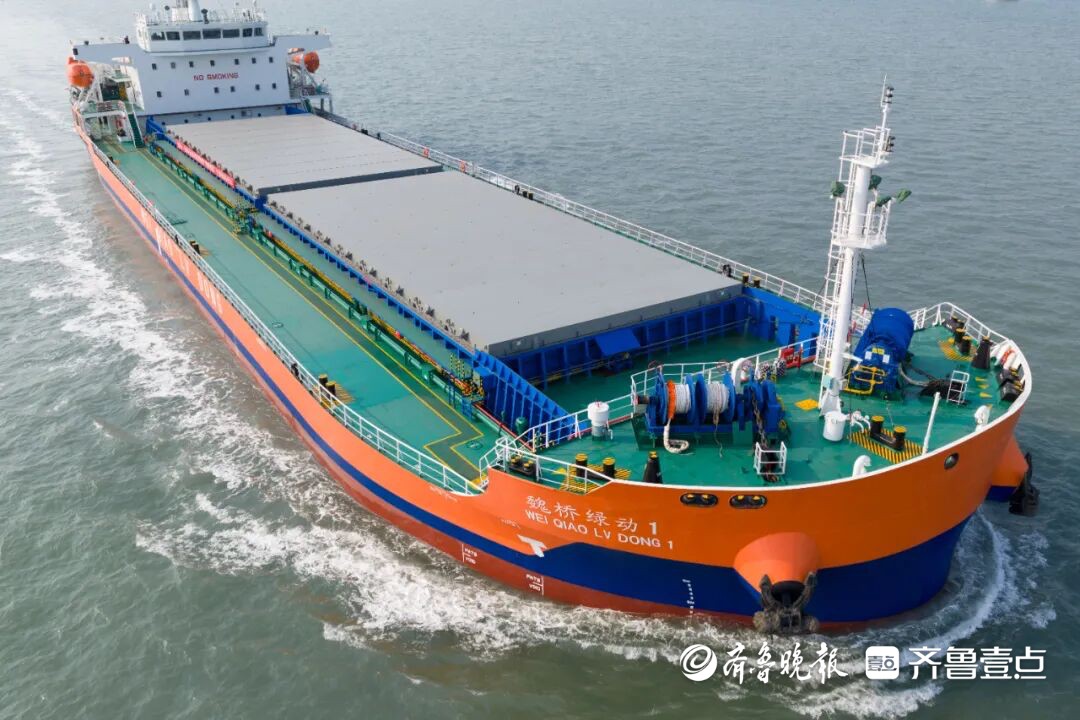
Core Viewpoint - The successful docking of the world's first 10,000-ton offshore new energy bulk carrier "Weiqiao Green Movement 1" at Yantai Port marks the official launch of the first green shipping logistics channel in the Bohai Bay, promoting the green transformation of Yantai Port to a new level [1][3]. Group 1 - The "Weiqiao Green Movement 1" is 109.8 meters long, 26.8 meters wide, with a maximum cargo capacity of 8,906 tons and a pure electric range of 150 nautical miles [3]. - The vessel's power system integrates eight container-style power sources and employs a "lithium battery + fuel" dual-drive mode, enabling zero carbon emissions in urban control and environmental protection areas, with an estimated annual carbon reduction of about 9,000 tons per ship [3]. - The ship is equipped with an AUT-0 auxiliary driving system and utilizes 5G and satellite communication technology for real-time interaction between the vessel and shore, achieving "unmanned operation, all-time monitoring, and intelligent decision-making" [3]. Group 2 - Yantai Port has prioritized the construction of an internationally leading smart green port, implementing a strict "1+3+5+8+N" green port construction path, enhancing government-enterprise collaboration, and striving to build a low-carbon and efficient green shipping system [3]. - The port aims to optimize energy structure, reconstruct operational processes, and upgrade equipment technology to accelerate the green and low-carbon transformation across the entire supply chain [3]. - Future plans include deepening cooperation with new energy vessel platforms, improving the supporting service system for new energy vessels, and continuously advancing the construction of green ports and smart logistics to inject new momentum into the port's transformation and regional economic sustainable development [4].