
美墨加协定

Search documents
加拿大宣布取消部分对美报复性关税
Xin Hua Wang· 2025-08-23 07:03
Core Viewpoint - Canada will begin to lift some retaliatory tariffs against the U.S. starting September 1, while maintaining tariffs on steel, aluminum, and automobiles [1] Group 1: Tariff Changes - Canada will no longer impose tariffs on U.S. goods covered under the United States-Mexico-Canada Agreement (USMCA) as a measure of reciprocity [1] - The decision to cancel certain tariffs is seen as a goodwill gesture to restart stalled trade negotiations [1] Group 2: Future Trade Considerations - The Canadian government plans to assess its priorities in the new global trade environment starting in September, in preparation for the review of the USMCA next year [1] - The USMCA, signed in 2018, officially came into effect in July 2020 and is scheduled for renewal discussions in 2026 [1]
多家药企宣布将在墨西哥投资约120亿比索
Sou Hu Cai Jing· 2025-08-09 09:37
Group 1 - Multiple pharmaceutical companies, including AstraZeneca and Bayer, announced investments totaling approximately 12 billion Mexican pesos (about 4.6 billion RMB) in Mexico, seen as a strategy to circumvent U.S. tariffs through the USMCA [1][8] - Bayer plans to invest around 3 billion Mexican pesos (approximately 1.16 billion RMB) over the next five years to expand local production facilities [3] - AstraZeneca will invest over 2 billion Mexican pesos (about 770 million RMB) in the next two years to enhance clinical research activities and expand production facilities for diabetes and chronic kidney disease medications [4] Group 2 - Boehringer Ingelheim is investing approximately 3.5 billion Mexican pesos to make its tablet production facility in Mexico City the largest globally [6] - A large domestic pharmaceutical company in Mexico announced plans to invest about 3.5 billion Mexican pesos to build a factory in central Mexico, creating over 5,000 jobs [6] - The Mexican government stated that the pharmaceutical industry will receive investments totaling around 12 billion Mexican pesos (about 4.6 billion RMB) [6] Group 3 - President Trump threatened tariffs on imported drugs that could reach up to 250%, with specific measures expected to be announced soon [8] - Products meeting the USMCA preferential tariff treatment conditions, such as drugs produced in Mexico, will not be affected by the new tariff measures [8]



加拿大总理对特朗普上调关税税率表示失望
news flash· 2025-08-01 10:19
Core Viewpoint - The U.S. has increased tariffs on Canadian goods from 25% to 35% effective August 1, due to perceived lack of cooperation from Canada on controlling the flow of fentanyl and other illegal drugs into the U.S. [1] Group 1: Impact on Canadian Industries - Canadian industries such as lumber, steel, aluminum, and automotive are significantly affected by the U.S. tariff policy [1] - The Canadian government plans to take action to protect jobs and diversify export markets in response to the increased tariffs [1] Group 2: U.S. Justification for Tariffs - The U.S. administration believes the tariff increase is necessary due to Canada's retaliatory measures against the U.S. [1] - Goods that qualify for preferential tariff treatment under the United States-Mexico-Canada Agreement (USMCA) will not be affected by the new tariff measures [1]
加拿大总理卡尼:木材、钢铁、铝和汽车行业受到美国关税的严重影响!尽管加拿大政府对美国关税感到失望,但我们仍然致力于《美墨加协定》
Ge Long Hui· 2025-08-01 04:47
Group 1 - The Canadian government expresses disappointment over U.S. tariffs but remains committed to the USMCA, which is the second-largest timber trade agreement globally by trade volume [1] - Various sectors, including timber, steel, aluminum, and automotive, are significantly impacted by U.S. tariffs and trade barriers [1]

经济学家:加拿大出口商可能因特朗普对美墨加协定的计划而面临风险。
news flash· 2025-07-29 14:39
Core Viewpoint - Canadian exporters may face risks due to Trump's plans regarding the US-Mexico-Canada Agreement (USMCA) [1] Group 1 - The potential changes in the USMCA could impact trade dynamics for Canadian exporters [1] - Economic analysts are concerned about the implications of these changes on Canada's export market [1] - The uncertainty surrounding the agreement may lead to volatility in export performance [1]
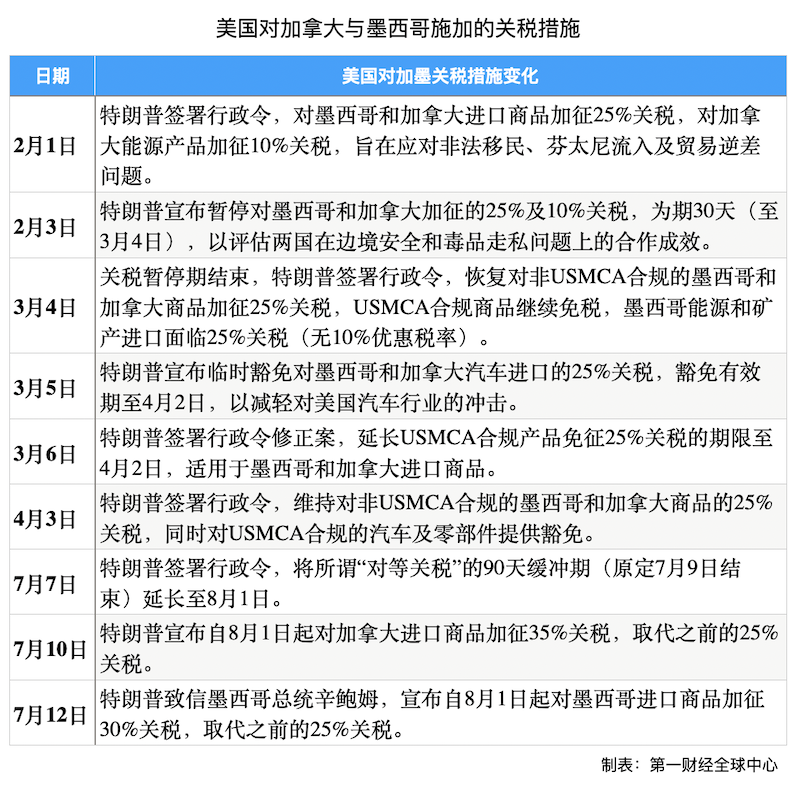
美威胁对加墨分别征收35%和30%关税,如何影响美墨加产业链?|特朗普关税风云第二季
Di Yi Cai Jing· 2025-07-13 09:15
Core Viewpoint - The recent tariff measures imposed by the Trump administration on imports from Mexico and Canada are primarily aimed at addressing drug trafficking issues, but their actual impact may be limited due to exemptions for products that comply with the USMCA rules [1][5]. Group 1: Tariff Details - Starting August 1, a 30% tariff will be imposed on goods imported from Mexico, while a 35% tariff will be applied to goods from Canada [1]. - The tariffs are justified by Trump's claims of insufficient action by both countries in controlling fentanyl trafficking [1][6]. - The tariffs are expected to raise prices by approximately 1.2% due to direct and indirect effects on the economy [6]. Group 2: Economic Impact - The US imports over $100 billion annually in industrial goods from Canada and Mexico, which includes machinery, electronics, and agricultural products [5]. - The tariffs may create new negotiation leverage for the US in trade discussions, particularly regarding dairy and aluminum tariffs [4][6]. - The potential for retaliatory tariffs from Canada and Mexico exists, but both countries are currently focused on demonstrating compliance with USMCA to mitigate the impact [7][8]. Group 3: Political Context - Trump's administration has sent letters to 24 countries and the EU regarding tariff adjustments, indicating a broader strategy of using tariffs as a negotiation tool [3]. - The political implications of these tariffs could lead to public dissatisfaction if prices for well-known consumer goods rise significantly [6]. - Both Canada and Mexico have expressed intentions to negotiate rather than retaliate, given their economic dependence on the US market [8].
特朗普批加拿大“非常难缠” 加方取消征收数字服务税
Xin Hua She· 2025-06-30 07:48
Group 1 - The core viewpoint is that President Trump criticizes Canada for being difficult in trade negotiations, particularly regarding high tariffs on U.S. agricultural products [2] - Canada announced the cancellation of the digital services tax, which was set to take effect on June 30, to facilitate trade negotiations with the U.S. [3] - The U.S. has expressed strong opposition to Canada's digital services tax plan, which would impose a 3% tax on revenues from tech companies providing services to Canadian users [3] Group 2 - Trump highlighted that Canada imposes tariffs as high as 400% on certain U.S. agricultural products, indicating a significant trade imbalance [2] - The current tariff policies between the U.S. and Canada are established under the USMCA agreement, which Trump claims could become ineffective if Canada defaults [2] - The Canadian government had initially planned to implement the digital services tax retroactively to 2022, but this plan has now been abandoned to resume negotiations with the U.S. [3]
凯投宏观:加拿大出口将在2025年剩余时间内保持低位
news flash· 2025-06-05 13:31
Core Viewpoint - CIBC Macro believes that Canadian exports have reached a peak of weakness, with a potential for rebound in the coming months, but exports are expected to remain low through the remainder of 2025 unless there is a change in U.S. trade policy [1] Trade Data Summary - In April, nominal export values fell by 10.8%, with a seasonally adjusted decline of 9.1% [1] - Out of 11 industries, 10 experienced record declines in exports, with the automotive and industrial machinery sectors seeing the largest drops [1] Economic Impact - The poor trade data from April poses risks to the expectation of a 0.1% quarter-on-quarter GDP growth for Canada [1]
市场消息:美国海关与边境保护局为《美墨加协定》覆盖车辆制定了实施条例。
news flash· 2025-06-03 13:14
Group 1 - The U.S. Customs and Border Protection has established implementation regulations for vehicles covered under the United States-Mexico-Canada Agreement (USMCA) [1]
戴姆勒:2025财年展望基于假设美墨加协定下公司能够继续运营。
news flash· 2025-05-13 18:11
Group 1 - The core viewpoint of the article indicates that Daimler's outlook for the fiscal year 2025 is contingent upon the assumption that the company can continue operations under the US-Mexico-Canada Agreement [1]