数字服务税

Search documents
突发特训!德总理通告全球:若美征收高额关税,欧洲将以同等方式回击,引发全球高度关注
Sou Hu Cai Jing· 2026-02-19 14:21
Group 1 - The announcement by German Chancellor Merz on the 18th indicates that Europe will retaliate against U.S. tariffs, signaling a shift in transatlantic trade relations from "special allies" to "strategic adversaries" [1] - The temporary truce on steel and aluminum tariffs reached in August 2023 was broken by the U.S., prompting Europe to prepare a list of retaliatory measures that could target key products accounting for 35% of EU exports to the U.S., including German cars and French wines [3] - The recent U.S. threats regarding Greenland have exacerbated the erosion of trust between Europe and the U.S., leading to a rare unified stance among EU member states to respond collectively to potential U.S. tariffs on automobiles, which could cost Volkswagen alone €3.8 billion annually [5] Group 2 - Tensions are rising in the digital services tax arena, with the European Commission President stating that the EU has the right to establish a "digital sovereignty firewall" against U.S. tech giants that evade taxes while benefiting from the European market [6] - The European Central Bank predicts that a full-blown trade war could reduce the Eurozone's GDP growth to 0.2% in 2024, highlighting the severe economic implications of the ongoing conflict [6] - Merz's strong statements reflect a shift towards a more combative stance, suggesting that Europe is prepared to fight back rather than submit to U.S. demands, indicating a potential rewriting of global trade rules [6]

美国企业批评波兰拟推数字服务税
Xin Lang Cai Jing· 2026-02-02 13:53
Core Viewpoint - The U.S. businesses criticize Poland's Ministry of Digital Affairs for proposing a digital services tax that unfairly targets major foreign investors [1] Group 1: Tax Proposal Details - The proposed legislation aims to impose a tax of up to 3% on digital platforms that sell advertising, process user data, or facilitate online transactions [1] - The tax will apply to companies with global revenues exceeding €1 billion and at least 25 million Polish złoty (approximately $700,000) reported in Poland [1] Group 2: U.S. Response and Concerns - The Trump administration has threatened retaliatory actions against the EU's tax measures on U.S. tech companies, indicating a potential escalation in transatlantic tensions [1] - Marta Pawlak, head of legal and public policy at the American Chamber of Commerce in Poland, stated that the proposal undermines the positive impact of U.S. investors on the Polish economy, which has seen $60 billion in U.S. investments [1]
美欧“数字税战”再升级 华盛顿放话“动用一切手段”
Yang Shi Xin Wen· 2025-12-17 04:48
Core Viewpoint - The ongoing tensions between the US and EU in the digital economy have escalated, with the US Trade Representative's Office warning of potential retaliatory measures against European companies if the EU continues to impose regulations perceived as discriminatory against American digital service providers [1][5][12]. Group 1: Background and Context - The immediate trigger for the current dispute was the EU's imposition of a €120 million fine on Elon Musk's social media platform X under the Digital Services Act (DSA), which highlighted issues such as advertising transparency and data accessibility [5]. - The US has framed the EU's actions, including fines and regulations, as part of a systematic discrimination against American service providers, extending the potential for retaliation beyond tariffs to include fees on European companies and restrictions on their market access in the US [5][8]. Group 2: Underlying Issues - The digital services tax (DST) has been viewed by the US as a targeted policy against American tech firms, with previous disputes leading to retaliatory tariffs on French goods due to similar concerns [8][12]. - The lack of progress on a global tax reform framework under the OECD has led to a resurgence of tensions, as the EU continues to implement its own digital service taxes and stringent regulations without a unified approach [8][14]. Group 3: Strategic Implications - The US perceives digital services as a strategic asset for national competitiveness, arguing that EU regulations increase compliance costs and undermine American technological advantages [14]. - The US Trade Representative's approach suggests a shift towards using market access as leverage in negotiations, indicating that the conflict could extend beyond tech companies to encompass a broader range of European service industries [14]. Group 4: Future Scenarios - Potential outcomes include a controlled escalation where the US selectively pressures certain sectors while embedding digital issues into broader trade negotiations, or a return to negotiations aimed at de-escalating tensions through technical arrangements [17]. - However, if the EU maintains its stringent enforcement of regulations and the US responds with concrete actions against foreign services, the situation could evolve into a service trade war, impacting various sectors beyond technology [17].
12月17日金市早评:金价震荡冲高至4315 聚焦特朗普讲话与美联储人事
Jin Tou Wang· 2025-12-17 03:12
Market Overview - The US dollar index is trading around 98.187, while spot gold opened at $4301.84 per ounce and is currently trading at approximately $4317.57 per ounce. Gold T+D is trading around 971.80 CNY per gram, and the Shanghai gold main contract is at 976.98 CNY per gram [1][1]. - The previous trading day saw the US dollar index decrease by 0.05% to 98.225, and spot gold also fell by 0.05% to $4302.28 per ounce. Other precious metals showed mixed results: spot silver decreased by 0.47% to $63.74 per ounce, while platinum rose by 3.54% to $1847.80 per ounce, and palladium increased by 2.13% to $1606.00 per ounce [1][1]. Inventory Data - As of December 16, COMEX gold inventory stands at 1119.46 tons, an increase of 0.75 tons from the previous trading day. COMEX silver inventory is at 14116.20 tons, a decrease of 22.22 tons from the previous trading day [2][2]. - SPDR gold ETF holdings remain unchanged at 1051.69 tons, while SLV silver ETF holdings decreased by 42.31 tons to 16018.29 tons [2][2]. Economic Indicators - The ADP report indicates that private sector employers added an average of 16,250 jobs per week over the four weeks ending November 29. The US non-farm payroll for November recorded an increase of 64,000 jobs, following a decline of 105,000 jobs in October. The unemployment rate for November is reported at 4.6%, marking a four-year high [6][6]. - Speculation regarding the Federal Reserve chair candidate is expected to be announced in early January, with media reports suggesting that Waller will interview with Trump on Wednesday. Following this news, market predictions have raised the probability of Waller being a candidate for the Fed chair to 15% [6][6]. Upcoming Economic Events - Key economic data to be released includes the UK November CPI and retail price index at 15:00, Germany's December IFO business climate index at 17:00, and the Eurozone November CPI final values at 18:00. Additionally, speeches from Federal Reserve officials Waller and Williams are scheduled for later in the day [8][8].
美英科技协议签署三月即搁浅,美国葫芦里卖的什么药?
第一财经· 2025-12-16 16:06
Core Viewpoint - The US-UK "Technology Prosperity Agreement" has been paused less than three months after its signing, indicating a reassessment by the US government regarding the benefits and feasibility of the agreement [2][6]. Group 1: Agreement Details - The agreement was signed during President Trump's visit to the UK in September and aimed to enhance cooperation in advanced technology fields such as artificial intelligence, quantum computing, and civil nuclear energy [2]. - Major US tech companies, including Microsoft, Google, NVIDIA, and OpenAI, pledged to invest over $40 billion in the UK to improve its AI infrastructure and other advanced technologies [2]. - The agreement is based on the US-UK "Economic Prosperity Agreement" signed in May and is not legally binding, allowing either party to terminate it with written notice [6]. Group 2: US Government's Position - The US government has paused the agreement due to perceived insufficient progress by the UK in reducing trade barriers [2]. - Analysts suggest that the US may use the agreement as leverage to demand more concessions from the UK in trade negotiations and geopolitical matters [2][7]. Group 3: Concerns and Criticism - Critics have raised concerns about the potential for the US to dominate the partnership due to its superior funding and technological capabilities, which could lead to the UK facing technology dependency and sovereignty risks [7]. - The agreement has faced skepticism since its announcement, with some labeling it as "second-rate" compared to other tech partnerships [7]. Group 4: Ongoing Negotiations - Recent discussions between the UK and US have included topics such as tariffs on steel and whiskey, as well as cooperation on critical minerals [11]. - The UK has agreed to a significant increase in tariff-free quotas for US beef and ethanol, indicating a willingness to negotiate on agricultural products in exchange for technological cooperation [10].

紧盯互联网巨头 法国调整数字服务税
Jing Ji Guan Cha Wang· 2025-12-08 09:38
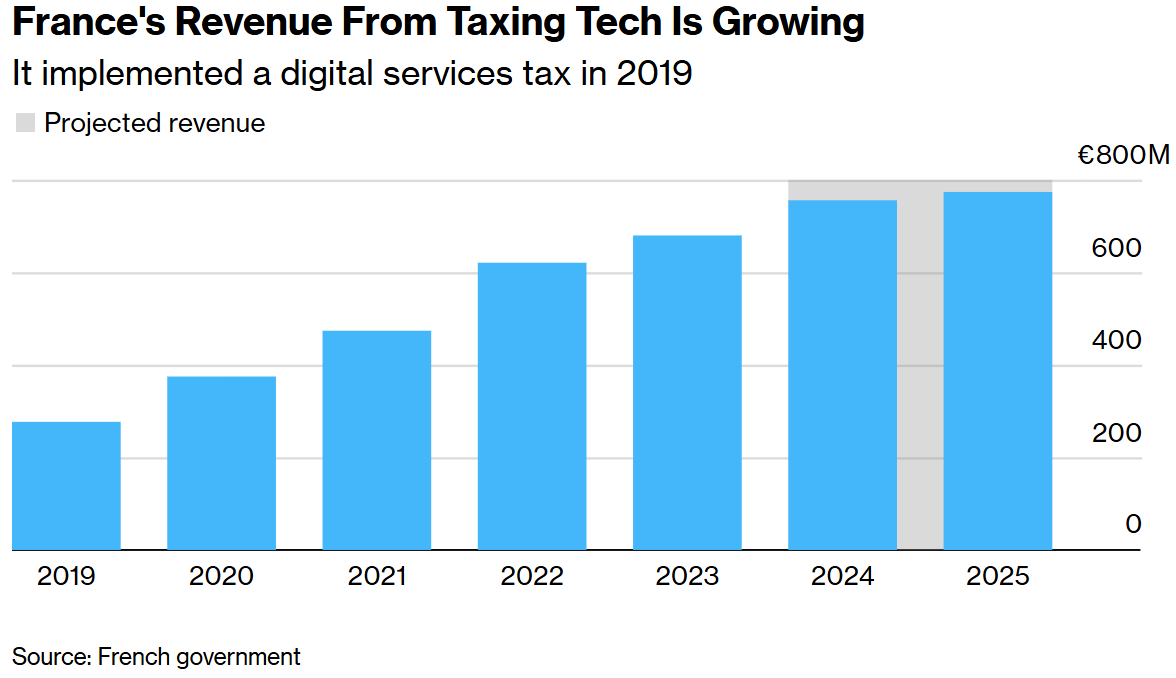
Core Viewpoint - The French government has adjusted the digital services tax (DST) rate from 3% to 6% and raised the global revenue threshold for taxation from €750 million to €2 billion, targeting large digital tech companies while aiming to address tax fairness and protect local interests [2][3]. Summary by Sections Tax Rate and Revenue - The adjustment of the DST is the first since its implementation in 2019, expected to generate increased revenue for the French treasury, with projected revenues of €700 million in 2023 and over €1 billion by 2025 [2][3]. - The tax will now apply to companies with global revenues exceeding €2 billion and digital revenues in France exceeding €25 million [2]. Impact on Companies - The new tax structure primarily affects large multinational internet giants, particularly from the U.S. and to a lesser extent from China, as many Chinese companies have limited market share in France [3][5]. - The adjustment is seen as a direct response to the challenges posed by U.S. tech companies that have historically utilized tax avoidance strategies [4][5]. International Context - France's digital tax initiative is closely linked to ongoing international tax reform discussions led by the OECD, particularly the stalled "Two-Pillar" framework aimed at addressing tax jurisdiction issues in the digital economy [7][8]. - The adjustment reflects France's frustration with the slow progress of OECD negotiations and aims to unilaterally enhance its tax revenue while addressing perceived inequities in the current tax system [9][10]. Economic Implications - The increase in the DST may lead to higher costs for consumers and businesses that rely on these digital platforms, as companies may pass on the tax burden [11][12]. - The adjustment could potentially create a ripple effect in the French economy, impacting local businesses and consumers who engage with these platforms [12].



“废除欧盟”!马斯克反应激烈另有玄机
Xin Jing Bao· 2025-12-08 02:10
Core Viewpoint - The European Union (EU) has imposed a fine of €120 million (approximately $140 million) on Elon Musk's social media platform X, marking a significant escalation in tensions between Musk and the EU [1] Group 1: Fine Imposition - The EU Commission announced the fine as part of its enforcement of the Digital Services Act, marking its first non-compliance decision [1] - Musk reacted strongly, labeling the fine as absurd and criticizing the EU as a "bureaucratic monster" [1] - Compared to previous fines imposed on other tech giants like Apple and Meta, the fine on X is relatively low, especially considering Musk's net worth reached $500 billion in October [1] Group 2: Timing and Context - The timing of Musk's reaction is significant, coinciding with a shift in the U.S. perception of Europe as outlined in the latest U.S. National Security Strategy, which describes Europe as facing a "civilizational decline" [3] - The U.S. government has begun to openly criticize the EU's regulatory approach, indicating a growing ideological divide between the U.S. and Europe [4] Group 3: U.S. Government Response - Following Musk's outburst, U.S. officials, including Vice President Vance and Secretary of State Rubio, publicly supported Musk, framing the EU's actions as an attack on American companies [6][7] - The rhetoric from U.S. officials suggests a coordinated response to bolster Musk's position against the EU [8] Group 4: Broader Implications - The EU's digital services tax has become a major point of contention, with the U.S. previously warning of potential retaliatory measures if the EU does not retract its regulations [9][10] - The EU's commitment to its digital tax is seen as a means to protect its industries and generate significant revenue, further complicating U.S.-EU relations [10]
“废除欧盟”!马斯克反应激烈另有玄机 | 京酿馆
Xin Jing Bao· 2025-12-08 02:09
Core Viewpoint - The European Union (EU) imposed a fine of €120 million (approximately $140 million) on Elon Musk's social media platform X, marking a significant escalation in tensions between Musk and the EU [2][3]. Group 1: EU's Actions and Musk's Response - The EU's fine against X is the first non-compliance decision under the Digital Services Act, highlighting the EU's regulatory stance towards American tech companies [2]. - Musk's reaction was notably more intense compared to previous fines imposed on other tech giants like Google, Apple, and Meta, indicating a shift in the context and timing of the EU's actions [4][5]. - Musk's comments included calling the EU a "bureaucratic monster" and suggesting that it should be abolished to return sovereignty to individual nations [2][5]. Group 2: US-EU Relations and Political Context - The timing of Musk's reaction coincides with a shift in the US's perception of Europe, as indicated by the latest US National Security Strategy report, which describes Europe as facing a "civilizational decline" [5][6]. - The report suggests that the US should cultivate resistance against Europe's current trajectory, reflecting a growing ideological divide between the US and EU [6]. - Musk's relationship with former President Trump has reportedly improved, which may have influenced his strong stance against the EU [6]. Group 3: US Officials' Support for Musk - Following Musk's outburst, several US officials publicly supported him, with Vice President Vance criticizing the EU for attacking American companies [7]. - Secretary of State Rubio and Deputy Secretary Landau echoed similar sentiments, framing the EU's actions as an attack on American interests [8]. - This collective support from US officials indicates a strategic alignment with Musk, potentially as a response to the EU's regulatory actions [8]. Group 4: Broader Implications for US-EU Relations - The EU's digital services tax has become a significant point of contention, with the US previously warning of potential retaliatory measures if the EU continues its regulatory approach [9][10]. - The EU's commitment to maintaining its digital regulatory sovereignty is seen as a means to protect its industries and generate substantial tax revenue [10]. - The ongoing tensions may lead to further deterioration in US-EU relations, extending beyond digital services to broader trade and political issues [10][11].
特朗普施压无效,英国继续对美征收服务税,特朗普交易正在瓦解!
Sou Hu Cai Jing· 2025-11-29 09:13
Core Viewpoint - The UK remains steadfast in imposing a digital services tax on US tech companies despite pressure from the Trump administration, indicating a potential collapse of Trump's trade policies [1][6][9] Group 1: UK-US Trade Relations - The UK has historically been a close ally of the US, often serving as a model for Trump's trade policies, including tariff agreements [3][4] - The UK was the first country to reach a tariff agreement with the US, which has influenced subsequent agreements with other nations [3][4] Group 2: Tariff Agreements - Specific tariff reductions include a decrease in the tariff on the first 100,000 cars exported from the US to the UK from 27.5% to 10%, with a 25% rate on additional units [4] - The UK eliminated tariffs on US beef and set a 13,000-ton duty-free quota, while also removing tariffs on US ethanol [4] Group 3: Digital Services Tax - The UK has been collecting a digital services tax since 2020, which has significantly impacted major US tech companies, generating £678 million in 2024 [6][7] - The tax targets companies with global digital revenues exceeding £500 million and UK user revenues over £25 million, with a rate of 2% [7] - The UK government anticipates that the digital services tax could generate £1.4 billion annually by 2030 [7][9] Group 4: International Taxation Issues - The UK's insistence on the digital services tax reflects a broader issue of tax revenue loss from multinational corporations in the digital economy [9] - The lack of a unified global tax framework has led to fragmented international tax systems, necessitating consensus through multilateral organizations like the OECD [9]
亚马逊、谷歌、Meta或面临法国数字税升级,美国或反制
智通财经网· 2025-10-29 11:29
Core Points - French lawmakers have passed a bill to increase taxes on large tech companies, potentially provoking retaliatory measures from the U.S. government [1] - The proposed amendment raises the digital services tax rate from 3% to 6%, which is less aggressive than a previous proposal to increase it to 15% [1] - The amendment is part of the 2026 budget proposal and does not guarantee final enactment into law [1] Group 1 - The French National Assembly approved an amendment that could significantly increase taxes on companies like Amazon, Alphabet, and Meta [1] - U.S. Republican lawmakers have warned that raising the tax rate to 15% would be an unwarranted attack on American tech companies, leaving Congress and the Trump administration with little choice but to retaliate [1] - The French government, lacking a majority in parliament, is cautious about the proposal and aims to collaborate with lawmakers [1] Group 2 - French Finance Minister Roland Lescure acknowledged the parliament's desire to strengthen taxes on digital giants and emphasized the need for careful handling of tax rate increases [5] - The French government is under pressure to control its significant fiscal deficit, which is the largest in the Eurozone [5] - A new amendment proposed by the far-left opposition party imposes a universal tax based on multinational companies' business activities in France, but Lescure stated that this measure would be unimplementable due to existing bilateral tax treaties [5] Group 3 - The proposed tax rate increase is expected to generate approximately €700 million (about $814 million) annually, which lawmakers argue is disproportionate compared to the profits large tech companies make in France [6] - The threshold for companies subject to this tax will be raised from €750 million to €2 billion in global revenue [6]