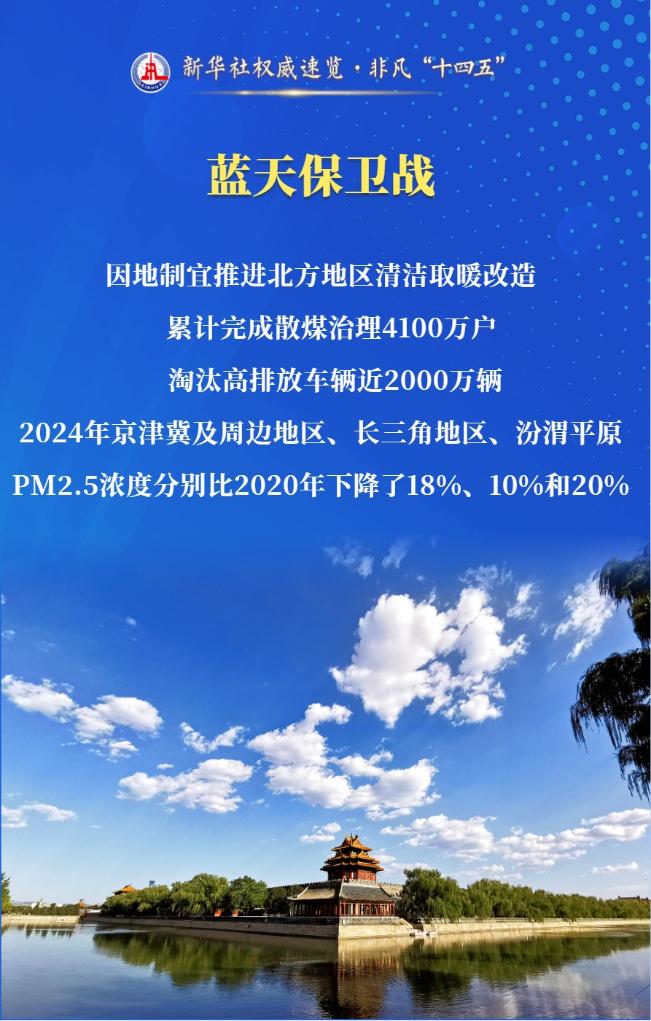
蓝天保卫战

Search documents
北京空气质量多项指标创监测以来最优
Xin Hua She· 2026-01-05 03:04
Core Insights - Beijing has achieved a significant improvement in air quality, with the annual average concentration of PM2.5 dropping to 27.0 micrograms per cubic meter in 2025, marking the first time it has fallen below 30 micrograms since monitoring began [1] - The city has implemented a comprehensive "Blue Sky Defense War" to combat air pollution, focusing on various pollution sources and achieving substantial reductions in heavy pollution days [1] Group 1 - The annual average PM2.5 concentration in Beijing reached 27.0 micrograms per cubic meter in 2025, a record low [1] - The number of good air quality days increased to 348 in 2025, up by 144 days compared to 2013, while heavy pollution days decreased from 58 in 2013 to just 1 in 2025, a reduction of over 98% [1] - All six major pollutants, including inhalable particles, nitrogen dioxide, and ozone, met national standards, indicating comprehensive compliance with air quality requirements [1] Group 2 - Despite improvements, experts warn that the air quality gains are not yet stable, with regional pollutant emissions still high and exceeding environmental capacity [2] - The Beijing Ecological Environment Bureau plans to continue its efforts over the next five years, integrating air pollution control into broader economic and social development, focusing on green transformation and collaborative reduction of emissions and carbon [2] - The "0.1 microgram" action plan will be a key initiative in the ongoing battle for better air quality in Beijing [2]
“北京蓝”成“常态蓝”
Xin Lang Cai Jing· 2026-01-04 23:11
Core Viewpoint - Beijing's air quality has significantly improved, with PM2.5 annual average concentration projected to reach 27.0 micrograms per cubic meter by 2025, marking a historic low and a milestone in air pollution control efforts [1][3][8] Air Quality Improvement - PM2.5 annual average concentration is expected to decrease by 11.5% compared to the previous year, achieving a level below 30 micrograms for the first time [1][3] - Other major pollutants, including PM10, NO2, and O3, have also seen reductions of 11.1%, 8.3%, and 7.0% respectively, with all six monitored pollutants meeting national standards [2][3] - The number of days with good air quality is projected to reach 348, accounting for 95.3% of the year, the highest since monitoring began [1][2][4] Historical Context - Since 2013, PM2.5 levels have dropped from 89.5 micrograms per cubic meter to 27.0 micrograms per cubic meter, a reduction of 69.8% [3] - Heavy pollution days have decreased dramatically from 58 days in 2013 to just 1 day in 2025, a reduction of 98.3% [3] New Energy Vehicles - By 2025, the number of new energy vehicles in Beijing is expected to exceed 1.28 million, tripling from the end of the 13th Five-Year Plan [5] - New energy vehicles are projected to account for over 60% of new cars, with a focus on enhancing the structure of motor vehicles to achieve the best standards in the country [5] Green Initiatives - The city has implemented various green initiatives, including the creation of 1,803 "green" enterprises, representing 39.7% of total enterprises [6] - Measures to reduce volatile organic compounds (VOCs) and promote green upgrades in key industries are ongoing, contributing to a continuous decline in environmental VOCs [6][7] Future Plans - Over the next five years, Beijing aims to integrate air pollution control into broader economic and social development, focusing on a green transition and collaborative efforts to reduce emissions [7] - The "0.1 microgram" action plan will be a key strategy to maintain and enhance air quality [7]
机动车检验机构排放检验评审新规出台
Xin Lang Cai Jing· 2025-12-19 14:22
Core Viewpoint - The issuance of the "Guidelines for On-Site Assessment of Emission Inspection Equipment and Personnel Competence of Motor Vehicle Inspection Institutions" aims to standardize and strengthen the qualification assessment of motor vehicle inspection institutions, ensuring strict market entry requirements for vehicle emissions testing [1][2]. Group 1: Key Requirements - The guidelines focus on five dimensions: testing equipment, measurement standards, testing software, video monitoring, and personnel competence, establishing rigid requirements for each [1]. - Testing equipment must include essential devices such as exhaust gas analyzers, opacity meters, chassis dynamometers, and OBD diagnostic tools, all meeting specified technical standards [1]. - Measurement standards require that items like filters, tachometers, and standard gases obtain calibration and standard material certificates [1]. - Testing software must ensure data traceability and include anti-tampering features [1]. - Video monitoring mandates the installation of panoramic cameras and monitoring devices at inspection sites to display the testing process in real-time [1]. - Personnel in key positions, such as inspectors and technical leaders, must possess relevant professional qualifications and complete demonstration tests [1]. Group 2: Regulatory Impact - The introduction of the guidelines further refines the technical requirements for motor vehicle inspection institutions, preventing capability deficiencies and aiding regulatory bodies in standardizing assessment criteria [2]. - The guidelines aim to enhance the overall capability of vehicle inspections, contributing to the fight against air pollution, as motor vehicle nitrogen oxide emissions account for over 46% of total nitrogen oxide emissions nationwide [2]. - As of now, there are approximately 16,000 motor vehicle inspection institutions in the country, with recent regulatory efforts focusing on optimizing environmental supervision and combating fraudulent inspection practices [2]. - In 2025, regulatory authorities are expected to inspect 11,000 motor vehicle inspection institutions, resulting in 1,439 cases of violations and the revocation of qualifications for 148 severely non-compliant institutions [2].
北京黄色预警:打赢蓝天保卫战还需百尺竿头更进一步
Bei Jing Qing Nian Bao· 2025-12-18 06:48
Core Viewpoint - The air pollution control in Beijing has made significant progress, achieving a historical low in PM2.5 concentration, but challenges remain as the focus shifts to more complex and difficult issues in environmental governance [1][2][3][4] Group 1: Air Quality Improvement - From January to November this year, Beijing's average PM2.5 concentration was 26.5 micrograms per cubic meter, a year-on-year decrease of 16.7%, marking the best performance for the same period since monitoring began [1] - The number of days with good air quality increased by 23 days year-on-year, totaling 282 days [1] - The air pollution yellow alert will be activated on December 18, 2025, indicating ongoing challenges in air quality management [1][2] Group 2: Long-term Challenges - Despite improvements, structural and fundamental pressures on ecological environment protection remain, with significant resource constraints and environmental capacity issues persisting [2] - The air quality improvements are not yet stable, and regional emissions still exceed environmental capacity, posing risks during adverse weather conditions [2][3] Group 3: Governance and Strategy - The environmental governance in Beijing is characterized by persistent efforts and innovative approaches, contributing to a "Beijing Miracle" in air pollution control [3][4] - The focus is shifting from broad measures to more precise actions, with a goal of reducing PM2.5 concentration from 1 microgram to 0.1 microgram, indicating a narrowing margin for improvement [4] - Collaborative efforts among the Beijing-Tianjin-Hebei region are essential for enhancing air quality and achieving sustainable development [3][4]
北京前11月PM2.5平均浓度达有监测记录以来历史同期最优
Xin Hua She· 2025-12-16 06:40
Group 1 - The average concentration of PM2.5 in Beijing from January to November was 26.5 micrograms per cubic meter, a year-on-year decrease of 16.7%, marking the best historical level for the same period since monitoring began [1] - The number of good air quality days reached 282, an increase of 23 days compared to the previous year [1] - The implementation of the "0.1 microgram" action plan has led to significant results in structural emission reduction, promoting the electrification of vehicles, green upgrades for enterprises, and refined urban management [1] Group 2 - The number of new energy vehicles in Beijing exceeded 1.28 million, with over 50% of new cars being electric, and the electrification rate of non-road mobile machinery increased to over 40% [1] - A total of 1,090 new green enterprises were established this year, raising the proportion of green enterprises to 37.5% [1] - The city has exceeded its targets for clean heating renovations and improved the pollution control levels of 1,401 catering units, completing annual tasks ahead of schedule [1] Group 3 - The average dust load on city roads decreased by 18.6% year-on-year, reflecting enhanced dust control measures [2] - The introduction of fully enclosed construction techniques for foundation pits has resulted in 13 new installations this year, bringing the total to 25 [2] - Efforts to strengthen waste gas collection and treatment at 17 large-scale livestock farms have successfully exceeded ammonia reduction targets [2] Group 4 - Beijing will focus on the characteristics of pollution during the autumn and winter seasons, enhancing air quality forecasting and targeted actions in key areas to ensure the completion of the "14th Five-Year" planning goals and the Blue Sky Defense War action plan by 2025 [2]
好天儿常见 空气更新鲜
Liao Ning Ri Bao· 2025-10-31 01:04
Group 1: Air Quality Improvement - The air quality in Shenyang has significantly improved, with no smog days reported since October and PM2.5 daily average concentration remaining below 65 micrograms per cubic meter [1] - In 2024, the province recorded 325 days of good air quality, an increase of 19 days compared to 2020, with heavy pollution days averaging only 1.8, a reduction of 2.1 days from 2020 [1] - By the third quarter of 2025, the proportion of good air quality days reached 89.4%, marking the best historical level for the same period [1] Group 2: Industrial Transformation - The green transformation of industrial enterprises is crucial for expanding blue sky coverage, with Ansteel Baicheng Steel Plant investing 2.6 billion yuan in ultra-low emission modifications, achieving advanced emission levels for sulfur dioxide, particulate matter, and nitrogen oxides per ton of steel [2] - Thirteen steel enterprises in Liaoning have completed ultra-low emission modifications, covering 91.44% of the production capacity of operating enterprises [2] - A comprehensive monitoring network has been established, including 15 county-level and 10 township-level air quality automatic monitoring stations, enhancing pollution source identification and management [2] Group 3: Heating Season Management - The previous heating season in Shenyang did not experience heavy pollution days, with significant upgrades to old heating pipelines and the elimination of small coal-fired boilers in various cities [3] - The city plans to eliminate over 30,000 old diesel trucks and update 82,400 National III passenger vehicles in 2024, promoting electric and hydrogen vehicles in public transport and logistics [3] - The comprehensive utilization rate of straw in the province is expected to reach 93.16% by the end of 2024, utilizing methods such as feed, fuel, fertilizer, substrate, and raw material [3] Group 4: Public Sentiment and Quality of Life - The improvement in air quality has enhanced public happiness, with citizens enjoying outdoor activities and observing more stars at night due to clearer skies [4] - Key air quality indicators, including PM2.5 concentration, proportion of good air days, and heavy pollution days, have shown year-on-year improvements by the third quarter of 2025 [4] - The blue sky campaign aligns with public needs, allowing citizens to share in the benefits of high-quality development through improved air quality [4]
久久为功,“APEC蓝”成为“北京蓝”
Ren Min Ri Bao· 2025-10-20 06:29
Core Viewpoint - The article discusses the significant improvements in air quality in Beijing, transitioning from the temporary "APEC Blue" to a more permanent "Beijing Blue" through systematic environmental governance and pollution control efforts [1][4][6]. Group 1: Environmental Governance Efforts - In 2014, President Xi Jinping emphasized the need for systematic environmental governance in major cities like Beijing, identifying air pollution as a critical issue [2][3]. - A series of targeted measures were implemented, including PM2.5 source analysis, transitioning from coal to electricity and gas, and the elimination of outdated vehicles [3][5]. - The collaboration among Beijing, Tianjin, Hebei, and surrounding cities has been formalized into a joint air pollution prevention and control mechanism, expanding from "2+26" to "2+36" cities [5]. Group 2: Achievements in Air Quality - Since 2013, the number of heavily polluted days in China has decreased by over 90%, with the average PM2.5 concentration in cities expected to reach 29.3 micrograms per cubic meter by 2024 [5][6]. - The average PM2.5 concentration in Beijing in 2024 is projected to be 30.5 micrograms per cubic meter, a 65.9% reduction from 2013 levels [8]. Group 3: Global Impact and Cooperation - China has become the fastest country in the world to improve air quality, with significant commitments to carbon peak and neutrality goals by 2030 and 2060, respectively [6][8]. - The country has signed cooperation agreements with over 40 developing nations to combat climate change and is a major supplier of wind and solar energy equipment globally [8].
久久为功,“APEC蓝”成为“北京蓝”(总书记的关切·落地的回响)
Ren Min Ri Bao· 2025-10-20 00:43
Core Points - The article emphasizes the importance of practical implementation of policies and the commitment of the Chinese government to environmental protection and air quality improvement [1][2][3] Group 1: Environmental Policy and Implementation - The Chinese government has prioritized air pollution control as a major public welfare issue, particularly in large cities like Beijing, and has initiated a comprehensive approach to environmental governance [2][3] - Specific measures taken include the analysis of PM2.5 sources, transitioning from coal to electricity and gas, and the elimination of outdated vehicles, showcasing a meticulous approach to pollution control [3][4] - The collaboration among the Beijing-Tianjin-Hebei region and surrounding cities has expanded from 2+26 to 2+36 cities to enhance air quality management [5] Group 2: Achievements in Air Quality Improvement - Since 2013, the number of heavily polluted days in China has decreased by over 90%, with a target PM2.5 average concentration of 29.3 micrograms per cubic meter by 2024 [5][8] - The average PM2.5 concentration in Beijing has dropped by 65.9% from 2013 to 2024, indicating significant progress in maintaining blue skies as a norm [8][9] - The transformation towards a greener economy is highlighted, with China becoming the fastest country in improving air quality globally, aiming for carbon peak by 2030 and carbon neutrality by 2060 [7][8] Group 3: International Cooperation and Global Impact - China has signed cooperation agreements with over 40 developing countries to combat climate change and is a major supplier of wind and solar energy equipment globally [8] - The commitment to international climate cooperation is reinforced by China's announcement of new national contributions at the UN climate summit, aiming for a climate-adaptive society by 2035 [8]
从雾霾围城到蓝天常在,散煤治理还需啃下“可持续”的硬骨头
2 1 Shi Ji Jing Ji Bao Dao· 2025-09-25 07:23
Core Insights - The article discusses the significant progress made in coal consumption reduction and air quality improvement in China over the past decade, particularly in the context of the "Blue Sky Defense War" and subsequent action plans aimed at combating air pollution [1][2][3] Summary by Sections Achievements in Coal Reduction - China has cumulatively reduced coal consumption by approximately 600 million tons over the past ten years, with the clean heating rate in northern regions increasing from less than 30% in 2018 to over 80% currently [1] - The average PM2.5 concentration in the Beijing-Tianjin-Hebei region has decreased by over 50% compared to ten years ago, marking a significant milestone in air quality improvement [1][2] Clean Heating Initiatives - More than 40 million households in the Beijing-Tianjin-Hebei region have benefited from clean heating transformations, with the clean heating rate rising from 65% at the end of 2020 to approximately 83% [2] - The reduction in coal usage for residential heating in northern rural areas is projected to fall to between 5.5 million and 7.5 million tons by the end of 2024 [2] Challenges and Future Directions - Despite significant achievements, challenges remain, particularly in the northwest and northeast regions where coal consumption reduction efforts need to be sustained [3][4] - The need for a long-term mechanism to ensure the sustainability of clean heating initiatives is emphasized, as rising costs may lead to a potential rebound in coal usage [4] - The article suggests that future efforts should focus on integrating clean heating with rural economic development and enhancing the affordability of clean energy solutions [5] Policy and Innovation - The report advocates for policy innovation, technological advancements, and the exploration of new business models to address the structural and regional challenges in coal governance [6] - It highlights the importance of aligning clean heating initiatives with broader goals of energy transformation, environmental protection, and socio-economic development [6]
新华社权威速览·非凡“十四五”丨污染防治几场保卫战,环保部门这样打!
Xin Hua She· 2025-09-19 11:18
Core Viewpoint - The "14th Five-Year Plan" period is significant for ecological civilization construction and environmental protection in China, with the ecological environment department setting higher standards for key battles such as blue sky, clear water, and clean land [1] Group 1: Blue Sky Protection Campaign - The northern region has implemented clean heating modifications, completing coal-to-gas conversions for 41 million households [3] - Nearly 20 million high-emission vehicles have been eliminated [3] - PM2.5 concentrations in the Beijing-Tianjin-Hebei region, Yangtze River Delta, and Fenwei Plain are projected to decrease by 18%, 10%, and 20% respectively compared to 2020 levels by 2024 [3] Group 2: Clear Water Protection Campaign - A comprehensive investigation of pollution outlets has been conducted, identifying over 360,000 river pollution outlets and more than 63,000 sea pollution outlets [5] - The remediation completion rates for seven major river basins and key bays have reached 90% and 93.3% respectively [5] Group 3: Clean Land Protection Campaign - Actions for soil pollution source prevention have been implemented, with the tracing of heavy metal pollution in agricultural land completed in 132 key counties [8] - Over 100,000 administrative villages have undergone comprehensive environmental remediation [8] - The rural sewage treatment rate has exceeded 45% [8]