AI手机

Search documents
弘信电子:预计2025年净利润同比增长93.61%-164.01%
Xin Lang Cai Jing· 2026-01-27 08:45
弘信电子公告,预计2025年度净利润为11000-1.5亿元,同比增长93.61%-164.01%。报告期内,国内各 大国产主流手机品牌推出创新的AI手机以及叠加国补政策的驱动手机消费需求显著释放,激发国内手 机市场的进一步复苏,有力的拉动了国内手机产业链的需求。公司始终保持对高端FPC产品的研发和生 产制造的高投入,凭借在技术水平、产品品质、交付能力及综合服务能力方面优势,获得国内头部手机 品牌的一致认可。 ...

AI手机的终局,“读屏”还是“对话”?
创业邦· 2026-01-24 10:43
Core Viewpoint - The article discusses two distinct technological approaches to AI integration in mobile devices: the GUI (Graphical User Interface) route, which prioritizes speed and ease of use, and the A2A (Agent-to-Agent) route, which emphasizes security and collaboration through standardized APIs [7][17][29]. Group 1: AI Integration Approaches - The GUI approach allows AI to simulate user actions on apps by utilizing system permissions, enabling rapid deployment but raising concerns about user experience and security [10][14]. - The A2A approach establishes a standardized communication protocol between AI and applications, requiring dual authorization from users and app developers, which enhances security and accountability [14][15]. - The choice between these approaches reflects companies' strategic interests and their positions within the tech ecosystem, with GUI being faster but riskier, while A2A is slower but more stable and secure [17][29]. Group 2: Industry Responses - Major tech companies like Apple and Google favor the A2A approach, focusing on API integration to maintain control over their ecosystems and ensure compliance with privacy regulations [18][21]. - Microsoft has developed frameworks like "AutoGen" to facilitate multi-agent collaboration, while OpenAI and Anthropic are pushing for API standards that align with the A2A model [19][21]. - In contrast, domestic companies like ByteDance are exploring high-permission GUI routes to disrupt existing ecosystems and capture new market opportunities [23][24]. Group 3: Future Implications - The A2A model is seen as a long-term solution that could lead to new business opportunities, including the development of specialized agents for various industries and the establishment of a new ecosystem of protocols and middleware [33][35]. - The article suggests that the evolution of AI integration will ultimately shape the relationship between humans and machines, emphasizing the need for AI to serve as an intelligent assistant rather than a replacement for human decision-making [37][38].






闻泰科技涨2.07%,成交额10.46亿元,主力资金净流出2381.59万元
Xin Lang Cai Jing· 2026-01-23 03:24
Core Viewpoint - Wentech Technology's stock price has shown a mixed performance in recent trading sessions, with a year-to-date increase of 7.16% and a significant drop of 12.12% over the past 60 days, indicating volatility in its market position [2]. Group 1: Stock Performance - As of January 23, Wentech Technology's stock rose by 2.07%, reaching a price of 39.95 CNY per share, with a trading volume of 10.46 billion CNY and a turnover rate of 2.15% [1]. - The stock has experienced a 1.37% increase over the last five trading days and a 4.53% increase over the last 20 days, while it has decreased by 12.12% over the last 60 days [2]. Group 2: Financial Performance - For the period from January to September 2025, Wentech Technology reported a revenue of 29.769 billion CNY, reflecting a year-on-year decrease of 44.00%. However, the net profit attributable to shareholders increased by 265.09% to 1.513 billion CNY [2]. - The company has distributed a total of 796 million CNY in dividends since its A-share listing, with 155 million CNY distributed over the past three years [3]. Group 3: Shareholder Information - As of September 30, 2025, Wentech Technology had 160,400 shareholders, an increase of 5.70% from the previous period, with an average of 7,758 circulating shares per shareholder, a decrease of 5.39% [2]. - The top ten circulating shareholders include Hong Kong Central Clearing Limited, holding 39.3967 million shares, which is a decrease of 7.7472 million shares from the previous period [3].

华为登顶,吃了谁的蛋糕?
Xin Lang Cai Jing· 2026-01-22 20:13
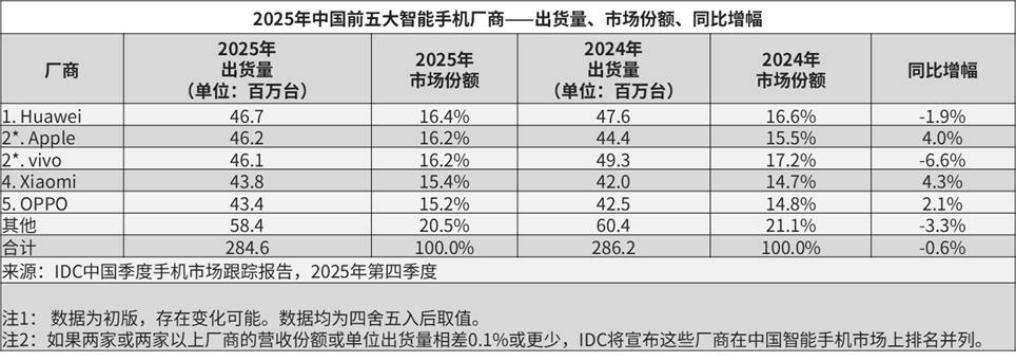
Core Insights - Huawei has regained the top position in the Chinese smartphone market with a shipment of 46.7 million units and a market share of 16.4% in 2025, although this is significantly lower than its peak of 124.9 million units and 38.3% market share in 2020 [2][3][6] - The competition among the top three manufacturers—Huawei, Apple, and Vivo—is intense, with their shipment volumes closely aligned, indicating a highly competitive market landscape [4][7] - Despite Huawei's return to the top, its shipment volume has decreased by approximately 2% year-on-year, reflecting a broader market decline [5][6] Shipment and Market Share - In 2025, the top five smartphone manufacturers in China by shipment volume are: 1. Huawei: 46.7 million units (16.4%) 2. Apple: 46.2 million units (16.2%) 3. Vivo: 46.1 million units (16.2%) 4. Xiaomi: 43.8 million units (15.4%) 5. OPPO: 43.4 million units (15.3%) [3][6] - The overall smartphone market in China saw a slight decline, with total shipments of 284.4 million units in 2025, down 0.6% from 2024 [6] Activation vs. Shipment - Huawei's activation volume ranks fifth, significantly lower than its shipment volume, indicating potential inventory issues with a gap of over 3 million units between shipments and activations [10][12] - In contrast, other brands like Vivo, Apple, and OPPO have activation volumes closely matching their shipment volumes, suggesting healthier inventory management [12][10] Competitive Landscape - The competition is not only between Huawei and Apple but also includes Vivo, which has maintained a strong presence in the market, and Xiaomi, which has shown positive growth [30][34] - OPPO has also demonstrated resilience, achieving a year-on-year shipment growth of nearly 30% in 2025, indicating a robust competitive strategy [34] Product Strategy and Pricing - Huawei's successful return is attributed to its strong product lineup, including the Mate 70 and Pura 80 series, which have seen significant sales despite the absence of advanced 3nm chips [21][24] - The company has strategically reduced prices on key models, with reductions exceeding 800 yuan, making its products more competitive in a market where other brands have raised prices [27][29] Future Outlook - The smartphone market in 2026 is expected to face challenges, including rising storage costs and a potential decline in overall shipments, which could reshape the competitive dynamics [36][38] - The ability of manufacturers to adapt to these changes and maintain product appeal will be crucial for sustaining market positions in the coming years [38]

苹果计划将Siri重塑为内置聊天机器人!机器人ETF(562500)开盘冲高,震荡整理
Mei Ri Jing Ji Xin Wen· 2026-01-22 06:21
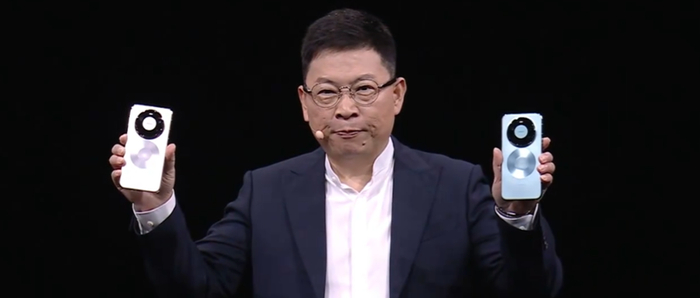
Group 1 - The Robot ETF (562500) opened with a high volatility, reaching a maximum increase of 0.81% during the day, with a latest price of 1.119 yuan, up 0.09% from the opening price. Among the 66 constituent stocks, 33 showed an increase, with CITIC Heavy Industries rising over 10% [1] - The trading volume of the Robot ETF (562500) reached 258 million yuan, with a turnover rate of 0.98%, indicating normal trading activity [1] - Apple plans to significantly revamp Siri into its first AI chatbot, codenamed Campos, to compete with generative AI leaders like OpenAI and Google. The chatbot is expected to be deeply integrated into iPhone, iPad, and Mac operating systems, with a showcase at the WWDC in June and a formal release in September [1] Group 2 - The Robot ETF (562500) is the only robot-themed ETF in the market with a scale exceeding 20 billion yuan, covering various segments such as humanoid robots, industrial robots, and service robots, allowing investors to easily access the entire robot industry chain [2] - Following the adjustment of constituent stocks, the humanoid robot content in the index tracked by the Robot ETF (562500) has increased to nearly 70%. The recent rebalancing effectively removed underperforming stocks and included quality stocks, achieving a "retain the strong, remove the weak" strategy [2]

ETF午评 | 半导体板块领涨,集成电路ETF涨4.79%
Ge Long Hui· 2026-01-21 03:53
Market Performance - The Shanghai Composite Index rose by 0.16%, while the ChiNext Index increased by 0.85% [1] - The total trading volume in the Shanghai, Shenzhen, and Beijing markets reached 16,458 billion yuan, a decrease of 2,196 billion yuan compared to the previous day [1] Sector Performance - The computing hardware industry chain showed strength, with GPU and server sectors leading the gains [1] - Active sectors included lithium mining, semiconductors, AI smartphones, rare earths, and humanoid robots [1] - Weaker sectors included coal, retail, liquor, banking, and electric power [1] ETF Performance - The semiconductor sector saw significant gains, with ETFs such as the Jiashi Fund Integrated Circuit ETF, Guolianan Fund Sci-Tech Chip Design ETF, and Guotai Fund Integrated Circuit ETF rising by 4.79%, 4.31%, and 4.22% respectively [1] - The Xinchuang sector also performed well, with the E Fund Xinchuang ETF and GF Fund Xinchuang ETF increasing by 3.88% and 3.62% respectively [1] - Cyclical sectors experienced a pullback, with the coal ETF declining by 1.85%, and the food and beverage sector also saw declines, with the liquor ETF and food and beverage ETF falling by 1.67% and 1.38% respectively [1]
弘信电子涨2.02%,成交额1.28亿元,主力资金净流入74.45万元
Xin Lang Cai Jing· 2026-01-21 02:34
Core Viewpoint - Hongxin Electronics has shown a mixed performance in stock price and financial metrics, with a notable increase in revenue and net profit year-on-year, indicating potential growth in the flexible printed circuit board (FPC) sector [1][2]. Financial Performance - For the period from January to September 2025, Hongxin Electronics achieved a revenue of 5.55 billion yuan, representing a year-on-year growth of 24.75% [2]. - The net profit attributable to shareholders reached 90.51 million yuan, marking a significant increase of 65.47% compared to the previous year [2]. Stock Performance - As of January 21, the stock price of Hongxin Electronics rose by 2.02% to 29.86 yuan per share, with a total market capitalization of 14.41 billion yuan [1]. - Year-to-date, the stock has increased by 7.95%, but it has experienced a decline of 4.17% over the last five trading days [1]. Shareholder Information - As of September 30, 2025, the number of shareholders increased to 79,100, up by 9.07% from the previous period [2]. - The average number of circulating shares per shareholder decreased by 5.80% to 5,927 shares [2]. Dividend History - Since its A-share listing, Hongxin Electronics has distributed a total of 126 million yuan in dividends, with no dividends paid in the last three years [3]. Institutional Holdings - As of September 30, 2025, the fourth largest circulating shareholder is the Southern CSI 1000 ETF, holding 3.5725 million shares, a decrease of 36,800 shares from the previous period [3]. - Hong Kong Central Clearing Limited is the sixth largest circulating shareholder, holding 2.8626 million shares, down by 318,900 shares [3].
2025年中国手机激活量排名:vivo蝉联榜首 小米反超苹果登次席
Xin Lang Cai Jing· 2026-01-20 13:39
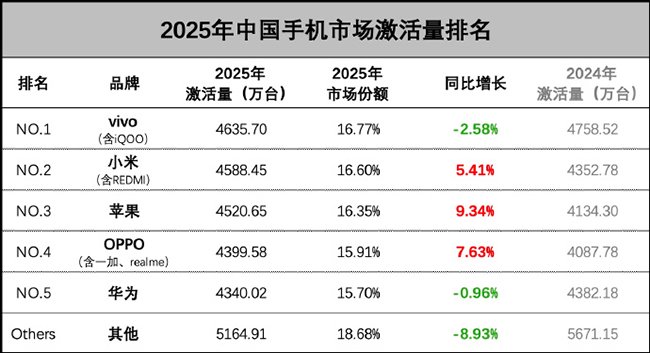
Core Insights - The 2025 Chinese smartphone market has seen a subtle shift in the competitive landscape, with vivo maintaining its lead, followed by Xiaomi and Apple, all surpassing 40 million units in activation volume [1][7]. Market Rankings - Vivo (including iQOO) ranked first with an activation volume of 46.357 million units, holding a market share of 16.77%, despite a slight decline of 2.58% from 2024 [2][8]. - Xiaomi (including REDMI) achieved an activation volume of 45.884 million units, capturing a market share of 16.60%, marking a growth of 5.41% year-on-year, thus surpassing Apple to claim the second position [3][9]. - Apple secured the third position with an activation volume of 45.206 million units and a market share of 16.35%, experiencing a significant growth of 9.34% [3][10]. - OPPO (including OnePlus and realme) ranked fourth with 43.996 million units and a market share of 15.91%, showing a year-on-year increase of 7.63% [4][10]. - Huawei placed fifth with an activation volume of 43.400 million units and a market share of 15.70%, reflecting a slight decline of 0.96% [4][10]. Market Trends - The overall smartphone market in China saw a slight decline in demand, with total shipments around 285 million units, down 0.6% year-on-year, indicating a softening consumer demand [2][8]. - The market is characterized by a "high-end consolidation and mid-range competition," with AI smartphones and foldable screens emerging as key growth areas [4][10]. - In 2025, the shipment volume of AI smartphones reached 118 million units, achieving a penetration rate of over 40% [4][10]. Future Outlook - Industry experts predict a continued slight decline in overall shipments by 2%-3% in 2026, with rising memory chip prices potentially increasing average smartphone prices by 10%-20% [11]. - The focus for leading brands will likely shift towards high-profit segments, intensifying market competition [11]. - Key questions for 2026 include whether vivo can maintain its lead, if Xiaomi can solidify its second position, and whether Apple can sustain its high-end growth trajectory [11].
全球每三台手机就有一台广东造 广货“粤来粤强”驶入快车道
Nan Fang Du Shi Bao· 2026-01-19 13:52
Core Viewpoint - The Guangdong smartphone industry is experiencing significant growth and transformation, establishing itself as a global leader in smartphone manufacturing and innovation, with local brands gaining substantial market share both domestically and internationally [1][2][11]. Group 1: Industry Overview - Guangdong is the most important cluster for the smartphone industry in China, leading in scale, production, and export, with a projected revenue of 1.9618 trillion yuan in 2024, accounting for 38.7% of the province's new generation electronic information industry revenue [2]. - In 2024, Guangdong's smartphone production reached 683 million units, representing 40.9% of the national total, while exports amounted to 205 million units, also leading the country [2]. - The smartphone industry in Guangdong has evolved from a manufacturing hub to a global innovation leader, with local brands capturing 38% of the global market share by 2025 [2][12]. Group 2: Brand Performance - Major Guangdong brands like Huawei, OPPO, and vivo dominate both domestic and international markets, with Huawei's global shipment reaching 48.4 million units in 2024, capturing one-third of the high-end market [3]. - OPPO's global shipments reached 104.8 million units in 2024, with its Reno series leading in the $400-$600 price segment [3]. - By 2025, six Guangdong brands are expected to be among the top ten in the global smartphone market, with market shares of 9% for vivo, 8% for Transsion, and 7% for OPPO [2]. Group 3: Global Expansion Strategies - Guangdong smartphone brands are increasingly focusing on international markets, particularly in Southeast Asia and Latin America, leveraging cultural similarities and existing market experiences for efficient penetration [4][5]. - OPPO's gradual global expansion strategy began in Thailand and has since included Indonesia and Vietnam, with plans to enter European markets [5]. - vivo's strategy emphasizes deep localization, establishing a significant retail network in Indonesia and expanding into various regions since 2014 [5]. Group 4: Technological Innovation - Guangdong smartphone companies are at the forefront of technological innovation, with significant investments in R&D, particularly in chip technology and fast charging [11]. - Huawei's self-developed Kirin 9000S chip achieved a 65% self-sufficiency rate in 2024, while OPPO's 125W fast charging technology leads globally in patent numbers [11]. - The rise of AI smartphones, with brands like Huawei and vivo integrating advanced AI capabilities, marks a new era in the industry [12]. Group 5: Manufacturing and Supply Chain - Guangdong's smartphone manufacturing ecosystem is robust, with a high concentration of electronic component manufacturers, accounting for 28% of China's total [7]. - The region's strong supply chain allows for rapid assembly and production, with average production cycles as short as 48 hours in Dongguan [9]. - Major manufacturers like Foxconn and local firms have adopted advanced manufacturing techniques, enhancing efficiency and production capabilities [8][9].

中国手机市场,活活打成一场“消耗战”
3 6 Ke· 2026-01-19 11:20
Core Insights - The Chinese smartphone market experienced a slight decline in 2025, with total shipments around 285 million units, a year-on-year decrease of 0.6% compared to a 5.6% growth in 2024 [1] - Key trends include a solidified high-end market, intense competition in the mid-range segment, and the entry of external players, prompting traditional manufacturers to innovate and expand their business boundaries [1] Market Dynamics - Huawei regained the top position in the Chinese smartphone market in 2025, with a shipment of 46.7 million units, a 1.9% decrease from 2024 [6][5] - Apple followed closely with 46.2 million units shipped, marking a 4% increase year-on-year, and capturing a market share of 16.2% [6][5] - The top five manufacturers—Huawei, Apple, vivo, Xiaomi, and OPPO—showed minimal differences in market share, all exceeding 15%, with only a 330,000 unit gap between the first and fifth [4][3] Competitive Landscape - The competition among the top five manufacturers has intensified, with no significant gaps in market share, indicating a shift towards a more competitive environment [2][4] - Xiaomi is focusing on high-end markets and aims to increase its average selling price (ASP) while exploring new growth avenues through its automotive business [8][22] - OPPO and vivo are facing challenges in their traditional offline channels due to the rise of e-commerce and aggressive competition from peers [9] Market Segmentation - The mid-range market (2000-4000 yuan) is characterized by fierce competition, with brands pushing flagship technologies into this segment, leading to a homogenization of products [11] - The high-end market remains stable, with no significant shifts in market dynamics, as brands struggle to introduce disruptive technologies that could challenge established players like Apple and Huawei [12] Technological Evolution - The smartphone industry is transitioning into an era of "joint definition," where both hardware and AI capabilities are being integrated to enhance user experience [15][21] - Two main technological paths are emerging: one led by internet companies focusing on AI-driven hardware, and another by traditional manufacturers integrating AI into their existing hardware [17][20] Industry Expansion - Traditional smartphone manufacturers are diversifying their business models, exploring new growth avenues such as electric vehicles and AI products [22] - New entrants, particularly from the internet and AI sectors, are reshaping the competitive landscape, with companies like ByteDance seeking partnerships to leverage their AI capabilities in the smartphone market [25][26]