
未来产业

Search documents
靠前谋划一批重大项目 央企持续扩大有效投资
Xin Lang Cai Jing· 2026-01-12 21:04
Group 1 - The core objective of the central enterprises is to strengthen, optimize, and expand state-owned enterprises and state capital, focusing on enhancing value creation capabilities and planning major projects and landmark projects to achieve qualitative and quantitative growth [1] - Central enterprises have completed fixed asset investments of 3.3 trillion yuan (approximately 0.5 trillion USD) in the first 11 months before 2025, with an average annual growth rate of over 20% in emerging industries during the 14th Five-Year Plan period [1] - The State-owned Assets Supervision and Administration Commission (SASAC) emphasizes the need for effective investment to accumulate development potential, focusing on key areas such as industrial chain strengthening, infrastructure construction, energy resource security, and forward-looking industrial layout [1] Group 2 - In the first quarter of 2026, the Southern Power Grid plans to invest over 24 billion yuan (approximately 3.7 billion USD) in power grid infrastructure construction, reflecting a year-on-year increase of over 20% [2] - Major engineering projects are progressing, including the first "Hualong One" nuclear power project in the Greater Bay Area and the expansion of the Wanzhou Power Plant by the State Energy Group, with total investments reaching 7 billion yuan (approximately 1.1 billion USD) [2] - The promotion of major projects by central enterprises is expected to effectively invest and accumulate development potential, enhancing consumer vitality through urban renewal, affordable housing, and new infrastructure in smart logistics and 5G [2] Group 3 - The discussions emphasize the need for optimizing the layout and structural adjustment of state-owned economies, focusing on core responsibilities, integrating technological and industrial innovation, and accelerating the transformation and upgrading of traditional industries [3] - There is a call for deeper reforms to establish a modern enterprise system with Chinese characteristics, improve corporate governance structures, and address deep-seated issues that hinder enterprise development [3] - The goal is to build more world-class enterprises while balancing high-quality development and high-level security [3]
利好来了!万亿级“国家队”投向明确,四部门联合发布
Sou Hu Cai Jing· 2026-01-12 15:54
Core Viewpoint - The National Development and Reform Commission and three other departments have issued a significant document to guide the planning and investment direction of government investment funds, marking the first systematic regulation at the national level for these funds [1][2]. Group 1: Investment Direction and Areas - The government investment funds will focus on supporting the development of new productive forces, with key areas including emerging industries such as new generation information technology, new energy, new materials, high-end equipment, new energy vehicles, green environmental protection, civil aviation, and marine engineering equipment [1][5][7]. - Future industries highlighted include the metaverse, brain-computer interfaces, quantum information, humanoid robots, generative artificial intelligence, biomanufacturing, biological breeding, future displays, future networks, and new energy storage [1][5][7]. Group 2: Policy Measures and Guidelines - The document outlines 14 policy measures focusing on three main aspects: where to invest, how to invest, and who manages the funds [5][6]. - It emphasizes the need for funds to support major strategies and key areas, particularly in sectors where market resources are inadequately allocated, promoting deep integration of technological and industrial innovation [5][6]. Group 3: Evaluation and Management - The newly established evaluation management method includes three primary indicators: policy compliance (60% weight), optimization of productive force layout (30% weight), and policy execution capability (10% weight) [6][7]. - The policy compliance indicator assesses the fund's role in supporting new productive forces, technological innovation, and green development, among other areas [7][8]. Group 4: Regional Focus and Local Fund Management - Local funds are required to align their investment directions with local industrial foundations and development realities, focusing on industrial upgrades and enhancing innovation capabilities [6][8]. - The document also mandates that local funds support small and micro enterprises and technology-based startups, guiding social capital to participate effectively [6][8].

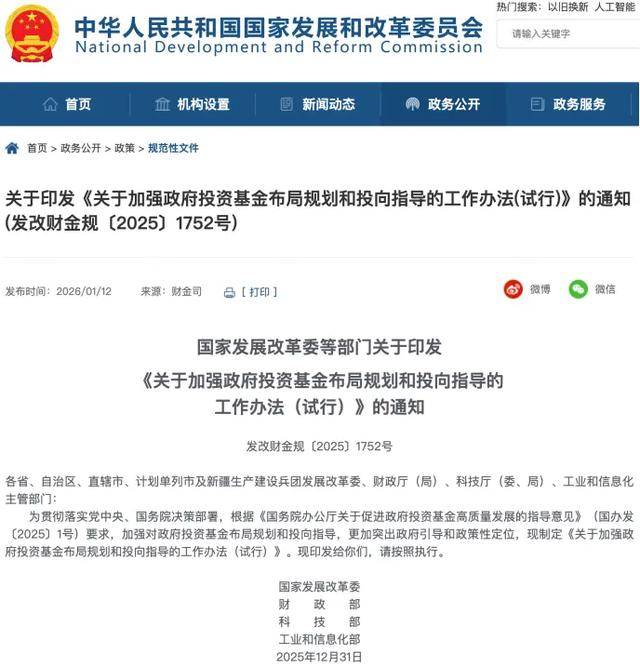
大利好!首次国家层面规范,万亿级政府投资基金指向科学仪器
仪器信息网· 2026-01-12 14:53
Core Viewpoint - The article discusses the systematic regulation of government investment funds at the national level, aiming to direct substantial investments into sectors that struggle with resource allocation, particularly in high-tech industries like high-end scientific instruments, which represent "hard technology" [1][8]. Group 1: Policy Framework - The National Development and Reform Commission, Ministry of Finance, Ministry of Science and Technology, and Ministry of Industry and Information Technology jointly released the "Work Method for Strengthening the Layout Planning and Investment Guidance of Government Investment Funds (Trial)" [2]. - The "Management Method" establishes a comprehensive evaluation system for fund investment, combining quantitative and qualitative assessments to enhance policy guidance and management [2][8]. Group 2: Investment Focus Areas - The evaluation of fund investments will focus on supporting the development of new productive forces, with targeted sectors including new generation information technology, new energy, new materials, high-end equipment, new energy vehicles, green environmental protection, civil aviation, and marine engineering equipment [6]. - Future industries highlighted include areas such as metaverse, brain-computer interfaces, quantum information, humanoid robots, generative artificial intelligence, biomanufacturing, biological breeding, future displays, future networks, and new energy storage [7]. Group 3: Strategic Investment Guidelines - The "Work Method" outlines 14 policy measures focusing on "where to invest, how to invest, and who manages it" [8]. - It emphasizes the need for funds to support major strategies and key areas, particularly in sectors where market resource allocation is ineffective, promoting deep integration of technological and industrial innovation [8].

从粗放式向精细化转变 政府投资基金投向“路线图”划定
Bei Jing Shang Bao· 2026-01-12 13:11
1月12日,国家发展改革委、财政部、科技部、工业和信息化部联合发布《关于加强政府投资基金布局 规划和投向指导的工作办法(试行)》(以下简称《工作办法》),国家发展改革委相关负责人表示, 这是首次在国家层面对政府投资基金的布局和投向作出系统规范。 国家发展改革委还同步制定了《政府投资基金投向评价管理办法》(以下简称《管理办法》)。这两份 文件有机衔接,标志着我国政府投资基金从粗放式管理向精细化管理转变,对于提升财政资金使用效 益、引导社会资本、服务国家战略意义重大。 推动政府投资基金精准发力 政府投资基金是各级政府通过预算安排,单独出资或与社会资本共同出资设立,采用股权投资等市场化 方式,引导各类社会资本支持相关产业和领域发展及创新创业的投资基金。其中,国家级基金是经国务 院批准、中央财政出资设立的政府投资基金,地方基金是经批准由地方财政出资设立的政府投资基金。 近年来,政府投资基金作为财政支出方式的重要创新,在撬动社会资本、支持创新创业、培育新兴产 业、推动产业升级等方面发挥了积极作用。 2025年,国家层面对创业投资、股权投资的重视程度持续提升,对政府投资基金的政策支持力度不断加 大。2025年1月,国务院 ...

迈普医学:公司将持续关注新兴产业、未来产业的技术发展方向
Zheng Quan Ri Bao Wang· 2026-01-12 11:11
Group 1 - The core viewpoint of the article is that MaiPu Medical (301033) is committed to continuously monitoring the technological development directions of emerging and future industries [1] Group 2 - The company engages with investors through interactive platforms to address inquiries and provide updates on its strategic focus [1]
政府投资基金,投向明确!四部门联合发布
Sou Hu Cai Jing· 2026-01-12 09:28
事关政府投资基金,四部门重磅发文。 1月12日,国家发展改革委等四部门联合印发《关于加强政府投资基金布局规划和投向指导的工作办法(试行)》(以下简称《工作办法》)。同时,国家 发展改革委也同步出台了《政府投资基金投向评价管理办法(试行)》(以下简称《管理办法》)的通知。 其中提到,主要考察基金投向是否符合支持新质生产力发展,支持的投向领域包括:培育新兴产业、未来产业。新兴产业主要包括新一代信息技术、新能 源、新材料、高端装备、新能源汽车、绿色环保、民用航空和船舶与海洋工程装备等领域;未来产业主要包括元宇宙、脑机接口、量子信息、人形机器 人、生成式人工智能、生物制造、生物育种、未来显示、未来网络、新型储能等领域。 四部门重磅发布 1月12日,国家发展改革委、财政部、科技部、工业和信息化部联合发布《关于加强政府投资基金布局规划和投向指导的工作办法》(以下简称《工作办 法》)。国家发展改革委相关负责人表示,这是首次在国家层面对政府投资基金的布局和投向作出系统规范。 据央视新闻,《工作办法》围绕政府投资基金"投向哪、怎么投、谁来管"三方面,提出14项政策举措。 在优化基金布局方面,要求基金支持重大战略、重点领域和市场 ...

利好来了!刚刚,四部门联合发布!
天天基金网· 2026-01-12 08:30
Core Viewpoint - The article discusses the release of a significant document by four government departments aimed at strengthening the planning and guidance of government investment funds, focusing on supporting emerging and future industries [2][4]. Group 1: Government Investment Fund Guidelines - The document titled "Work Method" outlines a systematic approach to the layout and investment direction of government investment funds for the first time at the national level [4]. - It emphasizes the need for funds to support major strategies and key areas, particularly in sectors where market resource allocation is weak, promoting deep integration of technological and industrial innovation [7]. - The guidelines specify that funds should align with national major plans and encourage investment in emerging industries such as new generation information technology, renewable energy, and high-end equipment [7][10]. Group 2: Investment Focus Areas - The investment focus includes nurturing emerging industries and future industries, with specific sectors identified such as artificial intelligence, quantum information, and bio-manufacturing [10][11]. - Traditional industry upgrades and digital economy development are also highlighted, with initiatives like "Artificial Intelligence+" and the promotion of smart manufacturing [11][12]. - The guidelines require local funds to choose investment directions based on regional industrial foundations and development realities, supporting industrial upgrades and innovation capabilities [8][10]. Group 3: Evaluation and Management - The "Management Method" establishes a comprehensive evaluation system for fund direction, combining quantitative and qualitative assessments [8][10]. - It includes three primary indicators: policy compliance (60% weight), optimization of productivity layout (30% weight), and policy execution capability (10% weight) [10][12]. - The evaluation aims to ensure that funds effectively support national development goals and adhere to regional strategic initiatives [12].

重磅利好,万亿级“国家队”投向明确了
21世纪经济报道· 2026-01-12 08:13
政府投资基金,是不少科创企业和产业项目的"伯乐"和"助攻"。这一次,国家出手,首次为万 亿级的政府投资基金发展定方向。 据央视新闻,12日,国家发展改革委、财政部、科技部、工业和信息化部联合发布《关于加强 政府投资基金布局规划和投向指导的工作办法(试行)》(以下简称《工作办法》)。 同 时,国家发展改革委也同步出台了《政府投资基金投向评价管理办法(试行)》(以下简称 《管理办法》)的通知。 国家发展改革委相关负责人表示:这是首次在国家层面对政府投资 基金的布局和投向作出系统规范。 同时,《工作办法》还进一步明确由省级发展改革部门牵头制定本地区重点投资领域清单,并 据此优化基金布局和投向。 涉及航空、A I、人形机器人 据券商中国,在指标设置上,《管理办法》共设置3个一级、13个二级指标。一是政策符合性 指标(权重 60%),主要评价基金在支持新质生产力发展、支持科技创新和促进成果转化、 推进全国统一大市场建设、支持绿色发展、支持民营经济发展和促进民间投资、壮大耐心资 本、带动社会资本、服务社会民生等方面发挥的作用,推动基金立足政策性定位,更好服务国 家发展大局。 二是优化生产力布局指标(权重 30%),主要评 ...

利好来了!刚刚,“国家队”投向明确!四部门联合发布
券商中国· 2026-01-12 06:10
Core Viewpoint - The article discusses the release of a significant document by four government departments in China, outlining guidelines for government investment funds, focusing on supporting emerging and future industries, and establishing a structured evaluation system for fund allocation [1][3][6]. Group 1: Government Investment Fund Guidelines - The document titled "Work Method" aims to systematically regulate the layout and investment direction of government investment funds for the first time at the national level [3]. - The guidelines emphasize the need for funds to support major strategies and key areas, particularly in sectors where market resource allocation is weak, promoting deep integration of technological and industrial innovation [6]. - Investment areas include emerging industries such as new-generation information technology, new energy, new materials, high-end equipment, and future industries like the metaverse, brain-computer interfaces, and generative artificial intelligence [1][9]. Group 2: Evaluation and Management of Fund Investments - The "Management Method" establishes a comprehensive evaluation system for fund investments, combining quantitative and qualitative assessments [7][9]. - Three primary indicators are set: policy compliance (60% weight), optimization of productivity layout (30% weight), and policy execution capability (10% weight) [9][11]. - The evaluation focuses on whether fund investments align with national strategic plans and encourage the development of new productive forces, including support for green development and the private economy [9][10].

工信部:聚焦脑机接口、6G等领域,加强技术攻关、产品开发
Xin Hua She· 2026-01-12 05:11
Core Viewpoint - The Ministry of Industry and Information Technology emphasizes the need for a forward-looking layout and coordinated planning to accelerate the establishment of mechanisms for future industry investment growth and risk sharing, focusing on breakthroughs in fields such as quantum technology, humanoid robots, brain-computer interfaces, deep-sea polar exploration, and 6G technology [1] Group 1: Industrial Economic Stability - The industrial and information system aims to maintain stable growth in the industrial economy, achieving a year-on-year increase of 6% in industrial added value for large-scale industries in the first 11 months of 2025, with high-tech manufacturing and equipment manufacturing growing by 9.2% and 9.3% respectively [2] - The focus will be on four areas: "stability," "expansion," "innovation," and "growth" to ensure industrial economic resilience and vitality [2][3] Group 2: Modern Industrial System Development - The construction of a modern industrial system will prioritize advanced manufacturing, aiming for high-quality development through intelligent, green, and integrated manufacturing [4] - Traditional industries will undergo renewal through targeted improvement plans, while emerging industries will be supported to become new engines of growth [4][5] Group 3: Technology and Innovation Integration - The integration of technology and industry will be deepened, with a focus on enhancing the supply of high-quality technology and promoting the transformation of technological achievements [6][7] - The establishment of a national manufacturing innovation center and the implementation of major technology projects will be prioritized to boost industrial technological innovation capabilities [6][8] Group 4: Digital Transformation in Manufacturing - The push for deep integration of information technology and industrialization will continue, with significant advancements in digitalization, networking, and intelligence in manufacturing [9][10] - The focus will be on building a robust digital foundation and enhancing network connectivity to facilitate the transition to smart manufacturing [9][10]
