
数字化转型

Search documents
华蓝集团股价短期反弹,主力资金持续流出
Jing Ji Guan Cha Wang· 2026-02-11 08:01
Group 1 - The stock price of Hualan Group (301027) closed at 18.92 yuan on February 11, 2026, with a daily increase of 0.58% and a trading volume of 44.7 million yuan, reflecting a turnover rate of 2.00% [1] - Over the past 7 days, the stock price has shown significant volatility, with a slight decline of 0.11% to 18.81 yuan on February 10, accompanied by a net outflow of 6.4264 million yuan from main funds, accounting for 8.14% of the total trading volume [1] - The stock price has cumulatively increased by 2.10% over the last 5 days, but has experienced a decline of 5.16% over the past 20 days, indicating a coexistence of short-term rebounds and medium-term pressures [1] - Retail investor funds saw a net inflow of 6.2761 million yuan on February 10, while main funds continued to flow out, suggesting a divergence in market sentiment [1] Group 2 - On February 6, 2026, Hualan Group released its 2024 Social Responsibility and ESG report, highlighting the company's accelerated digital transformation and the completion of its AI computing power center [2] - The report emphasizes the company's development of photovoltaic power generation and other businesses in line with its "dual carbon" strategy, showcasing its commitment to sustainable development and technological upgrades [2] - The short-term impact of these developments on the stock price is expected to be limited [2]

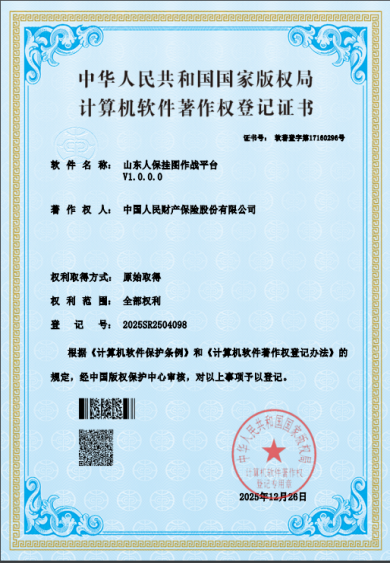
人保财险山东分公司斩获三项软件著作权证书
Qi Lu Wan Bao· 2026-02-11 07:35
Core Viewpoint - The digital transformation is essential for the high-quality development of the insurance industry, and the company has made significant progress through a series of innovative achievements in technology and customer service [1]. Group 1: Digital Innovation Achievements - The company has recently received national software copyright certifications for its self-developed platforms, including the "Battle Map Operation Platform," "Mobile Quick Report Platform," and "Smart Claims Management System," indicating a new level of technological innovation in customer service and resource integration [1][5]. - The "Battle Map Operation Platform" utilizes big data and artificial intelligence to enhance management efficiency and provide tailored insurance solutions for corporate clients [5][6]. - The "Mobile Quick Report Platform" integrates business data analysis and daily office functions, allowing real-time data access and automated report generation to improve management efficiency [5]. Group 2: Smart Claims Management System - The "Smart Claims Management System" enhances claims processing efficiency through full online and intelligent control, improving customer satisfaction and experience [6]. - The system ensures fairness and consistency in claims processing by automatically matching third-party service providers based on preset rules, eliminating human intervention [6]. - The implementation of a closed-loop management model allows for traceable operations and clear documentation, significantly reducing claims processing time [6]. Group 3: Future Directions - The approval of software copyrights marks a significant achievement in the company's digital transformation strategy, demonstrating its commitment to innovation and intellectual property protection [6]. - The company plans to continue deepening its efforts in the digital insurance sector, accelerating the integration of AI and other innovative technologies into business scenarios to provide more efficient and convenient insurance products and services [6].

四大AMC明确2026路线图:锚定主责主业 筑牢风险底线
2 1 Shi Ji Jing Ji Bao Dao· 2026-02-11 05:04
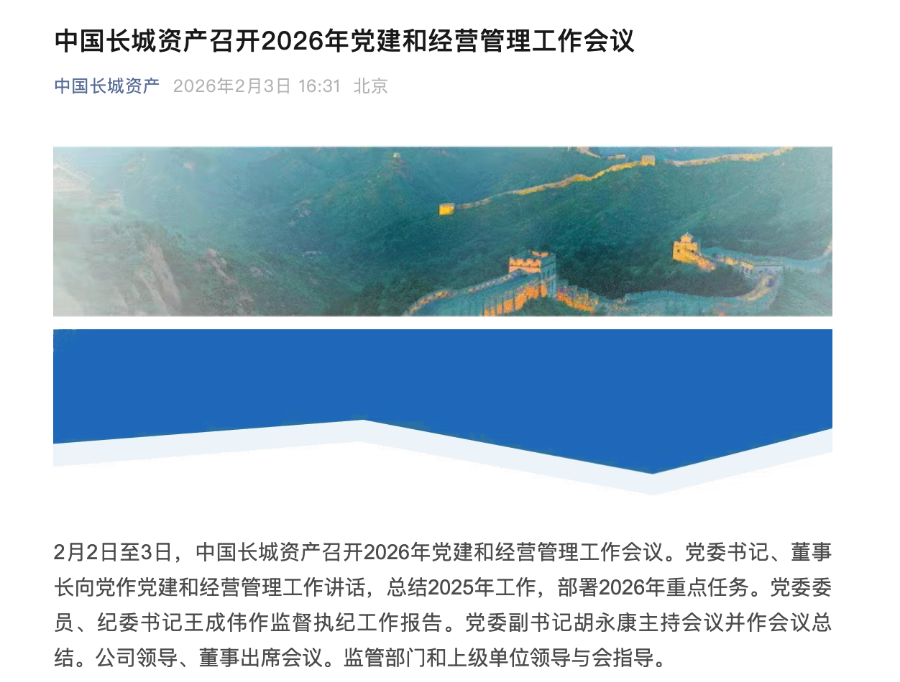
Core Viewpoint - The four major national Asset Management Companies (AMCs) in China are focusing on their core responsibilities and aligning their operations with national strategies to enhance risk management and support high-quality economic development [1][5][9]. Group 1: Focus on Core Responsibilities - The AMCs emphasize the importance of maintaining their core function of handling non-performing assets and aligning their business development with national strategic needs, particularly in relation to the financial "five major articles" [2][5]. - Great Wall Asset Management aims to "precisely expand non-performing asset business" and innovate in real estate revitalization [2]. - CITIC Financial Asset Management stresses the need to "stick to the main battlefield of non-performing assets" and expand high-quality business investments [2]. Group 2: Risk Management - The AMCs are prioritizing risk prevention and management to ensure stable operations, with a focus on creating a robust "safety net" [9][12]. - Great Wall Asset Management has identified "risk prevention" as a key annual work line, while CITIC Financial Asset Management aims to "strengthen bottom-line thinking" [9][12]. - The AMCs are committed to building a comprehensive risk management system that is intelligent and covers all aspects of their operations [12][15]. Group 3: Technological Empowerment - The AMCs are pushing for digital transformation and talent development as key drivers for enhancing their core competitiveness [16]. - Great Wall Asset Management plans to deepen reforms in personnel, incentives, and management [16]. - CITIC Financial Asset Management aims to become a leader in industry transformation through the implementation of a "strong core" project [16].

宜春经开区:生产线上争春早 奋力冲刺“开门红”
Zhong Guo Fa Zhan Wang· 2026-02-11 05:02
Core Insights - The companies in Yichun Economic Development Zone are experiencing a surge in production as they prepare for the upcoming Spring Festival, demonstrating a strong growth momentum and aiming for a successful start in 2026 [1] Group 1: Company Performance - Jiangxi Suqiang Hydraulic Co., Ltd. is the largest domestic production base for hydraulic hose fittings, achieving over 60 million yuan in revenue in January 2026, with stable order growth projected through June [1] - The company is actively working on fulfilling urgent orders from foreign clients, including Caterpillar, indicating a robust demand for its products [1] Group 2: Technological Advancements - Since establishing an intelligent factory in 2018, the company has invested significantly in technological upgrades and process innovations, optimizing workshop management and enhancing production efficiency [2] - The introduction of new equipment and smart factory construction has notably improved production efficiency and reduced physical labor for employees [2] Group 3: Future Projections - The company anticipates a revenue growth of over 20% in 2026, aiming for a production value of 800 million yuan [2] - Continued investment in research and development, along with a focus on digital transformation and smart factory initiatives, is expected to further enhance production efficiency and product competitiveness [2]
锦富技术子公司拟收购奥英创智10%股权 强化控制权聚焦商显协同
Zheng Quan Ri Bao Wang· 2026-02-11 04:35
Core Viewpoint - The acquisition of a 10% stake in Suzhou Aoying Chuangzhi Technology Co., Ltd. by Aoying Optoelectronics will enhance the company's control over the target, improve operational efficiency, and optimize resource allocation in the context of the growing digital transformation and smart scene market demand [1][2]. Group 1: Transaction Details - Aoying Optoelectronics plans to acquire a 10% stake in Aoying Chuangzhi for 12 million yuan, increasing its ownership from 40.80% to 50.80% [1]. - The transaction is classified as a related party transaction due to the involvement of Wang Xiaohu, who holds a significant stake in the acquiring entity [1]. Group 2: Financial Performance of Aoying Chuangzhi - As of 2024, Aoying Chuangzhi reported total assets of 214 million yuan, net assets of 19.73 million yuan, and an operating income of 288 million yuan, with a net loss of 4.69 million yuan [2]. - By September 30, 2025, the company had total assets of 202 million yuan, net assets of 25.52 million yuan, and an operating income of 290 million yuan, with a net profit of 5.80 million yuan (unaudited) [2]. Group 3: Strategic Implications - The increase in control over Aoying Chuangzhi is expected to enhance strategic management, reduce coordination costs, and align the target's business development with the parent company's overall strategy [2]. - The commercial display industry is experiencing structural growth due to digital transformation, and leading companies are better positioned to leverage technological advancements and customer resource accumulation [2][3]. - Continuous monitoring of Aoying Chuangzhi's technological development and market expansion capabilities is essential, given the fast-paced nature of the commercial display industry [3].

榜单印证实力!东鹏特饮以59%涨幅突围,铸就国民能量品牌传奇
Quan Jing Wang· 2026-02-11 02:50
Core Insights - Dongpeng Special Drink has achieved significant brand value growth, ranking 53rd in the 2025 Hurun China Brand List with a 59% increase in brand value and a rise of 11 places [1] - The company reported a revenue of 12.563 billion yuan in the first three quarters of 2025, reflecting a nearly 20% year-on-year growth [1] - The launch of a sugar-free variant in 2025 aims to expand consumer demographics and meet health demands, while strategic marketing in top-tier sports events enhances brand recognition [1] Market Position - Dongpeng Special Drink has maintained its position as the top-selling energy drink in China since 2021, achieving both sales volume and revenue leadership in 2025 [2] - The market share of Dongpeng Special Drink increased from 15.0% in 2021 to 26.3% in 2024, solidifying its status as a benchmark brand in the domestic functional beverage sector [2] Product Strength - The product's competitive edge is rooted in a scientifically formulated energy matrix, which includes taurine, lysine, inositol, caffeine, and vitamins, catering to various energy replenishment scenarios [3] - The new sugar-free variant includes L-α-glycerylphosphorylcholine to support cognitive function, appealing to health-conscious consumers [3] Brand Strategy - Dongpeng Special Drink's branding strategy focuses on engaging the youth demographic through sports, esports, and trendy events, positioning itself as a vital energy partner for young consumers [4] - The company has sponsored major events such as the FIFA World Cup and the Asian Games, enhancing its visibility and brand association with high-profile sports [4] Distribution Network - The company has established a comprehensive sales network covering nearly 100% of China's prefecture-level cities, with over 3,200 distributors and more than 4.3 million active retail points [5] - Dongpeng Special Drink has embraced digital transformation, implementing a full-chain digital system to enhance operational efficiency and consumer engagement [5] Future Outlook - Dongpeng Special Drink's growth trajectory is attributed to its understanding of industry trends and consumer needs, positioning it as a leading brand in the functional beverage market [6] - The company aims to continue strengthening its market leadership and enhancing the brand's influence in the Chinese functional beverage sector [6]

今天,可口可乐2025年报出炉,候任CEO说,中国一直是最重要的市场之一,将在华保持超前投入
3 6 Ke· 2026-02-11 02:40
Core Insights - Coca-Cola Company reported resilient growth in its annual financial results for 2025, with Q4 revenue of $11.822 billion, a 2% increase year-over-year, and net profit of $2.316 billion, up 5% [1] - The company’s total net revenue for 2025 reached $47.941 billion, a 2% growth, while net profit surged by 23% to $13.137 billion [1] - CEO James Quincey emphasized the company's focus on strategic execution for long-term success as he prepares to hand over leadership to Henrique Braun in March 2026 [3][21] Financial Performance - In Q4 2025, Coca-Cola's earnings per share (non-GAAP) was $0.58, exceeding market expectations of $0.56, while the full year EPS was $3.00, surpassing the forecast of $2.99 [1] - Global single-serve sales grew by 1% in Q4, while annual sales remained flat; however, the company noted a strong momentum towards the end of the year [17][18] Market Performance in Asia-Pacific - In the Asia-Pacific region, Q4 single-serve sales were flat, with comparable operating profit (non-GAAP) declining by 3% due to rising input costs [4] - The company is focusing on long-term growth opportunities in China, despite a weaker performance in Q4 compared to other periods [6][11] Product Innovations and Marketing Strategies - Coca-Cola introduced several innovative products in 2025, including the "Share a Coke" campaign and new flavors in its Sprite and tea brands, aimed at enhancing market performance [8][10] - The company is actively engaging in market feedback through initiatives like the "Market Impact Week" to inform future product planning and strategies [10] Supply Chain Enhancements - Coca-Cola is investing in its supply chain, with upgrades to five production bases in China, including new facilities in Shaanxi and Zhengzhou, to improve efficiency and resilience [11][13][15] - The company has implemented a "24-hour emergency drinking water rescue mechanism," responding to natural disasters and supporting community resilience [16] Leadership Transition and Future Outlook - The transition to new CEO Henrique Braun is part of a planned succession strategy, with Braun expected to leverage his experience in the Greater China region to drive future growth [21][25] - Coca-Cola has set a 2026 guidance for organic revenue growth of 4% to 5% and EPS growth of 7% to 8%, indicating a positive outlook for the upcoming year [20]


CORRECTING and REPLACING Q2 FY26 Results: LuxExperience Group reports Net Sales growth of +5.7% ex-FX and return to Adjusted EBITDA profitability, fully confirming the transformation plan targets
Businesswire· 2026-02-11 02:32
Core Insights - LuxExperience Group reported a net sales growth of +5.7% excluding foreign exchange (FX) effects and returned to adjusted EBITDA profitability, confirming the targets of its transformation plan [1][2] Financial Highlights - Positive cash flow from operating activities amounted to €118.5 million for the second quarter ended December 31, 2025 [1][2] - The adjusted SG&A cost ratio decreased by 180 basis points to 19.1% in Q2 FY26, excluding capitalized IT development costs [1][2] - Mytheresa achieved a GMV growth of +12.7% ex-FX (+9.9% reported) with adjusted EBITDA increasing by +40% to a 9.3% margin compared to Q2 FY25 [1][2] - The group confirmed medium-term targets of €4 billion in net sales and a 7-9% adjusted EBITDA margin [1][2] - The adjusted EBITDA margin for the group was +2.0% in Q2 FY26, marking a return to profitability [1][2] Segment Performance Luxury | Mytheresa - Adjusted EBITDA reached €22.6 million with a margin of 9.3%, up from 7.3% in Q2 FY25 [2] - GMV grew by +9.9% reported (+12.7% ex-FX) to €268.9 million [2] - Net sales increased by +8.8% reported (+11.6% ex-FX) to €242.7 million [2] Luxury | NAP & MRP - Adjusted EBITDA was -€1.9 million with a margin of -0.7%, down from 4.2% in the prior year [2] - GMV decreased by -1.9% reported (+4.9% ex-FX) to €290.7 million [2] - Net sales decreased by -1.0% reported (+6.0% ex-FX) to €277.1 million [2] Off-Price | YOOX - Adjusted EBITDA was -€7.5 million with a margin of -6.0%, an improvement from -18.1% in Q1 FY26 [2] - GMV declined by -12.1% reported (-9.4% ex-FX) to €125.3 million [2] - Net sales decreased by -7.3% reported (-4.6% ex-FX) to €125.3 million [2] Strategic Developments - The company is executing a transformation plan with a focus on cost discipline and customer engagement [1][2] - A binding agreement was made to sell assets powering THE OUTNET platform for a cash consideration of USD 30 million, allowing LuxExperience to concentrate on its YOOX business [3][4] - The divestment is expected to enhance the overall transformation plan and improve infrastructure efficiency for NET-A-PORTER and MR PORTER [3][4]

跟着首都发展节拍跃马扬鞭
Bei Jing Ri Bao Ke Hu Duan· 2026-02-10 22:46
Core Viewpoint - The "Five Sub-areas" linkage is a core strategy for high-quality development in Beijing, with Huaxia Bank deeply integrating into the capital's development through its "Jinghua Action" initiative, focusing on technology and green finance to stimulate consumption and support regional collaboration [1]. Group 1: Financial Support and Services - Huaxia Bank has established a funding support system worth hundreds of billions, aiming to provide over 500 billion yuan in various financing services to the Beijing region by 2025, representing a 15% year-on-year increase [1]. - The bank has successfully granted a comprehensive credit line of 3.5 billion yuan to a high-end semiconductor equipment company, with 2.5 billion yuan already disbursed to enhance its technological capabilities [6]. - By 2025, Huaxia Bank's loans to technology enterprises are expected to exceed 240 billion yuan, with a growth rate of over 50%, focusing on key industries such as digital economy and artificial intelligence [11]. Group 2: Technology Finance Initiatives - Huaxia Bank has elevated technology finance to a strategic priority, aiming to support the construction of Beijing as an international technology innovation center [7]. - The bank has created a product matrix addressing the entire lifecycle of enterprises, offering tailored financial products from startup loans to mergers and acquisitions financing [9]. - A grid-based service system has been established, with a focus on 23 specialized technology branches to ensure comprehensive coverage of technology finance resources across Beijing [8]. Group 3: Green Finance Development - Green finance is a key area for Huaxia Bank, with a dedicated management committee and specialized departments to enhance its green finance capabilities [12]. - The bank has developed a diverse range of green financial products, including loans and investment options, and has been recognized for its contributions to green finance at international trade events [13]. - By 2025, the bank's green loans in the clean energy sector are projected to reach nearly 4 billion yuan, supporting various renewable energy projects [15]. Group 4: Consumer Finance Enhancement - Huaxia Bank is actively enhancing consumer finance by designing differentiated products that integrate financial tools into consumption scenarios, promoting a healthy consumption cycle [18]. - The bank has collaborated with major supermarkets and restaurants to launch promotional activities, benefiting over 200,000 customers [20]. - Initiatives in cultural and entertainment sectors have attracted significant participation, generating over 10 billion yuan in transaction volume [21]. Group 5: Regional Collaboration and Development - The "Jinghua Action" has achieved full coverage of 37 state-owned enterprises in the capital, providing over 4.8 billion yuan in credit for key projects [23]. - The bank has supported major relocation projects and infrastructure developments, contributing over 2 billion yuan in credit for the Beijing urban sub-center [25]. - In 2025, Huaxia Bank is expected to provide nearly 90 billion yuan in financing services for key projects in the Beijing-Tianjin-Hebei region, marking a 31% year-on-year increase [27]. Group 6: Digital Transformation - Huaxia Bank is advancing its digital transformation, with loans to core digital economy sectors exceeding 100 billion yuan and a growth rate of 24.8% [28]. - The bank is optimizing its organizational structure to enhance technological support and has received an A-grade in digital management assessments [28]. - The integration of artificial intelligence into key operational areas is being prioritized to build competitive advantages [28]. Group 7: Future Directions - The bank aims to leverage new policies to expand domestic demand and enhance its service offerings in technology finance and green trade [30]. - Continued focus on the "Jinghua Action" will drive financial support for the capital's modernization efforts, ensuring alignment with the city's development goals [30].

药明生物(2269.HK):业绩修复与平台化能力强化推动经营表现持续提升
Ge Long Hui· 2026-02-10 21:06
Core Viewpoint - The company is expected to see continuous performance recovery in 2025, with stable revenue and profit growth anticipated to extend into 2026, driven by enhanced platform capabilities and an optimized project structure [1][2]. Group 1: Performance Outlook - The company forecasts double growth in revenue and profit for 2025, supported by global network expansion and digital transformation initiatives [1]. - Revenue and profit growth rates for 2025E-2027E are projected at 13.4%/18.9%/18.4% and 10.7%/18.6%/16.7%, respectively [1]. Group 2: Project Growth and Quality - In 2025, the company plans to add 209 comprehensive projects, bringing the total to 945, with approximately two-thirds being complex molecules such as bispecific antibodies and ADCs [2]. - The bispecific antibody segment is the fastest-growing and most profitable, contributing nearly 20% of revenue with over 120% year-on-year growth [2]. - By the end of 2025, the company will have 74 clinical phase III projects and 25 commercial production projects, supporting future revenue growth [2]. Group 3: Global Expansion and Strategic Investments - About half of the new projects signed in 2025 are from the U.S., as the company continues to build strategic hubs in the U.S., Singapore, and Qatar [3]. - Significant investments are being made in the U.S., including a 36,000L bulk liquid capacity in Worcester, Massachusetts, expected to be operational by 2028 [3]. - The target price has been raised to HK$54.23, reflecting a P/E ratio of 49 times for 2026, indicating potential for further valuation growth [3].