
自主创新

Search documents
攻克“卡脖子”,无惧打压勇攀登(评论员观察) ——“十四五”创新突破启示录①
Ren Min Ri Bao· 2025-10-12 22:14
Core Insights - The emphasis on technological modernization as a foundation for national strength and high-quality development is highlighted, with a focus on breakthroughs in "bottleneck" technologies during the 14th Five-Year Plan period [1][2] - The transformation of external pressures into opportunities for innovation and self-reliance is underscored, showcasing advancements in domestic technologies such as operating systems and high-end bearings [2][3] - The importance of a coordinated effort in tackling key technological challenges is emphasized, with a call for reforms to enhance the innovation ecosystem and empower enterprises [3][4] Group 1 - The breakthroughs in "bottleneck" technologies enhance national confidence and collective spirit, reflecting a resilient attitude towards external challenges [1][3] - The development of domestic operating systems and high-end bearings strengthens strategic autonomy in key industries, contributing to a more robust digital economy [2][3] - The shift from dependency to self-sufficiency in technology is evident, with significant advancements in lithium battery production and laser radar technology [2][3] Group 2 - The coordinated national effort in addressing technological challenges is crucial, leveraging the advantages of the new type of national system to focus on critical areas like integrated circuits and basic software [3][4] - The resilience of the Chinese industrial and supply chain is demonstrated through examples such as Huawei's recovery in chip development and Zhejiang Yiwu's export growth despite external pressures [3][4] - The recognition of China's innovation capabilities is reflected in its ranking in the Global Innovation Index, marking a significant milestone in the country's modernization journey [4]
攻克“卡脖子”,无惧打压勇攀登(评论员观察)
Ren Min Ri Bao· 2025-10-12 22:10
Core Viewpoint - The article emphasizes the importance of technological innovation as a foundation for China's modernization and high-quality development, highlighting significant achievements during the "14th Five-Year Plan" period [1]. Group 1: Technological Breakthroughs - Breakthroughs in "bottleneck" technologies have enhanced national confidence and resilience, showcasing a collective spirit of perseverance and determination [2][4]. - The "Zuchongzhi No. 3" supercomputer is reported to be 15 orders of magnitude faster than the current fastest supercomputer, marking a significant advancement in computing power [2]. - The development of domestic operating systems and high-end bearings has strengthened key industries such as digital economy and aerospace [3]. Group 2: Strategic Autonomy - Addressing "bottleneck" issues has allowed China to gain strategic autonomy in development, reducing reliance on foreign technologies [3][4]. - The domestic lithium battery industry has seen a resurgence due to breakthroughs in manufacturing techniques, enabling a shift from dependence to self-sufficiency [3]. - The successful development of laser radar technology lays a foundation for intelligent driving, further enhancing China's technological capabilities [3]. Group 3: Systematic Innovation Efforts - A coordinated effort from top to bottom is necessary to tackle key technological challenges, emphasizing the importance of a national strategic approach [4]. - Reforms in the technology system, including the removal of barriers and the promotion of innovation, are crucial for unleashing the potential of technological advancements [4]. - The resilience of China's industrial and supply chains is highlighted by the ability to adapt and thrive despite external pressures, as seen in the case of Zhejiang Yiwu's export growth [4]. Group 4: Global Innovation Standing - According to the World Intellectual Property Organization, China has entered the top ten of the Global Innovation Index for the first time, reflecting its growing influence in global development and civilization [6].
正听 | 科技赋能,中国风电“风头正劲”
Ke Ji Ri Bao· 2025-10-12 17:52
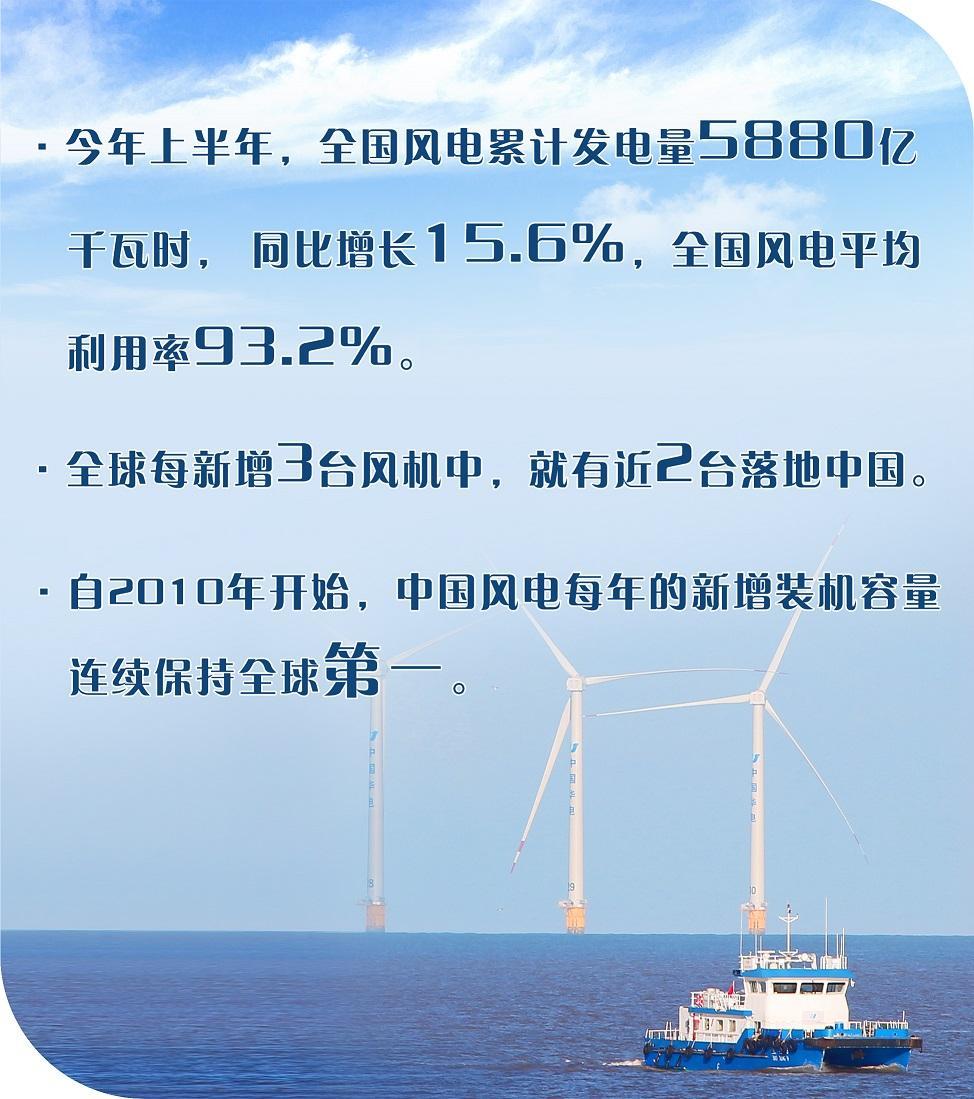
Core Viewpoint - The Chinese wind power industry is experiencing robust growth, with significant advancements in technology and market expansion, positioning itself as a global leader in renewable energy [2][5][11]. Industry Overview - The A-share wind power sector saw a strong performance on the first trading day of October, with leading wind turbine manufacturers' stock prices rising collectively, reflecting the industry's strong development momentum [2]. - According to the National Energy Administration, China's newly installed wind power capacity reached 51.39 million kilowatts in the first half of the year, with a cumulative installed capacity of 573 million kilowatts by June 2025, marking a year-on-year growth of 22.7% [2]. - Wind power generation in China totaled 588 billion kilowatt-hours in the first half of the year, representing a year-on-year increase of 15.6%, with an average utilization rate of 93.2% [2]. Company Highlights - Yunda Energy Technology Group has played a pivotal role in the evolution of China's wind power industry, transitioning from reliance on imported technology to becoming a leader in innovation [4][5]. - The company has developed significant products, including the world's largest 10 MW onshore wind turbine and the 18 MW floating platform, contributing to a projected 12.5 GW of new installed capacity in 2024, placing it among the top three globally [5][6]. - Mingyang Smart Energy Group has established a comprehensive industrial chain from nearshore to deep-sea wind power, demonstrating resilience during extreme weather events [7][8]. - Mingyang's floating wind turbines can be deployed in deep waters, significantly expanding the potential for wind energy development [7]. - Envision Group has expanded its operations globally, with over 30,000 wind turbines managed and an installed capacity exceeding 80 GW, leading in global order volume [10][11]. Technological Advancements - Yunda Energy has achieved breakthroughs in high-voltage technology, enabling the integration of electrical systems for large-capacity wind turbines, marking a significant milestone for Chinese enterprises [5]. - Mingyang has developed various wind power solutions tailored to different environmental conditions, enhancing the industry's adaptability [8]. - Envision's self-research and manufacturing capabilities in core components have driven the development of the entire supply chain, improving the efficiency of green energy utilization globally [11].



中美关系其实并不复杂,要么是中国交出财富,要么是美国放弃霸权
Sou Hu Cai Jing· 2025-10-12 09:27
Group 1 - The core issue of US-China relations revolves around the struggle for economic dominance, with the US seeking to maintain its hegemony while China aims for greater autonomy and technological advancement [2][4] - The trade war initiated by the US in 2018, characterized by tariffs on Chinese goods, reflects a strategic competition where the US perceives China's economic success as a threat to its own interests [4][5] - The US has targeted Chinese tech companies like Huawei and ZTE, imposing restrictions on semiconductor access, indicating a fear of losing technological supremacy to China [5][7] Group 2 - The US has formed alliances, such as the AUKUS agreement, to counter China's influence, particularly in the South China Sea, highlighting the military dimension of the rivalry [7][8] - Human rights issues have been used by the US as a pretext to impose sanctions on China, which China argues is a cover for economic dominance [8][10] - China's long-term strategy involves leveraging the US dollar system for technological acquisition while simultaneously building self-sufficiency in key industries, indicating a dual approach to economic development [10]
从“中国的北斗”到“世界的北斗”
Ren Min Ri Bao· 2025-10-12 04:27
Core Points - The article emphasizes the significance of the BeiDou system in enhancing the quality of life and its potential to benefit both China and the world [1][14] - It highlights the importance of independent innovation in technology development, particularly in the context of the BeiDou project [2][9] Group 1: BeiDou System Development - The BeiDou system serves as a model for high-level technological self-reliance and innovation, showcasing the dedication of Chinese scientists [3][9] - The BeiDou satellite navigation system has achieved a 100% localization rate for key components and satellites, reflecting the commitment to independent innovation [12] Group 2: Key Technological Innovations - The development of the satellite-based atomic clock, crucial for navigation accuracy, faced challenges due to reliance on imported technology, leading to a push for domestic production [4][5] - The BeiDou team successfully overcame initial setbacks with the atomic clock, ensuring high precision and reliability for the navigation system [6][7] Group 3: Team Efforts and Achievements - The BeiDou team, under the leadership of key figures like Xie Jun and Lin Baojun, has made significant breakthroughs in satellite technology, including inter-satellite link technology and mixed constellation architecture [9][10][11] - The team has demonstrated resilience and innovation, achieving what was previously deemed impossible in satellite technology development [11][12] Group 4: Applications and Future Goals - The BeiDou system is now integrated into various sectors, including national infrastructure, consumer markets, and international standards, enhancing its global presence [12][13] - Future goals include the establishment of a comprehensive national timing and navigation system based on BeiDou by 2035, aiming for continuous improvement and innovation [9][14]
潮州潮涌
Jing Ji Ri Bao· 2025-10-11 22:26
Group 1: Economic Development and Industrial Upgrading - The GDP growth rate of Chaozhou has ranked fourth in Guangdong for two consecutive years, with significant contributions from traditional industries like food and ceramics, as well as emerging sectors such as new energy and electronic information [1] - Chaozhou has established itself as a modern light industrial hub, with strategic industry clusters worth over 100 billion yuan emerging rapidly [1] - The local government is actively supporting innovation and industrial upgrades, with 78 "strong enterprises" playing a crucial role in driving high-quality economic development [5] Group 2: Technological Innovation and Self-Reliance - Sanhuan Group has made significant breakthroughs in high-capacity, small-sized multilayer ceramic capacitors (MLCC), achieving a technological leap from 5 micrometers to 1 micrometer in dielectric layer thickness, covering 90% of specifications domestically [3][4] - The company has established a complete industrial chain from raw materials to finished products, achieving 95% self-manufacturing of production lines, which has positioned it as a leader in the global electronic components market [3][4] - The local government is facilitating innovation through policy support, research collaboration, and talent acquisition, aiming to fill domestic gaps in high-end electronic components [4] Group 3: Cultural Heritage and Tourism - Chaozhou is leveraging its rich cultural heritage, with 17 national intangible cultural heritage projects, to enhance tourism and local economy [8] - The city has successfully integrated traditional crafts like Chao embroidery into modern fashion, significantly boosting exports and global market presence [6][7] - Recent cultural events and innovative tourism strategies have led to a surge in visitor numbers, with tourist arrivals increasing from 4.07 million in 2021 to 8.55 million in 2024 [11]
从“中国的北斗”到“世界的北斗”(新发展理念引领高质量发展·一线故事)
Ren Min Ri Bao· 2025-10-11 21:53
Core Points - The article emphasizes the significance of the BeiDou system in enhancing the quality of life and its role in global navigation technology [1][14] - It highlights the commitment of Chinese leaders to innovation and self-reliance in technology, particularly in the development of the BeiDou system [2][12] Group 1: BeiDou System Development - The BeiDou system has evolved from serving China to benefiting the world, showcasing a unique path in satellite navigation exploration [1][14] - The system's key technologies, such as the inter-satellite link technology, have been crucial for its global coverage [9][10] - The BeiDou system has achieved a 100% localization rate for satellite components and key technologies, reflecting the dedication of Chinese scientists [12] Group 2: Innovation and Challenges - The development of the satellite-based atomic clock was essential for the BeiDou system, leading to a realization of the need for independent technology [4][5] - Initial attempts to create the atomic clock faced significant challenges, but through teamwork and perseverance, these obstacles were overcome [6][7] - The BeiDou team, led by key figures like Xie Jun and Lin Baojun, has consistently pushed the boundaries of technology, achieving breakthroughs that were previously deemed impossible [10][11] Group 3: Applications and Future Goals - The BeiDou system is now integrated into various sectors, including national infrastructure, consumer services, and international standards [12][13] - The goal is to make satellite messaging accessible to the general public, enhancing communication capabilities beyond mere location tracking [13] - Future plans include establishing a comprehensive national timing and navigation system based on BeiDou by 2035 [9][12]
“无人区”拓荒,河海大学青年教授突围水利与能源双领域
Yang Zi Wan Bao Wang· 2025-10-11 11:29
Core Insights - The South-to-North Water Diversion Project is recognized as the world's largest and most complex inter-basin water transfer project, with significant contributions from Wen Xin, a young professor at Hohai University, who has been involved since 2009 [1][2] - Wen Xin's team has successfully addressed multiple core technical challenges, ensuring the safe and high-quality operation of the Eastern Route for nine consecutive years [1][2] Group 1 - Wen Xin participated in the South-to-North Water Diversion Project from its early stages, conducting extensive field surveys to collect hydrological data [1] - The Eastern Route's operational management system, developed by Wen Xin's team, was launched in 2021, enabling automated scheduling decisions for large-scale pump station systems [1] - The project has contributed significantly to the digital construction of the national water network, providing valuable experience for future initiatives [1] Group 2 - Wen Xin's leadership in the development of the North Panjiang multi-energy complementary system represents a significant challenge in energy management, marking China's first pilot project of its kind [2] - The team developed the first domestic and international scheduling rules and models suitable for multi-energy complementary systems in river basins, facilitating successful grid connection and power generation [2] - Wen Xin emphasizes the importance of independent innovation in overcoming challenges in water and energy technology, aligning with national strategic development needs [2]
这套装备实现了中国人的“易拉罐自由”——2300毫米六辊铝带冷轧机组研发记
Ke Ji Ri Bao· 2025-10-11 03:19
Core Viewpoint - The development of a domestically produced 2300mm single-stand six-roll aluminum cold rolling mill by China Nonferrous Metal Industry's Foreign Engineering and Construction Co., Ltd. (中色科技) has ended the long-standing reliance on imported equipment for producing aluminum can materials, marking a significant breakthrough in the industry [1][5]. Group 1: Equipment Development - The six-roll mill is crucial for producing ultra-thin aluminum can materials, which have specific requirements for thickness, strength, and flatness [2][5]. - For over two decades, the industry faced challenges due to reliance on imported six-roll mills, which limited domestic production capabilities [2][3]. - The first domestic UCM six-roll mill was developed in 2004, but it was considered rudimentary compared to international standards [3][4]. Group 2: Technological Advancements - The latest 4.0 version of the six-roll mill successfully produced aluminum strips thinner than 0.258mm, achieving stable mass production and breaking foreign monopolies in this technology [5][6]. - The new mill design significantly reduces costs by two-thirds compared to imported equipment and shortens the construction cycle [6]. - The mill features an advanced UCM system that allows for precise control of the rolling process, enhancing the quality of the produced materials [6][7]. Group 3: Innovation and Future Directions - The company is focusing on addressing industry pain points and aims to develop a "4.0+1" version of the six-roll mill, integrating advanced technologies such as 5G and artificial intelligence [7][8]. - The introduction of electromagnetic induction heating technology has improved efficiency and safety in the production process, replacing traditional heating methods [7]. - The company plans to concentrate resources on developing major technological equipment, emphasizing high-end equipment for the aluminum and copper materials industry [8].
三位首都产业一线科技人才走进中传,讲述攻坚克难奋斗故事
Xin Jing Bao· 2025-10-11 01:19
Group 1 - The event featured representatives from key industries such as integrated circuits, artificial intelligence, and new energy vehicles, sharing their stories of overcoming challenges and contributing to national development [1][2][3] - The speakers emphasized the importance of mastering "root technologies" and promoting independent innovation to build a self-reliant information industry in China [3] - The narrative of personal dedication to national progress was highlighted, with speakers sharing their journeys and the significance of returning to contribute to China's technological advancements [4][5] Group 2 - The event aimed to inspire students to integrate their personal aspirations with national development, encouraging them to explore various fields to find their interests [5][6] - The importance of combining theoretical knowledge with practical experiences in education was stressed, with a focus on using real-life examples to motivate students [5] - The speakers' commitment to technological self-reliance and innovation was presented as a model for students to emulate in their own careers [5][6]