
数据安全

Search documents
【网络安全宣传周】没有网络安全,就没有国家安全!这些网络安全知识要牢记!
天天基金网· 2025-09-12 10:33
Core Viewpoint - The article emphasizes the importance of cybersecurity in the digital age, highlighting the need for a robust legal framework to protect against various cyber threats and ensure the safety of critical information infrastructure [3][12]. Legal Framework - The "Cybersecurity Law of the People's Republic of China" was enacted on June 1, 2017, as the first comprehensive law regulating cybersecurity management in China [5]. - The "Regulations on the Security Protection of Critical Information Infrastructure" came into effect on September 1, 2021, focusing on the protection of critical information infrastructure [6]. - The "Data Security Law" was implemented on September 1, 2021, serving as a foundational law in the data sector [7]. - The "Personal Information Protection Law" took effect on November 1, 2021, aimed at protecting personal information rights and regulating data processing activities [9]. - The "Generative Artificial Intelligence Service Management Interim Measures" were approved on May 23, 2023, to regulate the development and application of generative AI services [11]. Critical Information Infrastructure - Critical information infrastructure includes essential sectors such as energy, transportation, water resources, finance, and national defense, where damage or data breaches could severely threaten national security and public interest [15]. - The identification of critical information infrastructure is managed by relevant supervisory departments, which develop rules based on industry-specific conditions [16]. Cybersecurity Incidents - Notable cybersecurity incidents include the 2015 Ukraine power grid attack, the 2016 Dyn DNS attack, and the 2021 Colonial Pipeline ransomware attack, all of which highlight the vulnerabilities in critical infrastructure [19]. Security Measures - The "Regulations on the Security Protection of Critical Information Infrastructure" aim to establish a national security protection system, ensuring the safety of critical infrastructure [20]. - Key measures include comprehensive coordination, defined responsibilities, proactive defense, and continuous monitoring and assessment of cybersecurity risks [20]. Data Security - Data security threats encompass data theft, loss, and unauthorized use, necessitating strict data handling protocols [23]. - The "Data Security Law" categorizes data into general, important, and core data levels based on the potential harm from breaches [25]. Cyber Fraud - Cyber fraud techniques include phishing emails, investment scams, and AI-based scams, which exploit personal information and trust to deceive victims [30][32]. - Preventive measures include safeguarding personal information, verifying requests through multiple channels, and using secure platforms for transactions [30]. Collective Responsibility - Cybersecurity is portrayed as a collective mission, requiring collaboration across society to build a secure digital environment [34].

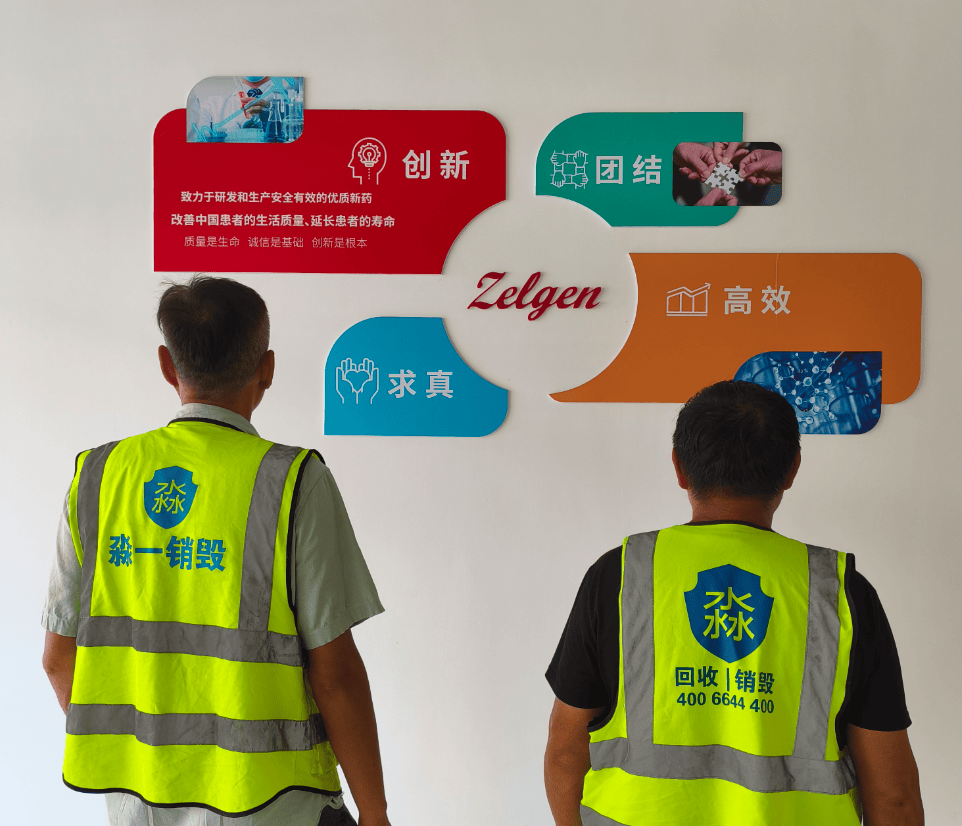
洞察中国数据安全数据销毁行业发展现状
Sou Hu Cai Jing· 2025-09-12 08:02
Core Insights - The data destruction industry in China is rapidly growing due to the increasing importance of data security in the digital age, driven by the need to safely dispose of data to prevent leaks and misuse [1][9] - The market size of the data destruction industry reached 8 billion yuan in 2024, reflecting a 22% increase from the previous year, with projections to exceed 20 billion yuan by 2030, maintaining a compound annual growth rate (CAGR) of over 18% [3][9] Market Demand - The digital transformation in China has led to an explosive growth in data volume, with a compound growth rate exceeding 30% over the past five years, increasing the demand for professional data destruction services [2] - Financial institutions are particularly focused on data destruction due to the sensitive nature of customer information, with a reported 25% year-on-year increase in spending on data destruction services in 2024 [2] Technological Development - The data destruction industry is characterized by diverse technological approaches, including physical destruction (disk shredding, incineration, demagnetization) and logical destruction (data overwriting, encrypted deletion) [5][6] - Innovations such as automated data destruction systems and the application of blockchain technology for tracking the destruction process are emerging, enhancing the reliability and security of data destruction [6] Regulatory Environment - A robust legal framework has been established in China, including laws like the Cybersecurity Law and the Data Security Law, which impose strict obligations on data handlers regarding data lifecycle management, including destruction [7] - Regulatory enforcement has intensified, with government agencies conducting inspections and imposing penalties for non-compliance, prompting companies to prioritize data destruction practices [7] Competitive Landscape - The competitive environment in the data destruction industry is intensifying, with both international giants and local companies vying for market share, leading to increased innovation and service differentiation [8] - Companies are focusing on enhancing their core competencies through technological investments and improved customer service, resulting in a concentration of market power among leading firms [8] Future Outlook - The data destruction industry in China is poised for further growth, driven by ongoing technological advancements, regulatory improvements, and increasing market demand, playing a crucial role in safeguarding data security [9]
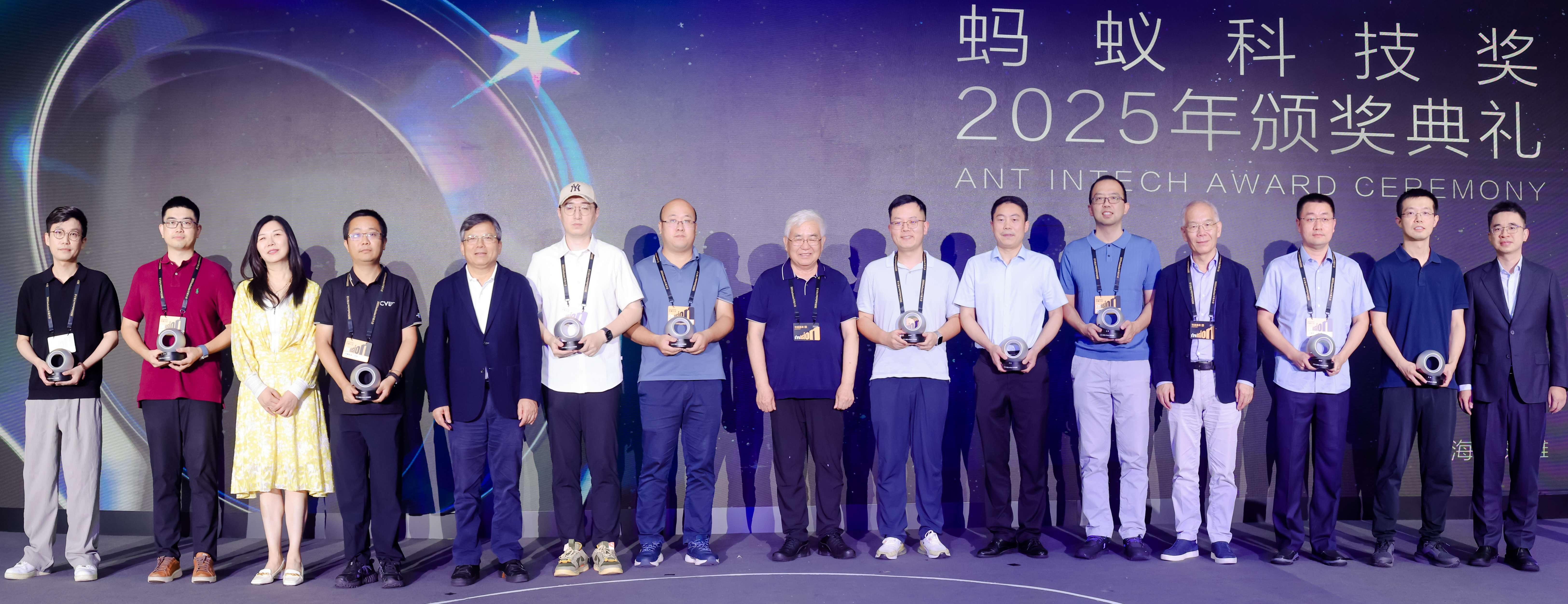
加码AGI等青年人才培育,蚂蚁InTech奖在外滩大会揭晓
Bei Ke Cai Jing· 2025-09-12 07:37
Core Points - The "2025 Ant Group InTech Award" was officially announced at the 2025 Inclusion Bund Conference, recognizing 10 young scientists with a prize of 200,000 yuan each and awarding 10 Chinese doctoral students from top global universities with a scholarship of 50,000 yuan each [1][15] Group 1: Award Details - The award ceremony featured prominent academic figures, including Chinese Academy of Engineering academicians and foreign academicians from the U.S. National Academy of Engineering, who encouraged young scholars to boldly pursue truth in their research [3] - The award winners demonstrated exceptional innovation in cutting-edge fields such as General Artificial Intelligence (AGI), embodied intelligence, digital medicine, and data security, with their results widely adopted in the industry [8] Group 2: Award Winners - Notable winners include: - Jin Xin (Peking University) for proposing a software-defined AI system for large-scale distributed resource management [8] - Wang Liming (Nanjing University) for developing the leading general video understanding model InternVideo, which has over 5 million downloads [9] - Zhang Fan (University of Electronic Science and Technology) for integrating AI into diffusion magnetic resonance imaging, significantly reducing preoperative imaging time [9] - Zhao Hengshuang (University of Hong Kong) for developing multiple leading scene understanding visual foundation models [9] Group 3: Scholarship Details - The "Ant Group InTech Scholarship" was awarded to 10 Chinese doctoral students from prestigious universities, each receiving 50,000 yuan, highlighting the importance of nurturing young scientific talent [15] - The overall participation in the awards tripled compared to the previous year, with over 20% of applicants from overseas, indicating a significant increase in global interest [15] Group 4: Company Initiatives - Ant Group emphasizes that technology-driven innovation is fundamental to its business, with young scientific talent being a key engine for innovation [15] - The company has increased its investment in cutting-edge technologies and young talent, launching initiatives like "Plan A" to recruit top AI talent globally and forming an AGI task force led by its CTO [15]
业绩亮眼股价却大跌!Rubrik(RBRK.US)遭遇“利好兑现”抛压 多家大行依旧看涨
智通财经网· 2025-09-11 03:52
Core Viewpoint - Rubrik reported strong financial results for Q2 FY2026, exceeding revenue expectations and showing significant growth in subscription revenue and annual recurring revenue (ARR) [1][2] Financial Performance - Total revenue for Q2 reached $309.9 million, surpassing the expected $282.26 million [1] - Subscription revenue grew by 55% year-over-year to $297 million [1] - ARR increased by 36% year-over-year to $1.25 billion [1] - Adjusted loss per share was $0.03, better than the expected loss of $0.34 [1] - Free cash flow was $57.5 million, compared to a negative $32 million in the same period last year [1] Future Outlook - Rubrik expects Q3 revenue to be $321 million, up from a previous estimate of $302 million [1] - Projected loss per share for Q3 is between $0.18 and $0.16, improved from an earlier expectation of $0.26 [1] - The company anticipates full-year ARR to be between $1.41 billion and $1.42 billion, exceeding the previous estimate of $1.38 billion [1] Analyst Ratings and Target Price Adjustments - Goldman Sachs reiterated a "Buy" rating, raising the target price from $117 to $120, citing strong underlying business momentum despite concerns over one-time revenue impacts [2] - KeyBanc maintained an "Overweight" rating, increasing the target price from $114 to $117, highlighting revenue growth driven by one-time income [2] - Piper Sandler kept an "Overweight" rating with a target price of $115, emphasizing Rubrik's market expansion strategy and potential for long-term investment [2] - Mizuho maintained a "Neutral" rating with a target price of $97, noting the stock's significant price increase since its IPO [2]

迪奥客户数据泄露风波背后:如何维护买单人的隐私
Hua Xia Shi Bao· 2025-09-10 18:16
Core Viewpoint - The article highlights the data security breach incident involving Dior (Shanghai) and emphasizes the broader issue of data protection challenges faced by luxury brands in the context of increasing digitalization [1][2][5]. Group 1: Incident Details - Dior (Shanghai) was found to have committed three violations regarding personal information protection, including unauthorized data transmission to its French headquarters and failure to inform users adequately about data handling [2][3]. - The data breach was discovered on May 7, 2025, and involved unauthorized access to customer data, including names, phone numbers, and email addresses, but did not include sensitive financial information [3][4]. Group 2: Industry Context - The luxury goods sector has seen multiple data breaches this year, with brands like Cartier and Louis Vuitton also experiencing similar incidents, indicating a systemic issue within the industry [5][6]. - Experts suggest that the luxury brands' reliance on high-end image and customer service has led to insufficient investment in data governance, treating compliance as a secondary function rather than a strategic risk management area [3][5]. Group 3: Compliance and Management Recommendations - To address the frequent data breaches, luxury brands should enhance their compliance management, technical safeguards, and internal controls, ensuring clear communication with consumers regarding data handling practices [6][7]. - Establishing a robust data protection mechanism involves building a compliance framework, managing data throughout its lifecycle, and developing emergency response capabilities to handle data breaches effectively [7][8].
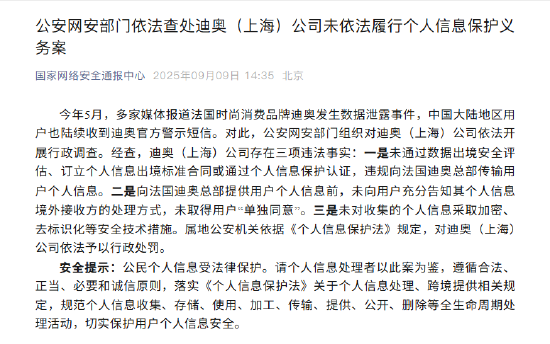
迪奥(上海)公司因数据泄露事件被行政处罚
Xin Lang Ke Ji· 2025-09-09 06:43
Core Viewpoint - The article reports on a data breach incident involving the French fashion brand Dior, leading to an administrative investigation by Chinese authorities due to violations of personal information protection laws [1]. Group 1: Incident Overview - In May, multiple media outlets reported a data leak involving Dior, prompting warnings to users in mainland China [1]. - The investigation revealed three main violations by Dior (Shanghai) Company regarding the handling of user personal information [1]. Group 2: Violations Identified - The first violation involved the unauthorized transmission of user personal information to the French headquarters without proper security assessments or contracts [1]. - The second violation was the failure to adequately inform users about the processing methods of their personal information by the overseas recipient, lacking "separate consent" from users [1]. - The third violation was the absence of security measures such as encryption or de-identification for the collected personal information [1]. Group 3: Regulatory Actions - The local public security authority imposed administrative penalties on Dior (Shanghai) Company in accordance with the Personal Information Protection Law [1]. - The article emphasizes the importance of legal compliance in personal information handling, urging companies to adhere to principles of legality, necessity, and integrity [1].
“广东通信杯”第五届网络安全技能大赛在深圳落幕
Sou Hu Cai Jing· 2025-09-07 13:15
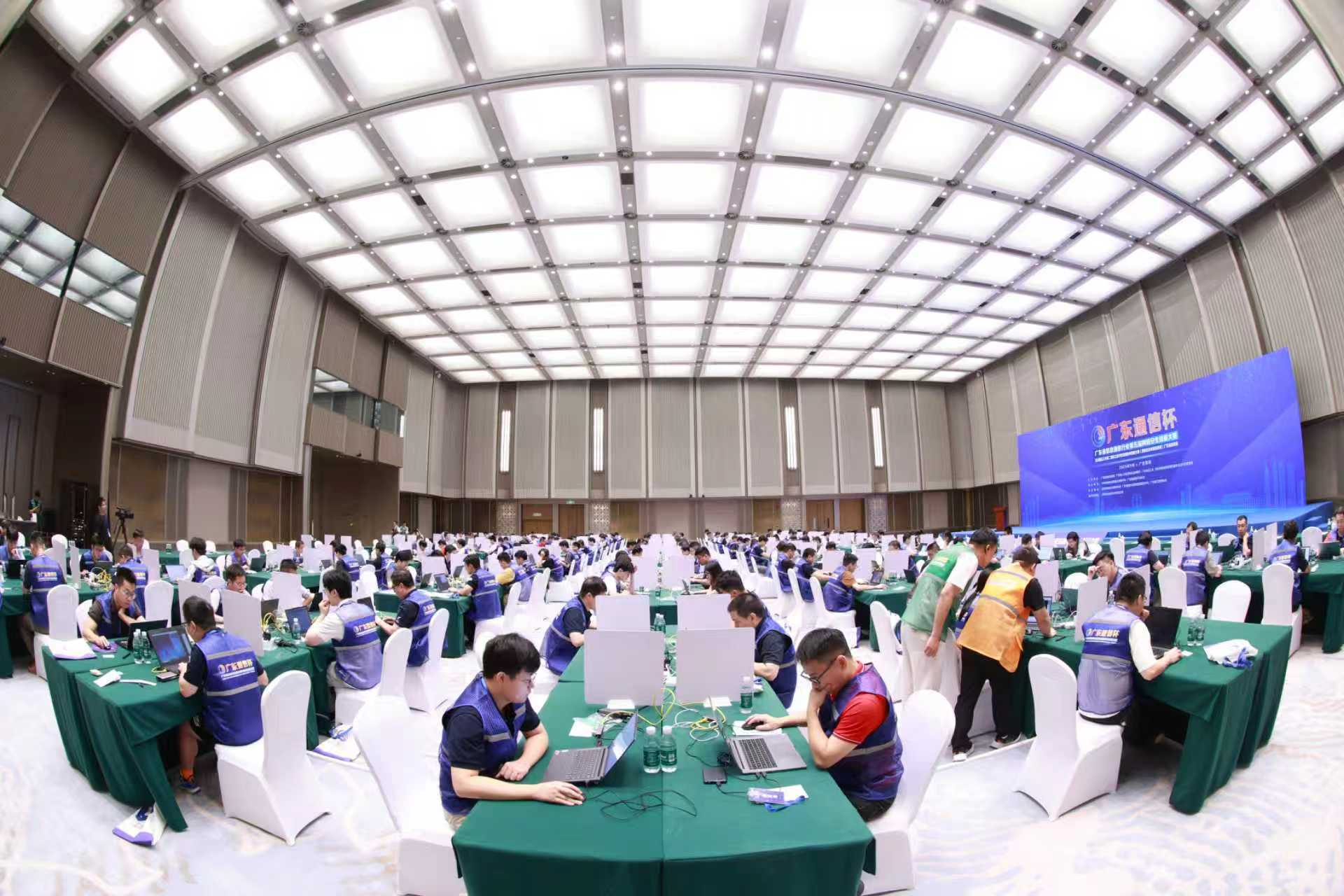
Group 1 - The "Guangdong Communication Cup" cybersecurity skills competition concluded successfully in Shenzhen, focusing on data security and digital application technology [1][3] - The event was co-hosted by multiple government bodies and organizations, emphasizing the importance of cybersecurity in various sectors [3] - The competition featured a theme of "AI forging the network, safeguarding security," addressing current trends in cybersecurity, including AI, data security, and IoT security [3] Group 2 - A total of 185 participants competed in the individual category, while 192 individuals formed 64 teams for the team competition, showcasing a wide range of industry representation [3] - Awards were given to outstanding individuals and teams, with notable achievements from Zhongshan Unicom and Foshan Mobile, highlighting the competitive nature of the event [4] - The event also saw the establishment of new initiatives, such as the "Internet Fraud Prevention Professional Committee" and a "Network and Data Security Joint Laboratory," enhancing cybersecurity efforts in Guangdong [4]
移动金融App开启自律检查,剑指违规使用个人信息!此前已有2664款完成备案
Bei Jing Shang Bao· 2025-09-07 12:06
北京商报讯(记者 廖蒙)备案动作之外,移动金融App再次被要求自查。9月7日,北京商报记者注意到,为持续提升金融领域App自律管理工作水平,切实 防范相关风险,中国互联网金融协会(以下简称"协会")日前发布《关于进一步加强金融领域App自律检查的通知》(以下简称《通知》)。 根据《通知》,本次检查对象为直接开展金融业务的App和为金融业务提供相关服务的App,重点检查发生安全事件、引发严重舆情、投诉高企、应备案未 备案、不遵守自律管理相关要求等情况的App。检查内容包括App网络防护措施不到位、数据安全管理制度不完善、违规使用个人信息等问题,App安全管 理薄弱、涉嫌违法违规开展业务和不遵守自律管理相关要求等问题。 博通咨询首席分析师王蓬博认为,开展自律检查有利于金融行业进行自我规范,在运营中长期违反相关规定的金融类App,必然会在自查中经历淘汰。对于 金融机构而言,在协会敦促下开展自纠自查,能够让机构加强在信息收集方面的规范化操作,以最小必要为前提,减少信息泄露的可能。 近年来,App已成为金融消费者享受金融服务的重要渠道,极大提升了金融服务的可获得性和覆盖范围。这一过程中,部分移动金融App隐私协议内容模 ...

物联网企业出海必须关注的20+数据/网络安全/AI/可持续法规
3 6 Ke· 2025-09-05 13:30
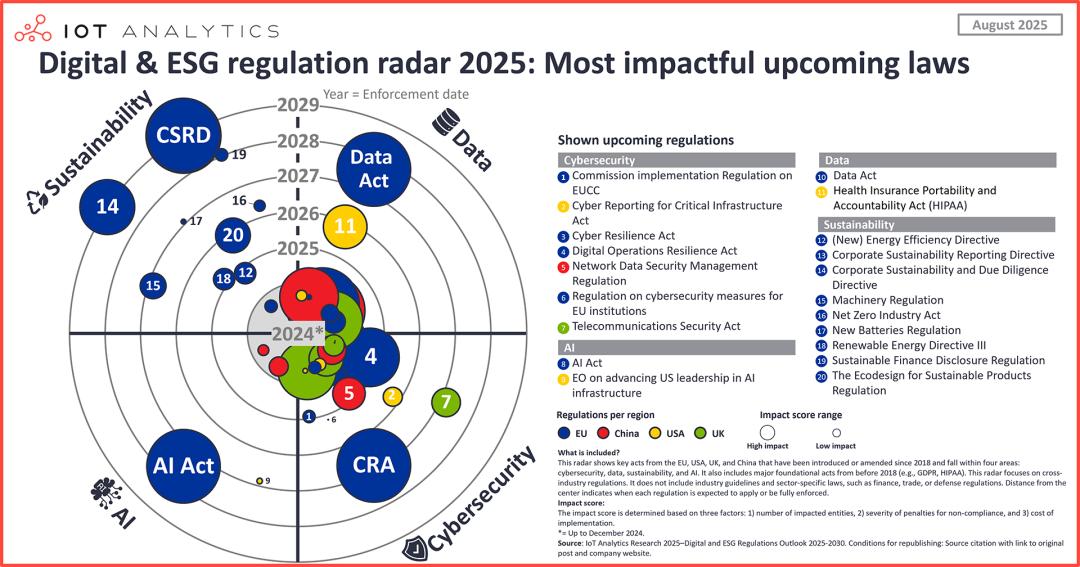
Core Insights - Recent regulations from the EU, US, China, and the UK regarding data governance, ESG disclosure, and cybersecurity have significantly impacted IoT companies, particularly those from China aiming for global expansion [1][3]. Regulatory Overview - Compliance with regulations has become a prerequisite for market entry, with higher demands for data security, device safety certification, and personal privacy protection. Failure to establish compliance mechanisms can lead to hefty fines, sales bans, and loss of access to key markets [1][3]. - New ESG and sustainability regulations are rapidly raising the reputation and trust thresholds for companies, making compliance a competitive advantage in the context of increasing geopolitical regulatory scrutiny [1][3]. Key Regulations to Monitor - The article outlines 20+ critical regulations that IoT companies must pay attention to, categorized into four main areas: data regulations, cybersecurity regulations, artificial intelligence regulations, and sustainability regulations [3][6]. Data Regulations - The EU's General Data Protection Regulation (GDPR) is the global benchmark for personal data protection, imposing strict user rights and severe penalties for non-compliance, including fines up to €20 million or 4% of global revenue [4][5]. - The EU Data Act, effective from September 12, 2025, mandates fair access and sharing of data among businesses and individuals, with penalties for non-compliance [7][8]. Cybersecurity Regulations - The US's Critical Infrastructure Cyber Incident Reporting Act (CIRCIA) requires critical infrastructure entities to report significant cyber incidents within 72 hours, with penalties determined through civil litigation [19]. - The IoT Cybersecurity Improvement Act mandates federal agencies to procure IoT devices that meet specific security standards, with penalties for non-compliance [21][22]. Artificial Intelligence Regulations - The EU's AI Act, effective from August 1, 2024, introduces a comprehensive regulatory framework for AI systems, categorizing risks and imposing strict obligations on high-risk AI applications [35][36]. - China's interim measures for generative AI services emphasize compliance with data training requirements and respect for intellectual property rights [32][34]. Sustainability Regulations - The EU's Corporate Sustainability Reporting Directive (CSRD) requires companies to disclose their environmental impact and sustainability goals, with third-party audits mandated for accuracy [42]. - The Carbon Border Adjustment Mechanism (CBAM) aims to equalize carbon costs for imported high-carbon products, with implementation phases starting from October 2023 [40][41]. Conclusion - The evolving regulatory landscape necessitates that IoT companies proactively adapt to these changes to maintain market access and competitive positioning in a global context [1][3].
温州设立浙江省首个市级人工智能局
Xin Hua She· 2025-09-04 11:52
Group 1 - Wenzhou has established the first municipal-level Artificial Intelligence Bureau in Zhejiang Province, focusing on "AI + data security" and demonstration applications to promote specialized development in AI [1] - The bureau's main responsibilities include formulating and implementing the city's AI development plans and policies, coordinating the construction of related infrastructure such as computing power, data, and algorithms, and leading the "AI +" initiatives [1] - The establishment of the AI Bureau is seen as a new mission for the city's future development strategy, emphasizing collaboration among departments and innovation across government, industry, academia, and investment [1] Group 2 - Over the next three years, Wenzhou plans to build three comprehensive systems: computing power infrastructure, data infrastructure, and full-service AI industry support [2] - The city aims to accelerate the cultivation of four key industries: intelligent computing power and core hardware manufacturing, the full data element chain, large models, intelligent agents, software platforms, and smart terminals [2] - Wenzhou will promote AI applications in 12 sectors, including manufacturing, energy, and healthcare, while implementing 12 supportive policies to lower innovation costs, encourage R&D investment, and support enterprise development [2]