
中部地区崛起

Search documents
武汉南昌双城记: 黄鹤楼和滕王阁的双向奔赴
Chang Jiang Ri Bao· 2025-09-22 01:03
Core Viewpoint - The article highlights the growing tourism and economic collaboration between Wuhan and Nanchang, emphasizing their geographical proximity and cultural connections, which are fostering a "golden travel route" and enhancing cooperative development in various sectors. Transportation - The travel time between Wuhan and Nanchang is currently 1 hour and 51 minutes by train, with plans to reduce it to 1 hour and 30 minutes through ongoing railway construction initiatives [1] - The "Central Six Provinces Capital City Transportation Cooperation Initiative" aims to accelerate the development of key railway lines, enhancing connectivity between the two cities [1] Cultural Significance - Both cities are rich in cultural heritage, with landmarks like Wuhan's Yellow Crane Tower and Nanchang's Tengwang Pavilion symbolizing their historical significance [2] - The cities share a deep historical connection, illustrated by events such as the Nanchang Uprising and the August 7th Meeting [3] Culinary Diversity - The culinary offerings of both cities reflect their cultural ties, with local dishes like Wuhan's hot dry noodles and Nanchang's rice noodles being popular among tourists [1][4] Economic Collaboration - Wuhan and Nanchang are key cities in the Central Region and the Yangtze River Midstream Urban Agglomeration, with a strong foundation for cooperation [5] - Recent meetings led by President Xi Jinping have emphasized the importance of innovation-driven development and collaboration between the two cities [5][6] Technological Cooperation - A framework agreement for technological cooperation has been established among Hubei, Jiangxi, and Hunan provinces, promoting joint initiatives and resource sharing [7] - The "Wuchuangyuan" disruptive technology innovation competition has been held in Nanchang, showcasing collaborative efforts in technology and innovation [7] Education and Research - Educational institutions from both cities, such as Nanchang University and Wuhan University, have signed cooperation agreements to facilitate student exchanges and joint research [8] - Experts from Nanchang are actively participating in significant technological assessments and collaborative events in Wuhan [8] Business Development - Wuhan's local commercial group, Wushang, has chosen Nanchang as its first expansion destination, with sales reaching 3.1 billion yuan in 2024 [8] - The establishment of a public housing fund that allows for mutual recognition and lending between the two cities supports residents in living a "dual-city life" [9] Future Prospects - The article suggests that the collaboration between Wuhan and Nanchang can lead to the development of influential industrial clusters, particularly in sectors where each city has its strengths, such as optics and artificial intelligence in Wuhan and aviation and biomedicine in Nanchang [9]

湖北公路水路投资连续两年位居中部第一 “十四五”交通重大任务和重大项目进展顺利
Chang Jiang Shang Bao· 2025-09-04 00:03
Core Viewpoint - Hubei is accelerating the construction of a modern comprehensive transportation system, aiming to establish a demonstration zone for a strong transportation nation and enhance its strategic position in central China [1] Group 1: Transportation Infrastructure Development - During the "14th Five-Year Plan" period, Hubei's transportation fixed asset investment reached 789.7 billion yuan, a year-on-year increase of 43%, with road and waterway investments ranking first in central China for two consecutive years [1] - By the end of this year, Hubei's high-speed rail mileage is expected to exceed 2,500 kilometers, placing it among the top five in the country [2] - The province's highway network has reached 8,184 kilometers, with the main national highways fully connected [2] Group 2: Multi-Modal Transportation Integration - Hubei has established 30 comprehensive passenger transport hubs, achieving 100% coverage in cities and states [2] - The province's port container throughput capacity has surpassed 6.1 million TEUs, with a significant annual growth rate of 49.5% in container rail-water intermodal transport from 2020 to 2024 [3] - The logistics cost as a percentage of GDP in Hubei is projected to be 12.82% in 2024, which is 1.28 percentage points lower than the national average [3] Group 3: Green Transportation Initiatives - The proportion of new energy buses in urban areas has reached 84.67%, and the coverage of charging stations in highway service areas is 100% [3] - Hubei has completed the renovation of over 6,000 aging bridges as part of its "three-year danger elimination" initiative [3] Group 4: Future Development Plans - In the "15th Five-Year Plan" period, Hubei will focus on enhancing its role as a major logistics hub and improving the interconnectivity of various transportation modes [4] - The province aims to strengthen its railway network, with more than two high-speed rail lines expected to commence construction each year [6] Group 5: Aviation and Low-Altitude Economy - Hubei has established a new development pattern of "dual hubs and multiple branches" in aviation, with four international airports supporting its inland open economy [5][7] - The province has made significant breakthroughs in both the airport economy and low-altitude economy, forming strategic partnerships with over 30 leading enterprises [7]
湖北:以支点建设为牵引 推动湖北在全国大局中的地位更加稳固
Zhong Guo Fa Zhan Wang· 2025-08-28 07:58
Core Viewpoint - The Hubei provincial government has made significant progress in economic development and regional coordination during the "14th Five-Year Plan" period, with a focus on enhancing its strategic position, regional development, urban-rural integration, and inter-provincial cooperation [1][2][3][4][5][6][7] Group 1: Economic Growth and Strategic Position - Hubei's economic total has surpassed 6 trillion yuan, with an average annual growth rate of 7.1%, making it a key engine for the rise of the central region [2] - The province's economic share in the central region increased from 19.5% at the end of the "13th Five-Year Plan" to an expected 20.9% by 2024 [2] - Hubei has achieved significant environmental protection and ecological governance, with the Yangtze River's water quality maintained at Class II or above [2] Group 2: Regional Development Coordination - Hubei is optimizing its regional development layout, focusing on the collaborative growth of the "Golden Triangle" of Wuhan, Xiangyang, and Yichang [3] - Wuhan's economic total has exceeded 2 trillion yuan, solidifying its position as the leading provincial capital in central China [3] - The Wuhan metropolitan area has a total economic output of over 3.6 trillion yuan, accounting for more than 60% of the province's total [3] Group 3: Urban-Rural Integration - Hubei is promoting new urbanization with a focus on county-level economies, increasing the number of top 100 counties to 8, ranking 4th nationally [4] - The urbanization rate of the permanent population in counties reached 56.7%, an increase of 3.44 percentage points from the end of the "13th Five-Year Plan" [4] - The income disparity between urban and rural residents has decreased, with the ratio of per capita disposable income falling to 2.08 [4] Group 4: Inter-Provincial Cooperation - Hubei is enhancing inter-provincial collaboration, particularly with neighboring provinces, to better integrate into the new development pattern [5][6] - Major projects like the Han-Xiang-Gui Canal and the Hunan-Guangxi high-speed rail are being advanced collaboratively [6] - The establishment of a technology innovation center in the central Yangtze River region is underway, with deepening industrial cooperation among urban agglomerations [6][7]
“十四五”湖北经济总量跃上6万亿 提前一年完成经济增长总量指标
Chang Jiang Shang Bao· 2025-08-20 23:51
Core Insights - Hubei Province has achieved significant economic growth during the "14th Five-Year Plan" period, surpassing the 6 trillion yuan mark ahead of schedule, with an average annual growth rate of 7.1% [1][2][3] - The province is focusing on regional coordination and development, enhancing its position as a strategic hub in the Yangtze River Economic Belt and the central region of China [2][7][8] Economic Performance - Hubei's economic total reached 6 trillion yuan, with a notable increase in its share of the central region's economy from 19.5% at the end of the "13th Five-Year Plan" to an expected 20.9% by 2024 [2][3] - The Wuhan metropolitan area has an economic total of 3.6 trillion yuan, accounting for over 60% of the province's economy [3][4] Infrastructure Development - Major infrastructure projects, including high-speed rail and highways, are being accelerated, with the completion of several key routes enhancing connectivity within the province [4][5] - The construction of the Hubei section of the Yangtze River high-speed rail and other significant projects is expected to create a one-hour high-speed rail circle among Wuhan, Xiangyang, and Yichang [4][5] County-Level Economic Growth - The number of top 100 counties in Hubei has increased to 8, with the emergence of four counties expected to achieve a GDP of over 100 billion yuan [5][6] - The urbanization rate of the county's permanent population has reached 56.7%, reflecting a 3.44 percentage point increase from the end of the "13th Five-Year Plan" [5][6] Social Development and Integration - Hubei is making strides in reducing urban-rural disparities, with 86% of counties having established tertiary hospitals and over 80% of primary and secondary schools covered by educational networks [6][7] - The province is actively promoting rural revitalization, with significant agricultural brands and a stable reduction in poverty risks [6][7] Regional Cooperation - Hubei is enhancing inter-provincial collaboration, particularly with neighboring provinces, to strengthen regional economic integration and cooperation [7][8] - The province is leveraging its strategic location and infrastructure to deepen economic ties with major regions such as Beijing-Tianjin-Hebei and the Yangtze River Delta [7][8]
向“新”而行,向“实”发力——郑州银行书写中部崛起新样本
Guo Ji Jin Rong Bao· 2025-08-13 03:14
Core Viewpoint - Financial services are crucial for the development of the Central Plains region and play a significant role in addressing the challenges of rapid growth in the central region of China [2]. Group 1: Strategic Importance - The construction of the "Five Strong Provinces" in Henan is a strategic practice that aligns with technological and industrial development trends, emphasizing the importance of high-quality development [2]. - Zhengzhou Bank recognizes the "Five Strong Provinces" initiative as a major strategic opportunity for the financial industry, requiring enhanced effectiveness, adaptability, and sustainability in financial supply [2][4]. Group 2: Performance and Growth - Zhengzhou Bank achieved growth in assets, deposits, loans, and profits in 2024, with a deposit growth rate of 12.07%, surpassing the average growth rate of 8.81% for financial institutions in Henan [3]. - By the end of Q1 2025, Zhengzhou Bank's total assets exceeded 700 billion yuan, reaching 706.53 billion yuan, a 4.46% increase from the previous year [3]. Group 3: Economic Context - Henan's economy has shown steady growth, with key economic indicators leading the national average, supported by a focus on high-quality development and ecological protection [4]. - The province's industrial economy is robust, contributing significantly to the national industrial output, with high-tech manufacturing and strategic emerging industries showing strong growth [6]. Group 4: Financial Innovation and Support - Zhengzhou Bank is focusing on financial innovation in emerging sectors such as technology, green finance, and rural revitalization, aiming to transition from a "scale bank" to a "value bank" [4][8]. - The bank has introduced various financial products to support rural development and smallholder farmers, with a notable increase in inclusive agricultural loans [8]. Group 5: Collaboration and Project Support - Zhengzhou Bank is enhancing collaboration with local governments to support industrial parks and key projects, committing to provide at least 30 billion yuan in credit support for industrial park construction over the next three years [7]. - The bank has actively supported major construction projects, including technology parks and sports centers, to drive regional economic development [7]. Group 6: Future Development Focus - The next five years are critical for Henan's development, with a focus on building a modern industrial system and promoting consumption [5]. - Zhengzhou Bank aims to leverage financial services to support the province's strategic initiatives, enhancing its role in regional economic growth [10][14]. Group 7: Organizational Transformation - Zhengzhou Bank is undergoing a systematic transformation to align its services with the higher demands of the "Five Strong Provinces" initiative, focusing on technology and efficiency [10][12]. - The bank is optimizing its internal mechanisms to create a more agile and customer-oriented organization, enhancing its operational efficiency and service quality [11]. Group 8: Risk Management and Digitalization - The bank is implementing comprehensive risk management strategies to address various financial risks, including credit and operational risks [13]. - Zhengzhou Bank is advancing its digital transformation to improve financial service capabilities and enhance customer experience [13]. Group 9: Commitment to Local Development - Zhengzhou Bank is dedicated to serving local economies and enhancing the quality of life for residents through targeted financial services and community engagement [14]. - The bank's initiatives reflect its commitment to supporting the economic and social development of Henan, contributing to the broader goals of Chinese modernization [14].
善用地利之便 凝聚人和之力——重走英雄路②
Ren Min Ri Bao· 2025-08-06 04:33
Core Insights - The article emphasizes the importance of historical and cultural values, particularly the spirit of self-reliance and hard work, as essential for achieving development and common prosperity [1][3][4] Group 1: Historical Context and Development - The New Fourth Army's strategic choice to cross the river and enter the mountains during wartime was influenced by the unique geographical advantages of the Taohua Mountain area, which provided a natural barrier for guerrilla warfare [2] - The current development in Huarong County is leveraging its geographical advantages, such as the construction of the coal-water intermodal terminal at the intersection of the Yangtze River and the Huoji Railway, which significantly reduces transportation costs and time [2] Group 2: Community and Economic Growth - The historical bond between the military and local communities is highlighted, showcasing how collective efforts during wartime laid the foundation for current economic initiatives [3] - Modern agricultural and green food processing industries in Huarong have seen a significant increase, with a total output value exceeding 43 billion yuan, creating employment for over 200,000 people [3] Group 3: Future Outlook - The article suggests that by continuing to harness historical lessons and geographical advantages, Huarong can create new opportunities for development and honor the legacy of its predecessors [4]
发力下半年,湖北再提这条“黄金水道”
Mei Ri Jing Ji Xin Wen· 2025-08-06 00:02
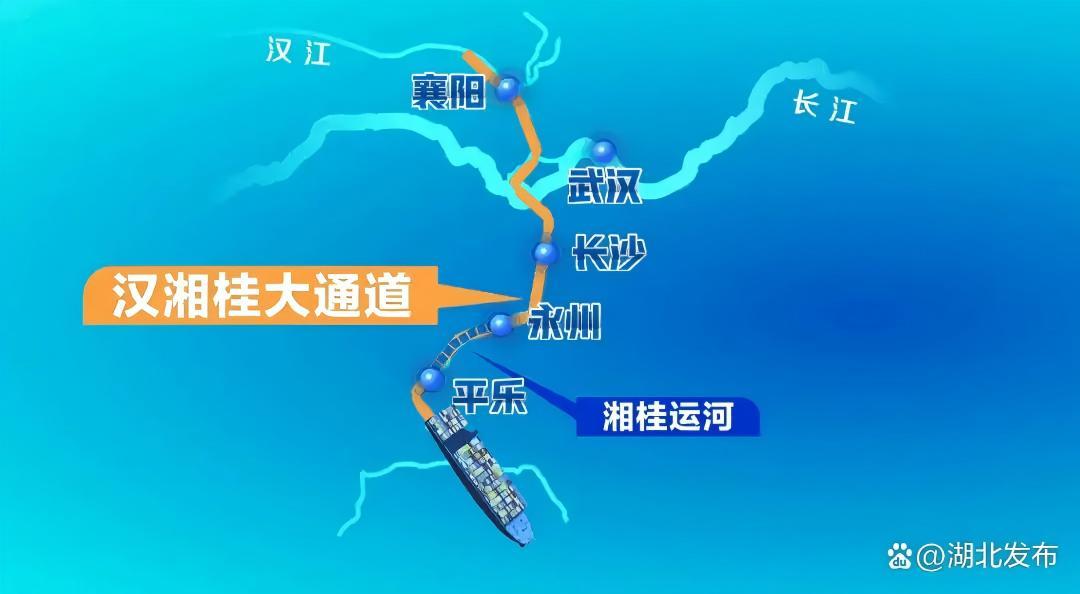
Core Insights - Hubei Province has achieved a transportation investment of 104.16 billion yuan in the first half of the year, reaching 51.9% of its annual target, with a year-on-year growth of 1.8%, ranking third nationally and first in Central China [1] - The province aims to secure a total transportation investment of 200 billion yuan, striving for 220 billion yuan by the end of the year, focusing on major transportation projects and optimizing the waterway development pattern [1][3] - The Han-Xiang-Gui inland waterway corridor, approximately 3,200 kilometers long, is a key project that will connect the Yangtze and Pearl River systems, enhancing low-cost water transport to coastal ports [3][4] Investment and Development Goals - Hubei's transportation investment target for the year is set at 200 billion yuan, with an ambition to reach 220 billion yuan, supported by significant transportation projects [1] - The province is focusing on the construction of the Han-Xiang-Gui corridor, promoting multi-modal transport to reduce logistics costs and improve efficiency [1][3] Project Progress and Achievements - The feasibility study for the second phase of the Hanjiang Qianpan Mountain to Xinglong section waterway improvement project has been approved, marking a breakthrough in the preliminary work for the Han-Xiang-Gui corridor in Hubei [4] - Key projects within the corridor, including "three locks and one channel," have received construction approvals, with plans to start construction this year and achieve a fixed asset investment of 10 billion yuan [4]
善用地利之便 凝聚人和之力(现场评论)
Ren Min Ri Bao· 2025-08-05 22:21
Core Viewpoint - The article emphasizes the importance of historical spirit, geographical advantages, and collective efforts in achieving development and prosperity, particularly in the context of Hunan's Huayuan County and its historical significance during the Anti-Japanese War [1][3][4]. Geographical Advantages - The unique geographical features of the Shigonghua area, including rivers and mountains, provided strategic advantages for guerrilla warfare during the Anti-Japanese War [2]. - The current development of the Yueyang Port Huayuan coal-water intermodal transportation base is positioned at a key intersection of transportation routes, significantly reducing transportation costs and time for coal delivery to the Yangtze River and surrounding enterprises [2]. Collective Efforts and Community Development - Historical accounts highlight the strong bond between the New Fourth Army and local residents, showcasing their mutual support during wartime, which laid the foundation for community resilience [3]. - Modern agricultural initiatives in Huayuan, such as the establishment of over 500 acres of modern orchards, have led to significant economic growth, with the agricultural and green food processing industry generating over 43 billion yuan and creating employment for more than 200,000 people [3]. Historical Reflection and Future Aspirations - The transformation of the once war-torn area into a thriving economic zone illustrates the potential for leveraging historical lessons and natural advantages to foster future development [4].
创新驱动中部地区加快崛起
Jing Ji Ri Bao· 2025-07-24 22:27
Group 1 - The core message emphasizes the importance of technological innovation and the transformation of traditional industries to revitalize the economy in Shanxi and other central regions of China [1][2] - The restructuring of industrial foundations is identified as a key engine for the rapid rise of central regions, with a focus on upgrading traditional industries like steel and machinery to high-end, intelligent, and green production [1][2] - The article highlights the need for a comprehensive innovation support system to overcome challenges such as talent outflow and financial shortcomings, which are critical for achieving breakthrough growth in the central region [2] Group 2 - The development of a robust innovation ecosystem is crucial for the rise of the central region, facilitating the integration of industry, academia, and research to accelerate the transformation of scientific achievements into practical applications [2] - The article calls for a balanced approach that leverages both effective market mechanisms and proactive government involvement to create a conducive environment for enterprises to innovate and compete fairly [2] - The central region's development is framed as a grand systemic project that requires addressing deep-seated institutional issues and focusing on key areas to foster high-quality growth [2]
谱写中部地区加快崛起新篇章
Jing Ji Ri Bao· 2025-07-03 22:05
Core Viewpoint - The central government has prioritized the development of the central region of China, which consists of six provinces, emphasizing its strategic importance in national economic growth and modernization efforts [1][2]. Group 1: Economic Growth and Development - Since the implementation of the strategy to promote the rise of the central region in 2004, the economies of the six provinces (Shanxi, Anhui, Jiangxi, Henan, Hubei, Hunan) have experienced sustained rapid growth, solidifying their roles as key contributors to national economic development [2][3]. - The GDP of the central six provinces is projected to grow from less than 15 trillion yuan in 2015 to approximately 28 trillion yuan by 2024, with a compound annual growth rate of 7.5%, outpacing the Beijing-Tianjin-Hebei region and the Guangdong-Hong Kong-Macau Greater Bay Area [6]. Group 2: Industrial Structure and Modernization - The central region is focusing on building a modern industrial system, with an emphasis on advanced manufacturing and high-tech industries, while also optimizing its industrial structure [3][8]. - The region has established several advanced manufacturing clusters, including rail transit equipment in Zhuzhou, engineering machinery in Changsha, and optoelectronic information in Wuhan, showcasing its competitive edge in various sectors [8][9]. Group 3: Innovation and Technology - The central region aims to enhance its R&D investment to reach the national average by 2025, targeting a ratio of R&D expenditure to GDP of approximately 2.5% [4]. - Cities like Hefei and Wuhan are leveraging their educational and research institutions to foster innovation, particularly in emerging industries such as quantum computing and laser technology [9]. Group 4: Urbanization and Population Dynamics - The urbanization rate in the central six provinces is increasing at a pace faster than the national average, with projections indicating that by 2024, the urbanization rate in Henan will be 59.2% and the other five provinces will exceed 60% [6][7]. - The demographic structure is favorable, with a lower proportion of the population aged 65 and above compared to the national average, indicating a robust labor supply and long-term consumption potential [7]. Group 5: Agricultural and Energy Security - The central region plays a crucial role in ensuring national food security, contributing 28.92% of the total grain production in China in 2024, with a total output of 204.318 million tons [10]. - Shanxi, as a major coal-producing province, is also pivotal in energy security, with a coal output of 1.269 billion tons in 2024, accounting for 26.7% of the national total [10]. Group 6: Policy Support and Future Directions - The implementation of policies aimed at promoting the rise of the central region is expected to provide strong support for future development, with a focus on high-quality growth and sustainable development [7][12]. - The central provinces are encouraged to enhance their advanced manufacturing capabilities, innovate in production processes, and support the transformation of traditional industries through new technologies and business models [11][12].