
区块链技术

Search documents
虚拟货币再迎监管新规 从严监管态度明确
Jin Rong Shi Bao· 2026-02-09 02:00
围绕虚拟货币,监管再出新规。 2月6日,中国人民银行、国家发展改革委、工业和信息化部、公安部、市场监管总局、金融监管总局、 中国证监会、国家外汇局联合印发《关于进一步防范和处置虚拟货币等相关风险的通知》(以下简称 《通知》)。 《通知》共分为六部分19条。一是明确虚拟货币、现实世界资产(RWA)和相关业务活动的本质属性;二 是健全工作机制,形成央地协同、条块结合的工作格局;三是明确强化风险监测、防范与处置相关要 求,包括风险监测、中介机构监管、互联网信息内容管理、经营主体登记和广告管理、整治虚拟货 币"挖矿"、打击相关违法犯罪活动、行业自律管理等;四是从严监管境内主体及其控制的境外主体在境 外开展虚拟货币、RWA业务;五是强化组织实施,主要包括组织领导、宣传教育等;六是法律责任。 2025年12月,中国互联网金融协会等7个协会联合发布《关于防范涉虚拟货币等非法活动的风险提 示》,进一步明确虚拟货币、RWA相关业务活动属于非法金融活动,向社会公众提示风险。 业内人士分析认为,虚拟货币依托区块链技术,支持点对点交易,突破物理上的国境概念,相关风险极 易跨境传导。为切实防范风险,《通知》明确提出,未经相关部门依法依 ...
进一步防范和处置虚拟货币等相关风险
Qi Huo Ri Bao Wang· 2026-02-08 18:33
Core Viewpoint - The joint notice issued by eight Chinese regulatory bodies aims to further prevent and address risks associated with virtual currencies and tokenization of real-world assets, emphasizing that such activities are illegal financial activities and do not hold the same legal status as fiat currencies [1][2]. Group 1: Regulatory Framework - The notice reiterates that virtual currencies do not have the same legal status as fiat currencies and that any related business activities are considered illegal financial activities [1]. - It prohibits foreign entities and individuals from providing virtual currency-related services to domestic entities in any form [1]. - The notice emphasizes that tokenization of real-world assets is also illegal unless approved by relevant authorities, and foreign entities cannot provide related services to domestic entities [1]. Group 2: Specific Measures - Three specific measures are outlined: 1. Establishing a collaborative work structure between central and local governments to enhance risk prevention and management [3]. 2. Strengthening risk prevention and response through cross-departmental cooperation, including monitoring risks, managing funds and information flows, and regulating virtual currency mining [3]. 3. Enhancing organizational implementation by clarifying responsibilities among departments and regions, and promoting public awareness of risks associated with virtual currencies and tokenization [4]. Group 3: Importance of the Notice - The notice is significant for maintaining national financial sovereignty and ecological stability by enforcing strict regulations and combating illegal cross-border arbitrage [4]. - It aims to protect investor rights by implementing thorough regulatory measures to eliminate illegal financial bubbles [4]. - The notice also seeks to define the boundaries of financial innovation, discouraging fraudulent innovations while supporting compliant development of blockchain technology and data assets [4].
私募加密基金基本情况、监管规则与税务政策概述
Xin Lang Cai Jing· 2026-02-08 16:28
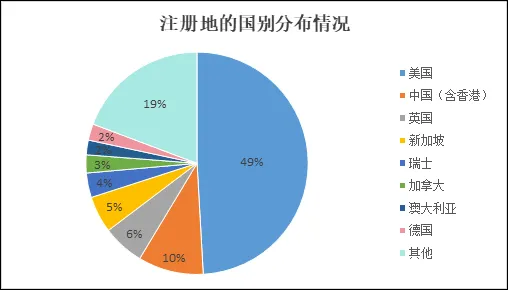
Core Insights - The article discusses the increasing importance of compliance in private crypto funds as traditional financial institutions and non-financial entities begin to engage in private crypto fund operations and allocate assets related to cryptocurrencies [1] Group 1: Definition and Classification of Private Crypto Funds - Private crypto funds are defined as non-public investment funds targeting wealthy individuals and institutional investors, focusing on crypto assets and related projects [2] - Key characteristics of private crypto funds include a specific investment focus on the crypto asset market, high value volatility, significant regulatory differences across countries, and lower transparency compared to traditional funds [3][4] - Private crypto funds differ from traditional private funds in terms of investment targets, risk and volatility, regulatory environment, investor types, technology reliance, and liquidity [5][6][7][8][9][10][11][12][13][14][15] Group 2: Classification of Private Crypto Funds - Private crypto funds can be classified based on investment targets, operational methods, and investment strategies [16] - Investment targets include direct investment funds (investing directly in cryptocurrencies and blockchain projects) and indirect investment funds (investing in related companies or derivatives) [16] - Operational methods can be categorized into closed-end funds (fixed size and duration) and open-end funds (allowing continuous investment and redemption) [17] - Investment strategies include passive strategies (tracking major cryptocurrencies), neutral strategies (hedging market volatility), active strategies (based on price predictions), and fixed-income strategies (earning interest through lending) [18][19] Group 3: Global Development of Private Crypto Funds - The total market capitalization of cryptocurrencies has shown fluctuating growth, exceeding $2.3 trillion, with nearly 900 crypto funds established globally by the end of 2023 [21] - The asset management scale of crypto funds reached $33 billion in 2023, with Bitcoin being the most popular investment target [21] - The United States is the primary registration location for crypto funds, accounting for nearly half of the total, while China also has a significant number of registered funds despite a conservative regulatory stance [22] Group 4: Notable Private Crypto Funds - Pantera Capital, established in 2003, manages $4.8 billion in blockchain-related assets and focuses on Bitcoin, ICOs, and DeFi [24] - a16z Crypto, part of Andreessen Horowitz, manages over $7.6 billion across four funds, investing in blockchain infrastructure and decentralized applications [25] - Galaxy Digital, founded in 2018, manages approximately $2.1 billion in digital assets and offers various crypto-related investment products [26] - AnB Investment, registered in the Cayman Islands, operates two funds with a total AUM of $50 million, focusing on crypto assets and DeFi [27] - HashKey Digital Investment Fund, launching in September 2023, will invest primarily in Bitcoin and Ethereum, with a diversified portfolio [28] Group 5: International Regulatory Overview for Private Crypto Funds - Various international organizations and countries have established regulations for private crypto funds, including the SEC's application of securities laws to certain crypto assets [29][31] - The EU's Market Abuse Directive and Regulation aim to prevent market manipulation and insider trading in the crypto market [33] - The FATF has set AML/CFT requirements for virtual asset service providers, impacting crypto funds [34] - The AIFMD has expanded to include crypto asset funds, requiring proper disclosure and risk management [35] - The EU's MiCA aims to create a unified regulatory framework for crypto assets, effective from June 2023 [36] Group 6: Tax Policies for Private Crypto Funds - Countries are developing tax policies to ensure accurate reporting and taxation of crypto fund earnings, including capital gains tax and VAT [37] - In the U.S., private crypto funds can be structured as LPs, LLCs, or corporations, each with different tax implications [38] - The EU has varied VAT policies for crypto transactions, with some countries exempting Bitcoin from VAT [40] - The UK incorporates crypto assets into existing tax frameworks, applying income and capital gains taxes [42] - Singapore does not tax capital gains, making it favorable for private crypto funds, while GST on crypto transactions was eliminated in 2020 [43]

吴说 1 月技术月报:BTC Core 新增维护者、ERC-8004 标准即将上线主网、Brevis 与 BNB Chain 扩展隐私保护等
Xin Lang Cai Jing· 2026-02-08 00:58
Bitcoin - The Bitcoin Core development team has appointed TheCharlatan as a Trusted Keys maintainer, increasing the number of PGP key maintainers with commit access to six [1] Ethereum - The Glamsterdam upgrade is expected between June and August 2026, maintaining a biannual upgrade schedule [1] - The Blob Pressure Optimization (BPO2) upgrade has been successfully implemented on the Ethereum mainnet, increasing the target value to 14 blobs per block and the maximum capacity to 21 [2] - The ERC-8004 standard is set to launch on the mainnet, enabling AI agents to interact across organizations while ensuring reputation flows globally [2] - Vitalik Buterin has outlined plans for Ethereum to systematically address past regressions in self-sovereignty and trustlessness by 2026, focusing on reducing the barriers for running full nodes and enhancing privacy features [3] - The OP Stack has introduced a post-quantum roadmap, planning to phase out ECDSA EOA over the next decade [4] - Starknet has released a post-mortem report on a recent mainnet outage, attributing the issue to inconsistencies between execution and proof layers [4] Layer 2 Solutions - ZKsync has published its 2026 roadmap, focusing on three core areas: Prividium for enterprise privacy, ZK Stack for cross-chain operations, and Airbender for developer experience [5] Solana - Jito has launched the IBRL Explorer tool to transparently display block construction details, highlighting issues like "tail packing" and "Slot Timing Games" that may affect network stability [7] BNB Chain - Brevis is collaborating with BNB Chain to expand privacy infrastructure, launching the "Intelligent Privacy Pool" in Q1 2026 [8] - The opBNB has completed a hard fork, reducing block time from 500 milliseconds to 250 milliseconds [8] SUI - The Sui mainnet has upgraded to version V1.63.3, optimizing transaction confirmation paths and addressing consensus issues among rejected transaction validation nodes [9] Security - A security alert has been issued regarding potential risks in VS Code-based IDEs, recommending users disable automatic task execution to prevent malicious code execution [10] - A vulnerability has been disclosed in the Bitcoin staking protocol Babylon, allowing malicious validators to potentially disrupt block production [11] Other - Stripe and Paradigm have launched the Tempo payment public chain with a new native token standard TIP-20, designed for stablecoins and payment use cases [12]
波士顿咨询:2026数字货币:香港基金行业倍增式发展机遇研究报告
Sou Hu Cai Jing· 2026-02-07 23:50
今天分享的是:波士顿咨询:2026数字货币:香港基金行业倍增式发展机遇研究报告 报告共计:32页 这份由BCG、Aptos Labs与恒生银行联合发布的报告,聚焦数字货币发展背景下香港基金行业的倍增式发展机遇,指出区块链技术推动 的代币化体系正重构全球金融基础设施,2026年成为香港链上金融发展的关键拐点,而代币化创新有望推动香港基金行业规模翻倍。 报告指出,传统金融报文体系存在效率低、结算滞后等痛点,代币化体系凭借价值直接传递、可编程、即时结算的特性成为金融演进新 方向。当前数字货币已步入商业化规模阶段,2025年11月锚定法币的稳定币市值突破3000亿美元,全球超130家央行探索央行数字货币, 代币化存款也在头部银行落地,三者互补共存形成多轨结算生态。代币化资产则从支付向投资领域延伸,2025年代币化基金市值从2024 年20亿美元跃升至80多亿美元,债券、大宗商品、房地产等资产的代币化也加速推进,预计2025至2033年数字货币和代币化资产市场规 模年复合增长率超50%。 三方在香港金管局"数码港元+"试点中,验证了Aptos公有许可链在代币化基金交易中的技术可行性,其具备亚秒级终局性、极低交易成 本, ...


八部门加强监管 遏制虚拟货币等风险
Yang Shi Wang· 2026-02-07 20:20
央行说的虚拟货币,不是由国家货币当局发行的,它是用了加密技术,以数字形式存在的所谓"资产", 它并没有法定货币的地位,不能像人民币一样在市场上正常流通使用,也不被国家承认。我们可能听过 像比特币、以太币、泰达币,这些就属于虚拟货币,不能作为货币在市场上流通使用。 对挂钩人民币的稳定币做出明确规定 境内主体不得在境外发行虚拟货币 由于虚拟货币依托区块链的技术,支持点对点交易,突破物理上的"国境"概念,相关风险极易跨境传 导。对此,《通知》首次明确,未经相关部门依法依规同意,境内主体及其控制的境外主体不得在境外 发行虚拟货币。 央视网消息:2月6日,中国人民银行、中国证监会等八部门联合发布《关于进一步防范和处置虚拟货币 等相关风险的通知》,明确虚拟货币不具有与法定货币等同的法律地位,境内对虚拟货币坚持禁止性政 策。近年来,虚拟货币等炒作交易活动变换马甲、更新套路,不断将黑手伸向百姓"钱袋子"。这次发布 的通知,八部门"攥指成拳"加强监管,合力遏制虚拟货币等风险。 通知规定:在境内开展法定货币与虚拟货币兑换业务、虚拟货币之间的兑换业务、作为中央对手方买卖 虚拟货币、为虚拟货币交易提供信息中介和定价服务等非法金融活动 ...
中国证监会:严管境内资产通过加密、区块链技术在境外代币化发行!“不得损害国家利益与社会公共利益”
Mei Ri Jing Ji Xin Wen· 2026-02-07 03:45
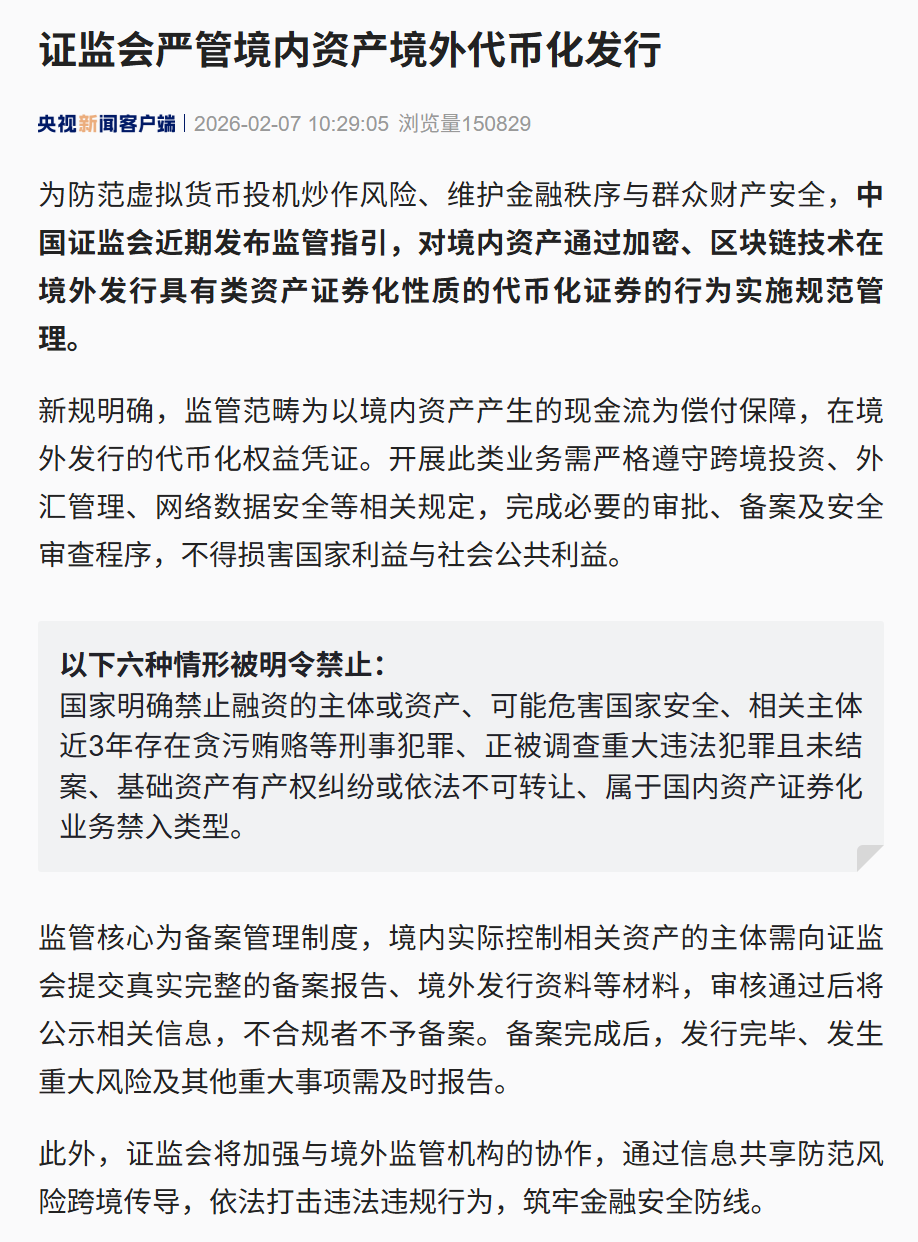
Core Viewpoint - The China Securities Regulatory Commission (CSRC) has issued regulatory guidelines to manage the issuance of tokenized securities abroad that are backed by domestic assets, aiming to prevent speculative risks associated with virtual currencies and protect financial order and public property safety [1] Regulatory Scope - The new regulations cover tokenized equity certificates issued abroad that are backed by cash flows generated from domestic assets [1] - Businesses engaging in such activities must comply with cross-border investment, foreign exchange management, and data security regulations, and must complete necessary approvals, filings, and security reviews [1] Prohibited Activities - Six specific scenarios are explicitly prohibited, including: - Entities or assets that are explicitly banned from financing by the state - Activities that may endanger national security - Entities with criminal records related to corruption or bribery in the past three years - Entities currently under investigation for major illegal activities that are unresolved - Assets with ownership disputes or that are legally non-transferable - Types of domestic asset securitization that are prohibited [1] Core Regulatory Mechanism - The core of the regulation is a filing management system, requiring entities that control relevant assets domestically to submit complete and truthful filing reports and issuance materials to the CSRC [1] - Upon approval, relevant information will be publicly disclosed, and non-compliant entities will not be allowed to file [1] - After filing, any significant risks or major events must be reported promptly [1] International Cooperation - The CSRC will enhance collaboration with overseas regulatory bodies to share information and prevent cross-border risk transmission, while also legally combating illegal activities to strengthen financial security [1]
证监会严管境内资产境外代币化发行
Jing Ji Guan Cha Wang· 2026-02-07 03:04
Core Viewpoint - The China Securities Regulatory Commission (CSRC) has issued regulatory guidelines to manage the issuance of tokenized securities based on domestic assets abroad, aiming to prevent speculative risks associated with virtual currencies and maintain financial order and public asset safety [1] Group 1: Regulatory Scope - The new regulations specify that the scope of supervision includes tokenized equity certificates issued abroad, backed by cash flows generated from domestic assets [1] - Businesses engaging in such activities must comply with cross-border investment, foreign exchange management, and cybersecurity regulations, and must complete necessary approvals, filings, and security reviews [1] Group 2: Prohibited Circumstances - Six specific scenarios are explicitly prohibited, including financing entities or assets that are banned by the state, those that may endanger national security, and entities involved in serious criminal activities within the last three years [2] - The core of the regulation is a filing management system, requiring entities controlling relevant assets to submit complete and truthful filing reports to the CSRC for approval [2] Group 3: Compliance and Cooperation - Upon approval, relevant information will be publicly disclosed, and non-compliant entities will not be allowed to file [2] - The CSRC will enhance cooperation with overseas regulatory bodies to share information and prevent cross-border risk transmission, while also taking legal action against illegal activities [2]
深夜发文!央行等八部门 升级虚拟货币监管政策!
Sou Hu Cai Jing· 2026-02-07 02:30
Core Viewpoint - The People's Bank of China and seven other regulatory bodies have issued a notification reinforcing the prohibition of virtual currency-related activities, emphasizing the risks associated with virtual currencies and stablecoins linked to fiat currencies [1][2]. Summary by Sections Regulatory Framework - Virtual currency-related activities are classified as illegal financial activities, and foreign entities are prohibited from providing such services to domestic subjects [2]. - The notification explicitly states that no entity or individual may issue stablecoins pegged to the Renminbi abroad without regulatory approval [2][5]. - Activities related to the tokenization of real-world assets (RWA) are also deemed illegal unless conducted under specific regulatory approvals [2][6]. Enforcement Measures - Internet companies are barred from providing services related to virtual currencies and RWA tokenization, including marketing and payment facilitation [2][5]. - Businesses and individual entrepreneurs are prohibited from using terms like "virtual currency," "stablecoin," and "RWA" in their registered names and business scopes [2][5]. - The notification mandates a crackdown on virtual currency mining activities, requiring the closure of existing mining projects and a ban on new ones [2][6]. Risk Monitoring and Accountability - The notification emphasizes the need for enhanced risk monitoring and the sharing of data across departments to combat illegal activities related to virtual currencies and RWA tokenization [7]. - Individuals and entities that knowingly assist foreign parties in providing illegal services related to virtual currencies will face legal consequences, including criminal charges if applicable [3][7]. Historical Context and International Perspective - The notification builds on previous regulations from 2021, reiterating the long-standing prohibition of virtual currency activities in China [4][8]. - Despite the growth of virtual currencies and stablecoins internationally, regulatory bodies remain cautious about their risks, as highlighted by the Bank for International Settlements [9].
中国人民银行、中国证监会等八部门联合发文——虚拟货币监管力度只紧不松
Xin Lang Cai Jing· 2026-02-06 21:01
具体来看,《通知》明确了风险监测、防范与处置相关要求,包括风险监测、中介机构监管、互联网信 息内容管理、经营主体登记和广告管理、整治虚拟货币"挖矿"、打击相关违法犯罪活动、行业自律管理 等。根据《通知》,相关部门将健全工作机制,形成央地协同、条块结合的工作格局。 "长期以来,境内始终对虚拟货币相关业务活动保持禁止性的政策立场。"中国人民银行、中国证监会有 关负责人表示,2013年,中国人民银行等五部门联合印发《关于防范比特币风险的通知》,明确比特币 是一种特定的虚拟商品,不能且不应作为货币在市场上流通使用。2021年印发的《关于进一步防范和处 置虚拟货币交易炒作风险的通知》再次明确,比特币、以太币,以及泰达币等稳定币,均不具有与法定 货币等同的法律地位,在境内开展虚拟货币相关业务活动属于非法金融活动,一律严格禁止。 近期,受多种因素影响,虚拟货币、现实世界资产(RWA)代币化相关投机炒作活动时有发生,风险 防控面临新形势、新挑战。为进一步完善监管政策,防范和处置相关风险,中国人民银行、中国证监会 等八部门联合发布《关于进一步防范和处置虚拟货币等相关风险的通知》(以下简称《通知》),明确 在境内虚拟货币相关业务 ...