十五五时期经济社会发展

Search documents
郑永年看“十五五”:以“中国人经济”拓展经济外延
21世纪经济报道· 2025-10-26 14:33
Core Viewpoint - The article emphasizes the importance of enhancing technological self-reliance and independence as a key goal for China's economic and social development during the "14th Five-Year Plan" period, with a focus on building a modern industrial system and boosting consumption through the development of the real economy [1][3][4]. Summary by Sections Economic Goals and Strategies - The "14th Five-Year Plan" aims for significant improvements in economic strength, technological capabilities, national defense, and overall national power by 2035, with a target of achieving a per capita GDP comparable to that of moderately developed countries [1][5]. - Key strategies include building a modern industrial system, strengthening the real economy, and accelerating high-level technological self-reliance to lead new productive forces [1][4]. Technological Self-Reliance - The concept of "technological self-reliance" reflects a shift in China's approach to technology, moving from merely acquiring technology from international markets to focusing on qualitative breakthroughs in technology development [3][4]. - The article highlights the need for increased investment in technology and research and development to adapt to complex external conditions, particularly in light of challenges such as trade wars and the COVID-19 pandemic [3][4]. Manufacturing and Consumption - The article stresses the critical role of manufacturing in enhancing consumption levels, arguing that simply providing financial incentives is insufficient; instead, a robust manufacturing sector is essential for creating wealth and improving overall consumption [6][7]. - It notes that China's current per capita GDP of over $13,400 must grow to approximately $30,000 within ten years to reach the target set for moderately developed countries, emphasizing the need for a strong manufacturing base to achieve this goal [5][6]. Investment in People - The article discusses the shift from investing in physical infrastructure to investing in human capital, highlighting the importance of education, technology, and talent development as central to economic and technological advancement [8][9]. - It argues that the ultimate goal of economic and technological development is to improve people's livelihoods, making "investment in people" a crucial aspect of the development strategy [8][9]. Global Economic Engagement - The article introduces the concept of "Chinese people’s economy," which encompasses the global economic activities of Chinese individuals and businesses, suggesting that both domestic and international economic strategies are essential for comprehensive economic development [9][10]. - It emphasizes the need for Chinese enterprises to engage in international markets while simultaneously strengthening the domestic economy [9].


深刻把握“十五五”时期我国发展必须遵循的重要原则——论学习贯彻党的二十届四中全会精神
Hai Nan Ri Bao· 2025-10-26 00:24
Core Viewpoint - The article emphasizes the importance of the "Six Persistences" principles and the guiding ideology established during the 20th National Congress of the Communist Party of China, which are crucial for achieving decisive progress in the modernization of socialism in China during the "14th Five-Year Plan" period [1][2][5] Group 1: Guiding Ideology and Main Goals - The guiding ideology for the "14th Five-Year Plan" period is based on a comprehensive understanding of both domestic and international situations, historical positioning, and the complex changes in the development environment [1][2] - The main goals for economic and social development are outlined in seven aspects, aimed at inspiring the entire party and the nation to strive for the basic realization of socialist modernization [1][2] Group 2: Importance of the "Six Persistences" - The "Six Persistences" include: adherence to the Party's overall leadership, prioritizing the people, promoting high-quality development, deepening comprehensive reforms, combining effective markets with proactive government, and coordinating development with security [2][3] - These principles are a scientific summary of the experiences gained since the reform and opening-up, reflecting the Party's deepening understanding of economic and social development laws [2][3] Group 3: Role of the Party and Government - The article highlights that the key to managing China's affairs lies in the Party's leadership, which has been crucial in overcoming challenges such as the pandemic and external pressures [3][4] - The relationship between the market and government is emphasized, with the market playing a decisive role in resource allocation while the government provides necessary support [4][5] Group 4: Current Development Advantages - The article notes that China possesses numerous favorable factors and significant advantages for development, which should be leveraged to enhance the market system and create a first-class business environment [5] - It stresses the need to implement the principles from the 20th National Congress and maintain a focus on achieving the second centenary goal [5]
深刻把握“十五五”时期我国发展必须遵循的重要原则
Ren Min Ri Bao· 2025-10-25 22:12
Core Viewpoint - The article emphasizes the importance of the "Six Persistences" principles and the guiding ideology established during the 20th National Congress of the Communist Party of China, which aims to provide a clear direction for achieving socialist modernization during the "14th Five-Year Plan" period [1][2]. Group 1: Guiding Ideology and Main Goals - The guiding ideology for the "14th Five-Year Plan" period is based on a comprehensive understanding of both domestic and international situations, historical positioning, and the complex changes in the development environment [1][2]. - Seven main goals for economic and social development have been proposed to inspire the entire party and the nation to strive for the basic realization of socialist modernization [1]. Group 2: Six Persistences Principles - The "Six Persistences" principles include: 1. Upholding the Party's overall leadership 2. Prioritizing the people 3. Committing to high-quality development 4. Deepening comprehensive reforms 5. Combining effective markets with a proactive government 6. Coordinating development and security [2][3]. - These principles are a scientific summary of the experiences gained since the reform and opening-up, reflecting a deepened understanding of the laws governing economic and social development [2]. Group 3: Importance of Party Leadership - The article highlights that the key to managing China's affairs lies in the Party's leadership, especially in navigating challenges such as the pandemic and external pressures [3]. - Maintaining the authority of the Party and its centralized leadership is essential for ensuring a bright future for Chinese-style modernization [3]. Group 4: Market and Government Relationship - The development of a socialist market economy is crucial, emphasizing the need to balance the roles of the market and government in resource allocation [4]. - The combination of market mechanisms and government support has been a significant factor in China's economic success, with recent policies aimed at boosting domestic demand and benefiting enterprises and citizens [4]. Group 5: Future Development Strategies - The article stresses the need to seize development opportunities, consolidate advantages, and improve the socialist economic system during the "14th Five-Year Plan" period [5]. - A unified, open, and competitive market system is essential for creating a first-class business environment that is market-oriented, law-based, and internationalized [5].
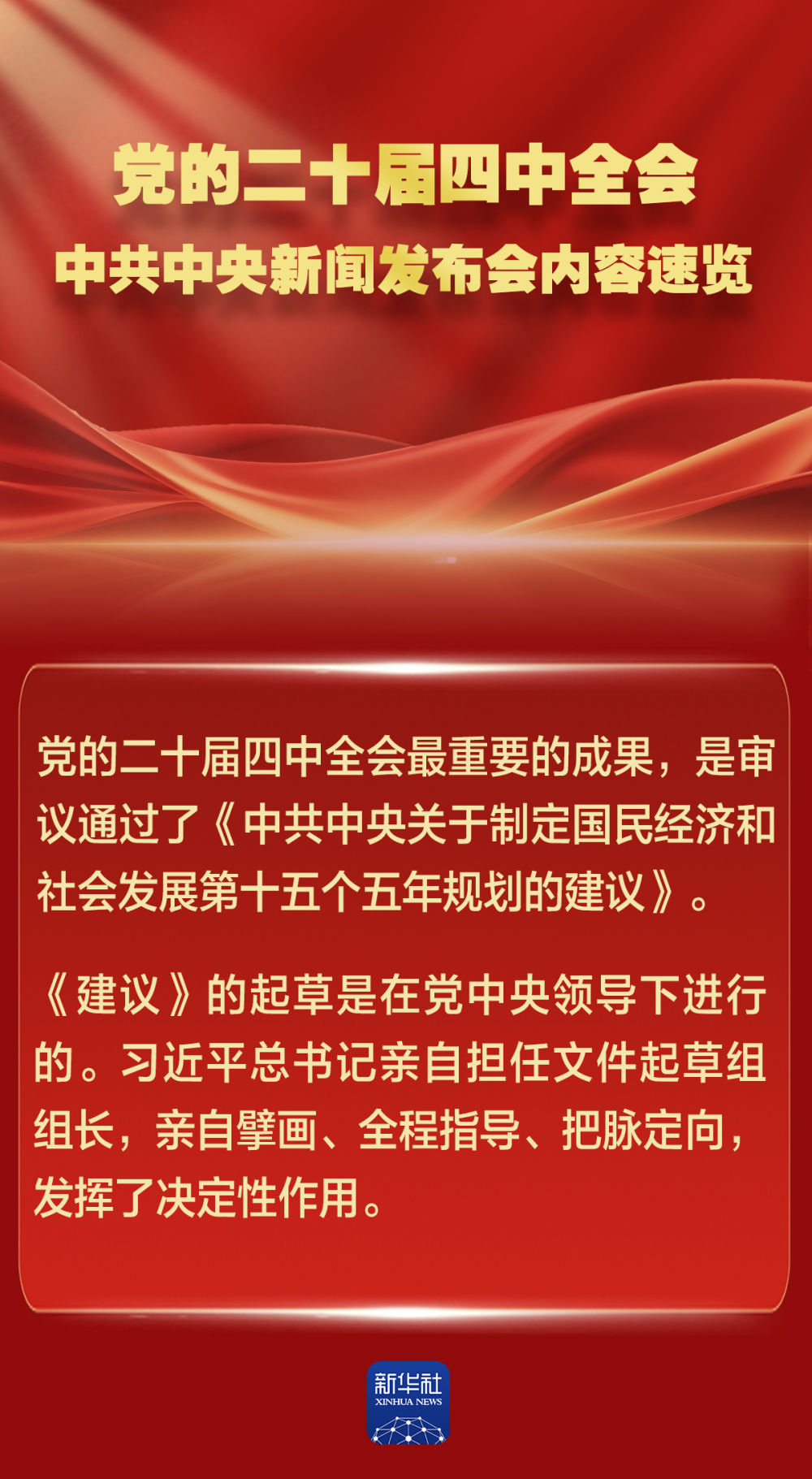
党的二十届四中全会 中共中央新闻发布会内容速览
Xin Hua She· 2025-10-24 14:43
Core Viewpoint - The 20th Central Committee's Fourth Plenary Session outlines significant achievements and strategic tasks for China's economic and social development during the "14th Five-Year Plan" and the upcoming "15th Five-Year Plan" [3][5][7]. Group 1: Major Achievements and Goals - The "15th Five-Year Plan" aims for high-quality development, significant improvements in technological self-reliance, breakthroughs in comprehensive reforms, enhanced social civilization, improved quality of life, progress in building a beautiful China, and strengthened national security [7]. - The session emphasizes the importance of establishing a modern industrial system and solidifying the foundation of the real economy as a top strategic task, focusing on four key areas: solidifying the foundation, upgrading, fostering innovation, and enhancing efficiency [9]. Group 2: Technological and Educational Initiatives - To accelerate high-level technological self-reliance, the plan includes strengthening original innovation, promoting deep integration of technological and industrial innovation, advancing education and talent development, and furthering the construction of a digital China [11][12]. Group 3: Open Economy and Trade - The "15th Five-Year Plan" promotes proactive expansion of autonomous opening-up, innovative trade development, and the expansion of bilateral investment cooperation, alongside high-quality construction of the Belt and Road Initiative [15].
学习快评:在党的坚强领导下创造新奇迹
Xin Hua She· 2025-10-24 08:26
Core Viewpoint - The 20th Central Committee's Fourth Plenary Session emphasizes the necessity of adhering to the Party's comprehensive leadership as a fundamental guarantee for economic and social development during the "14th Five-Year Plan" period [1] Group 1 - The practice shows that strengthening the Party's comprehensive leadership is essential for advancing Chinese-style modernization and serves as a stabilizing force for the continuous development of the Party and the country [1] - The importance of maintaining the authority of the Party Central Committee, with Xi Jinping at its core, is highlighted, ensuring that the Party's leadership is integrated throughout all aspects and processes of economic and social development [1] - Effective governance of the Party is linked to stronger national strength, indicating that the more effective the Party's self-governance, the stronger the support for economic and social development [1] Group 2 - The need for the Party's self-revolution to lead social revolution is emphasized, with a call for persistent efforts in advancing strict governance of the Party to enhance its political leadership, ideological guidance, organizational strength, and social appeal [1] - The Party's ability to lead economic and social development is crucial for gathering momentum towards achieving the goals set for the "14th Five-Year Plan" period [1] - A stronger Party is seen as key to uniting the people to continue writing new chapters of rapid economic development and long-term social stability, thus creating a new landscape for Chinese-style modernization [1]
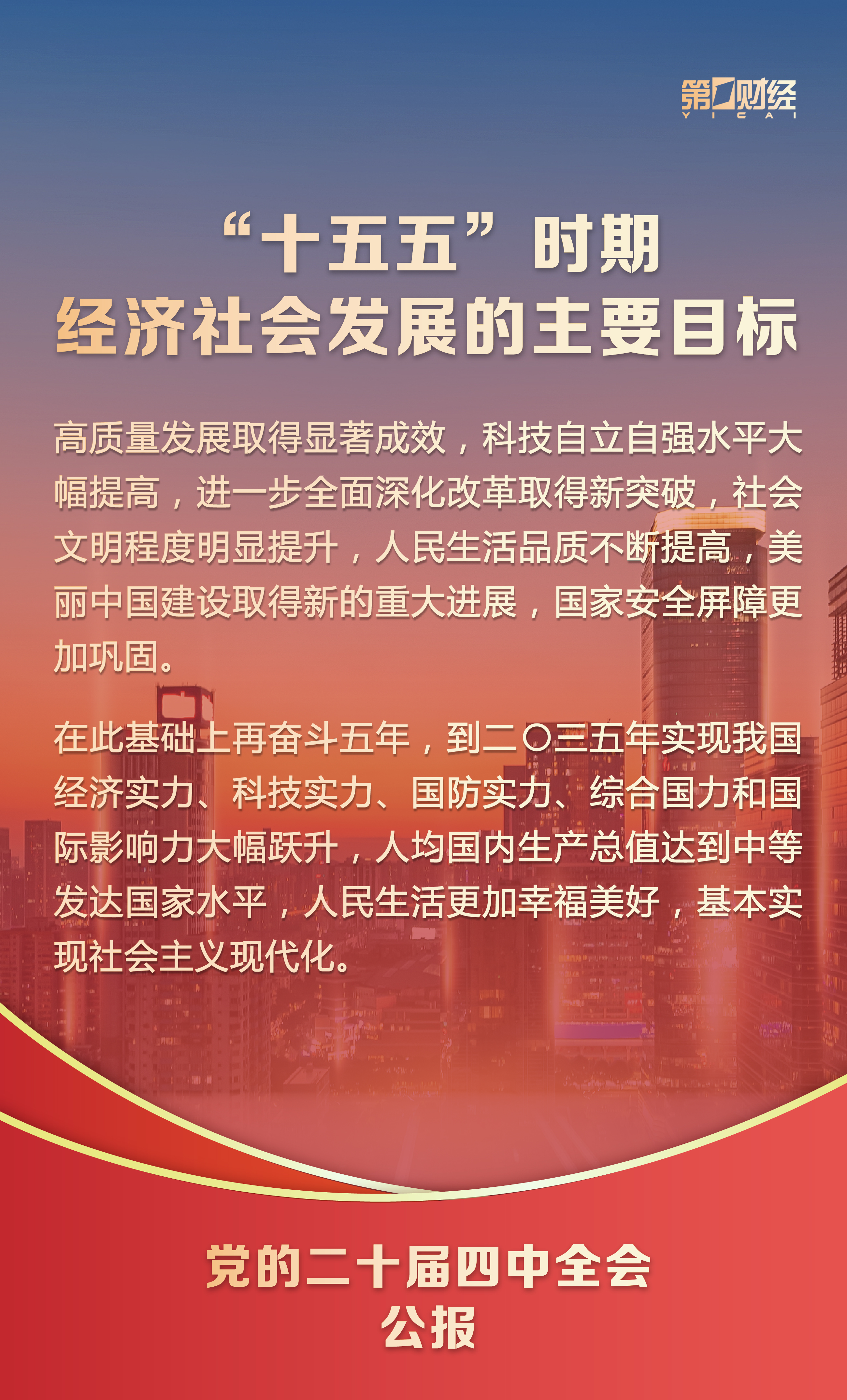
速览!“十五五”时期经济社会发展的主要目标
Di Yi Cai Jing· 2025-10-23 11:13
Group 1 - The level of civilization has significantly improved, indicating progress in societal development [2] - New achievements in the construction of a prosperous society have been made, suggesting a consolidation of previous efforts [2] - The international influence of the economy has greatly increased, reflecting a broader impact on global markets [2]
“十五五”主要目标!
中国能源报· 2025-10-23 09:46
Core Points - The main goals for the "14th Five-Year Plan" period include significant achievements in high-quality development, substantial improvement in technological self-reliance, breakthroughs in comprehensive reforms, enhancement of social civilization, continuous improvement in people's quality of life, major progress in building a beautiful China, and a more solid national security barrier [1] Summary by Sections - Economic Development Goals: The focus is on achieving remarkable results in high-quality development and significantly enhancing the level of technological self-reliance [1] - Reform and Civilization: There is an emphasis on further deepening reforms and improving social civilization standards [1] - Quality of Life: The plan aims to continuously enhance the quality of life for the people [1] - Environmental and Security Progress: Major advancements in building a beautiful China and strengthening national security are highlighted [1] - Long-term Vision: By 2035, the goal is to achieve a substantial leap in economic, technological, defense, comprehensive national strength, and international influence, with per capita GDP reaching the level of moderately developed countries [1]
王沪宁主持召开全国政协主席会议 易会满被免职
Xin Hua She· 2025-09-30 12:06
Core Points - The meeting of the 41st Chairman Meeting of the 14th National Committee of the Chinese People's Political Consultative Conference (CPPCC) was held on September 30, 2023, chaired by Wang Huning [1] - The meeting emphasized the importance of studying and implementing Xi Jinping's recent important speeches and directives, particularly regarding patriotism and anti-Japanese war spirit [2] - The meeting also discussed the need for ongoing education on the Central Eight Regulations and the promotion of achievements in Tibet and Xinjiang under the leadership of the Communist Party of China [2] - A decision was made to hold the 14th Standing Committee Meeting of the 14th CPPCC in late October in Beijing [3] - The meeting included discussions on global climate change and its responses, with a report from the head of the China Meteorological Administration [3] Summary by Categories Meeting Overview - The 41st Chairman Meeting of the 14th CPPCC was convened to discuss various important topics and directives from the central leadership [1] Key Directives - Emphasis on the need to promote patriotism and the spirit of the anti-Japanese war as articulated by Xi Jinping [2] - Importance of adhering to the Central Eight Regulations and enhancing understanding of work style construction [2] - Focus on the historical achievements in Tibet and Xinjiang, promoting the comprehensive implementation of the Party's strategies in these regions [2] Future Plans - The 14th Standing Committee Meeting of the CPPCC is scheduled for late October in Beijing [3] - A collective study session on global climate change is planned, indicating a focus on environmental issues [3]
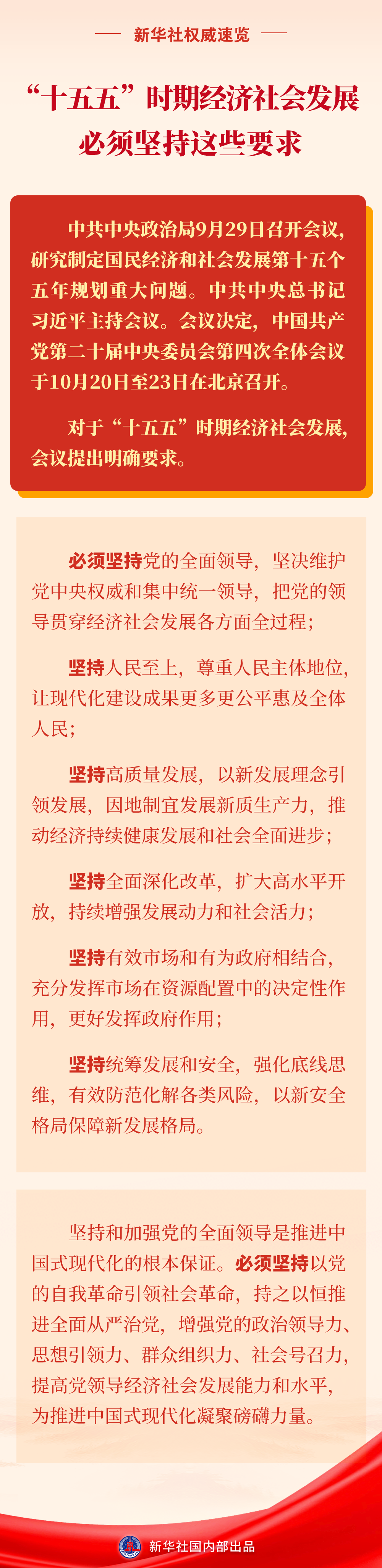
“十五五”时期经济社会发展必须坚持这些要求
Xin Hua She· 2025-09-30 00:13
Group 1 - The meeting of the Central Political Bureau on September 29 focused on the formulation of the 15th Five-Year Plan for national economic and social development, chaired by General Secretary Xi Jinping [2] - The upcoming Fourth Plenary Session of the 20th Central Committee of the Communist Party of China is scheduled to be held in Beijing from October 20 to 23 [2] Group 2 - The meeting emphasized the necessity of upholding the Party's comprehensive leadership and ensuring the authority and centralized leadership of the Party throughout the economic and social development process [3] - It highlighted the principle of putting people first, ensuring that the benefits of modernization are distributed more equitably among all people [3] - The focus on high-quality development was reiterated, advocating for a new development philosophy to guide development and promote sustainable economic growth and comprehensive social progress [3] - The meeting called for comprehensive deepening of reforms and expanding high-level opening-up to continuously enhance development momentum and social vitality [3] - It stressed the importance of a combination of an effective market and a proactive government, aiming to leverage the market's decisive role in resource allocation while enhancing government functions [3] - The need for coordinated development and security was underscored, with an emphasis on strengthening bottom-line thinking and effectively preventing and mitigating various risks [3]
《求是》杂志发表习近平总书记重要文章《用中长期规划指导经济社会发展是我们党治国理政的一种重要方式》
证监会发布· 2025-06-15 10:58
Core Viewpoint - The article emphasizes the importance of medium- and long-term planning in guiding economic and social development, highlighting it as a significant method for governance by the Communist Party of China [1][2] Group 1: Importance of Planning - The article states that scientifically formulating and continuously implementing five-year plans is a crucial experience for governance and a political advantage of socialism with Chinese characteristics [1] - It outlines that the goal of building a modern socialist country has been consistent from the first five-year plan to the 14th five-year plan, reflecting the Party's deepening understanding and strategic maturity in this process [1] Group 2: Chinese-style Modernization - The report from the 20th National Congress of the Communist Party provides a comprehensive top-level design for advancing Chinese-style modernization, which is characterized by phased and sectoral progress [1] - The article stresses the need for top-level design to accurately grasp global development trends and the common aspirations of the people, ensuring that planning and policy systems are timely, rule-based, and innovative [1] Group 3: People's Aspirations and Planning - The article highlights that the people's aspirations for a better life are the ultimate goal of development, and policies should align with public sentiment, incorporating insights from the masses, experts, and grassroots experiences into planning [2] - It emphasizes the necessity of accurately understanding the requirements for the 15th five-year period, focusing on national strength and rejuvenation, and setting reasonable goals and measures for each sector [2] Group 4: Implementation and Local Planning - The article calls for a comprehensive approach to planning that captures key factors, maintains a consistent direction with overall goals, and enhances the execution and effectiveness of local plans [2] - It stresses the importance of adapting local plans to actual conditions and ensuring that they are practical and achievable [2]