国家粮食安全

Search documents
中经评论:别给横向补偿贴上“割肉”标签
Jing Ji Ri Bao· 2025-11-20 00:20
Core Viewpoint - The implementation of horizontal compensation between production and sales areas is a significant adjustment of interest relations, facing numerous challenges in concepts and technology [1][4] Group 1: Horizontal Compensation Mechanism - The horizontal compensation mechanism aims to balance the interests of production and sales areas, ensure food security, and achieve common prosperity, but it has been misinterpreted as "robbing the rich to help the poor" [1][3] - The disparity in development between grain production and sales areas has become a potential threat to national food security, necessitating the establishment of a compensation mechanism [1][2] Group 2: Financial and Structural Challenges - The main production areas face financial difficulties due to limited fiscal revenue from strict agricultural production, which also leads to ecological issues such as groundwater over-extraction and soil degradation [2][3] - The current vertical compensation mechanism from the central government has shortcomings, including the inability to accurately quantify the costs incurred by production areas for national food security [2][3] Group 3: Multi-dimensional Compensation System - A multi-dimensional compensation system involving "funds + industry + technology" should be constructed to promote complementary advantages and win-win cooperation between production and sales areas [3] - The compensation funds from sales areas should be used to enhance grain production capacity, ecological restoration, and ensure farmers' income in production areas [3] Group 4: Strategic Importance - The horizontal compensation mechanism is not about making sales areas "sacrifice," but rather about ensuring they pay reasonable costs for stable grain supply, while also providing sustainable support for production areas [3][4] - This mechanism serves as a correction for market failures, a demonstration of social equity, and a strategic investment for long-term food security [3]
别给横向补偿贴上“割肉”标签
Jing Ji Ri Bao· 2025-11-20 00:05
实施产销区横向利益补偿,是一场深刻的利益关系调整,必然面临观念和技术等方面的诸多挑战。应着 力构建"资金+产业+技术"多维补偿体系,推动形成产销区优势互补、合作共赢新局面。 从目前来看,粮食主产区财政困难问题依然突出。我国虽然建立了中央对产区的纵向补偿机制,但在落 实中仍然存在短板与不足。一是难以精准量化产区为保障国家粮食安全所付出的实际代价,补偿标准与 真实损失不匹配。二是无法激发主销区节约资源、反哺主产区的责任意识。三是无法构建起产销区之间 风险共担、利益共享的市场化纽带。实施产销区省际横向补偿,正是对纵向补偿机制的重要补充,形成 对主产区"纵横结合"的利益补偿机制。该机制既能为主产区引入新的资金渠道,缓解财政压力,又能促 使主销区形成节约集约的消费观和发展观,推动双方从"单向输血"向"协同共生"转变。 实施产销区横向补偿,应着力构建"资金+产业+技术"多维补偿体系,推动形成产销区优势互补、合作 共赢新局面。资金方面,主销区补偿资金应精准用于主产区粮食产能提升、生态修复和农民收益保障。 产业方面,鼓励主销区企业到主产区投资建设现代农业产业园、发展农产品精深加工、共建冷链物流设 施,既能增强自身供应链韧性, ...
抢抓麦播窗口期
He Nan Ri Bao· 2025-11-17 23:21
河南小麦产量占全国四分之一强,这片中原沃土的麦播进度,始终牵动着国家粮食安全的神经。前期持 续阴雨导致土壤偏湿,全省麦播被迫推迟,这一局面不仅关乎来年夏粮收成,更考验着我们守护粮仓的 责任担当。抢时间、提质量,种足种好每一块麦田,是必须答好的政治题。 截至11月16日,全省整地面积8925万亩,小麦已播7760万亩,占预计面积91.3%。这一数字既说明麦播 工作取得阶段性进展,也警示我们仍有任务亟待完成。据气象部门预测,今年冬季气温偏高,11月中旬 完成播种的小麦,豫北地区尚可正常出苗,黄河以南地区可实现主茎2—3叶。但11月25日后播种的小 麦,出苗时间将明显延长,部分地块小麦出苗困难。时间窗口已然收紧,容不得迟疑观望,更不能有等 靠要的消极思想。 麦播从来不是单纯的农业生产任务,而是关乎国计民生的政治责任。河南作为全国小麦生产第一大省, 每一粒麦种的落地,都事关国家粮食安全的底线。要清醒认识到,粮食安全是"国之大者",麦播工作的 推进力度,就是责任担当的体现程度。 破解麦播难题,关键在主动作为。面对不利天气,我省高度重视,多次召开会议研判形势、对麦播工作 进行全面部署,为麦播制定了任务书和时间表。各地要因 ...
超7.3亿吨仓容确保秋粮颗粒归仓
Jing Ji Ri Bao· 2025-11-06 01:27
Core Viewpoint - The article emphasizes the importance of grain storage facilities in ensuring national food security, highlighting the current capacity of over 730 million tons and the need for continuous improvement in storage infrastructure and management practices [1][5]. Group 1: Importance of Grain Storage - Grain storage facilities serve as a "reservoir" and "stabilizer" for food security, helping to manage supply during both surplus and shortage periods [2]. - Adequate grain storage is crucial for responding to natural disasters and international market fluctuations, providing a buffer against unexpected events [2]. - Modern grain storage technologies significantly reduce losses and maintain quality, ensuring that harvested grains do not go to waste [2][4]. Group 2: Development of Grain Storage Infrastructure - China has established the world's largest grain storage network, evolving from traditional storage methods to modern facilities that enhance preservation and efficiency [3]. - The current storage capacity of over 730 million tons represents a significant increase of 58 million tons since the end of the 13th Five-Year Plan, aligning with grain production levels [1][5]. Group 3: Management and Technological Advancements - The management of grain storage has shifted towards intelligent and green practices, with standardized operations from storage to distribution [4]. - Advanced monitoring systems allow for real-time data collection on grain conditions, improving management efficiency and reducing losses [4]. - The workforce in grain storage has transformed, with many personnel becoming skilled in modern technologies, enhancing the overall capability of the sector [4]. Group 4: Future Challenges and Directions - Despite the current achievements, challenges such as regional imbalances in storage capacity and the need for optimized layouts remain [5]. - Continuous efforts are required to enhance storage capabilities, particularly in key production areas and logistics nodes, while also improving management practices [5]. - The article concludes that a robust grain storage system is essential for national stability and food security, emphasizing the need for ongoing investment and innovation in this sector [5].
中经评论:超7.3亿吨仓容确保秋粮颗粒归仓
Jing Ji Ri Bao· 2025-11-06 00:08
Core Insights - The grain storage system is a crucial component of national food security, requiring continuous optimization and enhancement of storage capacity, particularly in major grain-producing areas and key logistics nodes [1][5]. Group 1: Importance of Grain Storage - Grain storage facilities serve as a "reservoir" and "stabilizer" for food security, helping to manage supply during both surplus and shortage periods [2]. - Modern grain storage employs advanced technologies to minimize losses and maintain quality, ensuring that harvested grains do not go to waste [2][4]. - A well-structured grain storage network enhances circulation efficiency, reducing logistics costs and ensuring rapid response during emergencies [2]. Group 2: Development of Grain Storage Facilities - Over the past 70 years, China has built the world's largest grain storage network, transitioning from outdated storage methods to modern facilities with improved insulation and moisture control [3]. - The current grain storage capacity exceeds 730 million tons, marking a significant increase from previous years, which aligns with grain production levels [1][5]. Group 3: Management and Technological Advancements - Recent advancements in grain storage management focus on smart and green technologies, transitioning from manual to automated systems for better monitoring and control [4]. - The implementation of real-time monitoring systems allows for efficient management of grain conditions, significantly improving oversight and reducing losses [4]. - The workforce in grain storage has evolved, with many traditional roles transforming into positions requiring modern technical skills, supporting the industry's growth [4]. Group 4: Future Challenges and Directions - Despite the progress, challenges remain, including regional imbalances in storage capacity and the need for further optimization of the storage layout [5]. - Continuous efforts are necessary to enhance storage capabilities and management practices to meet the increasing demands for food quality and safety [5].
刘国中在人民日报发表署名文章:加快农业农村现代化
Xin Lang Cai Jing· 2025-11-05 23:52
Core Viewpoint - The article emphasizes the systematic deployment of key tasks for accelerating agricultural and rural modernization during the "15th Five-Year Plan" period, highlighting the importance of persistent implementation and achieving tangible results [1] Summary by Relevant Sections - **Modernization of Agriculture** - The fundamental solution for agriculture lies in modernization, with a focus on continuously improving comprehensive agricultural production capacity [1] - **Strategic Initiatives** - The strategy includes enhancing the supply guarantee capacity for important agricultural products such as grain, implementing the "storing grain in the land" and "storing grain in technology" strategies, and stabilizing grain planting areas [1] - **Production Capacity Enhancement** - A new round of actions to increase grain production capacity by 100 billion jin is to be launched, expanding the scale of grain yield improvement projects and promoting high-yield and efficient farming models [1] - **Food Security Measures** - Strengthening agricultural disaster prevention and mitigation capabilities is essential to solidify the foundation of national food security, ensuring that China's food supply remains stable [1] - **Diverse Food Supply System** - The development of modern facility agriculture and a diversified food supply system is encouraged, alongside continuous efforts to reduce food waste and establish long-term mechanisms for food conservation [1] - **Land Management** - Strict adherence to the arable land red line is mandated, with rigorous management of land occupation and compensation, and rectification of illegal land occupation behaviors [1]
刘宁会见国家粮食和物资储备局局长刘焕鑫
He Nan Ri Bao· 2025-11-04 11:40
Core Viewpoint - The meeting between Liu Ning, the Secretary of the Provincial Party Committee of Henan, and Liu Huanxin, a member of the National Development and Reform Commission, emphasizes the importance of Henan as a major grain-producing province and its role in ensuring national food security [1][2]. Group 1 - Henan is recognized as a significant grain production and processing province, playing a crucial role in national food security [1][2]. - The provincial government is committed to enhancing agricultural modernization and improving the quality and efficiency of agricultural production [2]. - The National Food and Material Reserve Bureau will increase support in areas such as grain storage logistics, procurement regulation, and industry development to enhance grain circulation in Henan [1][2]. Group 2 - The provincial leadership is focused on implementing the spirit of the 20th Central Committee and ensuring food security through various measures, including technological advancements and market strategies [2]. - There is a strong emphasis on building green storage facilities and modernizing grain management practices to support high-quality agricultural development in Henan [2].
农发行张家港市支行投放储备油贷款 为区域粮油安全“添砖加瓦”
Jiang Nan Shi Bao· 2025-10-28 07:20
Core Viewpoint - The Agricultural Development Bank of China (ADBC) Zhangjiagang Branch has successfully issued over 4 million yuan in loans for local reserve oil, aimed at supporting the collection and storage of local reserve oil, thereby enhancing the stability of the edible oil market and emergency supply capabilities [1] Group 1: Loan Impact - The loan provides essential financial support for the timely collection and storage of reserve oil, which is crucial for maintaining a stable supply of edible oil in the region [1] - With sufficient funding, local reserve oil collection can proceed smoothly, increasing the regional edible oil reserves and improving the ability to adjust to market fluctuations [1] Group 2: Strategic Role - The issuance of the local reserve oil loan reflects ADBC's ongoing commitment to supporting national food security strategies, emphasizing its role as a policy bank [1] - ADBC has consistently prioritized serving the agricultural sector and ensuring food security as part of its strategic mission [1] Group 3: Future Plans - Looking ahead, ADBC Zhangjiagang Branch plans to enhance credit support across the entire grain and oil industry chain, from planting to processing and market circulation [2] - The bank aims to strengthen the regional food supply security and contribute to the high-quality development of the local economy [2]
不买美国大豆后,国际大豆价格针对我们疯涨,为啥咱们还硬要买
Sou Hu Cai Jing· 2025-10-28 00:41
Core Insights - The article discusses the significant gap in soybean supply in China, highlighting the necessity of imports due to domestic production limitations [4][6][18] Group 1: Supply and Demand - China's annual soybean demand exceeds 110 million tons, while domestic production is only about 20 million tons, resulting in a shortfall of 90 million tons [4][18] - The 90 million ton gap is equivalent to more than the total annual soybean demand of Europe, indicating the scale of the issue [3][4] Group 2: Economic Viability - Growing soybeans is less profitable compared to other crops like corn, with profits from one acre of corn reaching over 300 yuan, while soybean profits may only be around 100 yuan [12][10] - The economic unfeasibility of soybean farming is compounded by the reliance on government subsidies to maintain production levels in regions like Northeast China [10][11] Group 3: Agricultural Practices - The article emphasizes the difference between imported soybeans (primarily genetically modified) and domestic soybeans (non-GMO), with the former being crucial for producing soybean meal, a key ingredient in animal feed [8][7] - The reliance on imported soybeans is framed as essential for maintaining the supply of meat, eggs, and dairy products in the country [7][18] Group 4: Strategic Responses - The government is pursuing multiple strategies to address the soybean supply issue, including developing high-yield, disease-resistant soybean varieties and promoting intercropping techniques to maximize land use [14][15] - Efforts are also being made to diversify import sources and reduce dependency on traditional suppliers like the U.S. and Brazil, including exploring alternatives like canola meal and insect protein [16][15]

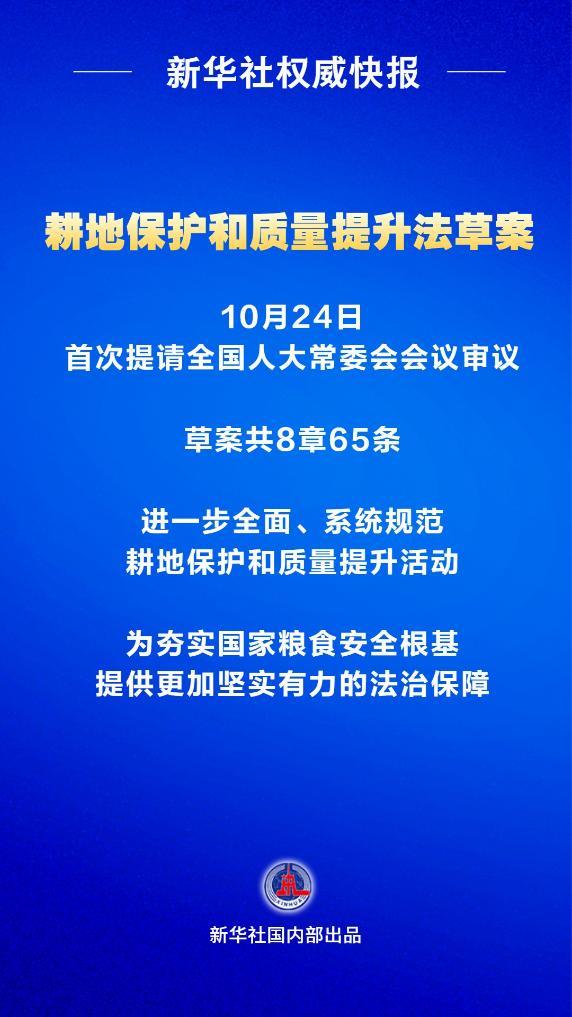
新华社权威快报丨我国首次专门立法加强耕地保护和质量提升
Xin Hua She· 2025-10-24 10:33
Core Points - The draft law on farmland protection and quality improvement was submitted for review by the National People's Congress Standing Committee on October 24 [2] - The draft consists of 8 chapters and 65 articles, aiming to systematically regulate farmland protection and quality enhancement activities [2] Summary by Sections Overall Requirements - The draft law clarifies the overall requirements for farmland protection, emphasizing the need for strict control over farmland occupation and enhancing the quality of farmland [2] Legal Framework - This legislation is designed to address issues related to the limited land resources in China, such as the non-agricultural and non-grain use of farmland, building upon existing laws like the Land Management Law and the Food Security Law [2] Protection Measures - The law aims to strengthen the "three-in-one" protection of farmland quantity, quality, and ecology, providing a robust legal guarantee for national food security [2]