政府引导基金

Search documents
最近,VC/PE都去福建了
母基金研究中心· 2025-09-04 08:54
Core Viewpoint - The article highlights the active role of the Fujian provincial government investment fund in attracting VC/PE attention through various initiatives and funding announcements, which is seen as a positive development for private equity investment in China [2][3]. Group 1: Fund Activities and Announcements - On August 22, the Fujian provincial government investment fund announced the selection of GP for the second batch of specialized sub-funds, following the public announcement of the first batch of five sub-fund managers on July 21 [2]. - The provincial fund has been active this year, launching multiple funds with target sizes of 1 billion for a biomedicine fund, 5 billion for a merger fund, 5 billion for an S fund, and 3 billion for a cultural tourism fund, indicating consistent progress and announcements [2]. - The fund's establishment and operations are efficient, having received government approval in February and subsequently releasing the first batch of sub-fund selection announcements in March [3]. Group 2: Policy Support and Mechanisms - The Fujian provincial fund has implemented positive incentives for sub-funds, allowing for profit-sharing based on development outcomes, with a maximum of 50% of government investment returns [4]. - Significant adjustments have been made to the fund management guidelines, including lowering the minimum return ratio from 1.5 times to 1 time the government investment and establishing a compliance exemption mechanism for investment failures under certain conditions [5]. - The fund's investment period has been extended to 30 years, reflecting a commitment to "patient capital" that can endure long investment cycles typical of technology innovation [6]. Group 3: Strategic Goals and Collaborations - Fujian aims to establish a comprehensive fund matrix, targeting the creation of a 300 billion functional fund group and a 1 trillion industrial fund group within five years, enhancing the role of government-led funds [7][9]. - The provincial government has successfully set up nine government investment funds totaling 13.3 billion, focusing on industries such as digital technology, new energy, and biomedicine [8]. - Collaborations with leading industry players and national funds are being fostered to enhance the resilience and security of industrial supply chains, with specific funds established for carbon neutrality and biomedicine [10]. Group 4: Future Outlook - The article anticipates that Fujian's continuous optimization of policies and mechanisms will enhance its attractiveness to VC/PE, driving talent, enterprises, and resources to the region [11]. - The upcoming 29th World Investment Conference and the 8th Sharjah Investment Forum are expected to facilitate discussions on emerging industries and foreign investment cooperation [12].


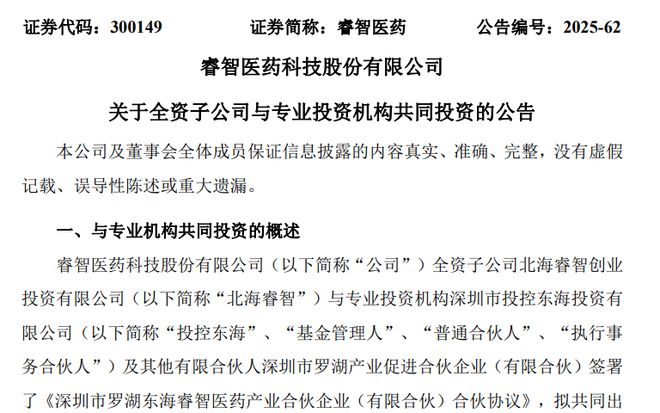
地方母基金出资70%,睿智医药拟参与设立2亿元产投基金
Nan Fang Du Shi Bao· 2025-09-04 07:44
Core Viewpoint - The announcement by Ruizhi Pharmaceutical Technology Co., Ltd. regarding the establishment of an industrial investment fund with a total subscription amount of 200 million RMB, primarily targeting the healthcare industry and focusing on innovative drugs [1][3]. Group 1: Fund Establishment Details - The fund will be established in partnership with Shenzhen Investment Holdings Donghai Investment Co., Ltd. and other limited partners, with a total subscription amount of 200 million RMB [1][3]. - The fund's name is Shenzhen Luohu Donghai Ruizhi Pharmaceutical Industrial Partnership (Limited Partnership), with Ruizhi's subsidiary contributing 58 million RMB, accounting for 29% of the total subscription [3][5]. - The Luohu District-level mother fund will contribute 140 million RMB, representing 70% of the total subscription [3][4]. Group 2: Fund Management and Investment Focus - The fund will focus on equity investments in the healthcare industry, particularly in innovative drugs and medical devices [5][6]. - Shenzhen Investment Holdings Donghai will act as the general partner and fund manager, with a focus on industrial technology, digital intelligence, and life health sectors [5][6]. Group 3: Fund Terms and Conditions - The fund has a duration of 7 years, with a 4-year investment period followed by a 3-year exit period, and can be extended by 2 years with unanimous agreement [6]. - Management fees will be charged at 2% during the investment period and 1.5% during the exit period, with no fees during the extension period [6]. - Strict reinvestment requirements include relocating the headquarters of invested companies to Luohu or establishing subsidiaries there, ensuring that revenues remain in the district [6][7].

中国母基金达460家总规模超3万亿,北上粤苏皖规模突出
Nan Fang Du Shi Bao· 2025-09-03 08:04
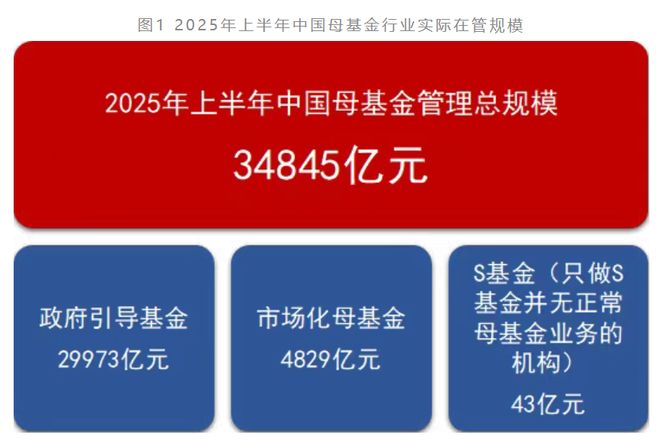
Core Insights - The report indicates a shift in China's mother fund industry from quantity expansion to quality improvement, influenced by significant policy changes such as the "State Council No. 1 Document" [1][7] Summary by Categories Overall Industry Trends - As of June 30, 2025, there are 460 mother funds in China with a total management scale of 34,845 billion RMB, a decrease of 23.7% compared to the end of 2024 [2][4] - The total planned management scale of these mother funds is 60,778 billion RMB [2] Fund Composition - Among the 460 mother funds, 338 are government-guided funds with a management scale of 29,973 billion RMB, down 24.0% from the end of 2024 [4] - There are 112 market-oriented mother funds with a management scale of 4,829 billion RMB, a decrease of 22.4% [4] - The report also includes 10 S funds with a management scale of 43 billion RMB [4] Investment Activity - In the first half of 2025, the total investment scale of mother funds was 3,338 billion RMB, down 7.2% from 3,791 billion RMB in the same period of 2024 [5] - Government-guided fund investments totaled 2,741 billion RMB, a decline of 5.59% from 2,903 billion RMB [5] - Market-oriented mother fund investments were 442 billion RMB, down 6.62% from 473 billion RMB [5] New Fund Establishments - A total of 33 new mother funds were established in the first half of 2025, including 31 government-guided funds and 2 market-oriented funds, with a total scale of 1,970.17 billion RMB [5] - Regions such as Jiangsu, Hubei, and Fujian saw the highest number of new fund establishments, while Beijing, Guangdong, and the Yangtze River Delta maintained scale advantages [5][6] Policy and Regulatory Changes - The "State Council No. 1 Document" has introduced systematic regulations for the establishment, fundraising, operation, and exit of government investment funds, marking a significant policy shift [6][7] - The focus is now on quality over quantity, with an emphasis on long-term orientation and capital efficiency [7] Operational Adjustments - Many regions have increased the contribution ratios and extended the duration of funds, with some allowing contribution ratios to exceed 70% [8] - The tolerance for losses has also increased, with some funds allowing for 100% loss on individual projects [9] - Management fee structures are becoming stricter, with a trend towards lower rates and performance-based fees [9]
存续期20年,高容亏100%!陕西省科技创新母基金管理办法(试行)公布
FOFWEEKLY· 2025-08-18 10:06
Core Viewpoint - The article discusses the implementation of the "Management Measures for the Shaanxi Province Science and Technology Innovation Mother Fund (Trial)" aimed at promoting technology innovation in the region through government-led investment strategies [1] Group 1: Fund Structure and Investment Strategy - The Science and Technology Innovation Mother Fund has a duration of 20 years, with at least 80% of its investments directed towards venture capital sub-funds, and a minimum of 30% allocated to seed and angel sub-funds [2] - Direct investments in major science and technology projects determined by the provincial government are capped at 5% of the total subscribed capital of the mother fund, with remaining funds allocated flexibly to industry sub-funds or direct investment projects [2] - The mother fund's investment in venture capital sub-funds generally does not exceed 50% of the total scale of the sub-fund, with seed and angel sub-funds capped at 60% [2] Group 2: Management and Fee Structure - The management fee for the mother fund is calculated at 1% per year based on the actual paid-in capital for the investment in sub-funds, and similarly for direct investments [3] - 80% of the management fee is a basic fee, while 20% is determined based on performance evaluation results [3] Group 3: Sub-fund Duration and Focus - The duration of sub-funds is limited to a maximum of 15 years, with extensions subject to approval by the provincial government [4] - Sub-funds focusing on early-stage projects must allocate at least 70% of their scale to such investments [5] Group 4: Investment Criteria for Seed and Angel Projects - Seed projects must meet specific criteria, including being within 5 years of establishment and having sales revenue not exceeding 50 million RMB and fewer than 100 employees [6] - Angel projects must also meet criteria, including being within 8 years of establishment and having sales revenue not exceeding 100 million RMB and fewer than 200 employees [7] Group 5: Risk Tolerance and Loss Absorption - The mother fund establishes a mechanism for due diligence exemption, allowing for a maximum loss tolerance of 70% for seed and angel sub-funds, 50% for venture capital sub-funds, and 30% for industry sub-funds [7]

2个50亿,福建省级母基金又在招GP了
母基金研究中心· 2025-08-18 09:05
Group 1 - The article highlights the launch of two new funds in Fujian, aimed at promoting mergers and acquisitions with a target scale of 50 billion yuan each [1] - Fujian's government plans to establish a total of 1.3 trillion yuan in provincial government-guided funds over the next five years, enhancing the investment landscape [1] - In 2023, Fujian's provincial government investment funds have demonstrated efficiency, completing selections for six market-oriented funds, resulting in a fund matrix of 133 billion yuan and facilitating over 1,000 billion yuan in social capital inflow [1] Group 2 - The establishment of 100 billion yuan merger and S funds is expected to provide more patient capital for technology enterprises and improve exit channels for equity investments [1] - Fujian is positioned to become a favored region for venture capital and private equity investments due to these developments [1]

“长续航版”政府引导基金频出,让耐心资本更有耐心
Zheng Quan Shi Bao· 2025-08-15 12:55
Core Insights - The trend of extending the duration of government-guided funds is emerging, with many new funds having a lifespan of over 10 years, some even reaching 20 years, which is a significant shift from the previous norm of 7-8 years [1][2] - This change is expected to foster a more patient capital environment, potentially altering the fundraising, investment, and exit dynamics within the venture capital industry [1][6] Group 1: Fund Duration Changes - Local government-guided funds are increasingly extending their durations, with regions like Shenzhen leading the way by announcing a 2-year extension for existing funds [1][2] - New funds are being established with longer durations, typically around 10 years, compared to previous funds which had shorter lifespans [2][4] - Despite the extension of mother funds' durations, the actual operational time for sub-funds remains limited, often around 10-12 years due to investment and exit periods [2][4] Group 2: Investment Strategies and LP Expectations - The investment periods for sub-funds have not significantly changed, with most still set at 3-4 years, as LPs demand quicker returns on investment [4][5] - The focus on achieving a high DPI (Distributions to Paid-In) ratio has led to a more strategic approach in project selection, balancing quick returns with long-term investments [4][5] - The management fee structures are also evolving, with a decrease in fees despite longer fund durations, as the exit period's fee base remains small [5][6] Group 3: Industry Sentiment and Future Outlook - The extension of fund durations is seen as a positive signal, promoting a more relaxed and patient investment mindset within the industry [6][7] - There is a recognition of the challenges related to exits, with concerns that unresolved exit issues could lead to a backlog of projects, creating a "backwater" effect [6][7] - The introduction of flexible operational models, such as "recycling investment" clauses, is being explored to enhance fund efficiency and address previous limitations [6][7]
政府引导基金延长存续期,创投“募投管退”更从容
Sou Hu Cai Jing· 2025-08-15 00:03
Core Insights - The typical duration of RMB venture capital funds has historically not exceeded 10 years, with most lasting only 7 to 8 years, which has forced many funds to exit before companies experience significant growth [1] - In 2025, a shift is observed as new guiding funds established in regions such as Beijing, Shanghai, Jiangsu, and Guangdong have durations exceeding 10 years, with some extending up to 20 years [1] - Existing guiding funds have also revised their rules to extend their durations, and second-phase funds are now offering longer terms compared to the first phase, allowing for more flexibility in the exit strategies of both parent and subsidiary funds [1]
政府引导基金延长存续期 创投“募投管退”更从容
Zheng Quan Shi Bao Wang· 2025-08-14 23:37
Core Viewpoint - The typical duration of RMB venture capital funds has historically been limited to around 7-10 years, which often forces funds to exit before a technology project reaches its growth potential. However, a significant change is expected in 2025 with the introduction of new guiding funds in various provinces and cities, extending their duration to over 10 years, and in some cases, up to 20 years [1] Group 1 - The average lifespan of RMB venture capital funds is usually 7-8 years, leading to premature exits from promising projects [1] - New guiding funds established in regions like Beijing, Shanghai, Jiangsu, and Guangdong will have a duration of over 10 years, with some extending to 20 years [1] - Existing guiding funds are also modifying their rules to extend their duration, allowing for more flexibility in the exit strategies of both parent and subsidiary funds [1]
产业基金摆脱困局,就往二级市场倒垃圾?
Hu Xiu· 2025-08-08 00:01
Core Viewpoint - The article discusses the current predicament of government-guided funds, highlighting the stagnation in both primary and secondary markets, leading to a situation where funds are unable to be invested or withdrawn, resulting in a "dead water" scenario for these funds [2][5][19]. Group 1: Market Conditions - The primary and secondary markets are experiencing a lack of liquidity, which has persisted for several years, making it difficult for funds to exit investments [2][3]. - The suggestion to relax IPO audits to facilitate exits is seen as misguided, as it may lead to the listing of subpar projects, further exacerbating market issues [5][8][41]. Group 2: Fund Management and Investment Quality - The core issue with government funds is the prevalence of low-quality projects, which are unable to generate returns or exit strategies [19][22]. - There is a critique of the investment culture that prioritizes quick returns and speculative practices over sustainable business models and profitability [15][44]. Group 3: Regulatory Environment - The article emphasizes the need for strong regulation to create a fair and healthy market environment, which is essential for attracting investment and ensuring liquidity [42][43]. - It argues against the notion that strict IPO audits are the root cause of liquidity issues, asserting that the focus should be on improving project quality rather than loosening regulatory standards [41][25]. Group 4: Economic Strategy Shifts - The discussion reflects a shift in economic strategy from supply-side reforms to stimulating demand through consumer spending, indicating a broader change in governmental economic policy [34][36]. - The article suggests that past strategies of subsidizing industries have led to overcapacity and the creation of non-viable projects, necessitating a reevaluation of investment approaches [33][27]. Group 5: Future Directions - Future investment strategies should focus on understanding industry dynamics and improving post-investment management to avoid repeating past mistakes [53][55]. - The need for a more specialized approach in investment practices is highlighted, advocating for deeper industry knowledge and management capabilities [54][56].
湘西金芙蓉产业发展引导母基金招GP
FOFWEEKLY· 2025-08-05 10:19
Core Viewpoint - The Xiangxi Jin Furong Industrial Development Guidance Mother Fund aims to establish a modern industrial system in Xiangxi Prefecture, with a total scale of 1 billion yuan, to promote high-quality economic development in the region [1]. Group 1 - The mother fund is initiated by Xiangxi State-owned Assets Investment and Operation Co., Ltd. and Hunan Caixin Industrial Fund Management Co., Ltd. [1] - The mother fund will not exceed 70% of the total scale of any single sub-fund [2]. - Investment areas for sub-funds include ecological cultural tourism, specialty agriculture and processing, liquor industry, green mining and new materials, traditional Chinese medicine and biomedicine, and new energy [2]. Group 2 - Sub-funds must invest at least 50% of their declared investment scale in the industrial chain [2]. - Investment in a single enterprise project by a sub-fund should not exceed 30% of the sub-fund's total scale and should not exceed 30% of the total equity of the single enterprise project [2]. - Sub-funds are required to reinvest at least an amount equal to the mother fund's paid-in capital within Xiangxi Prefecture [2].