并购基金

Search documents
两会|如何破解金融服务实体经济结构性矛盾?
券商中国· 2026-03-07 03:14
Core Viewpoint - The article discusses the need for financial services to better support the real economy, particularly focusing on how to direct funds towards innovative small and medium-sized enterprises (SMEs) and traditional businesses in need of transformation, addressing the imbalance in funding distribution [2]. Group 1: Financial Services and SMEs - There is a significant challenge in directing funds to innovative SMEs, which often struggle to access financing compared to larger, established companies [2]. - Suggestions include broadening private equity exit channels and innovating the investment-loan linkage mechanism to facilitate funding for key areas like technological innovation and industrial upgrades [2]. Group 2: Private Equity Fund Challenges - Private equity funds face difficulties in their investment cycle due to a slowdown in traditional exit channels like IPOs, leading to challenges in transferring and exiting investments [3]. - A proposal is made to establish a national market for private equity fund share trading in Hainan to improve transaction efficiency and transparency [3]. Group 3: Investment-Loan Linkage Mechanism - The current banking credit system is not well-suited for the characteristics of tech enterprises, which often have high upfront costs and long profit cycles [5]. - Recommendations include enhancing the investment-loan linkage mechanism to better align financial resources with technological innovation, and establishing standardized cooperation platforms between banks and private equity managers [5][6]. Group 4: Comprehensive Financial Service System - Strengthening direct financing channels in capital markets is essential to address structural contradictions in financial services [6]. - Suggestions include improving policies for merger and acquisition (M&A) funds and encouraging innovative credit products from financial institutions to support SMEs [6].


全国政协委员、中信资本董事长张懿宸:用好并购基金 提升资本市场资源配置效率
证券时报· 2026-03-03 00:19
Group 1 - The core viewpoint emphasizes the need to encourage and support merger and acquisition (M&A) funds in participating in capital market restructuring to enhance resource allocation efficiency [1] - M&A funds are recognized as significant players in the capital market, possessing numerous high-quality targets, including "invisible champions," which can aid listed companies in industry mergers and optimizing supply chains [3] - Current obstacles for M&A funds include strict regulatory policies on performance commitments and competition recognition, which hinder collaboration with listed companies [3] Group 2 - To unleash the potential of M&A funds, it is suggested that regulatory authorities relax requirements related to performance commitments, competition, and related transactions, encouraging M&A funds to engage with listed companies [4] - The QFLP (Qualified Foreign Limited Partner) tax policy should be optimized to attract foreign capital, with over 500 QFLP funds established and a total fundraising scale exceeding 600 billion yuan by 2025 [6] - There is a call for the integration of tax rules for cross-border investment models, establishing clear tax rate standards for "passive investment" and "active operation," while providing transitional periods for businesses [8]

这个市,要打造“双万基金”
Sou Hu Cai Jing· 2026-02-13 15:47
Core Viewpoint - Shenzhen aims to establish a diversified, relay-style technology finance service system that aligns with the entire lifecycle of enterprises, targeting the creation of over 10,000 innovation and industry investment funds with a total scale exceeding 10 trillion yuan, referred to as the "Double Ten Thousand Fund" framework [1][2]. Fund Development - Shenzhen has developed a distinctive "Shenzhen State-owned Capital Model," with over 500 state-owned funds totaling more than 700 billion yuan, focusing on strategic emerging industries and future industries, with over 90% of funds directed towards these sectors [2]. - The city is focusing on the "20+8" full industry chain, ensuring that at least 40% of investments are directed towards seed and angel rounds, and at least 20% towards B and C rounds [2]. Innovation and Risk Tolerance - Shenzhen has introduced a guideline that encourages tolerance for failure in technology innovation, establishing a framework for recognizing responsible performance while allowing for certain exemptions [3]. - The city has launched initiatives allowing for a maximum of 100% loss in specific funds, demonstrating a willingness to embrace high-risk investments [4][5]. Action Plan Highlights - The "Action Plan" aims to cultivate both "patient capital" and "bold capital" to support the "20+8" strategic emerging industries, with a goal of forming a "Double Ten Thousand" structure by the end of 2026 [5][6]. - The plan includes the establishment of three new mother funds to enhance the existing fund ecosystem, addressing various investment needs and promoting collaboration [6]. Investment Mechanisms - Shenzhen is exploring innovative mechanisms for fund management, including relaxing return investment requirements for early-stage funds and encouraging the entry of long-term capital sources such as insurance funds and pension funds [6][9]. - The city has also initiated measures to facilitate the entry of surplus funds from cooperative companies into the venture capital sector, showcasing a unique approach to mobilizing local resources [7]. Overall Impact - Shenzhen's initiatives position it as a leading hub for venture capital and private equity, with a strong legislative framework supporting the growth of the industry since 2003 [10]. - The city is expected to continue attracting private equity funds and innovative projects, enhancing its role in the venture capital landscape and contributing to industrial upgrades [10].
重磅信号,国家级并购基金要来了
3 6 Ke· 2026-01-21 02:52
Group 1 - The Chinese government is planning to promote significant projects in high-tech industries, indicating a favorable signal for mergers and acquisitions (M&A) [1] - The National Development and Reform Commission (NDRC) aims to establish a national-level M&A fund to enhance government investment and support innovation and entrepreneurship [1][2] - The number and average scale of newly established M&A funds are expected to significantly increase by 2025, marking a key sign of structural adjustment in China's private equity investment market [1] Group 2 - In 2025, 305 listed companies participated in the establishment of 321 industry M&A funds, with a total funding scale of approximately 297.51 billion yuan, showing a notable increase from 2024 [2] - Newly established M&A funds are highly concentrated in strategic sectors such as advanced manufacturing, healthcare, artificial intelligence, automotive, new materials, and semiconductors, indicating their role in implementing national industrial policies [2] - The increase in fund numbers and participation in emerging sectors like aerospace and low-altitude economy reflects a critical phase of professional and systematic integration in the technology industry [2] Group 3 - M&A funds are positioned as key vehicles for promoting industrial upgrades and are tasked with integrating local industrial chain resources [3] - The market is focusing on building a new exit ecosystem centered around M&A due to tightening IPO exit channels and increasing demand for revitalizing existing assets [3] - The year 2025 is anticipated to be a significant year for the rise of a new wave of M&A funds, further validating their role as a hub connecting capital and industry [3]
重磅信号!国家级并购基金要来了
Sou Hu Cai Jing· 2026-01-20 19:49
Core Insights - The Chinese government is planning to promote a series of significant projects in high-tech industries, with a focus on establishing a national-level merger and acquisition (M&A) fund to enhance government investment and support innovation and entrepreneurship [2][4] - The M&A market in China has shown strong vitality due to policies encouraging industrial mergers, with a notable increase in the number and scale of newly established M&A funds in 2025, marking a structural adjustment in the private equity investment market [2][3] Group 1 - The National Development and Reform Commission (NDRC) is set to formulate a strategic plan for expanding domestic demand from 2026 to 2030, aiming to lead new supply with new demand [2] - In 2025, 305 listed companies participated in the establishment of 321 industrial M&A funds, with a total fundraising scale reaching 297.51 billion yuan, showing significant growth compared to 2024 [3] - Newly established M&A funds are concentrated in strategic sectors such as advanced manufacturing, healthcare, artificial intelligence, automotive, new materials, and semiconductors, indicating their role in implementing national industrial policies [3] Group 2 - M&A funds are positioned as key vehicles for promoting industrial upgrades and are tasked with integrating local industrial chain resources [4] - The market is transitioning towards a new exit ecosystem centered on M&A due to tightening IPO exit channels and increasing demand for revitalizing existing assets [4] - The establishment of national-level M&A funds is expected to open a new chapter in the integration of capital and industry in the Chinese capital market in 2026 [4]
并购基金进入新周期
FOFWEEKLY· 2026-01-19 10:12
Core Viewpoint - A new wave of mergers and acquisitions (M&A) is emerging, driven by policy guidance, market development, and regional industrial needs, establishing M&A as a crucial link between capital and industry [4][7]. Group 1: Historical Context of M&A Funds - M&A funds originated in the 1950s in the U.S. and became a highly specialized financial entity by the 1970s, focusing on leveraged buyouts to address financial challenges faced by companies [5][6]. - The influence of the U.S. financial market led to the introduction of M&A funds in China by the end of the 20th century [6]. Group 2: Specific Roles of M&A - M&A serves four main functions: accelerating local industrial chain integration, assisting listed companies in transformation, optimizing resource allocation in the stock market, and providing exit channels for original investors [7]. Group 3: Domestic M&A Policies and Regulatory Review - The evolution of domestic M&A policies has seen several phases, from initial exploration (1998-2010) to a new cycle emphasizing professionalization and encouraging substantial industrial mergers [9][10]. - Recent policies like the "New National Nine Articles" and "M&A Six Articles" have shifted the focus towards encouraging M&A, particularly in sectors like semiconductors and biomedicine [9][10]. Group 4: Comparison of Domestic and Overseas M&A Fund Models - Domestic M&A funds have developed a unique operational model that combines international practices with China's specific economic environment and regulatory framework [11][24]. - The "PE + listed company" model exemplifies how domestic funds operate, focusing on strategic collaboration and asset transition [14][15]. Group 5: Recent Trends in New M&A Funds - The number of newly established M&A funds has significantly increased, indicating a structural adjustment in China's equity investment market [25][27]. - New funds are primarily concentrated in strategic sectors such as advanced manufacturing, healthcare, and artificial intelligence, reflecting a commitment to national industrial policies [30][31]. Group 6: Conclusion - The development of domestic M&A funds is entering a new phase centered on deep service to industries, aiming to facilitate local industrial chain integration and assist listed companies in achieving strategic transformations [33].

国家级引导基金活跃度提升
2 1 Shi Ji Jing Ji Bao Dao· 2026-01-09 23:16
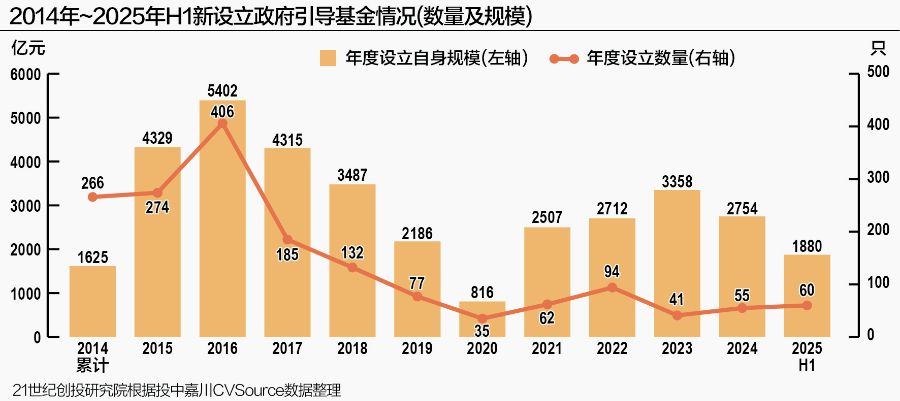
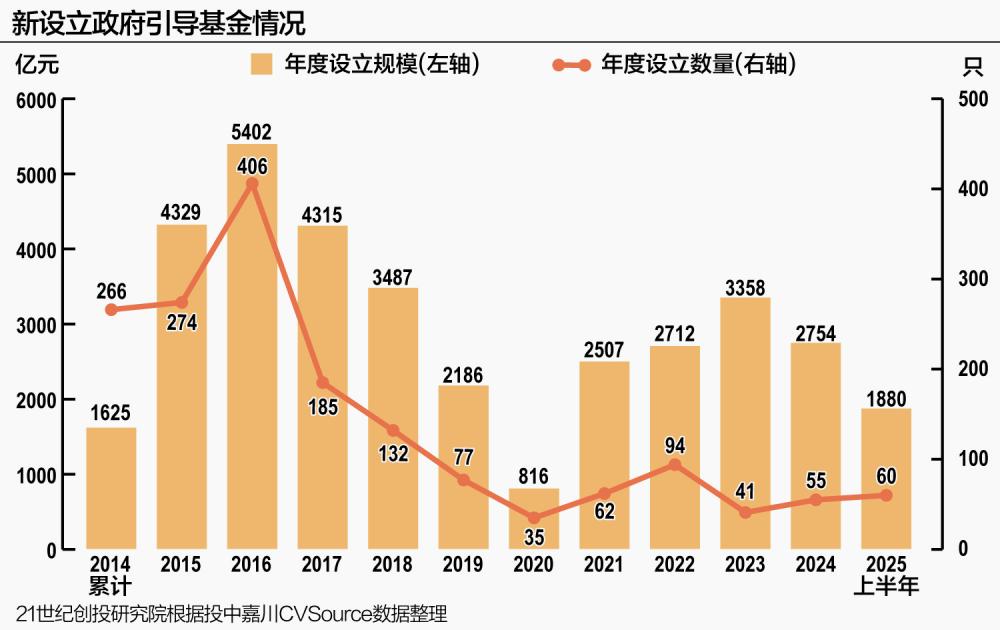
Core Insights - Government investment funds have become a major source of capital in China's private equity investment industry, playing a crucial role in promoting healthy industry development and optimizing traditional industries [1][9] - The release of the "Guiding Opinions on Promoting the High-Quality Development of Government Investment Funds" (Document No. 1) by the State Council on January 7, 2025, outlines 25 measures across seven areas to enhance the government funding guidance mechanism [1][10] - The establishment of the National Venture Capital Guidance Fund, which aims to leverage a trillion-scale fund, marks a significant step in promoting stable growth in the venture capital industry [3][24] Group 1: Government Investment Fund Development - The number and scale of newly established government investment funds peaked around 2016, with a gradual decline in the annual establishment rate, transitioning to a steady growth phase [4][19] - In the first half of 2025, 60 new government investment funds were established, surpassing the 55 funds created in 2024, with a total scale of 188 billion yuan [4][19] - The compound annual growth rate (CAGR) for the number of government guidance funds from 2014 to 2024 was 19.85%, while the scale increased by 31.87 billion yuan, with a CAGR of 35.33% [4][19] Group 2: Regional Disparities - The willingness to establish new government investment funds has significantly decreased in the central and western regions due to policy constraints and fiscal capacity, while regions like the Yangtze River Delta and the Guangdong-Hong Kong-Macao Greater Bay Area continue to show strong momentum [2][6] - The establishment of government investment funds is increasingly focused on strategic emerging industries, such as new-generation information technology, biotechnology, and new energy vehicles [6][10] Group 3: Investment Strategies and Management - The investment strategy has shifted towards "early and small" investments, with a growing consensus among national and local government funds to support early-stage projects [6][7] - The management model of government investment funds is evolving towards marketization and specialization, with local governments increasingly selecting fund managers based on long-term partnerships rather than merely increasing the number of partnerships [2][25] - Many local governments are lowering the return investment ratio and adopting more flexible recognition methods for return investments [2][30] Group 4: Policy Implementation and Local Responses - Following the release of Document No. 1, various local governments have introduced new management measures for government investment funds, aligning with the central policy while exploring diverse implementation paths [10][17] - The establishment of new funds is slowing down, with a focus on optimizing existing funds and enhancing their efficiency, as indicated by the revised management measures in several provinces [10][18] Group 5: Exit Strategies and Market Trends - The recovery of the A-share and Hong Kong IPO markets in 2025 has provided a favorable environment for government investment funds and state-owned enterprises to realize returns [35][36] - The development of secondary market funds (S funds) and merger and acquisition (M&A) funds is being encouraged, creating diversified exit channels for government investment funds [35][38] - The number of M&A transactions in 2025 increased by 12.58%, with a total transaction amount of 178.6 billion USD, indicating a vibrant M&A market [40][41]
2024—2025年度政府投资基金竞争力评价研究报告发布
2 1 Shi Ji Jing Ji Bao Dao· 2026-01-09 23:08
Core Viewpoint - Government investment funds have become a major source of capital in China's private equity investment industry, with increasing policy support and a focus on high-quality development in 2025 [1][9][23]. Group 1: Government Investment Fund Development - The State Council issued the "Guiding Opinions on Promoting the High-Quality Development of Government Investment Funds," outlining 25 measures across seven areas to enhance the fund's operational efficiency and effectiveness [1][9]. - In 2025, the establishment of new government investment funds showed a significant decline, with only 60 new funds set up in the first half of the year, compared to 55 in the entire previous year [4][19]. - The total scale of newly established government investment funds in the first half of 2025 reached 188 billion yuan, indicating a continued but slowing growth trend [4][19]. Group 2: Regional Disparities - The willingness to establish new government investment funds has significantly decreased in the central and western regions due to policy constraints and fiscal capacity, while regions like the Yangtze River Delta and the Guangdong-Hong Kong-Macao Greater Bay Area continue to show strong momentum [2][6][22]. - Local governments are increasingly focusing on optimizing existing funds rather than merely increasing the number of new funds, adopting a "fund cluster" model for more targeted investments [1][21]. Group 3: Investment Focus and Strategies - Government investment funds are primarily targeting strategic emerging industries such as new-generation information technology, biotechnology, and new energy vehicles, which are crucial for developing new productive forces [6][10]. - The investment strategy has shifted towards "early and small" investments, with a growing consensus on supporting early-stage projects while also considering investments in mature companies [6][10]. Group 4: Management and Operational Efficiency - The management model of government investment funds is evolving towards market-oriented and professional approaches, with a diverse range of fund managers being selected [25][27]. - Many local governments are offering more attractive conditions to fund managers, including lowering return ratios and extending fund durations to enhance operational efficiency [2][25]. Group 5: Exit Strategies and Market Conditions - The recovery of the A-share and Hong Kong IPO markets in 2025 has provided a favorable environment for government investment funds to realize exits, with many funds benefiting from the active M&A market [34][35]. - The introduction of S funds and the increasing flexibility in exit mechanisms are creating diverse exit pathways for government investment funds [34][39].
2025年底北京市金融街已汇聚各类私募基金管理人205个
Zheng Quan Shi Bao Wang· 2026-01-09 09:25
Core Viewpoint - Beijing's Xicheng District is accelerating the construction of a fund ecosystem, with significant national-level funds set to launch by 2025, totaling a registered fund scale of 234.1 billion yuan [1] Group 1: Fund Development - By the end of 2025, four national-level, corporate funds will be established, including the National Venture Capital Guidance Fund and the National Military-Civilian Integration Investment Fund (Phase II) [1] - The total scale of funds managed by private equity (venture capital) fund managers in Xicheng is approximately 1.04 trillion yuan, indicating a strong aggregation effect [1] Group 2: Future Focus - The next steps will focus on national-level, international, and market-oriented development directions, enhancing the establishment of various types of funds including industrial, venture capital, equity, and merger funds [1] - There will be support for the development of central state-owned enterprise funds and encouragement for global venture capital institutions and sovereign funds to establish a quality fund aggregation area [1]

2024-2025年度政府投资基金竞争力评价研究报告发布
2 1 Shi Ji Jing Ji Bao Dao· 2026-01-07 12:05
Core Insights - The government investment funds have become a major source of capital in China's equity investment industry, playing a crucial role in promoting healthy development, nurturing emerging industries, and optimizing traditional industries [2][4] - The release of the "Guiding Opinions on Promoting the High-Quality Development of Government Investment Funds" (Document No. 1) by the State Council on January 7, 2025, outlines 25 measures across seven areas to enhance the government funding guidance mechanism [2][12] - The establishment of the National Venture Capital Guidance Fund, which aims to leverage a trillion-scale fund, marks a significant step in promoting long-term capital investment [4][28] Group 1: Government Investment Fund Trends - The number and scale of newly established government investment funds peaked around 2016, with a gradual decline in the speed of new establishments, indicating a shift towards steady growth [6][13] - In the first half of 2025, 60 new government investment funds were established, surpassing the total of 55 for the entire year of 2024, with a total scale of 188 billion yuan [6][8] - The establishment of government investment funds is increasingly concentrated in economically vibrant regions like the Yangtze River Delta and the Guangdong-Hong Kong-Macao Greater Bay Area, while the willingness to establish new funds in central and western regions has significantly decreased [3][8] Group 2: Policy Changes and Local Responses - The "1号文" has led to a slowdown in the establishment of new government investment funds, with local governments focusing more on optimizing existing funds and enhancing their efficiency [12][13] - Various regions, including Shanxi, Heilongjiang, and Guangdong, have introduced new management measures for government investment funds in response to the "1号文," aligning local policies with national directives [20][21] - The emphasis on integrating and optimizing existing funds reflects a broader trend towards improving the effectiveness of government investment funds [21][22] Group 3: Investment Strategies and Focus Areas - Government investment funds are increasingly focusing on strategic emerging industries such as new-generation information technology, biotechnology, and new energy vehicles, which are critical for accelerating the development of new productive forces [8][9] - The investment strategy has shifted towards "early, small" investments, with a growing consensus on supporting early-stage projects while also not excluding later-stage investments [9][10] - The trend of establishing merger and acquisition funds is gaining traction, with "merger and acquisition investment" becoming a new model for attracting investments [9][10] Group 4: Management and Operational Efficiency - Most government investment funds have established sound systems and standardized operational processes, with many implementing ESG/responsible investment strategies [10][11] - The management fee structures are becoming more refined and market-oriented, with a focus on cost control and performance optimization [34][35] - The introduction of a tolerance for losses, with some regions allowing up to 100% loss on individual projects, reflects a shift towards a more flexible and supportive investment environment [41][42] Group 5: Exit Strategies and Market Dynamics - The recovery of the A-share and Hong Kong IPO markets in 2025 has provided a favorable environment for government investment funds to realize exits [46][49] - The development of secondary market funds (S funds) and merger funds is being encouraged, broadening the exit channels for government investment funds [46][54] - The number of mergers and acquisitions has increased, with a total of 2,963 transactions completed in 2025, indicating a vibrant M&A market [56][57]