
服务型制造

Search documents
工业和信息化部:启动“十五五”重大工程项目
Shang Hai Zheng Quan Bao· 2025-12-12 19:25
Group 1 - The meeting emphasized the importance of implementing the spirit of the Central Economic Work Conference and the 20th National Congress of the Communist Party, focusing on high-quality development and new industrialization as key tasks for the upcoming year [1] - The meeting called for stabilizing the industrial base, enhancing supply-demand adaptability, and promoting consumption through integrated effects of existing and new policies [1] - It highlighted the need for a high-quality development plan for the "14th Five-Year Plan" and the initiation of major engineering projects [1] Group 2 - The focus is on enhancing the self-controllability of industrial chains and implementing high-quality development actions for key industries [2] - There is an emphasis on optimizing industrial structure and promoting the transformation of traditional industries while fostering emerging pillar industries [2] - The meeting also addressed the need for high-quality development in the information and communication industry, including the advancement of 6G technology and satellite internet [2]
工信部:深化拓展制造业数字化转型行动和“人工智能+制造”
Zheng Quan Shi Bao Wang· 2025-12-12 12:45
Core Viewpoint - The meeting emphasized the need for optimizing and upgrading industrial structure, implementing actions for revitalizing traditional industries, and fostering the development of emerging pillar industries and future industries [1] Group 1: Industrial Structure and Transformation - The year ahead marks the beginning of the "14th Five-Year Plan," focusing on the optimization and upgrading of industrial structures [1] - The meeting highlighted the importance of deepening and expanding the digital transformation of manufacturing and integrating "Artificial Intelligence + Manufacturing" [1] Group 2: Manufacturing and Enterprise Development - There is a push for advancing intelligent manufacturing, green manufacturing, and service-oriented manufacturing [1] - The establishment of a quality enterprise cultivation system is crucial for promoting the specialized and innovative development of small and medium-sized enterprises [1]
天地科技(600582.SH)拟设立控股子公司投建煤矿重大智能成套装备研发中心项目
智通财经网· 2025-12-09 11:18
Core Viewpoint - The company plans to invest 3.545 billion yuan to establish a subsidiary in Xi'an, Shaanxi Province, focusing on the development of a major intelligent equipment research center for coal mining [1] Group 1: Investment and Project Details - The registered capital for the new subsidiary, Ke Gong Cheng Tiao Company, will be 2 billion yuan, subject to registration by market supervision authorities [1] - The project aims to integrate high-quality resources in coal machinery manufacturing and enhance the company's capabilities in equipment integration and intelligence [1] Group 2: Strategic Goals and Industry Impact - The establishment of the research center is expected to create a new service-oriented manufacturing model, significantly improving the company's core competitiveness [1] - Upon completion, the project will enhance the company's integrated operational advantages, expand its main business scale, and improve the quality of the listed company [1] - The initiative aligns with national energy security strategies and aims to lead the high-quality development of the coal industry [1]

广西“十五五”规划建议:全力打造制造业十大现代化支柱产业
Zheng Quan Shi Bao Wang· 2025-12-07 01:53
Core Viewpoint - The Guangxi Zhuang Autonomous Region aims to establish ten modern pillar industries in manufacturing as part of its 15th Five-Year Plan, focusing on enhancing industrial strength and creating trillion-yuan industrial clusters [1] Group 1: Key Industries - The plan emphasizes upgrading industries such as non-ferrous metals and key metal materials, advanced steel materials, modern green chemicals, artificial intelligence and next-generation information technology, high-end equipment manufacturing, new energy vehicles and batteries, food processing, forestry products and paper, biomedicine and health, and green building materials [1] - The goal is to create new trillion-yuan industrial clusters and add several hundred-billion-yuan industries [1] Group 2: Strategic Actions - The region will implement actions to strengthen and extend the supply chain of key advantageous industries, cultivate advanced manufacturing clusters, and promote large-scale equipment upgrades [1] - Development initiatives will focus on intelligent manufacturing, green manufacturing, and service-oriented manufacturing, aiming to establish a high-end brand "Guangxi Intelligent Manufacturing" [1] Group 3: Ecosystem and Innovation - The plan includes the establishment of a comprehensive experimental zone for high-quality development of key metals in Nandan and the creation of a national advanced manufacturing cluster for key metals [1] - There will be efforts to improve the industrial ecosystem, promote venture capital, and implement a strategic emerging industry doubling plan, along with the establishment of future industry incubators and pilot zones [1] - The initiative aims to foster the development of specialized, innovative small and medium-sized enterprises and cultivate unicorn companies [1]
从“产品”到“用户”的跨越之路: 大金DAIKIN CARE以用户为核心,打造制造业服务转型新标杆
Jin Tou Wang· 2025-12-03 04:47
Core Insights - The "14th Five-Year Plan" emphasizes service-oriented manufacturing as a key direction for innovation and upgrading in the manufacturing industry [1] - The implementation plan for promoting service-oriented manufacturing from 2025 to 2028 aims to guide the manufacturing sector from a "product mindset" to a "user mindset" [1] - The DAIKIN CARE service system, launched three years ago, exemplifies a successful model of service-oriented manufacturing by redefining service standards in the home central air conditioning industry [1][5] Group 1: Service Innovation - DAIKIN CARE offers proactive services that anticipate user needs, addressing common issues faced by users of complex air systems [2] - The service includes features like "heating shutdown reminders" that utilize IoT data analysis to guide users in energy-saving practices [2] - DAIKIN CARE acts as a "four-season guardian," providing timely alerts and emergency services during extreme weather events to ensure equipment safety [3] Group 2: User-Centric Approach - The service system emphasizes personalized maintenance reminders for tasks often overlooked, such as filter replacements, enhancing user convenience [4] - DAIKIN CARE employs a rigorous filtering logic to ensure targeted communication, avoiding unnecessary notifications for non-end users [4] - The service model has evolved to create tailored air health management plans for different households, improving user experience and energy efficiency [5] Group 3: Industry Transformation - The shift towards service-oriented manufacturing signifies a fundamental change in business models, moving from one-time product sales to creating long-term customer value through ongoing services [6] - DAIKIN's history in China reflects a commitment to local user needs, continuously innovating and upgrading its offerings over three decades [6] - The DAIKIN CARE service model represents a significant practice in exploring full lifecycle services, enhancing user satisfaction and addressing pain points in air system usage [7]
杭汽轮B(200771) - 000771杭汽轮B投资者关系管理信息20251128
2025-11-28 07:28
Group 1: Company Overview - The company introduced its basic situation, including manufacturing capacity and technical strength in Linping [2] - The application fields and market performance of industrial steam turbine products were discussed, along with the development history of gas turbines and collaboration with Siemens [2] Group 2: Strategic Transformation - During the "14th Five-Year Plan" period, the company aims to maintain its market position in industrial turbines and fully enter the distributed gas turbine market [2] - The company plans to transition from a traditional manufacturing enterprise to a "service-oriented manufacturing" enterprise and from a traditional energy equipment supplier to an energy system solution provider [2] Group 3: Market Insights - The overseas gas turbine market is thriving due to strong demand from AI computing center construction, while domestic energy supply mainly relies on grid power [2] - The domestic gas turbine market demand primarily comes from distributed energy generation and cogeneration [2] Group 4: Gas Turbine Development Progress - In September 2025, the company signed a technical agreement for the first application demonstration project of the HGT51F gas turbine, with the main unit expected to be delivered by mid-2026 and operational by the end of 2026 [3] - The company will begin a new round of testing for the HGT51F gas turbine to enhance temperature field accuracy and operational stability [3] Group 5: Demonstration Project Status - In April 2025, the joint venture "Lianyungang Zhonghang Gas Turbine Technology Co., Ltd." was successfully registered with a capital of 100 million yuan [3] - As of November 2025, the demonstration project has achieved several milestone targets, including project filing and preliminary design [3] Group 6: Maintenance Business Expansion - The company's subsidiary, Zhejiang Runchuang Turbine Machinery Co., Ltd., focuses on independent maintenance and technical transformation of heavy and light gas turbines [3] - In 2025, the company secured over 100 million yuan in orders for gas turbine maintenance services, marking significant progress in business scope and depth [3]

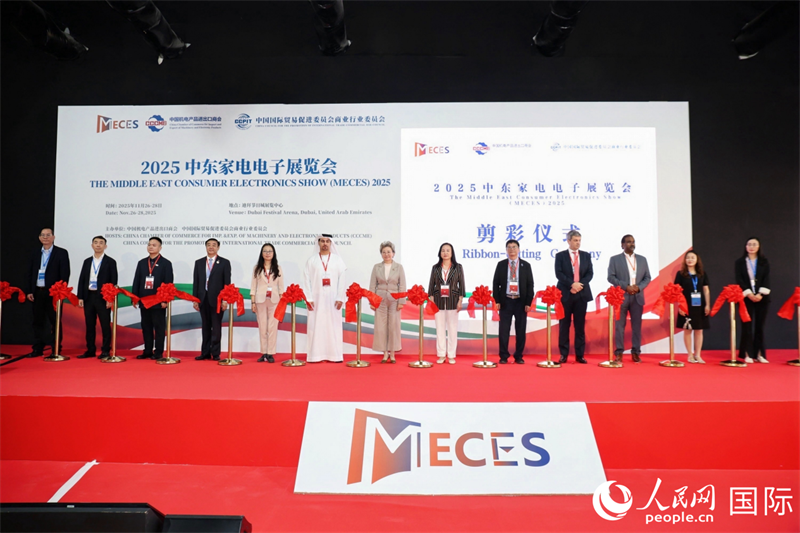
中国家电企业迪拜展风采
人民网-国际频道 原创稿· 2025-11-27 02:50
Core Insights - The 2025 Middle East Home Appliances and Electronics Exhibition and the "China Council for the Promotion of International Trade" (Middle East) Green and Innovation Cooperation Exhibition opened in Dubai, attracting over 300 Chinese enterprises [1] Group 1: Trade and Economic Cooperation - The China-UAE economic and trade cooperation has deepened in recent years, with bilateral trade in electromechanical products doubling over the past five years, particularly in automobiles, electronic consumer goods, and home appliances [4] - The UAE is recognized as the leading country in the Middle East for digital development, making it a preferred destination for Chinese electronic product exports and related enterprises [4] - The Middle East consumer electronics market is projected to maintain an average annual growth rate of 6%, with China being a key partner in the home appliance and electronics market [4] Group 2: Exhibition Highlights - Major Chinese home appliance companies such as Hisense, Haier, Midea, and Gree showcased innovative products including smart interconnected refrigerators, washing machines, AI smart TVs, and AI air purifiers [5] - Hisense presented products like a 116-inch RGB-Mini LED TV and the world's first four-in-one heat pump washing and drying machine [5] - The exhibition also featured a concurrent "China Council for the Promotion of International Trade" (Middle East) Green and Innovation Cooperation Exhibition, covering over 1,000 square meters with exhibits in AI, machinery, new energy vehicles, medical supplies, and high-end consumer goods [9]

江河集团:十五五规划下公司融入大局坚持主业发展
Xin Lang Cai Jing· 2025-11-25 09:24
Core Viewpoint - The company's business will benefit positively from the "14th Five-Year Plan" by enhancing traditional industries and promoting technological upgrades in manufacturing [1] Group 1: Industry Impact - The "14th Five-Year Plan" emphasizes the optimization and enhancement of traditional industries, which includes construction, to strengthen their global competitiveness [1] - The plan aims to promote intelligent, green, and service-oriented manufacturing, facilitating the digital transformation of the manufacturing sector [1] Group 2: Company Strategy - The company is deeply integrating into the national development framework and is committed to its core business development [1] - There is a focus on enhancing quality and technical capabilities, strengthening standards, and improving internationalization and brand building [1]

金百泽(301041) - 2025年11月20日投资者关系活动记录表(2025年度深圳辖区上市公司投资者网上集体接待日活动)
2025-11-20 13:09
Revenue Growth and Business Segments - The company reported a revenue of 531.29 million yuan for the first nine months of 2025, representing a year-on-year growth of 6.43% [3] - Revenue from the industrial control sector increased by 7.05%, driven by growth in AI intelligent equipment and high-end manufacturing customer orders [3] - The smart hardware segment saw a significant revenue increase of 35.49%, attributed to rising demand for AI edge computing, servers, and robotics [3] - The automotive electronics sector experienced a remarkable revenue growth of 170.64% [3] Profitability Challenges - Despite revenue growth, profit margins declined due to increased competition and rising raw material costs, particularly in PCB sales [3] - The company has increased investments in technology services, digital transformation, and talent acquisition, impacting short-term profitability [3] Cash Dividend Policy - The company has consistently implemented cash dividends since its listing, with a distribution ratio exceeding 15% of the available profit each year [4] - For 2024, the company plans to distribute 1.00 yuan per 10 shares, totaling 10,539,920 yuan [4] Cash Flow Performance - For the first nine months of 2025, the company achieved a net cash flow from operating activities of 48.687 million yuan, a significant increase of 116.45% year-on-year [9] - Cash inflows from sales increased by 3.64%, while cash outflows decreased by 5.74%, indicating improved operational efficiency [9] Strategic Focus and Future Directions - The company emphasizes a "manufacturing + service + platform" strategy, focusing on electronic interconnection and packaging technology [5] - It aims to enhance its digital transformation capabilities and strengthen its supply chain ecosystem [6] - The company is actively involved in a joint venture with Foxconn's subsidiary, focusing on AI servers and robotics control modules [9] Share Buyback and Employee Incentives - As of March 7, 2025, the company repurchased 1,280,800 shares, accounting for 1.20% of its total share capital, with a total expenditure of approximately 30 million yuan [7][8] - The repurchased shares will be used for employee stock ownership plans or equity incentives to enhance employee motivation and productivity [8]
蒋忠中:加速“制造+服务”深度融合
Jing Ji Ri Bao· 2025-11-19 01:30
Core Insights - The Chinese government emphasizes the transformation and upgrading of manufacturing through smart and green manufacturing, aiming to establish a modern industrial system centered on advanced manufacturing [1][2] - The integration of manufacturing and services is highlighted as a strategic move to enhance China's position in the global industrial landscape [1][2] Industry Level - The focus is on overcoming technological bottlenecks in high-end chips, industrial operating systems, and core industrial software, with initiatives like national innovation centers and collaborative projects [3] - Establishing a universal standard system covering data interfaces and communication protocols is crucial to breaking down information silos [3] - Financial support mechanisms such as specialized funds and targeted financial products are proposed to assist small and medium-sized enterprises (SMEs) in their digital transformation [3] Enterprise Level - Leading enterprises are encouraged to share their digital transformation experiences and create reusable solutions to uplift their supply chains [4] - SMEs should focus on specialized improvements rather than pursuing large-scale automation, leveraging cloud platforms to enhance their core competencies [4] - The adoption of AI as a core driver in manufacturing processes is recommended to optimize operations and personalize offerings [4] Consumer Level - There is a need to cultivate a consumer market that recognizes the value of service-oriented manufacturing, encouraging consumers to pay for innovation and quality [4] - Engaging consumers in the value creation process through community building and feedback mechanisms is essential for achieving a dynamic balance between supply and demand [4]