
水土保持

Search documents
“十四五”以来 我国新增水土流失治理面积超二十八万平方公里
Ren Min Ri Bao· 2025-08-28 21:45
Core Insights - Since the beginning of the 14th Five-Year Plan, China has effectively controlled newly added soil and water loss, with significant progress in key areas, aiming to manage an additional 281,700 square kilometers of soil erosion by the end of 2024, increasing the soil conservation rate to 72.83% [1] Group 1: National Achievements - By the end of 2024, the national soil and water loss area is projected to decrease from 2,692,700 square kilometers in 2020 to 2,601,900 square kilometers, indicating a steady improvement in soil erosion conditions [1] - The soil conservation rate has improved from 71.85% in 2020 to 72.83% in 2024, reflecting a dual decrease in both the area and intensity of soil erosion [1] Group 2: Regional Efforts - In the Yellow River Basin, collaborative efforts have led to the management of 30,000 square kilometers of soil erosion, with the construction of 2,637 silt dams and 3,090 reinforcement projects for dangerous silt dams by the end of 2024 [1] - The area of soil erosion in the Loess Plateau has decreased from 234,200 square kilometers in 2020 to 218,800 square kilometers in 2024 [1] Group 3: Specific Initiatives - In the Northeast Black Soil Region, 33,000 erosion gullies have been managed, and new farmland indicators for gully management have been explored [2] - In the Danjiangkou Reservoir area and its upstream, a joint plan for water pollution prevention and soil conservation has been implemented, targeting 6,306 square kilometers of soil erosion by the end of 2024 [2] - In the "Three North" region, 30,900 square kilometers of soil erosion have been managed, with the capacity to intercept 687 million tons of sediment added through new silt dams [2]
“十四五”以来我国新增水土流失治理超28万平方公里
Yang Shi Xin Wen Ke Hu Duan· 2025-08-28 06:45
Core Viewpoint - Soil and water conservation is fundamental for river protection and management, with significant progress made in recent years in China, particularly during the 14th Five-Year Plan period [2][10]. Group 1: Achievements in Soil and Water Conservation - Since the beginning of the 14th Five-Year Plan, China has added 281,700 square kilometers of soil erosion control area [2]. - In the Yellow River basin, the area of soil erosion has decreased from 234,200 square kilometers in 2020 to 218,800 square kilometers in 2024 [4]. - By the end of 2024, the Three-North region will have treated 30,900 square kilometers of soil erosion, with new sediment interception capacity of 687 million tons from check dams [4]. Group 2: Specific Regional Efforts - The Danjiangkou Reservoir area, a key water source for the South-to-North Water Diversion Project, has seen 6,306 square kilometers of soil erosion treated, establishing a technical route for small watershed management [6]. - In the Northeast black soil region, 33,000 erosion gullies have been treated, and 2,119 ecological clean small watersheds have been constructed [8]. Group 3: Water Quality and Economic Impact - The water quality in Danjiangkou Reservoir has consistently met Class II surface water standards, with over 73 billion cubic meters of water supplied to the north over the past decade [8]. - Local initiatives have conducted over 60 transactions related to ecological product transformation in small watersheds, amounting to nearly 3 billion yuan [8]. Group 4: Future Goals and Management Improvements - By the end of 2024, the soil and water conservation rate is expected to increase to 72.83%, supporting high-quality water resource development and ensuring water security in China [10].

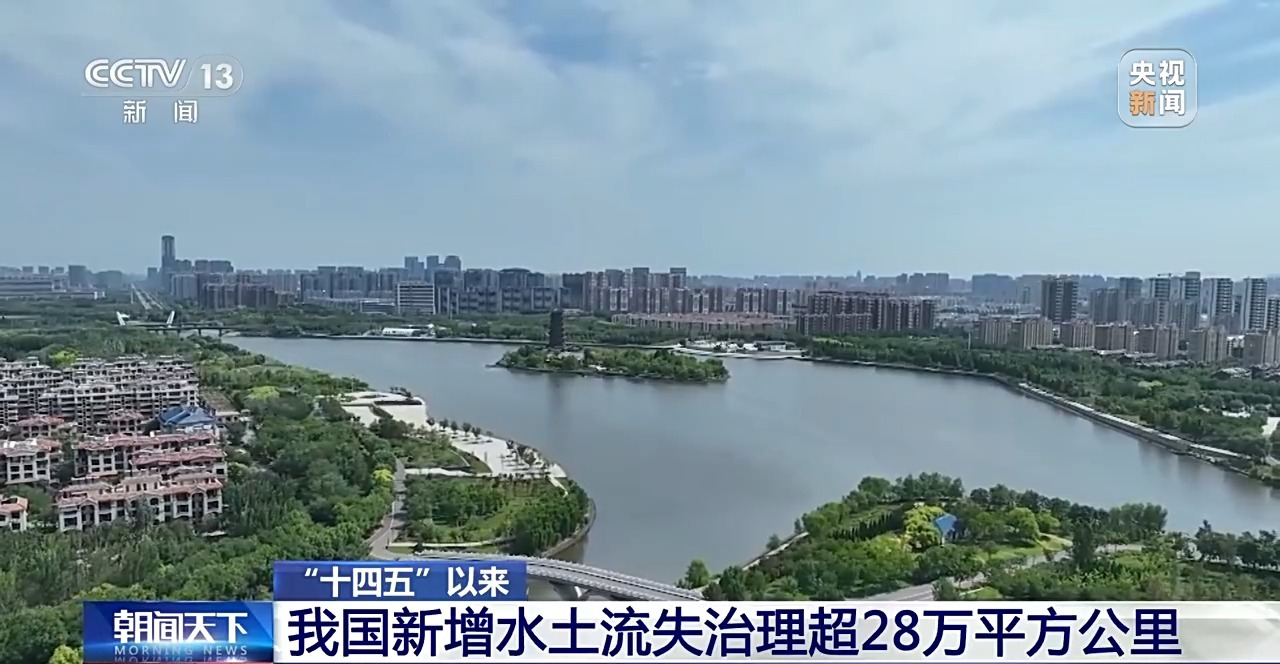
“十四五”以来我国新增水土流失治理面积超28万平方公里
Yang Shi Xin Wen Ke Hu Duan· 2025-08-28 00:26
Group 1 - Soil and water conservation is fundamental for river protection and management, with 281,700 square kilometers of new soil erosion control area added since the start of the 14th Five-Year Plan [1] - In the Yellow River basin, the Ministry of Water Resources has collaborated with the National Development and Reform Commission to implement sediment dam construction and slope farmland management, resulting in a decrease in soil erosion area in the Loess Plateau from 234,200 square kilometers in 2020 to 218,800 square kilometers by 2024 [1] - The Danjiangkou Reservoir area has seen soil erosion control covering 6,306 square kilometers, with water quality consistently meeting Class II surface water standards, delivering over 73 billion cubic meters of water to northern regions over the past decade [1] Group 2 - In the Northeast black soil region, the Ministry of Water Resources has initiated the trading of new cultivated land indicators for erosion gully management, with 33,000 gullies treated and 2,119 ecological clean small watersheds constructed by the end of 2024 [2] - The Ministry has accelerated the transformation of ecological products from soil and water conservation, with over 60 transactions in local small watersheds amounting to nearly 3 billion yuan [2] - The soil and water conservation rate is expected to increase to 72.83% by the end of 2024, providing strong support for high-quality water resources development and ensuring water security in China [2]
邢善萍在宝鸡市调研乡村全面振兴工作
Shan Xi Ri Bao· 2025-08-22 00:32
Group 1 - The core viewpoint emphasizes the importance of implementing Xi Jinping's important speeches and instructions during his visits to Shaanxi, focusing on rural revitalization and addressing issues effectively [1][2] - The research highlights the need for integrating red culture into educational curricula and promoting cultural tourism development while ensuring the protection of cultural relics [1] - The report discusses the significance of leveraging local resources and technology to enhance market opportunities and strengthen industries that benefit the rural population [1] Group 2 - The emphasis is placed on maintaining a bottom line to prevent large-scale poverty and improving rural industry development, construction, and governance [2] - The need for continuous implementation of the Central Eight Regulations and promoting strict governance within the party is highlighted to foster high-quality development [2] - The report stresses the importance of addressing urgent issues faced by the community with dedication and effort [2]
四水映绿 豫见两山丨石缝“绣”绿成金山
He Nan Ri Bao· 2025-08-16 23:33
Core Insights - The article highlights the successful ecological restoration efforts in the Xiaocaoyu small watershed, which have transformed the area from barren land to a lush green environment, significantly improving water conservation and local livelihoods [4][5][6]. Group 1: Ecological Restoration - The Xiaocaoyu small watershed has seen a forest coverage increase from less than 20% to 58% after the implementation of water and soil conservation projects [8]. - The annual soil erosion rate was previously 4000 tons per square kilometer, but post-restoration, the area can now retain 32,000 tons of sediment annually, reducing sediment flow into the Danjiangkou Reservoir [8]. - The restoration efforts included the establishment of 80 small water conservation projects, which have created a network of water retention facilities and improved local biodiversity [5][6]. Group 2: Economic Impact - The ecological restoration has led to the creation of economic opportunities, with local villagers earning additional income from the cultivation of pomegranates and other crops, with some families seeing annual income increases of over 20,000 yuan [6][7]. - The first carbon credit transaction in Henan Province, involving 10,000 tons of carbon credits from the Xiaocaoyu watershed, was completed for 300,000 yuan, showcasing the financial benefits of ecological projects [6][8]. - The annual direct economic benefits from ecological projects in the region are estimated at 18 million yuan, with per capita income from water conservation industries exceeding 800 yuan [7][8]. Group 3: Community Engagement - Local community involvement has been crucial, with thousands of villagers participating in restoration activities, demonstrating a strong commitment to environmental stewardship [5][6]. - The transformation of the area has led to the establishment of numerous agritourism businesses, with high occupancy rates in local accommodations, indicating a shift towards sustainable tourism [7].

改造黄土地 披绿又生金
Ren Min Ri Bao· 2025-08-10 22:40
Core Viewpoint - The article highlights the significant progress in soil and water conservation in the Yellow River Basin, emphasizing the transformation of previously degraded areas into productive and ecologically sustainable regions through various agricultural and ecological initiatives [4][6][10]. Group 1: Soil and Water Conservation Achievements - As of the end of 2024, the Yellow River Basin has a vegetation area of 541,300 square kilometers and a soil and water conservation rate of 69.07% [4]. - Over the past five years, the area of soil erosion in the Yellow River Basin has decreased by 18,400 square kilometers, indicating effective environmental restoration efforts [4]. - The soil and water conservation rate in Tianshui City has improved from 75.80% at the end of 2020 to 78.01% by the end of 2024 [6]. Group 2: Agricultural Innovations - The introduction of smart agricultural technologies in the apple orchards of Tianshui has led to a 90% rate of high-quality fruit, with an average yield of over 7,000 pounds per acre [5]. - In 2024, the sales of Huaniu apples in the Tianshui area reached 640,000 tons, generating a revenue of 2.56 billion yuan [5]. - The transformation of fragmented farmland into mechanized terraced fields in Yonghe County has increased average yields by 300 pounds per acre, resulting in an additional income of over 500 yuan per acre [12]. Group 3: Ecological and Economic Development - The integration of tourism and agriculture in villages like Gao Xigou has led to over 100,000 visitors in 2024, significantly boosting local economies [8]. - The collective income of Gao Xigou village surpassed 800,000 yuan in 2024, with per capita disposable income exceeding 25,000 yuan [8]. - The implementation of a comprehensive water and soil conservation system has transformed the ecological landscape, leading to improved agricultural productivity and environmental sustainability [9][11].

陕西水土保持重点区域划定取得阶段性成果
Shan Xi Ri Bao· 2025-08-10 22:36
Core Viewpoint - The key work of delineating important areas for soil and water conservation in Shaanxi has achieved significant progress, laying a solid foundation for spatial control of soil and water conservation in the province [1][2][3] Group 1: Key Areas Designated - The designated national-level soil erosion prevention areas cover 7 cities (districts) and 46 counties (cities, districts) with an area of 24,400 square kilometers [2] - The national-level soil erosion control areas involve 3 cities (districts) and 21 counties (cities, districts) with an area of 28,200 square kilometers [2] - The areas with severe soil erosion and ecological fragility are mainly distributed in the northern Shaanxi Loess Plateau, along the Yellow River, and the northern foot of the Qinling Mountains, covering 6 cities (districts) and 26 counties (cities, districts) with an area of 1,106 square kilometers [2] Group 2: Implementation and Training - The provincial soil and water conservation ecological environment monitoring center has organized multiple rounds of training and results assessment to ensure the delineation of areas prohibited for steep slope cultivation is completed by the end of the year [2] - A hierarchical coverage system is being constructed to achieve comprehensive control of soil and water conservation, with provincial-level soil erosion prevention areas covering 10 cities (districts) and 84 counties (cities, districts) over an area of 61,700 square kilometers [2] - The provincial-level soil erosion control areas involve 10 cities (districts) and 89 counties (cities, districts) with an area of 91,300 square kilometers [2] Group 3: Support for Ecological Protection - The delineation of these key areas will strengthen regional supervision, enforce the approval system for soil and water conservation plans, and promote the integration of soil erosion prevention and ecological restoration [3] - This initiative aims to provide solid support for ecological protection and high-quality development across the province [3]
“广东省兴宁市2025年一体化推进水土保持工程”动工
Nan Fang Ri Bao Wang Luo Ban· 2025-08-04 08:07
Core Viewpoint - The project "Integrated Promotion of Soil and Water Conservation Engineering in Xingning City, Guangdong Province" has been initiated, with a total investment of 108 million yuan, aimed at improving soil and water conservation and ecological environment [1] Group 1: Project Overview - The project is one of the first 12 pilot projects for integrated soil and water conservation engineering construction in China, and the only selected project in Guangdong Province [1] - The main construction activities include the treatment of soil erosion in 16 areas in Luofu Town and river management, covering a total area of 204.8 acres for soil improvement, with plans to add 60.8 acres of arable land [1] - The total length of the channel management is 13.41 kilometers, and the total length of slope management is 26.06 kilometers [1] Group 2: Environmental and Economic Impact - The project aims to enhance soil and water conservation functions, improve the ecological environment, and promote sustainable economic and social development [1] - Future efforts will focus on exploring ecological product value accounting, ecological resource transformation, and the development of ecological tourism to ensure that the community benefits from the ecological value conversion [1]
小流域治理也不能忘了防洪
Zhong Guo Huan Jing Bao· 2025-07-11 06:42
Group 1 - The current flood season poses significant challenges for flood prevention tasks in many areas, with some regions neglecting flood control efforts during small watershed management, leading to safety hazards and adverse impacts on local flood prevention work [1] - Small watershed management is a comprehensive and systematic project, where flood prevention during the flood season is crucial for the safety of people's lives and property, as well as the effectiveness and long-term stability of the entire management project [1] - Flood prevention should not be conducted in isolation but should be integrated with various measures such as water conservancy law enforcement, ecological restoration, soil and water conservation, and comprehensive water resource utilization [1] Group 2 - Small watersheds often have significant topographical variations and uneven surface coverage, leading to rapid runoff formation after rainfall, which can trigger sudden disasters like flash floods and mudslides [2] - During small watershed management, it is essential to consider the natural geographical features and historical hydrological data of the watershed to design appropriate drainage systems, flood control dams, and diversion channels [2] - Establishing and improving real-time monitoring and early warning systems for rainfall, water conditions, and disasters is crucial for timely information collection, transmission, and analysis to support emergency responses [2] Group 3 - To ensure the long-term effectiveness and systematic nature of flood prevention efforts, it is necessary to strengthen institutional frameworks and technological support [3] - A sound regulatory framework and responsibility mechanism for small watershed management should be established, clarifying the flood prevention responsibilities of various government levels, relevant departments, and social entities [3] - The introduction of modern information technologies, such as remote sensing monitoring, geographic information systems (GIS), and artificial intelligence prediction models, can enhance the scientific and intelligent level of flood prevention decision-making [3]
2024年全省水土流失面积减少千余平方公里
Liao Ning Ri Bao· 2025-06-19 01:05
Group 1 - The core point of the article highlights the significant reduction in soil erosion area in Liaoning Province, with a total of 32,600 square kilometers affected, which is 22% of the total land area, showing a decrease of 1,004.5 square kilometers compared to the previous year [1] - The overall soil conservation rate in the province is reported at 78%, with hydraulic erosion being the primary type, covering 31,800 square kilometers, which accounts for 97.58% of the total erosion area [1] - The intensity of erosion is predominantly mild, with mild erosion covering 77.03% of the total erosion area, while moderate, strong, very strong, and severe erosion areas account for 11.74%, 5.00%, 3.88%, and 2.35% respectively [1] Group 2 - Multiple departments in the province have collaborated to enhance comprehensive management of soil erosion, resulting in the addition of 3,543.51 square kilometers of managed area last year [2] - The key areas for soil erosion management include 11 cities and 43 counties (districts) such as Shenyang, Dalian, and Anshan, with a total land area of 96,090 square kilometers and an erosion area of 25,800 square kilometers [2] - The Northeast black soil region, which includes 6 cities and 28 counties, has a land area of 54,400 square kilometers, with a reported erosion area of 9,549.87 square kilometers, showing a decrease of 175.94 square kilometers from the previous year [2]