
生物制药

Search documents
新股消息 | 景泽生物二次递表港交所 共有八个候选药物
智通财经网· 2026-01-02 09:01
Core Viewpoint - Jingze Biopharmaceutical (Hefei) Co., Ltd. has submitted a listing application to the Hong Kong Stock Exchange, with CICC and Guoyuan International as joint sponsors. The company previously filed an application on June 27, 2025 [1]. Company Overview - The company, established in 2014, focuses on biopharmaceuticals in the fields of assisted reproduction and ophthalmology. It has two core products: JZB30, a recombinant human follicle-stimulating hormone (rhFSH) injection for assisted reproduction, and JZB05, an anti-VEGF intravitreal injection candidate for treating retinal neovascular diseases [4][5]. Product Pipeline - As of December 21, 2025, the company has eight drug candidates, with three in late-stage development, including one that has received NDA approval, one that has submitted an NDA, and one in Phase 3 clinical trials. The product portfolio addresses clinical indications in assisted reproduction and ophthalmology [5]. Key Products - JZB30 is the company's first commercialized product in assisted reproduction, targeting the global ovulation induction market. It has completed Phase 1 and Phase 3 clinical studies and received NDA approval in April 2025 [6][7]. - JZB05 is expected to be the first commercialized product in the ophthalmology field, targeting diseases like wet age-related macular degeneration (wAMD) and diabetic macular edema (DME). It has completed Phase 1 clinical studies and entered Phase 3 trials in September 2023, with NDA submission expected in the second half of 2026 [7]. - JZB33, another product, is a recombinant human follicle-stimulating hormone injection that improves patient compliance through a user-friendly delivery system. It has received approval for a simplified clinical study and is expected to submit an NDA in June 2025 [8]. Financial Information - The company's other income for the fiscal years ending June 30, 2023, 2024, and 2025 was approximately RMB 9.8 million, RMB 12.4 million, and RMB 0.83 million, respectively [10]. - The company reported total losses of approximately RMB 246.2 million, RMB 242.7 million, and RMB 128.1 million for the same periods [11]. - Research and development expenses were approximately RMB 122.0 million, RMB 133.0 million, and RMB 50.8 million for the respective fiscal years [12]. Industry Overview - The global biopharmaceutical market is projected to grow from USD 286.4 billion in 2019 to USD 441.9 billion by 2024, with a compound annual growth rate (CAGR) of 9.1%. It is expected to reach USD 828.6 billion from 2025 to 2030, with a CAGR of 11.0% [16]. - The Chinese biopharmaceutical market is expected to grow from RMB 312 billion in 2019 to RMB 493 billion by 2024, with a CAGR of 9.6%, and further to RMB 1,021 billion from 2025 to 2030, with a CAGR of 13.1% [16]. - The market for assisted reproductive drugs in China is projected to grow from RMB 4.2 billion in 2019 to RMB 5.7 billion by 2024, with a CAGR of 6.0%, and further to RMB 11.9 billion from 2025 to 2030, with a CAGR of 13.5% [19]. - The ophthalmic drug market in China is expected to grow from RMB 19.4 billion in 2019 to RMB 29.5 billion by 2024, with a CAGR of 8.7%, and further to RMB 53.7 billion by 2030, with a CAGR of 11.0% from 2025 to 2030 [22].

港股市场策略周报:2025.12.22-2025.12.28-20251230
Zhe Shang Guo Ji Jin Rong Kong Gu· 2025-12-30 06:09
Market Performance Review - The Hong Kong stock market experienced a narrow upward fluctuation during the week due to the Christmas holiday, with the Hang Seng Index, Hang Seng Tech Index, and Hang Seng Composite Index rising by 0.44%, 0.5%, and 0.37% respectively [5][15] - Most primary industry sectors saw gains, with notable declines in the information technology, telecommunications, and healthcare sectors, which fell by 0.77%, 1.09%, and 1.76% respectively [5][15] - The materials sector surged by 4.3%, driven by strong international precious and industrial metal prices and geopolitical risks that heightened macro risk aversion [15] Valuation Levels - As of the end of the week, the 5-year PE (TTM) valuation percentile for the Hang Seng Composite Index was 82.56%, indicating that the valuation level is close to one standard deviation above the 5-year average [5] Buyback Statistics - The buyback market cooled down this week, with 66 companies participating, a decrease of 9 from the previous week [27] - The total buyback amount for the week was 30.67 billion HKD, down by 19.54 billion from the previous week [27] - Tencent Holdings (0700.HK) led the buybacks with an amount of 1.907 billion HKD, followed by Xiaomi Group (1810.HK) with 444 million HKD [27] Macro Environment Tracking and Outlook - The overall profitability of the Hong Kong stock market is heavily reliant on Chinese state-owned enterprises, with over 80% of profits coming from mainland China, indicating a close correlation with the economic conditions in China [39][40] - Key economic indicators show that industrial profits in November fell by 13.1% year-on-year, significantly down from the previous value of -5.5%, reflecting weak domestic demand in consumption and real estate [45] - The People's Bank of China announced a new digital currency management framework set to launch on January 1, 2026, which may influence future financial transactions [39] - The government plans to continue supporting consumption through fiscal policies, focusing on sectors like artificial intelligence, biopharmaceuticals, and quantum technology [39] Sector Allocation Outlook - The report suggests a favorable outlook for sectors benefiting from policy support, including new energy, innovative pharmaceuticals, and AI technology [5][45] - Low-valuation state-owned enterprises are expected to perform well due to stable earnings and stock prices, alongside local Hong Kong banks, telecommunications, and utility dividend stocks that are relatively independent of broader economic fluctuations [5][45]
万联晨会-20251229
Wanlian Securities· 2025-12-29 00:53
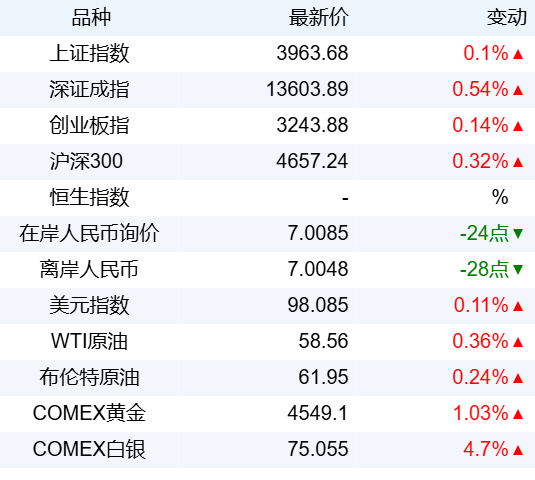
Core Viewpoints - The A-share market saw collective gains last Friday, with the Shanghai Composite Index rising by 0.1%, the Shenzhen Component Index increasing by 0.54%, and the ChiNext Index up by 0.14%. The total trading volume in the Shanghai and Shenzhen markets reached 21,600.31 billion yuan [1][7]. - In terms of industry performance, non-ferrous metals, electric equipment, and steel led the gains, while electronics, light industry manufacturing, and telecommunications lagged behind. Concept sectors such as Hainan Free Trade Zone, zinc, and lead also saw gains, while sectors like new technology stocks and photolithography experienced declines [1][7]. Important News - The National Financial Work Conference was held in Beijing from December 27 to 28, emphasizing the continuation of a more proactive fiscal policy in 2026. Key tasks include supporting domestic demand, enhancing financial collaboration, and promoting green transformation [2][8]. - The National Venture Capital Guidance Fund officially commenced operations on December 26. This fund aims to focus on early-stage investments in hard technology sectors such as artificial intelligence and quantum technology, with a lifespan of 15 to 20 years to match the long-term R&D needs [3][9].
宏观与资产论(20251228):春季躁动将至?
Western Securities· 2025-12-28 12:01
Market Trends - The US stock market has initiated a "Christmas rally," with the Shanghai Composite Index achieving an eight-day winning streak and a weekly increase of 1.88%[10] - The discussion around "year-end rally" and "spring surge" is intensifying, driven primarily by liquidity and risk appetite rather than macroeconomic fundamentals[1] Liquidity and Monetary Policy - Liquidity is not a concern for the upcoming spring surge, with expectations of policy rate cuts and reserve requirement ratio reductions in the first half of 2026, although urgency is low[2] - The People's Bank of China (PBOC) has continued to signal stable liquidity through medium-term lending facility (MLF) operations, with a net injection of 1,000 billion yuan in December[56] Currency and Asset Performance - The Chinese yuan has shown orderly appreciation, with the offshore yuan briefly surpassing the 7.0 mark against the US dollar, indicating a return of correlation between stock and currency movements[17] - The A-share sentiment index rose to approximately 45 on December 26, up nearly 13 percentage points from the previous week, reflecting improved market confidence[19] Industry Insights - Silver and lithium carbonate prices have continued to perform strongly, while industrial production remains weakly differentiated, particularly in the petroleum sector[47] - The automotive sales growth has improved on a month-on-month basis, alongside rising wholesale prices for agricultural products and fruits[47] Risk Factors - Potential risks include unexpected changes in the global economic landscape, geopolitical disturbances, and policy implementations falling short of expectations[3]
民航旅客量有望创新高,日本推出史上最高财政预算 | 财经日日评
吴晓波频道· 2025-12-27 00:29
Group 1 - The National Venture Capital Guidance Fund has officially launched, focusing on cutting-edge fields such as artificial intelligence, biopharmaceuticals, quantum technology, and 6G, with a lifespan of 15 to 20 years to match the long-term R&D needs of hard technology [2] - The fund aims to leverage a substantial fiscal investment to mobilize trillions in social capital, with at least 70% of investments directed towards seed and early-stage companies [2][3] - The fund operates as a "fund of funds," delegating decision-making to regional funds, which enhances efficiency and separates government guidance from market operations [2] Group 2 - Japan's new fiscal year budget is set at approximately 122.3 trillion yen (about $786 billion), marking a 6.3% increase from the previous year's budget [4] - The government plans to issue around 29.6 trillion yen in new bonds to support this budget, with a slight reduction in reliance on debt issuance [4][5] - The budget focuses on social security, debt repayment, and defense spending, reflecting the increasing financial pressures due to an aging population and rising costs [4][5] Group 3 - China's civil aviation sector is projected to achieve a record high of 770 million passenger trips in 2025, a 5.4% increase from 2024 and a 16.6% increase from 2019 [6] - The average economy class ticket price is expected to drop by 2.9% to 740 yuan, indicating a strategy of "price for volume" among airlines [6][7] - Despite the increase in passenger numbers, the low ticket prices are compressing profit margins, raising concerns about the sustainability of this pricing strategy [7] Group 4 - The robot rental market is experiencing explosive growth, with daily rental prices for basic intelligent robots dropping to around 200 yuan, while more advanced models range from 2,000 to 5,000 yuan [8] - The demand for robot rentals is high, with bookings extending into February, but prices are fluctuating significantly [8] - The market for humanoid robots is still in its early stages, and broader applications are needed for significant growth [9] Group 5 - The price of tomatoes has surged, with retail prices in many regions exceeding 10 yuan per jin, reflecting a nearly 71.9% year-on-year increase [10] - Adverse weather conditions have impacted supply, leading to higher prices during a seasonal transition period [10] - The demand for tomatoes is expected to rise further as the New Year and Spring Festival approach, maintaining upward pressure on prices [10] Group 6 - A report from Visa indicates that 28% of American adults would be pleased to receive cryptocurrency as a gift, with this figure rising to 45% among Gen Z [11] - Nearly half of shoppers have utilized AI tools for shopping tasks, highlighting the growing integration of technology in consumer behavior [11][12] - The rising inflation has made cryptocurrency a more appealing gift option, reflecting a shift in consumer preferences towards asset-based gifts [11] Group 7 - The LOF market has seen significant volatility, with multiple funds experiencing rapid price fluctuations, indicating potential irrational trading behavior [13] - The recent surge in silver prices has created arbitrage opportunities in the LOF market, but the risks associated with such trading strategies are evident [13] - The complexity of LOF products and the lack of transparency can lead to vulnerabilities for ordinary investors [13] Group 8 - The stock market experienced a slight increase, with the Shanghai Composite Index rising by 0.1% amid a volatile trading session [14] - Market sentiment showed signs of recovery after a brief dip, although many stocks turned from gains to losses [14] - The trading volume was substantial, indicating active market participation despite the fluctuations [14]

【财闻联播】涉嫌严重财务造假,*ST长药或被强制退市!官方回应“中原保时捷中心闭店跑路”
券商中国· 2025-12-26 13:33
Macro Dynamics - The Ministry of Industry and Information Technology emphasizes the construction of computing power network systems and the implementation of the "millisecond computing" initiative by 2026, focusing on high-quality development in the information and communication industry [2] - The National Entrepreneurship Investment Guidance Fund aims to leverage over one trillion yuan in social capital, with a focus on early-stage investments in hard technology sectors such as AI, biopharmaceuticals, quantum technology, and 6G [3] Company Dynamics - The Shanghai Stock Exchange has released detailed rules for commercial rocket companies under the fifth set of listing standards on the Sci-Tech Innovation Board, aimed at supporting the innovation and development of the commercial aerospace sector [5] - The first national standards for large AI models have been implemented, marking a new phase of scientific authority and unified norms in China's large model industry, with over 95,000 calls made to the model for evaluation tasks [6] - As of November 2023, China's total installed power generation capacity reached 3.79 billion kilowatts, a year-on-year increase of 17.1%, with solar power capacity growing by 41.9% [7] - The official response to the closure of the "Zhengzhou Central Porsche Center" indicates that operations will be suspended, with plans to address employee wages and customer issues within specified timeframes [13] - *ST Chang Pharmaceutical has received a notice of administrative penalty for suspected false financial reporting, which may lead to a significant violation forced delisting [15] - Jiufeng Energy has exclusively supplied liquid hydrogen for the Long March 8 carrier rocket launch, which successfully placed 17 low-orbit satellite internet satellites into orbit [16] - Weichuang Electric plans to establish a joint venture in Thailand with Zhejiang Rongtai to expand the mechatronics market for intelligent robots [17]
国家创业投资引导基金正式启动 预计撬动万亿级社会资本
Sou Hu Cai Jing· 2025-12-26 11:44
Core Insights - The National Venture Capital Guidance Fund has officially launched, with three regional funds established: Beijing-Tianjin-Hebei, Yangtze River Delta, and Guangdong-Hong Kong-Macao Greater Bay Area, managed by CICC Capital, State Investment and Development Corporation, and Shenzhen Capital Group respectively [1][4] Group 1: Fund Characteristics - Increased financial support: The fund utilizes long-term special national debt funding, with a total of 100 billion yuan contributed by the central government to leverage central financial resources [1] - More precise investment focus: The fund emphasizes "early, small, long-term, and hard technology" investments, targeting cutting-edge fields such as artificial intelligence, biopharmaceuticals, quantum technology, and 6G, with a lifespan of 15 to 20 years to match the long-term R&D needs of hard technology [1] - Enhanced fund operation model: The fund operates under a "mother fund + regional fund + sub-fund" model, aiming to mobilize social capital at a scale of trillions through substantial fiscal resources [2] Group 2: Management Mechanism - Improved management mechanism: The fund will be operated in a market-oriented manner by capable management institutions, with plans to explore a due diligence exemption mechanism and a full lifecycle assessment mechanism to enhance fund vitality and encourage long-term focus [3] Group 3: Regional Fund Focus - Yangtze River Delta Venture Capital Guidance Fund: This fund is jointly funded by national and multi-level state-owned assets from Shanghai, Jiangsu, Zhejiang, and Anhui, focusing on investments in artificial intelligence, quantum technology, hydrogen energy storage, biomanufacturing, embodied intelligence, and 6G, supporting original and disruptive technological innovations [4]

新华财经晚报:国家创业投资引导基金启动 预计撬动万亿级社会资本
Xin Hua Cai Jing· 2025-12-26 11:38
【重点关注】 ·国家创业投资引导基金启动预计撬动万亿级社会资本 ·工信部:有序开展卫星物联网等新业务商用试验 ·预计降费超8亿元深交所推出2026年降费措施 ·市场监管总局开展规范光伏行业价格竞争秩序合规指导 ·现货白银价格一度突破每盎司75美元 【国内要闻】 ·12月26日,国家创业投资引导基金启动,京津冀创业投资引导基金、长三角创业投资引导基金、粤港 澳大湾区创业投资引导基金三只区域基金设立运行。财政部相关负责人表示,国家创业投资引导基金具 备以下新的特点:一是财政力度更大;二是投资定位更精准,基金以"投早、投小、投长期、投硬科 技"为鲜明导向,聚焦人工智能、生物制药、量子科技、6G等前沿领域,以长达15年—20年的存续周期 匹配硬科技、长周期的研发需求;三是资金放大效果好,基金采取引导基金、区域基金、子基金三层架 构,在区域基金及子基金层面,积极面向地方政府、金融机构、国有企业、民营企业等,通过千亿级财 政资金,预计将撬动万亿级的社会资本。 ·财政部等四部门发布《关于进一步发挥政府性融资担保体系作用加力支持就业创业的指导意见》,其 中指出,降低创业群体综合融资成本。鼓励有条件的地方在可持续经营的基础上, ...
基本金属普涨 沪铜、贵金属续刷新高 碳酸锂涨逾8% 氧化铝涨超5%
Sou Hu Cai Jing· 2025-12-26 09:28
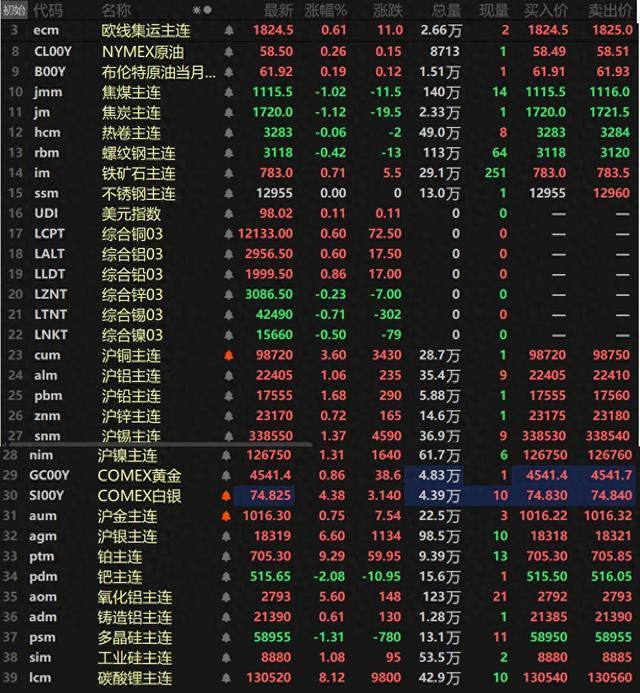
Metal Market - Domestic base metals collectively surged, with copper leading at a 3.6% increase, reaching a record high of 99,730 yuan/ton [1] - Aluminum rose by 1.06%, lead by 1.68%, tin by 1.37%, and nickel by 1.31%, while zinc increased by 0.72% [1] - Alumina futures saw a significant rise of 5.6%, hitting a peak of 2,830 yuan/ton, marking a new high since November 2024 [1] - Lithium carbonate futures skyrocketed by 8.12%, reaching 131,000 yuan/ton, a new high since November 2023 [1] - The black metal sector experienced a downturn, with stainless steel remaining stable at 12,955 yuan/ton, while iron ore rose by 0.71% [1] Precious Metals - COMEX gold increased by 0.86%, reaching a peak of $4,561.6/oz, continuing to set a historical high [2] - COMEX silver surged by 4.38%, hitting a record high of $75.495/oz [2] - Domestic gold rose by 0.75%, reaching a historical high of 1,023.96 yuan/gram, while silver increased by 6.6%, reaching 18,658 yuan/kg [2] - Platinum futures rose by 9.29%, reaching a historical high of 709.85 yuan/gram before slightly retracting [2] Macroeconomic Developments - The National Venture Capital Guiding Fund focuses on cutting-edge fields such as AI, biopharmaceuticals, quantum technology, and 6G, aiming to leverage trillions in social capital [5] - The fund will adopt a three-tier structure to attract local governments, financial institutions, and enterprises, with a focus on long-term investments [5] - The National Development and Reform Commission announced increased investment in early-stage projects in integrated circuits, AI, aerospace, and low-altitude economy [6][7] - As of November, China's total installed power generation capacity reached 3.79 billion kilowatts, a year-on-year increase of 17.1% [7] Oil Market - Both U.S. and Brent crude oil prices rose slightly, with U.S. oil up by 0.26% and Brent by 0.19% [13] - Oil prices are expected to face the largest annual decline since 2020, with Brent and U.S. crude projected to drop approximately 17% and 18%, respectively [13] - The U.S. Energy Information Administration (EIA) will release official inventory data, reflecting demand from the world's largest oil consumer [13]
东芯股份涨超6%,科创100指数ETF(588030)近一周累计上涨近6%
Xin Lang Cai Jing· 2025-12-26 05:57
Group 1 - The core viewpoint of the news highlights the performance and growth of the Sci-Tech Innovation 100 Index and its ETF, indicating a positive trend in the market with a recent increase in both index and ETF values [1][3] - The Sci-Tech Innovation 100 Index ETF has seen a significant increase in its scale, reaching 6.158 billion yuan, marking a new high in the past month [3] - The ETF has experienced a notable inflow of funds, with a net inflow of 8.1815 million yuan recently, and a total of 140 million yuan over the last ten trading days [3] Group 2 - The National Venture Capital Guidance Fund has been launched, focusing on early-stage investments in hard technology sectors such as artificial intelligence, biopharmaceuticals, quantum technology, and 6G, with a long-term investment horizon of 15 to 20 years [1] - A strategic emerging industry development fund of 51 billion yuan has been initiated, targeting sectors like artificial intelligence, aerospace, high-end equipment, and future energy, which are expected to receive dual support from policies and funding [2] - The top ten weighted stocks in the Sci-Tech Innovation 100 Index account for 26.72% of the index, indicating a concentration in key companies such as Huahong Semiconductor and East China Semiconductor [3]
