
通货膨胀率

Search documents
Core inflation rate watched by Fed hit 2.8%, delayed September data shows, lower than expected
CNBC· 2025-12-05 15:03
Core Insights - A key inflation measure, the core personal consumption expenditures (PCE) price index, rose by 0.2% monthly and recorded an annual rate of 2.8%, which is 0.1 percentage point lower than expected [1][2] - The headline PCE also increased by 0.3% for the month, maintaining the annual inflation rate at 2.8%, aligning with expectations [2] - The report's release was delayed due to a government shutdown, which halted data collection and economic reports [3] Federal Reserve Implications - The Federal Reserve uses the PCE price index as its primary tool for assessing inflation, with a preference for the core measure as a better indicator of long-term trends [2] - The lower-than-expected annual rate may provide further justification for the Federal Reserve to consider lowering interest rates [1]


阿曼1-10月份通货膨胀率上涨0.9%
Shang Wu Bu Wang Zhan· 2025-12-05 12:20
阿曼《观点报》12月3日报道,根据国家统计和信息中心发布的数据,2025年1月至10月,平均通货膨胀 率上升了0.9%。与2024年同期相比,2025年10月阿曼消费者价格指数上涨了1.5%(以2018年为基准年)。 数据显示,2025年1月至10月,阿曼苏丹国各类个人消费品及服务类别的平均通胀率达到6.6%,该类别 位居涨幅榜首,同比涨幅达8.8%。 ...
德国11月通胀率预计降至2.3%
Shang Wu Bu Wang Zhan· 2025-11-29 04:41
Group 1 - The core inflation rate in Germany is projected to be 2.7% for November 2025, indicating a decrease of 0.2% month-on-month [1] - The overall inflation rate in Germany is expected to be 2.3% for November 2025, reflecting a month-on-month decline [1] - The Harmonized Index of Consumer Prices (HICP), which serves as the EU's inflation coordination standard, is anticipated to rise by 2.6% year-on-year, with a month-on-month decrease of 0.5% [1]
ATFX汇评:新西兰联储降息25基点,年内第六次降息
Sou Hu Cai Jing· 2025-11-26 10:45
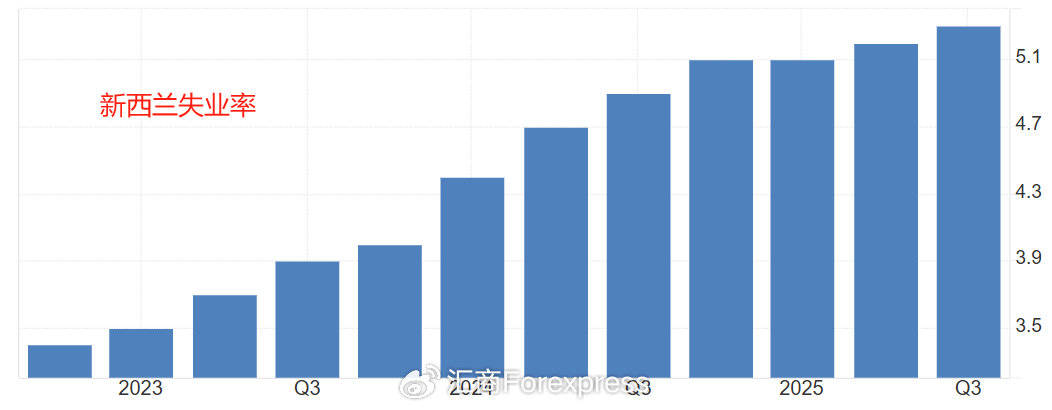
Core Viewpoint - The Reserve Bank of New Zealand (RBNZ) announced a 25 basis point rate cut, bringing the official cash rate (OCR) down to 2.25%, in response to rising inflation and a weak labor market [1][3]. Monetary Policy - The RBNZ's decision to lower the OCR is influenced by the Consumer Price Index (CPI) reaching 3% in Q3, which is at the upper limit of the official target range of 1%-3% [1]. - The RBNZ expects inflation to decline to around 2% by mid-2026, indicating a long-term outlook on inflation management [1]. - Since August 2024, the RBNZ has cut rates eight times, totaling a reduction of 300 basis points, which is significantly higher than the 150 basis points cut by the Federal Reserve [5]. Labor Market Insights - The labor market remains weak, with a rising unemployment rate that reached 5.3% in Q3, surpassing the 5% threshold for full employment [3]. - The RBNZ's rationale for the rate cut mirrors that of the Federal Reserve, focusing on the challenges within the labor market [3]. Interest Rate Context - The current cash rate of 2.25% is close to the neutral rate estimates of the Federal Reserve (2.5%-3.0%) and the European Central Bank (1.75%-2.25%), suggesting limited room for further significant rate adjustments [5]. - The RBNZ has not explicitly defined its neutral rate range, but the current rate is seen as supportive and stimulative for the economy [5]. Technical Analysis - The NZD/USD currency pair is in a medium-term bearish trend, with significant support levels identified around 0.5500, which has historically been a rebound point [7]. - The current market price of 0.5675 is close to this long-term support level, indicating potential for a significant rebound [7].
欧盟委员会将斯洛文尼亚2025年GDP增长预期减半
Shang Wu Bu Wang Zhan· 2025-11-25 16:43
Economic Growth Forecast - The European Commission has revised Slovenia's GDP growth forecast for 2025 from 2.0% to 1.0% while maintaining the 2026 forecast at 2.4% [1] - Slovenia's GDP growth rate is expected to further increase to 2.6% in 2027 [2] Inflation and Employment - Inflation rates are projected to reach 2.5% in 2025 and 2.3% in 2026, both higher by 0.4 percentage points than previous forecasts [1] - The unemployment rate is expected to rise to 3.4% in 2025 and 3.5% in both 2026 and 2027 [2] Private and Public Spending - Private and public spending in Slovenia is anticipated to strengthen in the second half of the year, driven by winter or Christmas bonuses for employees [1] - Public investment is expected to remain high in 2026, supported by the European recovery and resilience fund [1] Wage Growth - Wage growth is projected to be 7.9% in 2025, followed by 5.7% in 2026 and 5.4% in 2027, influenced by public sector wage increases and labor shortages [2] Trade Balance - The contribution of foreign trade balance to Slovenia's economic growth is expected to remain neutral by the end of 2027, with exports continuing to grow due to increased demand [1]
国际货币基金组织将斯洛文尼亚2025年GDP增长预期下调至0.8%
Shang Wu Bu Wang Zhan· 2025-11-25 14:31
Core Viewpoint - The International Monetary Fund (IMF) has revised Slovenia's GDP growth forecasts for 2025 and 2026, indicating a slower economic recovery than previously expected [1] Economic Growth Forecast - Slovenia's GDP is projected to grow by 0.8% in 2025, a decrease of 0.3 percentage points from the October forecast [1] - The growth forecast for 2026 has been lowered by 0.1 percentage points to 2.2%, with a further increase to 2.3% expected in 2027 [1] - The economy experienced a contraction in Q1 of this year but rebounded in Q2 and Q3, with an overall growth rate of 0.8% anticipated for the year [1] Inflation and Long-term Projections - If food and energy price increases slow down, inflation is expected to stabilize around 2% by 2030 [1] - Mid-term GDP growth is expected to stabilize at approximately 2.1% [1] Structural Challenges - The IMF highlights ongoing structural reform challenges, including the need for improved efficiency in the public sector and tax system [1] - Slovenia needs to find additional funding sources for pension and long-term care systems [1] - Key challenges include labor shortages, administrative barriers, enhancing the innovation environment, and providing incentives for promising businesses, necessitating increased investment to boost productivity [1]
【环球财经】欧盟委员会下调乌克兰2025年GDP增速预期至1.6%
Xin Hua Cai Jing· 2025-11-18 15:07
Core Insights - The European Commission's autumn economic forecast indicates that Ukraine's GDP growth is expected to decline from 2% to 1.6% due to ongoing attacks on key energy infrastructure and a decrease in agricultural output [1] - The prolonged Russia-Ukraine conflict is causing supply chain disruptions and labor shortages, leading to a projected GDP growth decline to 1.5% by 2026 [1] - Inflation in Ukraine has seen a rebound, with a year-on-year increase of 11.9% as of September, and the weighted average inflation rate is expected to rise from 6.5% last year to 13.1% this year [1] - Despite an increase in military tax rates, Ukraine's fiscal deficit is projected to rise to 23.8% of GDP this year due to defense procurement and military personnel salary expenditures outpacing revenue growth [1] Economic Projections - Ukraine's defense and security spending is expected to remain high, with a forecasted fiscal deficit narrowing to 21.2% of GDP next year due to measures like enhanced customs management and increased bank income tax rates [2]
瑞典10月份的通货膨胀率为0.9%
Shang Wu Bu Wang Zhan· 2025-11-15 03:15
Core Insights - Sweden's inflation rate remained stable at 0.9% in October 2025, unchanged from September, while the core inflation rate also held steady at 3.1% [1] Group 1: Inflation Data - The inflation rate in Sweden for October 2025 is reported at 0.9%, consistent with the previous month [1] - The core inflation rate is recorded at 3.1%, also unchanged from September [1] Group 2: Price Changes - Significant price increases were noted in food, particularly in candy and ice cream, which experienced the largest price hikes [1] - Transportation service prices rose, including ticket prices for international flights and railway travel [1] - Electricity prices saw an increase, while loan interest rates for owner-occupied homes and rental apartments decreased [1]
德国10月通胀率降至2.3%
Zhong Guo Xin Wen Wang· 2025-11-12 17:21
Core Insights - The final data from the German Federal Statistical Office indicates that the inflation rate in Germany for October 2025 is 2.3% [1] - Following increases in August and September, where inflation rates were 2.2% and 2.4% respectively, October saw a slight decrease in inflation [1] - Service prices continue to rise at a rate above the average, remaining a primary driver of inflation [1] Inflation Details - In October, service prices in Germany increased by 3.5% year-on-year, with significant price hikes in passenger transport services (11.4%) and social institution services (8.0%) [1] - Energy product prices saw a year-on-year decline of 0.9%, with household energy prices down by 1.7%, electricity prices down by 1.4%, and light fuel oil prices down by 6.0% [1] - Food prices increased by 1.3% year-on-year, showing a noticeable slowdown compared to previous months [1] Core Inflation Metrics - Excluding energy prices, the inflation rate for October stands at 2.5%, while the core inflation rate, excluding both food and energy prices, is at 2.8% [1] - Economists predict that the inflation rate in Germany will remain above 2% in the short term, but some analysts believe the peak of inflation following the Russia-Ukraine conflict has ended [1] - Multiple economic research institutions forecast a relatively moderate inflation rate for Germany this year, estimated at around 2.1% [1]
【环球财经】埃及10月份通胀率放缓至10.1%
Xin Hua Cai Jing· 2025-11-11 15:24
Core Viewpoint - Egypt's annual overall inflation rate slowed to 10.1% in October from 10.3% in September, indicating a slight easing in inflationary pressures [1] Inflation Data - The Consumer Price Index (CPI) in Egypt rose from 260.9 points in September to 264.3 points in October, primarily driven by an increase in fuel prices [1] - Prices for vegetables, meat, dairy, clothing, and home appliances saw a slight increase in October compared to September, while prices for fish, fruits, and hotel services experienced a slight decline [1]