量子精密测量

Search documents
量子革命:量子科技的现状与未来
Haitong Securities International· 2025-10-24 15:11
Investment Rating - The report indicates a focus on the quantum technology industry, particularly highlighting the potential of quantum computing, quantum security, and quantum measurement as key areas for investment [1]. Core Insights - Quantum computing is in an early breakthrough stage, with quantum error correction being crucial for its advancement. The report anticipates significant progress in the next 5 to 10 years, particularly in the U.S. and China, which are leading globally in this field [1][2]. - China is positioned as a leader in the Quantum Key Distribution (QKD) sector, with a comprehensive quantum secure communication industry chain. Chinese institutions hold approximately 93% of the top patents in the global quantum communication field [1][2]. - The quantum measurement industry is entering a diversified development phase, with various applications and clear industrial prospects [1][2]. Summary by Sections Quantum Computing - Quantum computing is recognized as one of the most disruptive technologies, with various technical routes such as superconducting, ion trap, neutral atom, photonic, and silicon semiconductor showing diverse development [1][2][3]. - The report emphasizes the importance of quantum error correction, which is essential for realizing the full potential of quantum computing [1][2][3]. - Significant advancements in quantum error correction have been reported, with various teams achieving breakthroughs in error rates and logical qubit reliability [1][2][3]. Quantum Security - Quantum security encompasses traditional mathematical paths (PQC) and physical security paths (QKD), with China leading in QKD technology [1][2]. - The report outlines the structure of the quantum secure communication industry chain in China, which includes core quantum devices and application technologies [1][2]. Quantum Measurement - The quantum precision measurement sector is characterized by its ability to enhance measurement accuracy across various physical quantities, indicating a broad range of applications and clear industrial prospects [1][2]. - The report notes that the maturity of quantum sensors varies across different physical quantities, leading to a diversified development cycle [1][2]. Investment Recommendations - The report suggests focusing on GuoDun Quantum, the only publicly listed quantum technology company in China, which covers quantum computing, quantum security, and quantum measurement [1][2].

合百集团:作为量子精密测量领域的代表企业,国仪量子于近日完成IPO辅导验收
Zheng Quan Ri Bao Zhi Sheng· 2025-10-24 09:41
Core Viewpoint - HeBai Group has invested 20 million yuan in the Hefei Co-Creation Relay Venture Capital Fund, marking a strategic move to expand its industrial investment layout in line with Hefei's industry positioning and development policies [1] Group 1 - The investment in the Hefei Co-Creation Relay Venture Capital Fund is part of the company's strategy to leverage opportunities in the local industrial fund development [1] - The fund has invested 131 million yuan in Guoyi Quantum Technology (Hefei) Co., Ltd., a representative enterprise in the field of quantum precision measurement [1] - Guoyi Quantum has recently completed its IPO guidance acceptance, indicating its readiness for public listing [1]

国盾量子20251009
2025-10-09 14:47
Summary of GuoDun Quantum Conference Call Company Overview - GuoDun Quantum operates in three main areas: quantum communication, quantum computing, and quantum precision measurement, making it a globally rare entity in this field [2][3][4] - The company reported a revenue growth of 74.5% year-on-year in the first half of 2025, reaching 120 million yuan, with a gross margin around 50% [2][3] - The company holds over 220 million yuan in orders, indicating optimistic future order expectations [2][3] Key Business Segments 1. **Quantum Communication** - GuoDun Quantum is the largest supplier in China with a market share exceeding 90% [2][5] - The company has completed the construction of metropolitan area networks in over 20 cities and is involved in international projects [2][5] - Following China Telecom's investment, the company is accelerating inter-city network construction, aiming to complete 100 city networks by 2030 [2][5] 2. **Quantum Computing** - The company leverages the technology platform from the University of Science and Technology of China (USTC) and is involved in the "Zu Chongzhi" superconducting quantum computer project [2][5] - Revenue in this segment grew nearly threefold year-on-year to 56 million yuan in the first half of 2025, with several large orders signed [2][5] 3. **Quantum Precision Measurement** - The cold atom gravimeter product has shown strong performance, with two orders completed and three additional orders for cold atomic clocks priced at approximately 3 million yuan each [2][5] - This segment has growth potential in mining exploration and underground structure surveying [2][5] Financial Performance and Projections - The company is expected to achieve a net profit of between 24 million and 87 million yuan from 2025 to 2027 [4][5] - Based on a price-to-sales (PS) valuation standard from overseas companies, a target price of approximately 550 yuan is set, with a buy rating initiated [4][5] Strategic Partnerships - The investment from China Telecom provides platform support, enhancing market share and facilitating large orders, such as a 64 million yuan order expected to be delivered next year [2][7] - The partnership with China Telecom is crucial for expanding the company's operational capabilities and securing future project orders [7] Market Position and Competitive Landscape - GuoDun Quantum is the only listed company in the A-share market focused on quantum technology as its main business [3][6] - The company has a unique position in the international market due to the current restrictions on domestic products, providing significant domestic substitution opportunities [6] Research and Development - The company has been increasing its R&D investment, with R&D expenses reaching approximately 50 million yuan in the first half of 2025, a 30% year-on-year increase [13] - The gross margin for quantum communication is around 60%, while quantum computing maintains a margin of about 50% [13] Future Outlook - The domestic quantum communication market is expected to continue growing, with GuoDun Quantum's market share likely to expand as infrastructure projects progress [16][29] - The global quantum computing industry is transitioning from experimental to commercial phases, with significant growth anticipated in the coming years [18][22] - The cold atom gravimeter market is projected to reach 1.09 billion USD by 2035, with a compound annual growth rate of nearly 20% [28] Conclusion - GuoDun Quantum is well-positioned for growth in the quantum technology sector, supported by strong financial performance, strategic partnerships, and a robust order backlog. The company's focus on R&D and market expansion will likely enhance its competitive edge in both domestic and international markets [30][31]
国盾量子(688027):量子计算驱动业绩高增,与中电信协同效应显著
Haitong Securities International· 2025-09-29 08:01
Investment Rating - The report maintains an "Outperform" rating for the company [4][8]. Core Insights - Quantum computing drives significant revenue growth, with a 74.54% year-on-year increase in H1 2025, and quantum computing revenue specifically rising by 283.92% [9]. - The synergy with China Telecom is becoming increasingly significant, transitioning quantum communication into an information security infrastructure, which is expected to enhance user convenience and accelerate industry growth [10]. - The commercialization of quantum computing is accelerating, highlighted by the successful delivery of the 504-qubit superconducting quantum computer "Tianyan-504" to China Telecom and a breakthrough in overseas markets with a 25-qubit delivery [11]. Financial Summary - The projected revenue for the company from 2025 to 2027 is estimated at 0.36 billion, 0.49 billion, and 0.64 billion RMB respectively, with earnings per share (EPS) expected to be 3.54, 4.80, and 6.22 RMB [4][8]. - In H1 2025, the company reported a net profit attributable to shareholders of -23.79 million RMB, with a recurring net profit of -46.75 million RMB [9]. - The company’s total revenue for 2023 is reported at 156 million RMB, with a projected increase to 640 million RMB by 2027, reflecting a compound annual growth rate (CAGR) of approximately 29.7% [3].
从科幻到现实!创新成果频频上“新” 中国驶入量子时代“快车道”
Yang Shi Wang· 2025-09-21 03:35
Core Insights - Quantum technology is a crucial development direction for China's future industries and is expected to revolutionize emerging technologies [1] - The field of quantum technology encompasses quantum computing, quantum communication, and quantum measurement, leveraging principles of quantum mechanics [3][24] Group 1: Quantum Technology Developments - China has made significant strides in quantum technology, with the "Zu Chongzhi III" quantum computing prototype set to be launched in March 2025, establishing a new global record in superconducting quantum computing [4] - A research team successfully constructed a 300-kilometer quantum direct communication network, demonstrating the feasibility of long-distance secure communication [6] - The "Nano-Photon Factory" was developed in July 2025, producing a new type of quantum entangled light source with a fidelity of 99.4%, laying a critical foundation for advanced quantum applications [6] Group 2: Quantum Sensing and Measurement - Quantum sensors, which are atomic-scale devices, can measure extremely small quantities, such as the temperature of individual cells or molecules, thus opening the door to the microscopic world [9] - Quantum precision measurement can detect magnetic field signals that are 10 billion times smaller than Earth's magnetic field, and portable gravity meters can identify mineral deposits deep underground [10][11] - The core team from Guoyi Quantum aims to transform research outcomes in quantum measurement into products, achieving breakthroughs in domestic high-end scientific instruments [11][13] Group 3: Quantum Applications in Power Systems - The world's first quantum application demonstration substation in Hefei operates 85 types of quantum technology-related products, enhancing the safety and efficiency of power transmission [18][20] - Quantum communication ensures secure transmission of electrical information, while quantum computing performs dynamic data calculations between power nodes [20] - Future developments in quantum sensors are expected to replace traditional measurement devices, significantly reducing size and costs, which is crucial for power systems [23] Group 4: Industry Growth and Policy Support - Hefei is a key hub for quantum technology innovation, with plans to develop the quantum industry into a 100 billion yuan industry cluster by 2027 [35] - Various cities, including Beijing, Shanghai, and Shenzhen, are accelerating the practical application of quantum technology through supportive policies and the establishment of innovation incubators [37]

新华财经早报:9月21日
Xin Hua Cai Jing· 2025-09-21 00:55
Group 1 - The Ministry of Commerce expressed hope for a fair business environment for Chinese companies like TikTok in the U.S. [2] - The National Organization for Drug Procurement released the 11th batch of centralized drug procurement documents, emphasizing principles of clinical stability, quality assurance, and anti-competitive practices [2] - Kuaishou and Weibo responded to regulatory discussions by forming special teams for rectification and improving content management [2] Group 2 - The 2025 World Manufacturing Conference opened in Hefei, with over 1,000 guests from more than 40 countries, highlighting the increase in the threshold for the top 500 Chinese manufacturing companies [2] - The China-Laos Railway has facilitated over 1,500 million tons of goods since its operation, with significant growth in agricultural exports [2] - The construction of the Duku Highway project commenced, aiming to enhance transportation efficiency in the region [2] Group 3 - The first fully autonomous 500 kV substation in China was launched in Liaoning, showcasing advancements in domestic technology for power grid safety [2] - Research teams confirmed high-temperature superconductivity in nickel oxide materials, marking a significant scientific breakthrough [2] - Observations from the Huairou-1 satellite provided evidence of a millisecond pulsar associated with a gamma-ray burst, contributing to astrophysical research [2]

什么是量子科技?都有哪些应用?一文了解→
Yang Shi Xin Wen Ke Hu Duan· 2025-09-21 00:50
Core Insights - Quantum technology is a crucial development direction for China's future industries and is expected to disrupt emerging technologies [1] - Recent innovations in China's quantum technology field have led to significant advancements in quantum computing, communication, and measurement [1][3] Group 1: Quantum Technology Innovations - China's self-developed quantum computing prototype "Zu Chongzhi III" was launched in March 2025, setting a new global record for superconducting quantum computing superiority [3] - In July 2025, a research team created a "nano-photon factory," producing a new type of quantum entangled light source with a fidelity of 99.4%, laying a critical foundation for advanced quantum applications [3] - A 300-kilometer quantum direct communication network has been successfully established, demonstrating the feasibility of long-distance high-security communication [5] Group 2: Quantum Sensing and Measurement - The world's smallest quantum sensor, located at the tip of a diamond probe with a diameter of only 500 nanometers, is capable of measuring at the atomic level [8] - Quantum sensors can measure extremely small entities, such as individual cells and molecules, which traditional sensors cannot detect [10] - The core team from Guoyi Quantum aims to transform quantum measurement research into products, achieving breakthroughs in China's high-end scientific instruments [12] Group 3: Applications in Power and Energy - The world's first quantum application demonstration substation in Hefei integrates 85 types of quantum technology-related products, enhancing operational safety and efficiency [14] - Quantum communication ensures secure transmission of electrical information, while quantum computing performs dynamic data calculations between power nodes [15] - Quantum sensors in the substation can monitor multiple parameters with high sensitivity, significantly improving the reliability of the power system [17][19] Group 4: Quantum Computing Capabilities - China's highest bit-count superconducting quantum computer has 504 qubits, potentially exceeding the computational power of all current supercomputers [21] - Quantum computing can revolutionize fields such as meteorological prediction and information security, with ongoing explorations proving its feasibility [23] - New quantum communication technologies are being tested to ensure absolute information security, with future applications in global secure information networks [25] Group 5: Industry Development and Policy Support - The Ministry of Industry and Information Technology and other departments have proposed plans to develop future industries, including quantum technology, aiming to create a hundred billion-level industrial cluster by 2027 [26] - Hefei is recognized as a key innovation hub for quantum technology, with specialized parks and clusters being established [26] - Other cities like Beijing and Shanghai are also accelerating the practical application of quantum technology through various initiatives and policies [26]
什么是量子科技?都有哪些应用?一文了解
Yang Shi Wang· 2025-09-20 22:33
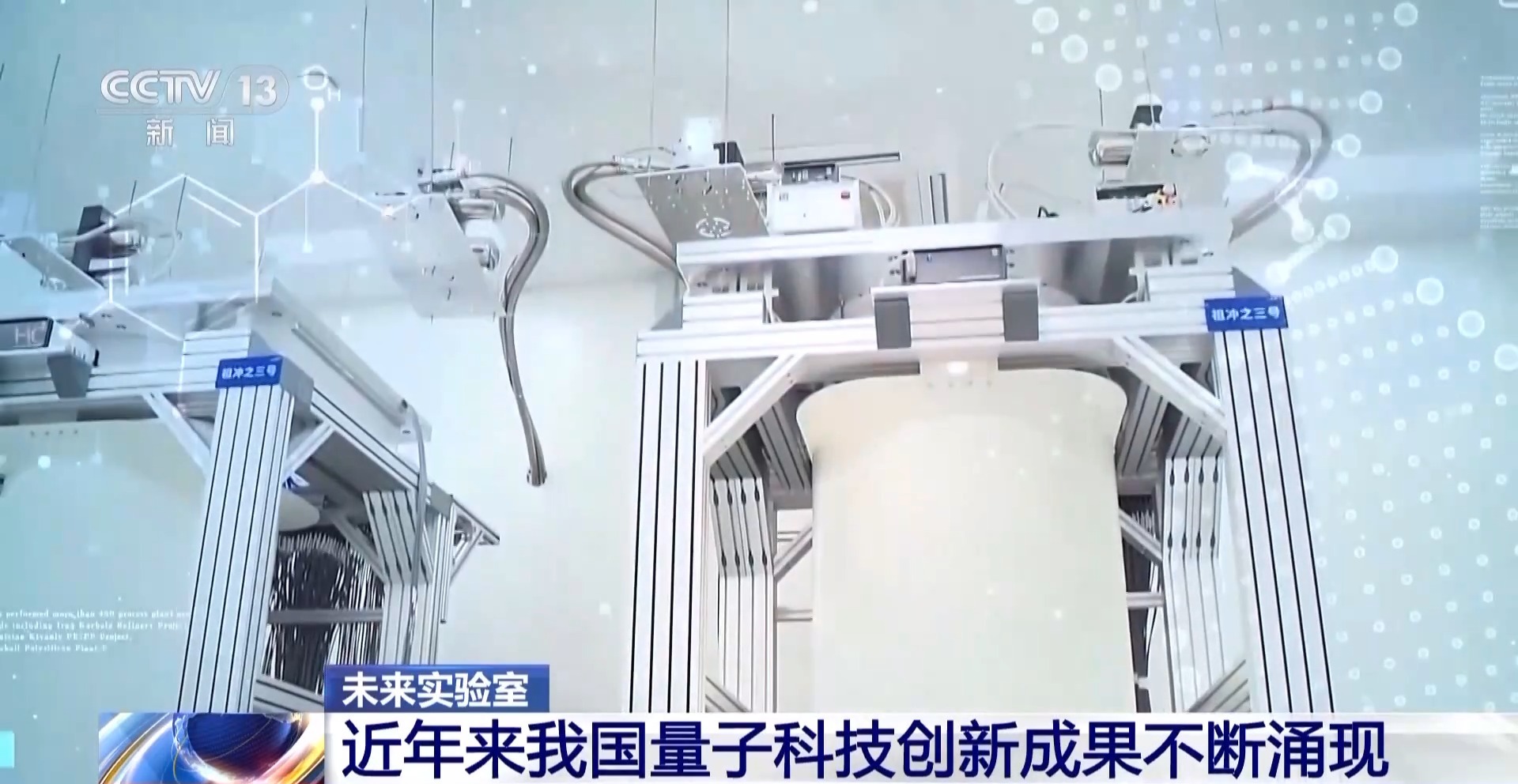
Core Insights - Quantum technology is a crucial development direction for China's future industries and is expected to revolutionize emerging technologies [1] - China has made significant strides in quantum technology, including the development of the "Zu Chongzhi No. 3" quantum computing prototype and a new type of quantum entangled light source with a fidelity of 99.4% [1][2] Group 1: Quantum Technology Innovations - Quantum technology is based on the principles of quantum mechanics, enabling advancements in quantum computing, communication, and measurement [1] - The "Zu Chongzhi No. 3" quantum computing prototype was launched in March 2025, setting a new global record for superconducting quantum computing superiority [1] - A research team created a "nano-photon factory" in July 2025, producing a new quantum entangled light source with a fidelity of 99.4%, laying the groundwork for advanced quantum applications [1] Group 2: Quantum Communication and Measurement - A 300-kilometer quantum direct communication network was successfully constructed, demonstrating the feasibility of long-distance high-security communication [2] - Quantum sensors, which are capable of measuring at the atomic level, are being developed to provide precise measurements for applications in various fields [3][4] - The world's smallest quantum sensor, with a scale of 0.5 nanometers, is being utilized for measuring extremely small entities, such as individual cells and molecules [4][5] Group 3: Practical Applications and Industry Development - The world's first quantum application demonstration substation in Hefei integrates 85 types of quantum technology-related products, enhancing operational safety and efficiency [8][9] - Quantum sensors are expected to replace many traditional measurement devices, significantly improving accuracy and reducing costs in power systems [9] - The quantum computing capabilities demonstrated in Hefei, with a quantum computer featuring 504 qubits, show potential for applications in weather prediction and information security [11][12] Group 4: National and Regional Strategies - The Chinese government is promoting the development of future industries, including quantum technology, through various policies and initiatives [13][14] - Hefei is recognized as a key hub for quantum technology innovation, with plans to develop a hundred billion-level industry cluster by 2027 [14] - Other cities like Beijing, Shanghai, and Shenzhen are also advancing their quantum technology initiatives, focusing on practical applications and industry cultivation [14]
【投融资动态】国测量子A+轮融资,融资额超亿人民币,投资方为中国国新控股、河北沿海产业投资基金等
Sou Hu Cai Jing· 2025-09-02 12:20
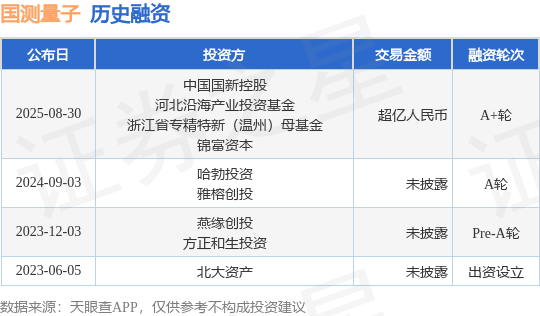
Group 1 - The core viewpoint of the news is that Guoce Quantum Technology (Zhejiang) Co., Ltd. has completed an A+ round of financing exceeding 100 million RMB, with participation from several investment institutions [1][2]. - The investment institutions involved in this financing round include China National New Holding, Hebei Coastal Industrial Investment Fund, Zhejiang Specialized and New (Wenzhou) Mother Fund, and Jinf Capital [1][2]. - Guoce Quantum is an industrial company initiated by Peking University in the field of quantum precision measurement, leveraging the university's technological advantages and aiming to develop high-end instruments for various applications [2]. Group 2 - The company is focused on applications of quantum precision measurement instruments in navigation, autonomous navigation timing micro-terminals, military communication, electronic warfare, micro-nano satellites, unmanned driving, the Internet of Things, and underwater detection [2]. - Guoce Quantum aims to establish a production base for high-end quantum precision measurement instruments, including chip atomic clocks, to achieve complete domestic control over high-end instruments and break foreign technology barriers [2]. - The company is committed to becoming a leading enterprise in the global time-frequency field [2].
商道创投网·会员动态|国测量子·完成数亿元A+轮融资
Sou Hu Cai Jing· 2025-09-01 15:43
Group 1 - The core viewpoint of the article highlights that Guoce Quantum Technology (Zhejiang) Co., Ltd. has successfully completed an A+ round financing of over 100 million yuan, led by Guofeng Investment (Beijing) Intelligent Manufacturing Transformation and Upgrade Fund, with participation from several other funds [2] - Guoce Quantum was established in June 2023, incubated by the quantum precision measurement team from Peking University, focusing on the localization of core quantum time-frequency devices, and has launched products such as chip-level atomic clocks and ultra-stable lasers [3] - The funds from this round of financing will be used to expand the production scale of domestically produced chip atomic clocks and high-end stable frequency lasers, enhance R&D of key devices, and accelerate batch verification and delivery in various applications such as communication, power grids, Beidou, and autonomous driving [4] Group 2 - The investment rationale provided by the National New Fund indicates that quantum precision measurement serves as the underlying "clock" for high-end manufacturing, and Guoce Quantum has achieved independent control of core technologies with rapid industrialization capabilities, meeting the surging demand in industrial, defense, and new infrastructure sectors [5] - The investment reflects a broader trend where local governments, state-owned funds, and market-oriented institutions respond to the call for "strengthening patient capital," with Guoce Quantum securing two rounds of financing within a year, showcasing the synergy between policy and capital [6]