A股IPO

Search documents
2025年A股IPO:新股数增14%,近五成募资投科创
Sou Hu Cai Jing· 2025-12-30 07:27
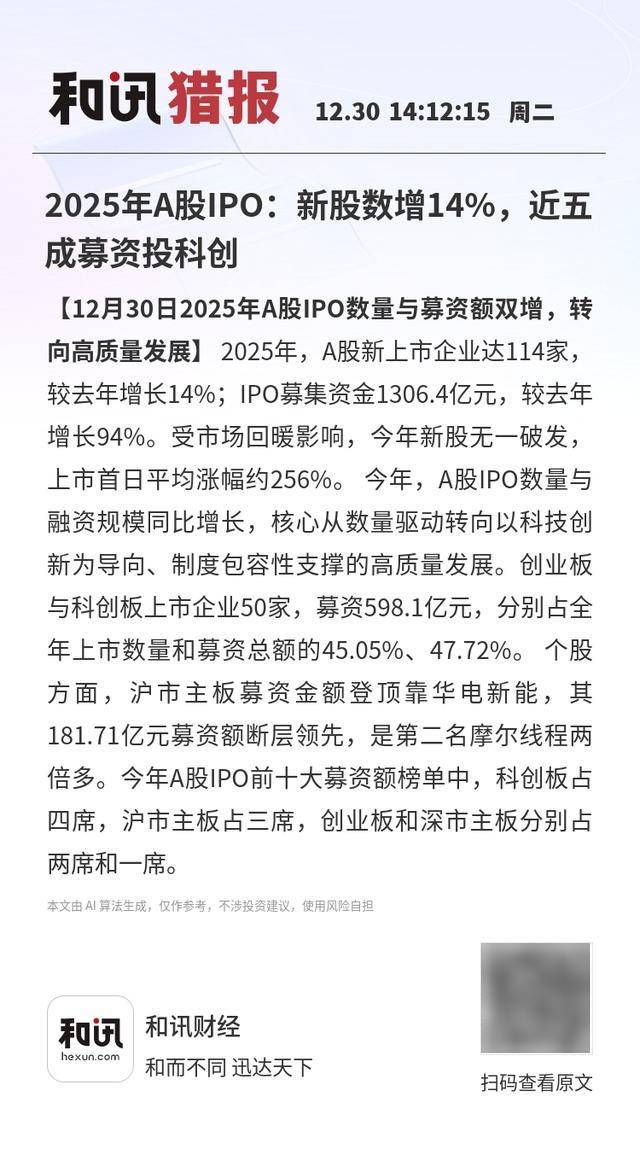
两席和一席。 本文由 Al 算法生成,仅作参考,不涉投资建议,使用风险自担 和讯财经 hexun.co 和而不同 迅达天下 扫码查看原文 【12月30日2025年A股IPO数量与募资额双增,转向高质量发展】2025年,A股新上市企业达114家,较 去年增长14%;IPO募集资金1306.4亿元,较去年增长94%。受市场回暖影响,今年新股无一破发,上 市首日平均涨幅约256%。 今年,A股IPO数量与融资规模同比增长,核心从数量驱动转向以科技创新为 导向、制度包容性支撑的高质量发展。创业板与科创板上市企业50家,募资598.1亿元,分别占全年上 市数量和募资总额的45.05%、47.72%。 个股方面,沪市主板募资金额登顶靠华电新能,其181.71亿元 募资额断层领先,是第二名摩尔线程两倍多。今年A股IPO前十大募资额榜单中,科创板占四席,沪市 主板占三席,创业板和深市主板分别占两席和一席。 本文由 AI算法生成,仅作参考,不涉投资建议,使用风险自担 ...

一签赚40万,A股最赚钱新股背后赢家曝光
2 1 Shi Ji Jing Ji Bao Dao· 2025-12-20 13:55
Core Insights - The recent IPOs of Muxi Co. and Moer Thread have set new records for the highest floating profits in the A-share market, with Muxi Co. achieving a maximum floating profit of approximately 395,200 yuan per share on its first trading day [1][6][7]. Group 1: IPO Performance - Muxi Co. and Moer Thread have been the most discussed companies in December, with their IPOs creating significant wealth for investors [5]. - Muxi Co. generated a floating profit of 395,200 yuan per share, while Moer Thread achieved a floating profit of 286,900 yuan per share on their respective first trading days [6][7]. Group 2: Underwriter Earnings - Huatai United Securities, the underwriter for Muxi Co., is expected to earn 268 million yuan in underwriting fees and over 652 million yuan in investment floating profits [2][7]. - CITIC Securities, the underwriter for Moer Thread, anticipates earning over 100 million yuan in underwriting fees and more than 828 million yuan in investment floating profits [9]. Group 3: Overall Market Trends - The A-share IPO market has seen a recovery, with 105 companies listed in 2023, raising a total of 120.99 billion yuan, representing an increase of over 80% compared to the previous year [11]. - The total underwriting and advisory fees generated for securities firms from IPOs reached 5.932 billion yuan, marking a growth of over 30% year-on-year [11][13]. Group 4: Competitive Landscape - Leading underwriters such as CITIC Securities, Huatai United Securities, and Guotai Junan have captured a significant share of the underwriting fees, with the top four firms accounting for nearly half of the total industry revenue [14][15]. - The competition among underwriters has shifted from quantity to the ability to price and sell high-value projects, reflecting a trend towards concentration in the industry [15]. Group 5: Strategic Placement and Risks - The strategic placement system in the Sci-Tech Innovation Board requires underwriters to participate in IPOs, with a lock-up period of 24 months, which adds uncertainty to the potential profits [20][24]. - As of December 18, 2023, 16 new stocks on the Sci-Tech Innovation Board have generated over 3 billion yuan in floating profits for underwriters, with CITIC Securities leading with 1.406 billion yuan in floating profits [21][24].
德勤:预计2025年A股IPO融资规模同比增加94%
Guo Ji Jin Rong Bao· 2025-12-19 00:39
Group 1: A-Share Market Outlook - The A-share market is expected to see 114 companies listed by December 31, 2025, raising approximately 129.6 billion yuan, representing a 14% increase in new listings and a 94% increase in total financing compared to 2024 [1] - The ChiNext board is projected to have the highest number of new listings (19), while the Shanghai Stock Exchange is expected to lead in financing amount (43.2 billion yuan) [1] - The Shanghai Stock Exchange is anticipated to maintain its position as the fifth largest stock exchange globally, with a new stock financing amount of 80 billion yuan [1] Group 2: Hong Kong IPO Market Forecast - Hong Kong is projected to complete 114 new stock listings in 2025, raising around 286.3 billion HKD, which indicates a 63% increase in new listings and more than a twofold increase in financing compared to the previous year [2] - The positive outlook for Hong Kong's IPO market is attributed to various reforms, including simplified listing approval processes and the establishment of a special listing system for technology companies [2] - In 2026, approximately 160 new stocks are expected to be listed in Hong Kong, with total financing of at least 300 billion HKD, including seven stocks each raising at least 10 billion HKD [2] Group 3: U.S. Market for Chinese Companies - About 63 Chinese companies are expected to list in the U.S. in 2025, raising approximately 1.12 billion USD, which is a 7% increase in the number of new listings but a 41% decrease in financing compared to 2024 [3] - The largest two Chinese companies listed in the U.S. this year are from the consumer and pharmaceutical sectors [3] - There is a cautious outlook for Chinese companies listing in the U.S. in 2026, particularly if proposed listing thresholds by Nasdaq are approved, which may lead to a decrease in the number of eligible Chinese companies [3]
德勤:预计2026年港股将发行约160只新股,融资额不少于3000亿港元
Bei Jing Shang Bao· 2025-12-18 10:59
Core Insights - Deloitte's report indicates a steady growth in the number of IPOs and financing amounts in the A-share market for 2026, with an expected 114 companies going public and raising 129.6 billion yuan [1] - The Hong Kong IPO market is projected to see around 160 new listings in 2026, with total financing expected to exceed 300 billion HKD [2] A-Share Market Summary - In 2025, the A-share market is expected to have 114 new listings, raising a total of 129.6 billion yuan, which represents a 14% increase in the number of IPOs and a 94% increase in financing compared to 2024 [1] - The top five IPOs in 2025 are projected to raise a total of 39.4 billion yuan, a significant increase of 260% from the previous year's 10.9 billion yuan [1] - Companies in priority sectors such as AI, new energy, high-end manufacturing, commercial aerospace, quantum technology, and biomanufacturing are expected to have a competitive advantage in the A-share market [1] Hong Kong Market Summary - For 2025, Hong Kong is anticipated to have 114 new IPOs, raising approximately 286.3 billion HKD, marking a 63% increase in the number of IPOs and a 227% increase in financing compared to the previous year [1] - The Hong Kong Stock Exchange is expected to lead global exchanges in total IPO financing for 2025 [1] - In 2026, the Hong Kong market is projected to have around 160 new listings, with at least 7 of them expected to raise over 10 billion HKD each, including leading mainland enterprises [2] - The focus will also be on "A+H" stock applicants, as well as sectors like technology, media, telecommunications, healthcare, consumer goods, and international companies [2]
IPO月报|欣强电子申报5个月就撤单 兴业证券沪深板块项目全军覆没
Xin Lang Cai Jing· 2025-12-05 10:23
Core Insights - In November 2025, the A-share IPO market saw a record high with 17 companies undergoing review, of which 16 were approved, resulting in a nominal approval rate of 94.12% [2][11] - Five companies terminated their IPO processes in November, maintaining a single-digit termination count for several months [4][13] - A total of 11 companies successfully listed in November, raising a total of 10.188 billion yuan [1][7] IPO Review Situation - Jiangsu Yongda Chemical Machinery Co., Ltd. was the only company to face a delay in its IPO review, primarily due to concerns regarding its photovoltaic business [2][11] - The review focused on three main issues: revenue recognition, operational performance stability, and the adequacy of revenue recognition for photovoltaic projects [2][11] - As of mid-2025, Yongda's accounts receivable stood at 338 million yuan, with over 80% being overdue, raising concerns about the company's financial data authenticity [2][11] IPO Termination Situation - Five companies withdrew their IPO applications in November, including Xinqiang Electronics, which retracted its application after just five months due to governance and related party transaction concerns [4][13][14] - Xinqiang Electronics is a family-controlled enterprise, with the controlling family holding 95.04% of the shares, leading to significant cash dividends despite weak performance [5][14] IPO Issuance Situation - The highest fundraising in November was achieved by Nanfang Digital, which raised 2.714 billion yuan, while the lowest was by Dapeng Industrial at 135 million yuan [7][17] - Hengkun New Materials was the only company with an issuance price-to-earnings ratio exceeding the industry average, at 71.42 times compared to the industry average of 60.47 times [7][17] - Audit fees for Hengkun New Materials were notably high, with a rate of 2.14%, compared to lower rates for other companies with higher fundraising amounts [7][17][18]

年内100家新股上市
Shen Zhen Shang Bao· 2025-12-03 23:01
Group 1 - The core viewpoint of the articles highlights the significant growth in the A-share IPO market in 2023, with 100 new stocks listed by December 3, matching the total number from the previous year [1][2] - The top three provinces for new stock listings are Jiangsu with 25 companies, Guangdong with 19, and Zhejiang with 14, indicating a regional concentration in IPO activities [1] - The total fundraising amount for the 100 new listings reached 104.97 billion yuan, reflecting an 80.8% increase year-on-year, showcasing a robust market environment [2] Group 2 - The A-share IPO market has seen a year-on-year increase of 12.4% in the number of listings, indicating a healthy growth trajectory [2] - The top five industries by IPO quantity include power equipment, automotive, electronics, machinery, and basic chemicals, suggesting a diverse sectoral representation in new listings [2] - The IPO process remains fast-paced, with 11 new stocks listed in November alone, and the highest first-day gain recorded was over 12 times for Dapeng Industrial, marking a significant milestone for the year [2]
11月A股IPO首发上会数创两年来新高 大鹏工业上市首日涨幅超12倍,破北交所纪录
Mei Ri Jing Ji Xin Wen· 2025-12-02 13:24
Group 1 - In November, 17 companies were approved for IPOs in the A-share market, marking the highest monthly number since October 2023, with 11 of these companies planning to list on the Beijing Stock Exchange, accounting for nearly 30% of the total IPOs this year on that exchange [1][2] - Among the 17 companies, 16 were approved, resulting in a high approval rate of 94.12%, while Yongda Co., Ltd. was the only company that had its approval postponed due to inquiries regarding revenue recognition and the stability of its business performance [2][3] - The IPO registration process remains fast-paced, with 7 of the approved companies entering the registration phase in November, and some, like Qiangyi Co. and Shaanxi Tourism, have already registered successfully [3] Group 2 - Five companies terminated their IPOs in November, an increase from two in October 2025, including Xinqiang Electronics, which had its IPO application accepted for less than five months [4] - Xinqiang Electronics, primarily engaged in the research, production, and sales of printed circuit boards (PCBs), had significant related-party sales, with a gross profit margin of 6.47% on sales to its related companies [5] - In November, the A-share market also received 8 new IPO applications, including companies like Green Biology and Luoxu Co., which have previously attempted IPOs but faced terminations [5]
A股IPO悄悄扩容,江苏成最大赢家
Sou Hu Cai Jing· 2025-11-18 10:01
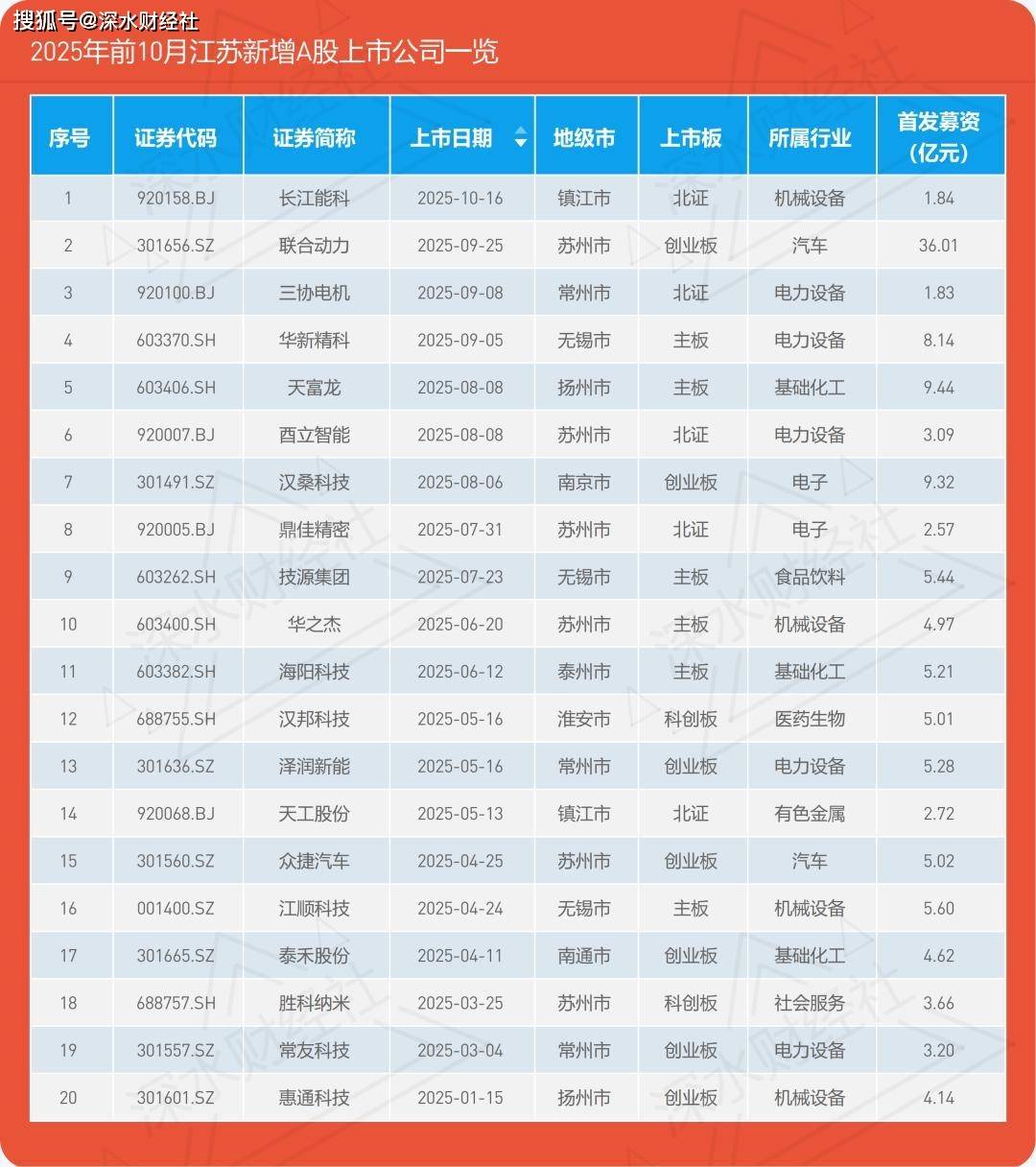
Core Insights - The number of IPOs in A-shares is expected to exceed last year's total, with 87 companies listed in the first ten months of 2025, surpassing the 80 from the same period in 2024 [1][4] - The total fundraising amount from IPOs in the first ten months of 2025 reached 901.72 billion, significantly exceeding the total of 673.53 billion for the entire year of 2024 [1][6] IPO Trends - The years 2019-2023 saw a surge in A-share IPOs, with a total of 1,899 companies listed, averaging 380 per year and raising a total of 17.4 trillion [3] - In 2024, the IPO market slowed dramatically, with only 100 new listings and total fundraising dropping to 673.53 billion [3] - The IPO environment began to relax again in 2025, with expectations of reaching 107 listings by year-end [4] Provincial Performance - Jiangsu province emerged as the biggest winner in 2025, with 21 companies listed in the first ten months, accounting for nearly a quarter of all IPOs [6][10] - Other provinces like Guangdong and Zhejiang had 17 and 13 companies listed, respectively, with total A-share counts reaching 887 and 728 [7] - In terms of fundraising, Fujian led with 181.71 billion, primarily from Huadian New Energy, followed by Guangdong with 146.34 billion and Jiangsu with 129.27 billion [10]

独家发布 | 2025年10月江苏A股公司IPO榜
Sou Hu Cai Jing· 2025-11-12 01:32
Core Insights - The report highlights the IPO activities in Jiangsu province for October 2025, indicating a stable trend with 9 new A-share companies listed, similar to previous months [1][10]. Group 1: IPO Overview - In October 2025, Jiangsu saw the listing of 1 new company, Changjiang Energy Materials, on the Beijing Stock Exchange, with a fundraising amount of 1.84 billion [2][10]. - For the first ten months of 2025, Jiangsu ranked first among provinces with 21 new A-share companies, surpassing Guangdong by 4 companies [10][17]. - The total fundraising amount for Jiangsu's IPOs in the first ten months reached 129.27 billion, placing it third nationally [17][29]. Group 2: City-wise IPO Distribution - Suzhou led the province with 7 new A-share companies in the first ten months, followed by Wuxi and Changzhou with 3 each [10][17]. - The distribution of new A-share companies by city in October 2025 shows that Jiangsu's cities are actively participating in the IPO market, with various cities contributing to the overall count [5][10]. Group 3: Fundraising Analysis - The total fundraising for Jiangsu's IPOs in October was relatively low at 1.84 billion, indicating a need for more robust fundraising activities [17]. - Suzhou's total fundraising amount for the first ten months was 57.48 billion, maintaining its position as the top city in Jiangsu for IPO fundraising [17][13]. Group 4: Sector and Board Distribution - The newly listed companies in Jiangsu for the first ten months were distributed across four boards, with the Growth Enterprise Market (GEM) having the highest number at 7 companies [17][11]. - The breakdown of the newly listed companies by board shows a diverse participation across different sectors, reflecting the province's economic landscape [11][17]. Group 5: IPO Pipeline and Support - As of the end of October, there were 301 companies in the IPO application queue nationwide, with Jiangsu having 51, ranking third in the country [29]. - Jiangsu also leads in the number of companies undergoing IPO guidance, with 243 firms, indicating a strong support system for potential IPO candidates [29][26].
11月3-9日A股IPO观察:市场加速,5家上市5家过会
Sou Hu Cai Jing· 2025-11-10 10:22
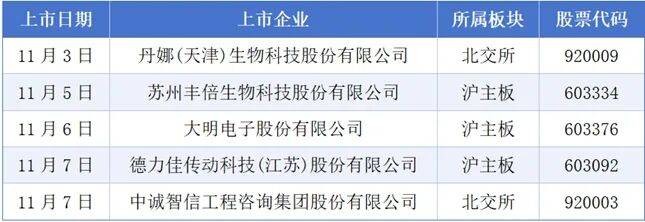
IPO Pipeline Status - As of November 9, there are 276 companies in the IPO pipeline, including 21 on the Shanghai Main Board, 35 on the Sci-Tech Innovation Board, 21 on the Shenzhen Main Board, 26 on the ChiNext, and 173 on the Beijing Stock Exchange [1] Newly Listed Companies - From November 3 to November 9, five companies were newly listed: - Dana (Tianjin) Biotechnology Co., Ltd. on the Beijing Stock Exchange with a closing price of 102.10 CNY per share, a rise of 497.08%, and a trading volume of 6.65 billion CNY [3] - Suzhou Fengbei Biotechnology Co., Ltd. on the Shanghai Main Board with a closing price of 66.76 CNY per share, a rise of 172.60%, and a trading volume of 16.50 billion CNY [3] - Daming Electronics Co., Ltd. on the Shanghai Main Board with a closing price of 64.45 CNY per share, a rise of 413.55%, and a trading volume of 16.94 billion CNY [4] - Delijia Transmission Technology (Jiangsu) Co., Ltd. on the Shanghai Main Board with a closing price of 70.52 CNY per share, a rise of 51.07%, and a trading volume of 18.50 billion CNY [5] - Zhongcheng Zhixin Engineering Consulting Group Co., Ltd. on the Beijing Stock Exchange with a closing price of 38.54 CNY per share, a rise of 170.08%, and a trading volume of 4.62 billion CNY [6] New Counseling Record Companies - During the same period, 10 companies were added to the counseling record, including: - Hangzhong Tianqi (Chongqing) Microelectronics Co., Ltd., focusing on communication and intelligent terminal chips [7] - Anwen Technology Group Co., Ltd., specializing in automotive cabin safety and comfort components [9] - Duality Biotherapeutics, Inc., a clinical-stage innovative biopharmaceutical company [9] - Wuhan Jiachen Electronics Technology Co., Ltd., engaged in high-voltage safety systems for new energy vehicles [9] - Guangdong Jingyi Furniture Co., Ltd., focusing on office seating solutions [9] - Inner Mongolia Dongyuan Environmental Protection Technology Co., Ltd., involved in wastewater treatment [9] - Ningbo Jinlai Chemical Co., Ltd., a chemical product manufacturer [9] - Shenzhen Zhongji Automation Co., Ltd., specializing in lithium battery automation production equipment [10] - Huanuo Star Technology Co., Ltd., engaged in radar and intelligent robotics research [10] - Anhui Xinyuan Technology Co., Ltd., focusing on fine chemicals [10] Companies Approved for Review - Five companies successfully passed the review process from November 3 to November 9: - Shandong Qilong Marine Oil Steel Pipe Co., Ltd., involved in marine drilling riser development [12] - Chongqing Zhixin Industrial Co., Ltd., specializing in automotive welding parts [12] - Shaanxi Tourism Culture Industry Co., Ltd., offering tourism-related services [12] - Zhejiang Haiseng Medical Devices Co., Ltd., providing anesthesia and monitoring medical devices [12] - Hebei Guoliang New Materials Co., Ltd., focusing on high-temperature industrial refractory materials [12] Companies Registered Successfully - Two companies received registration approval during the period: - Ningbo Jianxin Superconducting Technology Co., Ltd., involved in MRI equipment core components [15] - Inner Mongolia Shuangxin Environmental Protection Materials Co., Ltd., focusing on PVA and specialty fibers [15] Companies Terminated IPO Review - Two companies withdrew their IPO applications: - Fujian Haichuang Optoelectronic Technology Co., Ltd., specializing in laser technology [16] - Shandong Canon Technology Co., Ltd., focusing on energy-saving and environmental protection technologies [17]