净息差

Search documents
13家银行个人存款同比增11.9万亿
第一财经· 2025-09-01 00:46
2025.09. 01 第一财经还注意到,上半年存款定期化趋势依然存在。但业内认为,随着存款利率持续走低,加上定 存集中到期重定价,银行负债端成本有望较大幅度改善。Choice数据显示,今年上半年,上述13家 银行的存款平均成本率为1.61%,较2024年上半年下降34BP(基点)。 尽管如此,多数银行净息差仍存在压力。根据国家金融监督管理总局数据,2025年第二季度商业银 行净息差环比继续收窄,已降至1.42%。近期中期业绩发布会上,多家大行提及,主要是受LPR(贷 款市场报价利率)下调、存量房贷利率调整等因素影响。 银行存款是否"分流"? 中国银河证券研究院在研报中表示,存款搬家是居民将银行存款转移到其他资产的过程,因此一要看 到存款下降,二要看到存款流向其他资产。 今年上半年,国内大行的存款是否出现下降?在财报中,并未有明显信号。 本文字数:3300,阅读时长大约5.5分钟 作者 | 第一财经 王方然 近期存款"搬家"声浪渐起,多份券商研报称,居民存款正持续向基金、理财等资管产品转移。 从最新财报来看,今年上半年,大行负债端仍"按兵不动",13家主要商业银行个人存款余额合计为 112.07万亿元,同比增 ...








国有六大行上半年业绩出炉:合计日赚超37亿 不良贷款齐升
Xin Lang Cai Jing· 2025-09-01 00:15
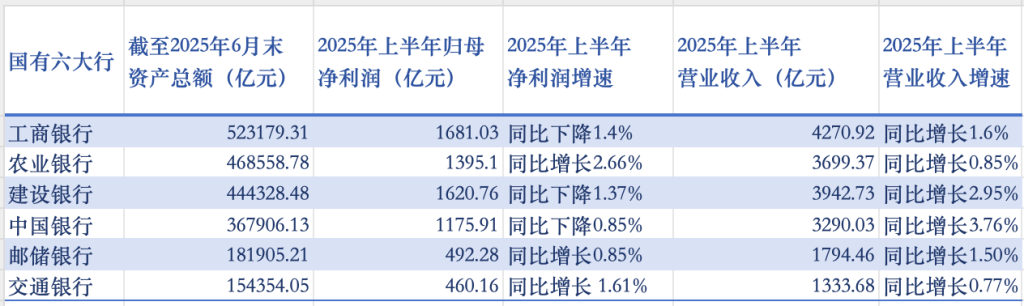
Core Insights - The six major state-owned banks in China reported a total net profit of 682.524 billion yuan for the first half of 2025, with a daily profit of 3.77 billion yuan [1] - All six banks experienced revenue growth in the first half of 2025, contrasting with two banks that saw revenue declines in 2024 [1] Financial Performance - In the first half of 2025, three of the six major banks reported a year-on-year decline in net profit, while all banks saw a recovery in operating income [3][5] - The net profit figures for the major banks are as follows: Industrial and Commercial Bank of China (ICBC) 168.103 billion yuan (down 1.4%), Agricultural Bank of China (ABC) 139.51 billion yuan (up 2.66%), China Construction Bank (CCB) 162.076 billion yuan (down 1.37%), Bank of China (BOC) 117.591 billion yuan (down 0.85%), Postal Savings Bank of China (PSBC) 49.228 billion yuan (up 0.85%), and Bank of Communications (BoCom) 46.016 billion yuan (up 1.61%) [4][5] Asset Quality - The non-performing loan (NPL) balance for the six major banks collectively increased in the first half of 2025, with the exception of PSBC, while the NPL ratios for five banks slightly decreased [2][6] - As of June 2025, the NPL ratios for the banks were as follows: ICBC 1.33% (down 0.01 percentage points), CCB 1.33% (down 0.01 percentage points), ABC 1.28% (down 0.02 percentage points), BOC 1.24% (down 0.01 percentage points), PSBC 0.92% (up 0.02 percentage points), and BoCom 1.28% (down 0.03 percentage points) [7][8] Net Interest Margin - The net interest margin for the six major banks continued to face pressure in the first half of 2025 due to factors such as the reduction in loan market quotation rates (LPR) and changes in deposit structures [9] - ICBC reported an annualized net interest margin of 1.16%, down 8 basis points year-on-year, while ABC's net interest yield was 1.32%, down 13 basis points [10][11] - PSBC had the highest net interest yield at 1.70%, but it also experienced the largest decline of 21 basis points [12] Management Outlook - Executives from the major banks provided insights on the future trajectory of net interest margins, with expectations of continued downward pressure but a potential stabilization in the latter half of the year [15][16][17]

中国银行上半年营收3294亿元 行长张辉:将持续改善资产负债结构,加大非利息收入拓展力度
Mei Ri Jing Ji Xin Wen· 2025-08-31 07:53
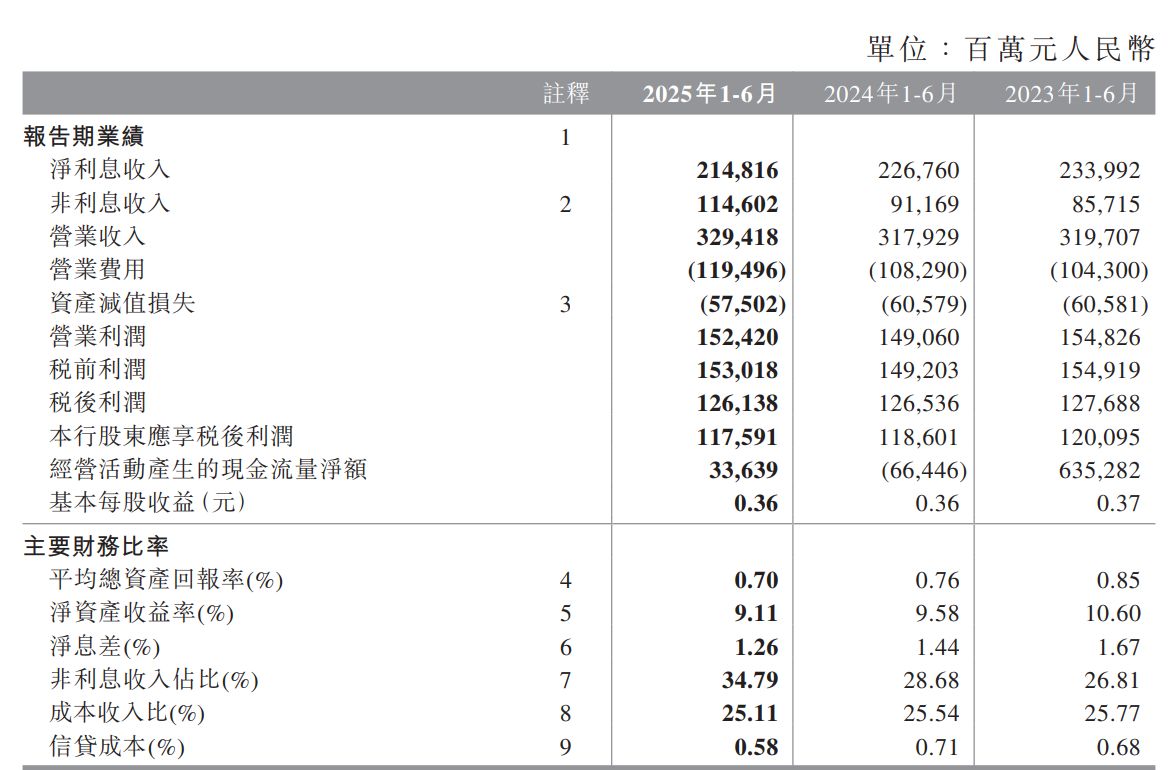
Core Viewpoint - China Bank reported a stable performance in the first half of 2025, with a year-on-year revenue growth of 3.61% and a net profit of 126.1 billion yuan, indicating a positive trend compared to the first quarter [1][3]. Financial Performance - The group achieved an operating income of 329.4 billion yuan, with net interest income of 214.8 billion yuan and non-interest income of 114.6 billion yuan [3][4]. - The net profit attributable to shareholders was 117.6 billion yuan, showing stability compared to the previous year [1][3]. - Key financial ratios included a net interest margin of 1.26%, return on assets (ROA) of 0.70%, and return on equity (ROE) of 9.11% [1][3]. Non-Interest Income Growth - Non-interest income accounted for over 30% of total operating income, with net fee income reaching 46.8 billion yuan, reflecting a 9.17% increase [4][5]. - The bank's strategy focuses on enhancing non-interest income through wealth management and customer service, with significant growth in fund distribution fees and insurance services [4][5]. Strategic Focus - The bank aims to optimize its asset-liability structure and expand non-interest income in response to the low interest rate environment [4][6]. - Emphasis is placed on customer and account expansion, with a 5.8% increase in domestic settlement fees and a 25.3% rise in bond underwriting fees [5][6]. Market Conditions and Outlook - The bank faces challenges from a low interest rate environment, with expectations of continued pressure on net interest margins due to external market conditions [7][8]. - Strategies include enhancing loan management, optimizing product structures, and increasing foreign currency bond investments to improve asset yield [8][9].
北京银行(601169):扩表速度提升,业绩增速改善
EBSCN· 2025-08-31 07:40
Investment Rating - The report maintains a "Buy" rating for Beijing Bank (601169.SH) with a current price of 6.00 CNY [1] Core Views - Beijing Bank's performance improved in the first half of 2025, with operating income reaching 36.22 billion CNY, a year-on-year increase of 1%, and net profit attributable to shareholders of 15.05 billion CNY, up 1.1% year-on-year [3][4] - The bank's return on equity (ROE) was 10.64%, a decrease of 0.61 percentage points year-on-year [3] Financial Performance Summary - Revenue and net profit growth improved compared to Q1, with revenue growth of 1% and net profit growth of 1.1%, up 4.2 and 3.6 percentage points respectively from Q1 [4] - Net interest income grew by 1.2%, with a 2.6 percentage point increase from Q1, while non-interest income increased by 0.5%, up 8.3 percentage points from Q1 [4] - Non-interest income accounted for 28.6% of total income, remaining stable compared to the same period last year [4] Asset and Loan Growth - Interest-earning assets and loans grew by 22.2% and 10.3% year-on-year respectively, with interest-earning asset growth increasing by 6.9 percentage points from Q1 [5] - The bank's loan structure showed a significant focus on corporate loans, with new corporate loans amounting to 153 billion CNY, an increase of 23.6 billion CNY year-on-year [6] Deposit and Liability Management - As of the end of Q2, interest-bearing liabilities and deposits grew by 21.6% and 13.3% year-on-year, with a notable increase in interest-bearing liabilities of 488.5 billion CNY in the first half [7] - The bank's net interest margin was reported at 1.31%, narrowing by 16 basis points compared to 2024 [8] Non-Interest Income and Fee Growth - Non-interest income increased by 0.5% to 10.37 billion CNY, with net fee and commission income rising by 20.4% to 2.51 billion CNY [8] - Investment income contributed significantly to non-interest income, amounting to 7.58 billion CNY, a year-on-year increase of 4.2% [8] Asset Quality and Risk Management - The non-performing loan (NPL) ratio remained stable at 1.3%, with a decrease of 1 basis point year-to-date [9] - The bank's provision coverage ratio was 195.7%, down 2.3 percentage points from Q1 [9] Profit Forecast and Valuation - The report forecasts earnings per share (EPS) for 2025-2027 at 1.28, 1.33, and 1.38 CNY respectively, with the current stock price corresponding to price-to-book (PB) ratios of 0.44, 0.41, and 0.38 [10][11]

农行半年答卷“稳”字当头,经营基石筑牢“信心”底气
Shang Hai Zheng Quan Bao· 2025-08-31 07:13
Core Viewpoint - Agricultural Bank of China (ABC) has demonstrated steady financial performance and asset quality improvement in the first half of 2025, with a focus on supporting the rural economy and maintaining stable growth despite industry challenges [2][5][11]. Financial Performance - In the first half of 2025, ABC achieved a net profit of 139.9 billion yuan, a year-on-year increase of 2.53%, and operating income of 369.8 billion yuan, up 0.72% year-on-year [5]. - The growth rates for net profit and operating income improved compared to the first quarter, with increases of 0.7 and 0.4 percentage points, respectively [5]. Asset Quality - As of June 2025, ABC's non-performing loan (NPL) ratio was 1.28%, a decrease of 0.02 percentage points from the beginning of the year, while the overdue rate stood at 1.22%, the lowest among state-owned banks [11][12]. - The bank's provision coverage ratio was 295%, with a provision balance exceeding 1 trillion yuan [11]. Business Development - ABC's county-level loans grew by 9.3% in the first half of 2025, surpassing the overall bank growth rate by 2 percentage points, with a total loan balance of 10.77 trillion yuan [8][9]. - The bank's "Huinong e-loan" product reached a balance of 1.79 trillion yuan, growing at a rate of 19.9% [9]. Strategic Focus - ABC aims to balance scale, pricing, risk, and efficiency in its operations, with a focus on enhancing revenue and maintaining asset quality [6][12]. - The bank is committed to supporting the rural economy and leveraging national policies to drive growth in rural financing [9][10].
现场直击!净息差走势、贴息政策、风险管控……建行管理层回应关切
Zhong Guo Zheng Quan Bao· 2025-08-31 05:53
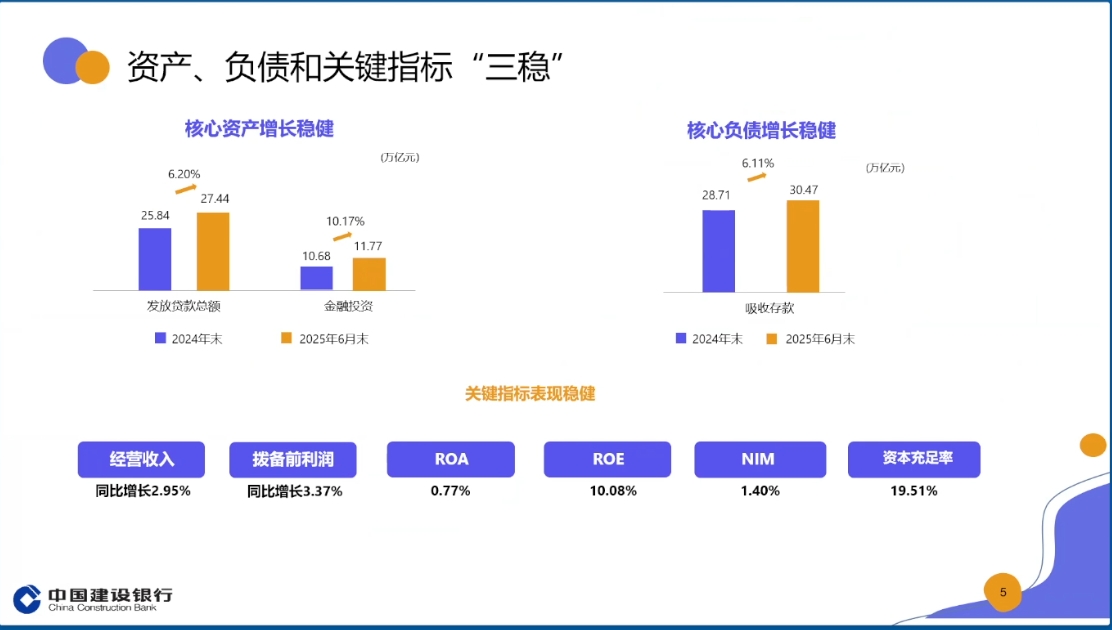
Core Viewpoint - Construction Bank's key operating indicators stabilized and improved in the first half of 2025, with a slight increase in operating income but a decrease in net profit [2] Group 1: Financial Performance - In the first half of 2025, Construction Bank achieved operating income of 394.273 billion yuan, a year-on-year increase of 2.15% [2] - The net profit attributable to shareholders was 162.076 billion yuan, a year-on-year decrease of 1.37% [2] - The bank has distributed over 1.3 trillion yuan in dividends since its listing and plans to maintain a 30% dividend payout ratio for the mid-year distribution in 2025 [2] Group 2: Loan Allocation - Construction Bank's loan growth was steady and balanced, with significant advantages in the retail loan market, including personal housing loans, personal consumption loans, and credit card loans [4] - As of the end of June, the bank's technology loan balance was 5.15 trillion yuan, up 16.81% from the end of the previous year; strategic emerging industry loans were 3.39 trillion yuan; green loans were 5.72 trillion yuan, up 14.88%; and digital economy core industry loans were 852.377 billion yuan, up 13.44% [4] - The bank actively supported national key regional strategies, with rapid loan growth in key areas such as Beijing-Tianjin-Hebei, the Yangtze River Delta, the Guangdong-Hong Kong-Macao Greater Bay Area, and Chengdu-Chongqing [4] Group 3: Interest Margin Outlook - The bank's CFO noted a 45 basis point decline in asset yield due to the impact of last year's LPR reduction and this year's interest rate cuts [8] - The deposit interest rate decreased by 32 basis points, and the overall liability interest rate fell by 34 basis points [8] - The bank expects the decline in net interest margin to gradually narrow due to the lagging effects of interest rate adjustments [8] Group 4: Risk Management - As of June 2025, the non-performing loan ratio was 1.33%, a decrease of 0.01 percentage points from the end of the previous year, while the ratio of special mention loans was 1.81%, down 0.08 percentage points [10] - The bank's provision coverage ratio improved to 239.40%, up 5.8 percentage points from the end of the previous year, indicating strong risk mitigation capabilities [10] - The bank is focused on managing risks in the real estate sector while ensuring reasonable financing needs are met [10]
中国银行(601988):营收增速提升,资本实力增强
EBSCN· 2025-08-31 03:40
Investment Rating - The report maintains an "Accumulate" rating for the company [1] Core Views - The company has shown an improvement in revenue growth and capital strength, with a reported operating income of 329 billion and a year-on-year growth of 3.8% for the first half of 2025 [2][3] - The net profit attributable to the parent company is 117.6 billion, reflecting a slight decline of 0.9% year-on-year, but the decline has narrowed compared to the first quarter [3] - The weighted average return on equity (ROE) stands at 9.11%, down by 0.47 percentage points year-on-year [2] Summary by Sections Revenue and Profitability - The company's revenue and pre-provision operating profit (PPOP) growth rates for the first half of the year are 3.8% and 0.4%, respectively, showing an improvement from the first quarter [3] - Non-interest income has significantly increased by 26.4%, contributing to 34.7% of total revenue, which is a 6.2 percentage point increase from the previous year [3][7] Asset and Loan Growth - As of the end of the second quarter, the company's interest-earning assets and loans have grown by 8.7% and 9.1% year-on-year, respectively, with a notable increase in loan issuance in key sectors [3][4] - The company has focused on lending to strategic emerging industries, private enterprises, and green loans, with significant growth rates in these areas [4] Liability and Deposit Growth - The growth rate of interest-bearing liabilities has improved, with retail and corporate deposits increasing by 8.4% and 8.2% year-on-year, respectively [5] - The proportion of deposits to interest-bearing liabilities is 78.6%, slightly down from the previous quarter [5] Interest Margin and Non-Interest Income - The net interest margin is reported at 1.26%, a decrease of 3 basis points from the first quarter, but the company expects resilience in the margin due to effective cost control [6] - Non-interest income has shown robust growth, with significant contributions from fees, commissions, and other non-interest revenues [7] Asset Quality and Capital Adequacy - The non-performing loan (NPL) ratio has decreased to 1.24%, indicating improved asset quality [8] - The company has successfully completed a capital increase of 165 billion, enhancing its capital adequacy ratios significantly [8] Earnings Forecast and Valuation - The earnings per share (EPS) forecast for 2025-2027 is set at 0.76, 0.79, and 0.81 yuan, respectively, with the current stock price corresponding to a price-to-book (PB) ratio of 0.68, 0.63, and 0.59 [9][10]
邮储银行(601658):非息收入贡献增强,营收盈利增速双升
EBSCN· 2025-08-31 03:40
Investment Rating - The report maintains a "Buy" rating for both A-shares and H-shares of Postal Savings Bank, with current prices at 6.04 CNY and 5.41 HKD respectively [1]. Core Insights - The report highlights an increase in non-interest income contribution, with total revenue and net profit growth observed in the first half of 2025. Total revenue reached 179.4 billion CNY, a year-on-year increase of 1.5%, while net profit attributable to shareholders was 49.2 billion CNY, up 0.9% year-on-year [3][4]. Revenue and Profitability - Revenue growth improved sequentially, with non-interest income's share rising to 22.5%. The year-on-year growth rates for revenue, pre-provision operating profit (PPOP), and net profit attributable to shareholders were 1.5%, 14.6%, and 0.9% respectively, showing improvements from the first quarter [4]. - Interest income decreased by 2.7% year-on-year, while non-interest income grew by 19.1%, indicating a shift towards more diversified income sources [4][9]. Loan and Asset Management - As of the end of Q2, the bank's interest-earning assets and loans grew by 10.7% and 10.1% year-on-year, respectively, with a notable increase in loan issuance [5]. - The loan structure showed significant growth in corporate loans, particularly in sectors like water conservancy and public facilities, which accounted for 19.1% of the total increase [6]. Liability and Deposit Management - The growth rate of interest-bearing liabilities increased to 10.6%, with total deposits growing by 8.4% year-on-year. The bank has optimized its deposit management strategy to enhance low-cost funding [7]. Interest Margin and Cost Management - The net interest margin slightly narrowed to 1.7%, with asset yields declining due to lower interest rates on new loans and existing loan repricing [8]. - The bank's proactive cost management strategies have led to a reduction in funding costs, benefiting from lower deposit rates [8]. Non-Interest Income Growth - Non-interest income saw a substantial increase of 19.1% year-on-year, driven by growth in fees and commissions as well as other non-interest income sources [9]. Asset Quality - The non-performing loan (NPL) ratio remained low at 0.92%, with a slight increase from the previous quarter. The bank's asset quality indicators, including the NPL generation rate, showed stability [10][29]. Capital Adequacy - The bank successfully completed a 130 billion CNY A-share placement, enhancing its capital base. As of Q2, the core Tier 1 capital adequacy ratio improved to 10.52% [11]. Earnings Forecast and Valuation - The report maintains earnings per share (EPS) forecasts for 2025-2027 at 0.74, 0.75, and 0.78 CNY, with corresponding price-to-book (PB) ratios for A-shares at 0.79, 0.74, and 0.70 [12][33].
建行业绩会剧透下半年关键信息:息差、活期存款、房贷表现
Di Yi Cai Jing· 2025-08-30 15:39
Core Viewpoint - Construction Bank's mid-year performance shows positive growth in both operating income and pre-provision profit, driven by strategic measures to enhance financial supply and risk management [1][5]. Group 1: Financial Performance - Non-interest income reached 107.56 billion yuan, an increase of 17.66 billion yuan, or 19.64%, year-on-year, accounting for 27.28% of total operating income [5]. - The net interest margin for the first half was 1.40%, down 0.14 percentage points from the same period last year, with expectations for a gradual narrowing of the decline in future quarters [3]. - Average annual cost rate of deposits decreased by 32 basis points compared to the same period last year, indicating effective cost management [3]. Group 2: Strategic Measures - The bank implemented four key measures: enhancing balanced development capabilities, accelerating the cultivation of new growth drivers, improving comprehensive cost management, and solidifying risk control foundations [1]. - The bank is focusing on optimizing asset allocation by controlling low-yield assets and increasing investments in higher-yield loans and bonds [3]. Group 3: Loan Growth and Market Strategy - The introduction of personal consumption loan interest subsidy policies is expected to lower borrowing costs and stimulate growth in personal and service industry loans [4]. - Infrastructure-related loans grew faster than the average for corporate loans, with a 0.23 percentage point increase year-on-year, supported by national key projects and special bond usage [4]. - The bank's second-hand housing loan issuance ranked first in the industry, with a year-on-year increase of over 20%, contributing significantly to overall loan growth [6].
六大行半年赚6825亿,分红超2000亿
2 1 Shi Ji Jing Ji Bao Dao· 2025-08-30 14:16
Core Viewpoint - The six major banks reported a total operating income of 1.81 trillion yuan for the first half of 2025, reflecting a year-on-year growth of 2.05%, while the net profit attributable to shareholders decreased by 0.13% to 682.52 billion yuan [1][3]. Financial Performance - All six banks achieved positive growth in operating income, but net profit showed a mixed trend with three banks experiencing declines [1][3]. - The operating income of the six banks was 1.81 trillion yuan, with a year-on-year increase of 2.05%, while the net profit totaled 682.52 billion yuan, down 0.13% from the previous year [3][6]. - China Bank led in revenue growth with an increase of 3.76%, reaching 329 billion yuan, driven by a significant rise of 26.43% in non-interest income [3][6]. Revenue Structure - The revenue structure of the six banks has shifted, with non-interest income increasing its share [3][6]. - The non-interest income of China Bank reached 114.19 billion yuan, accounting for 34.71% of total revenue, up 6.23 percentage points year-on-year [3][6]. Profitability - Industrial and Commercial Bank of China (ICBC) reported a net profit of 168.10 billion yuan, a decrease of 1.40%, while Agricultural Bank of China saw a profit increase of 2.66% to 139.51 billion yuan [6][7]. - The net profit of the six banks showed a decline for ICBC, China Construction Bank, and China Bank, while Agricultural Bank, Postal Savings Bank, and Bank of Communications reported slight increases [6][7]. Asset Quality - The asset quality of the six banks remained stable, with non-performing loan ratios at low levels [16][17]. - Postal Savings Bank had the lowest non-performing loan ratio at 0.92%, despite a slight increase [17]. Net Interest Margin - The net interest margin for the six banks decreased, with Postal Savings Bank at 1.70%, down 21 basis points year-on-year [19][20]. - The net interest margin for China Bank was 1.26%, reflecting an 18 basis point decline, attributed to factors such as the continuous decline in LPR and adjustments in mortgage rates [19][20].