稳定币

Search documents
小商品城(600415):业绩表现持续稳健向好 六区市场开业贡献增量
Xin Lang Cai Jing· 2025-11-19 08:27
Group 1 - The core viewpoint of the articles highlights the company's robust performance in the market, driven by the opening of six new districts and the rapid growth of its payment and trade services, with expectations for continued strong catalysts from AI+, the Belt and Road Initiative, and stablecoins [1][2] Group 2 - In Q3 2025, the company reported a revenue increase of 39% and a net profit increase of 101% year-on-year, exceeding expectations, primarily due to the launch of the global digital trade center in June [1] - The net cash flow from operating activities in Q3 reached 8.22 billion yuan, significantly higher than 340 million yuan in the same period last year and 1.66 billion yuan in Q2 2025, attributed to the collection of rental and sales payments [1] - The cross-border payment transaction volume of the company's payment service exceeded 27 billion yuan in the first three quarters, reflecting a year-on-year growth of 35% [1] Group 3 - The six district market officially opened on October 14, transitioning from traditional trade to a digital trade ecosystem, with over 35% of merchants coming from outside the province and 52% being new-generation merchants [2] - The market features a youthful, branded, and international character, with 57% of merchants owning independent brands or operating IP products [2] Group 4 - The company is expected to benefit from a stable rental business and high growth in trade services, with an upward revision of net profit forecasts for 2025 and 2026 to 4.6 billion yuan and 6.2 billion yuan, respectively [2] - The current stock price corresponds to a PE ratio of 19x for 2025 and 14x for 2026, indicating strong earnings certainty and flexibility [2]

ETF午评 | A股冲高回落,AI应用下挫,影视ETF、文娱传媒ETF跌2.8%,黄金股ETF涨1.78%,标普油气ETF涨2%,日经225ETF涨1.7%
Sou Hu Cai Jing· 2025-11-19 04:13
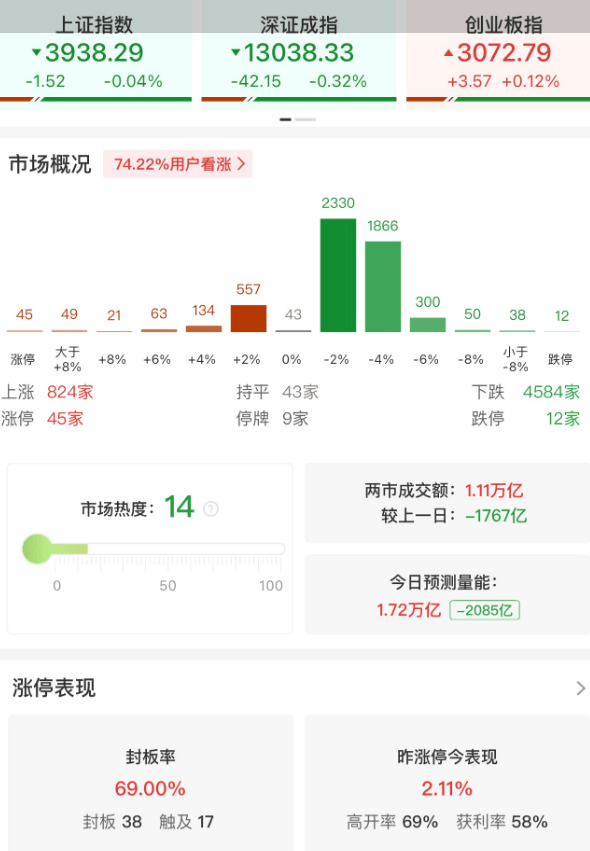
Market Performance - A-shares experienced a mixed performance with the Shanghai Composite Index down 0.04%, Shenzhen Component Index down 0.32%, and the ChiNext Index up 0.12% as of midday [1] - The Northbound 50 Index fell by 1.52%, and the total trading volume in the Shanghai and Shenzhen markets reached 1,115.7 billion yuan, a decrease of 180.4 billion yuan from the previous day [1] - Over 4,500 stocks in the market declined, indicating a broad market weakness [1] Sector Performance - Lithium mining stocks showed repeated activity, while military equipment, CPO, and oil sectors strengthened [1] - Conversely, sectors such as Hainan Free Trade Zone, photovoltaic, AI applications, innovative pharmaceuticals, and stablecoin themes experienced declines [1] - The technology innovation sector saw a downturn, with the Science and Technology Innovation New Energy ETF dropping by 2.83% [4] - The AI application sector also faced setbacks, with entertainment-related ETFs declining by 2.8% [4] ETF Performance - The Nasdaq Biotechnology ETF led gains with a rise of 3.92%, while WTI crude oil for December increased by 1.39% [3] - Both the Harvest Fund S&P Oil & Gas ETF and the Franklin Templeton S&P Oil & Gas ETF rose by 2% [3] - Gold prices rebounded, leading to a 1.78% increase in the fund's gold stock ETF [3] - Japanese stocks rose, with the Huaan Fund Nikkei 225 ETF gaining 1.7% [3]

德意志交易所将法国兴业银行稳定币纳入其业务
Ge Long Hui A P P· 2025-11-19 01:56
Group 1 - The core viewpoint of the article is the partnership between Deutsche Börse, Société Générale, and its crypto division, Societe Generale FORGE, aimed at promoting the use of stablecoins issued by Société Générale based on USD and EUR [1] - Deutsche Börse plans to integrate these stablecoins into its post-trade services subsidiary, Clearstream, with potential future applications for settlement and collateral management [1] - The partnership is expected to enhance the liquidity of the stablecoins through new listings on Deutsche Börse's digital platform [1]


Visa (NYSE:V) FY Conference Transcript
2025-11-18 20:02
Visa (NYSE:V) FY Conference Summary Industry Overview - The conference focused on Visa's proposed settlement regarding long-standing merchant litigation, which has been ongoing for over 20 years [2][3] - The settlement aims to provide merchants with more flexibility and options in payment acceptance [2] Key Points from the Proposed Settlement - **Interchange Reduction**: The proposed settlement lowers the U.S. average combined credit effective interchange rates by 10 basis points and caps credit interchange rates at 125 basis points for five years [3][4] - **Merchant Flexibility**: Merchants will have increased options for surcharging and the ability to choose which card categories to accept [4] - **Merchant Education**: Visa plans to offer education programs to merchants of all sizes to help them manage payment acceptance and costs [4] Financial Performance Insights - Visa reported strong Q4 performance with stable payment volumes and transactions compared to Q3 [16][18] - Discretionary and non-discretionary spending remained stable, with credit and debit transactions both increasing [18][19] - Cross-border volumes showed consistent growth, with 11% growth in both Q3 and Q4 [20] Guidance for FY 2026 - Visa anticipates low double-digit constant currency revenue growth for FY 2026, with operating expenses expected to grow at the same rate [21] - The company is focused on client success and operational efficiency to maintain its industry-leading margin profile [23][29] Investment Priorities - Visa is investing in innovation areas such as stablecoin and agentic commerce, with over 130 card issuance programs for stablecoin across 40 countries [26][27] - The company aims to leverage its sponsorships in major events like the FIFA World Cup and the Olympics to create marketing opportunities and enhance cross-border travel [45][49] Value-Added Services (VAS) Performance - VAS grew 23% in FY 2025, contributing $10.8 billion, which is about 27% of Visa's business [31] - The growth is driven by various portfolios, including Issuing Solutions, Acceptance Solutions, Risk and Security Services, and Advisory Services [38] Commercial Money Movement Insights - Visa Direct transaction growth was robust, up 27% for FY 2025, although it decelerated slightly in Q4 [62] - The commercial volume growth accelerated to 10%, indicating a positive trajectory for Visa's commercial money movement strategy [57][59] Conclusion - Visa remains well-positioned to compete in the evolving payments landscape, with a strong focus on innovation, client relationships, and strategic investments to drive long-term growth [6][29]

数字欧元进入关键阶段,目标是到2027年年中进行试点
Huan Qiu Wang· 2025-11-18 01:08
Core Insights - The European Central Bank's digital euro project has entered a critical phase after years of research, aiming to create an electronic cash version for all eurozone citizens [1] - The project is currently focused on technical aspects, with a pilot expected by mid-2027, contingent on legislative approval in 2026 [1] Group 1 - The project represents a significant qualitative leap, with two years of preparatory work leading to the current stage [1] - The implementation of the digital euro requires consideration of technical development, large-scale testing, and participation from banks, payment service providers, and merchants [2] - Following regulatory approval, the entire operational process may take an additional two to three years to complete [2] Group 2 - The rising importance of stablecoins in the financial system poses risks, as a market run could threaten European financial stability, macroeconomic conditions, and inflation, potentially necessitating intervention from the ECB [2]

【周一美股盘前你需要了解的全球要闻】 白宫经济顾问哈塞特:未来一段时间劳动力市场可能极度平静,美联储是时候真正“以数据为驱动”。 财政扩张担忧引发日本长债猛烈抛售,20年期收益率飙升至1999年来新高。 谷歌盘前一度涨超5%,伯克希尔哈撒韦第三季度买入谷歌母公司Alphabet1785...
Sou Hu Cai Jing· 2025-11-17 14:03
Group 1 - The U.S. labor market is expected to remain extremely quiet in the near term, with the Federal Reserve advised to be truly "data-driven" [1] - Concerns over fiscal expansion have led to a sharp sell-off in Japanese long-term bonds, with the 20-year yield soaring to its highest level since 1999 [1] - Google shares rose over 5% in pre-market trading after Berkshire Hathaway purchased 17.85 million shares of Alphabet in Q3 [1] Group 2 - Alibaba officially announced its "Qianwen" project, aiming to fully enter the AI to C market [1] - SMIC responded to its Q4 guidance, indicating no significant leap due to high memory prices causing clients to adopt a wait-and-see approach, with high price levels expected to persist [1] - Novo Nordisk launched a weight loss drug priced lower than Eli Lilly's offering [1] Group 3 - Luckin Coffee reported a 50% year-over-year increase in Q3 net revenue, while net profit attributable to ordinary shareholders decreased by 2.7%, with average monthly transacting customers surpassing 100 million for the first time [1] - Geely Automobile's Q3 profit grew by 59%, with Zeekr's delivery volume increasing by 13% year-over-year [1] - XPeng's Q3 revenue doubled, with net losses significantly narrowing by nearly 80%, and Q4 delivery and revenue expected to grow over 30% year-over-year [1] Group 4 - Morgan Stanley projected a target price of 7,800 points for the U.S. stock market by the end of 2026 [1]
联储放鹰,金价冲高回落
Mei Ri Jing Ji Xin Wen· 2025-11-17 07:45
Core Viewpoint - The recent fluctuations in gold prices are influenced by various macroeconomic factors, including Federal Reserve officials' hawkish statements, the end of the U.S. government shutdown, and ongoing global uncertainties, which may support gold prices in the medium to long term [1][5][6]. Group 1: Gold Market Dynamics - As of November 14, the London spot gold price closed at $4,082.16 per ounce, with a cumulative increase of $81.87 per ounce since November 7, representing a 2.05% rise [1]. - Gold prices experienced volatility, reaching a high of $4,245.22 and a low of $3,997.20 during the week [1]. - The end of the U.S. government shutdown has reduced the short-term appeal of gold as a safe-haven asset [1][5]. Group 2: Economic Indicators - The U.S. economy shows resilience, with the Atlanta Fed's GDPNow indicating a 4.0% growth rate for Q3, although government shutdowns may affect data accuracy [2]. - Consumer spending remains stable, with a 3.4% annualized growth rate in personal consumption and a slight increase in retail sales [2]. - The employment market shows a slight decrease in initial jobless claims, indicating stability [2]. Group 3: Federal Reserve Policy - Multiple Federal Reserve officials have expressed concerns about inflation, leading to a decrease in interest rate cut expectations for December [3]. - The probability of a rate cut in December has dropped from 70% to below 50%, influenced by internal voting tendencies within the FOMC [3]. - The Fed's decision-making process is shifting towards a more collective approach rather than being dominated by the chair [3]. Group 4: Global Central Bank Gold Purchases - Global central banks continue to show strong demand for gold, with a net purchase of 220 tons in Q3 2025, a 30% increase from the previous quarter [4]. - Brazil and South Korea have made significant gold purchases, with South Korea signaling plans to increase its gold reserves for the first time since 2013 [4]. - China's central bank has also been increasing its gold reserves for twelve consecutive months, reaching 7,409 million ounces by the end of October [4]. Group 5: Long-term Outlook for Gold - In the long term, the demand for gold as a safe asset is expected to rise due to challenges to the U.S. dollar credit system and increasing geopolitical tensions [6][7]. - The trend of "de-dollarization" globally may position gold as a new pricing anchor, potentially enhancing its upward momentum [7]. - The Fed's current easing cycle may be prolonged due to resilient employment and inflation, providing a favorable environment for gold investments [7].
市值蒸发6000亿!信仰动摇、机构观望,比特币 “减半后暴跌”的魔咒应验了?
Hua Er Jie Jian Wen· 2025-11-17 07:29
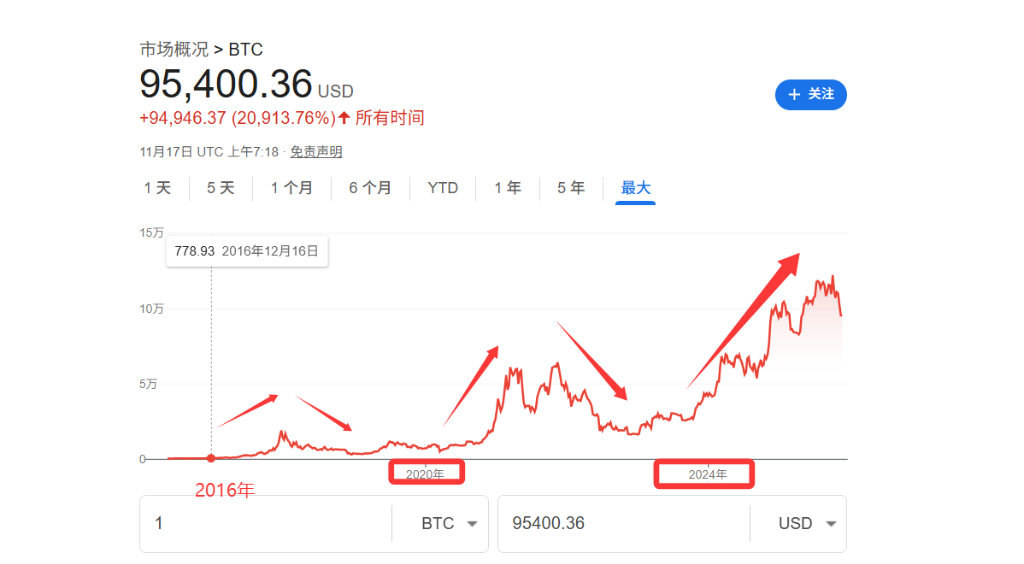
Core Viewpoint - Bitcoin's price has sharply declined after reaching a historical high in October, erasing all gains for 2025 and dropping below $93,714, which is lower than its closing price at the end of 2024, indicating a loss of over 30% in annual gains [1] Group 1: Market Dynamics - Bitcoin's total market capitalization has evaporated by approximately $600 billion compared to its peak in October, leading to a rapid and unexpected market downturn [1] - The current decline is characterized by a swift evaporation of market confidence, occurring in a year that was expected to solidify Bitcoin's legitimacy with the approval of spot ETFs and support from the Trump administration [1] - Market participants are reverting to familiar models, such as the four-year "halving" cycle, which historically leads to speculative booms followed by painful downturns [2] Group 2: Investor Sentiment - Concerns about a potential repeat of the four-year cycle are causing investors to preemptively withdraw from the market to avoid significant losses [4] - The recent downturn reflects market fatigue and disappointment, with retail investors suffering losses while chasing high-priced crypto stocks [5] - Analysts note that Bitcoin's trading behavior is increasingly influenced by macroeconomic factors and liquidity dynamics rather than predictable supply shocks [5] Group 3: Institutional Investment Trends - Institutional inflows into Bitcoin have stagnated, with some long-term holders cashing out, indicating a loss of market premium for holding Bitcoin [6] - The enthusiasm among institutional investors has cooled, as even the most steadfast supporters are no longer receiving market rewards for their holdings [6] Group 4: Competitive Landscape - Bitcoin faces macroeconomic headwinds and competition from emerging speculative assets like AI, stablecoins, and prediction markets, which are gaining traction [8] - Despite a well-functioning market infrastructure, recent price drops have been a significant setback for investors who anticipated Bitcoin reaching $200,000 by year-end [8] - Analysts suggest that the current market dynamics may disrupt traditional cycles, with global liquidity potentially returning following the resolution of the U.S. government shutdown [8]
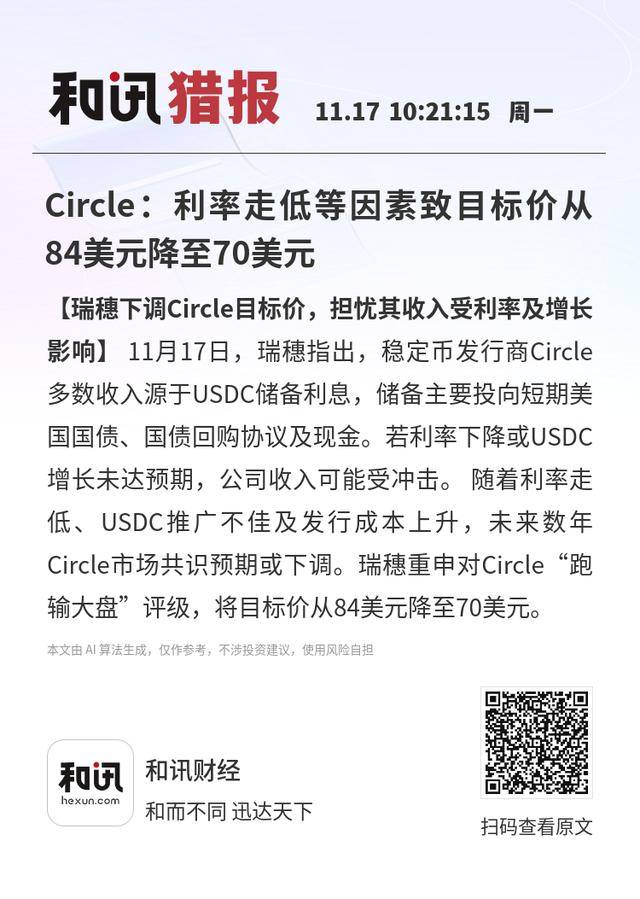
Circle:利率走低等因素致目标价从84美元降至70美元
Sou Hu Cai Jing· 2025-11-17 03:36
Group 1 - The core viewpoint of the article is that Mizuho has downgraded Circle's target price due to concerns over its revenue being affected by interest rates and growth [1] - Circle's majority of revenue comes from interest on USDC reserves, which are primarily invested in short-term U.S. Treasury securities, repurchase agreements, and cash [1] - A decline in interest rates or underperformance in USDC growth could negatively impact the company's revenue [1] Group 2 - Mizuho has reiterated a "underperform" rating for Circle, lowering the target price from $84 to $70 [1] - The future consensus expectations for Circle's market may be adjusted downward due to lower interest rates, poor USDC promotion, and rising issuance costs [1]
新书| 杜雨博士新书《稳定币》正式出版
未可知人工智能研究院· 2025-11-17 03:02
Core Viewpoint - Stablecoins are redefining the future of currency and are becoming essential components of the digital economy, bridging traditional finance and the crypto world [2][19]. Group 1: Understanding Stablecoins - Stablecoins emerged to address the volatility of cryptocurrencies, providing a stable medium of exchange and a unit of account [12][16]. - Different types of stablecoins exist, including collateralized and algorithmic stablecoins, each serving unique functions within the financial ecosystem [12][16]. Group 2: Historical Context - The introduction of Bitcoin in 2008 marked the beginning of decentralized value transfer, but its volatility limited practical use [6][9]. - Ethereum's launch in 2015 introduced smart contracts, enabling a programmable economy and leading to the rise of DeFi and NFTs, while highlighting the need for stability in the crypto market [11][12]. Group 3: The Rise of Real World Assets (RWA) - The integration of traditional assets like U.S. Treasury bonds and real estate into the crypto space through tokenization has provided stablecoins with diverse collateral options [14][15]. - Major stablecoins like USDC and USDT are now investing in short-term U.S. Treasury bonds, evolving into "yield-bearing stablecoins" [14][15]. Group 4: Current Role of Stablecoins - Stablecoins have evolved into critical infrastructure for the digital economy, facilitating transactions, providing liquidity for DeFi, and serving as a bridge between fiat and crypto [16][19]. - They are also promoting financial inclusion, particularly in cross-border payments and as tools against inflation in emerging markets [16][19]. Group 5: Challenges Ahead - Stablecoins face technical risks, including vulnerabilities in smart contracts and oracle systems, which could undermine their stability [18]. - Economic risks arise from the potential devaluation of collateral backing stablecoins, leading to trust issues and market instability [18]. - Regulatory challenges are significant, with varying global policies creating uncertainty for stablecoin issuers and users [18].