
5G

Search documents
IPO研究 | 全球导热界面材料市场销售额预计到2031年将增至41.48亿美元
Sou Hu Cai Jing· 2025-12-30 01:38
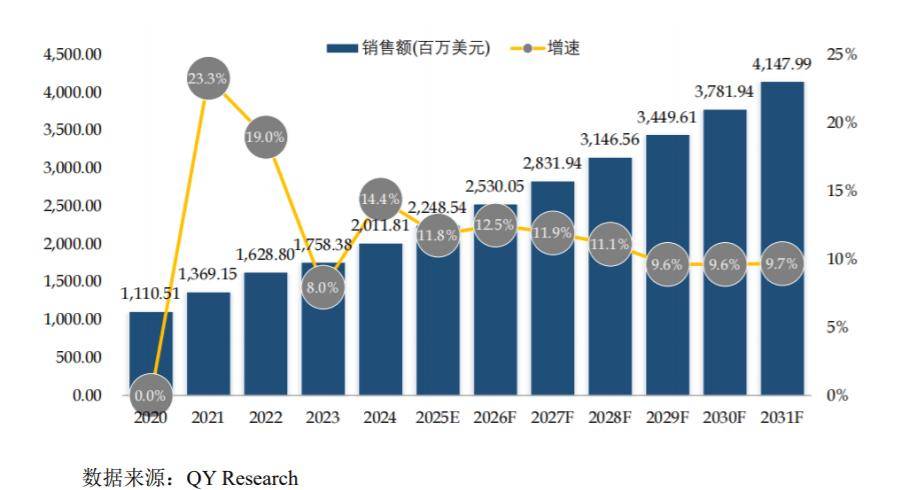
Group 1 - Shenzhen Hongfucheng New Materials Co., Ltd. has received approval for its IPO on the ChiNext board, with Huayuan Securities as the sponsor [1] - Established in 2003, the company focuses on the R&D and industrialization of advanced electronic functional materials and devices, particularly in thermal management, electromagnetic shielding, and wave absorption [1] - The company's products are widely used in data centers (AI high-power chips, optical modules), smart vehicles, 5G communications, and consumer electronics [1] Group 2 - The global market for thermal interface materials (TIM) is projected to reach $2.012 billion in sales by 2024, with an expected growth to $4.148 billion by 2031, reflecting a compound annual growth rate (CAGR) of 10.74% from 2025 to 2031 [1] - In the domestic market, the thermal interface materials market in China is expected to reach $1.027 billion in 2024 and grow to $2.164 billion by 2031, with a CAGR of 11.09% [2] - The demand for electronic device cooling is anticipated to increase due to the "AI+" wave, particularly in data centers, ADAS, consumer electronics, and electric vehicles [5]

数智服务改变城市清洁模式——盈峰环境聚力智能环卫装备生产
Jing Ji Ri Bao· 2025-12-29 22:01
Core Insights - The company, Yingfeng Environmental Technology Group, has developed intelligent cleaning robots that can autonomously perform over 20 core tasks, winning 7 awards at the 2025 Shenzhen International AI Sanitation Robot Competition [2] - The sanitation industry is evolving from a perception of being "dirty and chaotic" to a model characterized by "intelligence, cleanliness, and beauty," driven by technologies such as 5G, AI, and IoT [2] Group 1: Intelligent Cleaning Solutions - The "Little Bee" robot operates without human intervention, efficiently completing cleaning tasks that previously required multiple workers and hours of labor [3] - The "Bee Cluster" system, which includes various models of cleaning robots, has been implemented in over 60 cities across more than 20 provinces in China, addressing challenges like rising labor costs and insufficient management [4] - The "Bee Nest" smart central platform enables coordinated operations among multiple AI devices, enhancing urban service capabilities [5] Group 2: Snow Removal Equipment - The "Snow Dragon" series of snow removal equipment has been deployed in over 20 provinces, effectively managing severe winter weather conditions [7] - The equipment features advanced materials and design, improving efficiency by clearing 5 more kilometers of snow per hour compared to traditional models [8] - A smart cloud platform allows for real-time monitoring and adjustment of snow removal operations, enhancing response times and service quality [9] Group 3: Focus on Carbon Neutrality - Yingfeng Environmental is committed to developing new energy sanitation vehicles, having launched the first pure electric street sweeper in China in 2008 [10] - The company has achieved significant advancements in noise reduction technology for its cleaning vehicles, aiming for a noise level of 74 decibels [11] - From January to November of this year, the company sold 3,865 units of new energy sanitation equipment, with products being exported to Southeast Asia, Central Asia, and Europe [12]

ASML: Positive 2026 Outlook Despite China Weakness
Seeking Alpha· 2025-12-29 12:07
Core Insights - Khaveen Investments is a global investment advisory firm focused on serving high-net-worth individuals, corporations, associations, and institutions [1] - The firm is a registered investment adviser with the SEC and offers a range of services including market and security research, business valuation, and wealth management [1] - The flagship Macroquantamental Hedge Fund maintains a diversified portfolio across various asset classes, geographies, sectors, and industries [1] - The investment approach integrates top-down and bottom-up analysis, utilizing three core strategies: global macro, fundamental, and quantitative [1] - The firm's expertise is concentrated in disruptive technologies such as Artificial Intelligence, Cloud Computing, 5G, Autonomous and Electric Vehicles, FinTech, Augmented and Virtual Reality, and the Internet of Things (IoT) [1]

抓牢“新基建”风口 长盈精密上半年净利同比增长逾九成
Zheng Quan Ri Bao· 2025-12-29 07:10
Core Viewpoint - Changying Precision plans to raise up to 1.9 billion yuan through a private placement to support its strategic transformation and fund new product lines, focusing on the electric vehicle and 5G sectors [1] Group 1: Fundraising and Project Allocation - The company intends to allocate 900 million yuan to the electric vehicle components project and 1 billion yuan to the 5G smart terminal module project [1] - The initial plan for the 5G project was to raise 1.4 billion yuan, which has now been reduced to 1 billion yuan, while a previously planned 600 million yuan for working capital has been canceled [1][2] - The electric vehicle project will focus on the construction of high and low voltage connectors, battery structure components, and hydrogen fuel cell bipolar plates, with an estimated construction period of 18 months [1] Group 2: Market Position and Growth Potential - Changying Precision has become a key supplier of electric vehicle components for Tesla since 2017, with the upcoming Tesla Gigafactory (Phase II) expected to significantly boost market demand for these components [2] - The company aims to enhance its supply chain responsiveness and customer service capabilities through the new projects, which align with its strategic focus on electric vehicles and 5G [2] - The company has seen a 31.42% year-on-year increase in revenue from Tesla during the first half of the year [3] Group 3: Financial Performance - In the first half of the year, Changying Precision reported a revenue of 4.006 billion yuan, a year-on-year increase of 1.20%, and a net profit of 229 million yuan, up 91.10% [3] - The company has successfully adjusted its customer and product structures, leading to significant growth, with non-mobile business revenue exceeding 50% of total revenue during the reporting period [3][4] - The establishment of Shanghai Lingang Changying New Energy Technology Co., Ltd. marks a significant step in the company's industrial layout in the East China region for electric vehicles [3]

中恒电气跌2.01%,成交额5.67亿元,主力资金净流出3895.09万元
Xin Lang Zheng Quan· 2025-12-29 06:36
12月29日,中恒电气(维权)盘中下跌2.01%,截至14:25,报26.38元/股,成交5.67亿元,换手率 3.81%,总市值148.67亿元。 资金流向方面,主力资金净流出3895.09万元,特大单买入2857.76万元,占比5.04%,卖出4109.15万 元,占比7.25%;大单买入8333.06万元,占比14.70%,卖出1.10亿元,占比19.37%。 中恒电气今年以来股价涨146.77%,近5个交易日涨7.02%,近20日涨11.21%,近60日跌10.79%。 今年以来中恒电气已经20次登上龙虎榜,最近一次登上龙虎榜为11月10日,当日龙虎榜净买入-2198.36 万元;买入总计1.51亿元 ,占总成交额比9.76%;卖出总计1.73亿元 ,占总成交额比11.17%。 资料显示,杭州中恒电气股份有限公司位于浙江省杭州市高新区之江科技工业园东信大道69号,成立日 期2001年7月11日,上市日期2010年3月5日,公司主营业务涉及高频开关电源系统的研发、生产、销售 和服务,主要产品为通信电源系统、电力操作电源系统。主营业务收入构成为:数据中心电源45.66%, 电力操作电源系统19.60%,通 ...

长飞光纤跌2.02%,成交额9.13亿元,主力资金净流出8598.60万元
Xin Lang Cai Jing· 2025-12-29 05:40
Core Viewpoint - Changfei Fiber's stock price has experienced significant fluctuations, with a year-to-date increase of 303.08% but a recent decline of 6.02% over the past five trading days [1] Company Overview - Changfei Fiber Optic Cable Co., Ltd. is located in Wuhan, Hubei Province, and was established on May 31, 1988, with its listing date on July 20, 2018 [2] - The company focuses on the telecommunications industry, specializing in the research, innovation, and manufacturing of optical fiber preforms, optical fibers, and cables, forming a complete industrial chain [2] - The revenue composition includes optical transmission products (60.25%), optical interconnection components (22.61%), and others (17.13%) [2] Financial Performance - For the period from January to September 2025, Changfei Fiber achieved an operating income of 10.275 billion yuan, representing a year-on-year growth of 18.18%, while the net profit attributable to shareholders decreased by 18.02% to 470 million yuan [2] - The company has distributed a total of 2.129 billion yuan in dividends since its A-share listing, with 943 million yuan distributed over the past three years [3] Shareholder Information - As of September 30, 2025, the number of shareholders increased by 112.91% to 48,200, with an average of 0 circulating shares per person [2] - Notable shareholders include Debon Xinxing Value A, which is the sixth largest shareholder with 3.7323 million shares, and Hong Kong Central Clearing Limited, which is the seventh largest shareholder with 3.1874 million shares, having decreased its holdings by 2.7622 million shares [3]
德科立跌2.02%,成交额9.62亿元,主力资金净流出8220.61万元
Xin Lang Cai Jing· 2025-12-29 05:32
Core Viewpoint - The stock of Dekoli has experienced significant fluctuations, with a year-to-date increase of 104.64% but a recent decline of 7.49% over the last five trading days, indicating volatility in investor sentiment and market conditions [2]. Financial Performance - For the period from January to September 2025, Dekoli reported a revenue of 652 million yuan, representing a year-on-year growth of 8.59%. However, the net profit attributable to shareholders decreased by 47.43% to 40.11 million yuan [3]. - Since its A-share listing, Dekoli has distributed a total of 158 million yuan in dividends [4]. Stock Market Activity - As of December 29, Dekoli's stock price was 142.57 yuan per share, with a market capitalization of 22.567 billion yuan. The trading volume was 9.62 billion yuan, with a turnover rate of 4.19% [1]. - The stock has appeared on the "Dragon and Tiger List" seven times this year, with the most recent appearance on December 9, where it recorded a net purchase of 353 million yuan [2]. Shareholder Structure - As of September 30, 2025, Dekoli had 17,300 shareholders, an increase of 81.68% from the previous period. The average number of circulating shares per shareholder decreased by 2.48% to 9,163 shares [3]. - Notable changes in institutional holdings include an increase in shares held by Zhonghang Opportunity Leading Mixed Fund and new entries from several funds, indicating growing institutional interest [4]. Business Overview - Dekoli, established on January 31, 2000, and listed on August 9, 2022, specializes in the research, production, and sales of optical transceiver modules, optical amplifiers, and optical transmission subsystems. Its products are primarily used in key national development areas such as communication trunk transmission and 5G applications [2]. - The company's revenue composition is 75.33% from transmission-related products, 23.54% from access and data products, and 1.13% from other sources [2].

奥士康涨2.05%,成交额1.08亿元,主力资金净流入272.45万元
Xin Lang Cai Jing· 2025-12-29 03:19
Core Viewpoint - Aoshikang's stock price has shown significant growth, with a year-to-date increase of 84.56%, indicating strong market performance and investor interest [1][2]. Group 1: Stock Performance - On December 29, Aoshikang's stock rose by 2.05%, reaching 43.39 CNY per share, with a trading volume of 1.08 billion CNY and a turnover rate of 0.84% [1]. - The company's market capitalization stands at 13.77 billion CNY [1]. - Year-to-date, the stock has increased by 84.56%, with a 4.03% rise in the last five trading days, 25.84% in the last 20 days, and 6.66% in the last 60 days [1]. Group 2: Financial Performance - For the period from January to September 2025, Aoshikang reported a revenue of 4.032 billion CNY, reflecting a year-on-year growth of 21.89% [2]. - The net profit attributable to shareholders for the same period was 282 million CNY, showing a year-on-year increase of 1.31% [2]. - The company has distributed a total of 1.163 billion CNY in dividends since its A-share listing, with 505 million CNY distributed over the past three years [2]. Group 3: Shareholder Information - As of September 30, 2025, Aoshikang had 14,500 shareholders, a decrease of 12.13% from the previous period [2]. - The average number of circulating shares per shareholder increased by 13.80% to 20,876 shares [2]. - Hong Kong Central Clearing Limited is the third-largest circulating shareholder, holding 8.204 million shares, an increase of 4.629 million shares from the previous period [2]. Group 4: Company Overview - Aoshikang Technology Co., Ltd. is located in Nanshan District, Shenzhen, Guangdong Province, and was established on May 21, 2008, with its IPO on December 1, 2017 [1]. - The company's main business involves the research, production, and sales of high-density printed circuit boards (PCBs), with revenue composition as follows: 75.36% from four-layer and above boards, 16.24% from single/double-sided boards, and 8.40% from other sources [1]. - Aoshikang is classified under the electronics industry, specifically in the PCB sector, and is associated with concepts such as 5G, IDC (data centers), 6G, and semiconductors [1].
东山精密涨2.15%,成交额15.86亿元,主力资金净流入2878.81万元
Xin Lang Cai Jing· 2025-12-29 02:22
Core Viewpoint - Dongshan Precision has shown significant stock price growth this year, with a year-to-date increase of 199.79% and notable recent performance in the stock market, indicating strong investor interest and market confidence in the company [2]. Group 1: Stock Performance - As of December 29, Dongshan Precision's stock price rose by 2.15% to 87.33 CNY per share, with a trading volume of 1.586 billion CNY and a turnover rate of 1.33%, resulting in a total market capitalization of 159.954 billion CNY [1]. - The stock has experienced a 6.73% increase over the last five trading days, a 15.58% increase over the last 20 days, and a 27.34% increase over the last 60 days [2]. Group 2: Financial Performance - For the period from January to September 2025, Dongshan Precision achieved a revenue of 27.071 billion CNY, representing a year-on-year growth of 2.28%, while the net profit attributable to shareholders was 1.223 billion CNY, reflecting a year-on-year increase of 14.61% [3]. Group 3: Shareholder and Institutional Holdings - As of December 19, the number of shareholders for Dongshan Precision reached 90,700, an increase of 13.63% from the previous period, while the average number of tradable shares per shareholder decreased by 12.00% to 15,292 shares [3]. - The company has distributed a total of 1.544 billion CNY in dividends since its A-share listing, with 731 million CNY distributed over the past three years [4]. - As of September 30, 2025, the largest circulating shareholder is Hong Kong Central Clearing Limited, holding 68.7123 million shares, an increase of 5.2492 million shares from the previous period [4].

沃格光电涨2.11%,成交额1.27亿元,主力资金净流出641.39万元
Xin Lang Zheng Quan· 2025-12-29 02:20
Core Viewpoint - Woge Optoelectronics has shown a significant increase in stock price and trading activity, indicating potential investor interest despite some challenges in profitability [1][2]. Group 1: Stock Performance - As of December 29, Woge Optoelectronics' stock price rose by 2.11% to 32.98 CNY per share, with a trading volume of 1.27 billion CNY and a turnover rate of 1.75%, resulting in a total market capitalization of 74.09 billion CNY [1]. - The stock has increased by 30.61% year-to-date, with a 1.23% rise over the last five trading days, 5.17% over the last 20 days, and 0.33% over the last 60 days [1]. Group 2: Financial Performance - For the period from January to September 2025, Woge Optoelectronics reported a revenue of 1.9 billion CNY, reflecting a year-on-year growth of 15.66%, while the net profit attributable to shareholders was -66.94 million CNY, a decrease of 35.45% compared to the previous year [2]. - The company has distributed a total of 118 million CNY in dividends since its A-share listing, with cumulative distributions of 21.36 million CNY over the past three years [2]. Group 3: Shareholder Information - As of December 10, the number of shareholders for Woge Optoelectronics reached 23,100, an increase of 10.46% from the previous period, while the average number of circulating shares per person decreased by 9.46% to 9,729 shares [2]. - Among the top ten circulating shareholders, Changcheng Jiujia Innovation Growth Mixed A holds 5.5 million shares, unchanged from the previous period, while Hong Kong Central Clearing Limited is a new shareholder with 1.92 million shares [2].
