AI医疗

Search documents
专家会议-AI-医疗模型落地实践及-2026-展望
2026-01-13 01:10
且实际可行的健康建议。例如,通过与生鲜服务商合作,为糖尿病患者提供具 体饮食建议,并帮助用户实现这些建议。这种知行合一的方法,是 OpenAI 与 阿福最大的区别。 目前,中国在这方面还存在一些基础设施上的不足,例如生 鲜超市及农业工业化进程的不成熟。因此,未来阿福可能需要进一步延伸,从 知到行这一步骤上进行改进,以解决互联网医疗时代未能很好解决的问题。 从 长远来看,这些技术将有助于更好地管理全人群健康,从而形成新的流量入口。 虽然医院和药企仍然受支付方市场决定,但这种全生命周期概念将带来一些新 的增量市场,如定制化供应链及生态化农业等。这不仅扩展了原有医疗健康外 延,也契合国家推崇的大趋势,即主动健康与全生命周期管理。 Tempus 公司 2026 年第四季度业绩表现出色,股票上涨 12%,收入增长 83%,达到 12.7 亿美元。其业绩超预期的原因是什么? 专家会议-AI 医疗模型落地实践及 2026 展望 20260112 摘要 OpenAI 通过整合生活方式相关的健康要素资源,提供更全面且实际可 行的健康建议,与国内互联网医疗主要关注医药和医保生态建设形成差 异化竞争优势。 美国医疗健康产业占 GD ...
AI医疗投资观点汇报
2026-01-13 01:10
Summary of AI Medical Investment Insights Industry Overview - The AI medical market is experiencing significant growth driven by application-side catalysts, including the launch of large models like Zhipu and OpenAI's ChatGPT Health version, as well as advancements in brain-computer interface technology [1][2]. Key Points and Arguments Market Trends - In 2026, the AI medical market is more influenced by application-side enhancements compared to 2025, which was primarily driven by sentiment and thematic factors [2]. - The introduction of AI-assisted diagnostics into some regions' medical insurance reimbursement projects has increased payment certainty [3]. Financial and Investment Insights - Hospitals have significantly increased their investments in AI and cybersecurity, indicating a rise in budget allocations for related systems such as electronic medical records [3][4]. - Despite the growth, challenges remain, including uncertainties in business models and some companies facing negative PE ratios due to pressure on their main businesses [5]. Policy Support - Recent policies from the Ministry of Industry and Information Technology and other departments have provided support for AI medical initiatives, including the development of intelligent medical equipment and diagnostic systems [6]. Technological Developments - OpenAI's ChatGPT Health product allows users to upload health check results and connect with applications like Apple Health, providing personalized health management services [7][8]. - Deepseek has introduced a new training architecture that enables the development of larger AI models without additional chip investments, with plans to launch a new flagship AI model in February [10]. AI in Health Management - AI's value in health management includes interpreting test reports, connecting case information, and enhancing patient recovery management while ensuring data security through isolation measures [9]. Notable Companies and Trends - Companies like Yuying Health, Jiahe Meikang, and Yidu Technology are highlighted as key players in the medical information technology sector, focusing on data interconnectivity and clinical decision support systems [24]. - AI pharmaceutical companies such as Yingshi Intelligent and Jingtai Holdings are noted for their promising pipelines and collaborations, indicating strong industry potential [22]. Future Directions - Recommendations include focusing on brain-computer interface technology and its clinical advancements, as well as monitoring the growth of medical robots, which are expected to benefit from advancements in AI models [21][26]. - The overall AI medical market is expected to remain a focal point for investment throughout the year, with particular attention on large internet companies like Alibaba and Tencent, which may positively influence related firms [27]. Additional Important Insights - The CES 2026 discussions highlighted AI's role in precision medicine and drug development, with significant advancements in screening and testing processes [13]. - The Tsinghua University team achieved a breakthrough in drug screening efficiency using an AI-driven platform, marking a significant milestone in drug development [14]. - The medical robot sector is poised for growth due to lower current valuations and the increasing precision of robotic operations enabled by AI advancements [26].
把握出海陡峭曲线,卡位AI医疗商业化落地:医疗器械2026年度策略
Huafu Securities· 2026-01-12 12:57
Core Insights - The report maintains a strong market rating for the medical device industry, emphasizing the importance of capitalizing on overseas expansion and the commercialization of AI in healthcare [1][3][5] Medical Device Strategy - The strategy focuses on a three-step approach: prioritizing overseas expansion, benefiting from centralized procurement, and being sensitive to fiscal policies [3][5] - The report highlights the acceleration of overseas growth, particularly in high-value orthopedic, electrophysiology, and robotic sectors, which are expected to be the main contributors to growth in 2025 [5][24] - Companies such as MicroPort, Tianzhihang, and Weigao are recommended for their potential in overseas markets and innovative product offerings [5][24] AI Applications and Brain-Computer Interfaces - The report identifies a significant opportunity in AI applications, with a focus on the commercialization phase driven by policy support and market demand [4][9] - The brain-computer interface sector is poised for growth, with several leading companies expected to go public soon, which could catalyze the market [9][24] Financial Performance and Market Trends - The medical device sector is showing signs of recovery, with Q3 2025 revenues reaching 593.7 billion yuan, a year-on-year increase of 2.9%, indicating a clear upward trend [13][31] - The report notes a significant contraction in fund allocation to the medical device sector, dropping from 24.5% to 15% from Q3 2022 to Q3 2025, suggesting potential for valuation recovery [14][21] Overseas Growth Potential - The report emphasizes the importance of overseas markets, particularly in Europe and the U.S., where companies are transitioning from product-focused strategies to comprehensive commercialization partnerships [5][24] - Key growth areas include surgical robots and high-value consumables, with companies like Tianzhihang and MicroPort leading the charge in international markets [24][30] Fiscal Policy Impact - The report discusses the sensitivity of equipment demand to fiscal policies, with expectations of a more favorable environment as inventory levels decrease and demand normalizes [31][34] - The anticipated release of more proactive fiscal signals in the upcoming years is expected to support the recovery of the medical device sector [31][34]
编程“内战”未平,医疗“外战”又起,Anthropic打响双线生死战
Tai Mei Ti A P P· 2026-01-12 10:55
Group 1 - Anthropic plans to raise $10 billion with a pre-money valuation of $350 billion, nearly doubling its valuation from four months ago [2] - The company anticipates a nearly threefold increase in annual revenue by 2026, targeting $26 billion, driven by increased AI procurement from B2B clients [2] - Following the news, Anthropic abruptly cut off external access to its programming model, Claude Code, leading to significant discussions among developers and users [3][4] Group 2 - Users reported issues accessing Claude Code through third-party platforms, with subscription fees for individual users at $200 per month, while enterprise users could face costs exceeding $1,000 for similar usage [3] - The decision to restrict access has sparked backlash, with users expressing frustration over account suspensions without clear communication of the rules [4][5] - Anthropic's team acknowledged the enforcement of access restrictions and committed to clarifying service terms to prevent user confusion [5] Group 3 - The incident has drawn attention from competitors, with xAI's team indicating that the access cut is a strategic move against major rivals [6] - OpenAI engineers and GitHub executives expressed support for alternative platforms, allowing users to access various coding tools, including their own models [7] - Anthropic's actions are seen as an effort to protect its core assets and maintain user engagement by creating high switching costs [8] Group 4 - Anthropic announced the launch of Claude for Healthcare, targeting the clinical medical market and allowing users to manage personal health records [9][11] - The new product is designed to assist healthcare providers and consumers in handling complex medical issues, with a focus on reducing error rates [11] - The healthcare sector is projected to experience significant growth, with a compound annual growth rate of approximately 44% over the next decade, making it a key area for AI applications [12][13] Group 5 - Anthropic has been actively pursuing B2B opportunities since its inception, emphasizing safety, reliability, and stability as core values [13] - The company is aware of the long-term value of large models in productivity tools rather than entertainment, indicating a strategic focus on enterprise solutions [13]


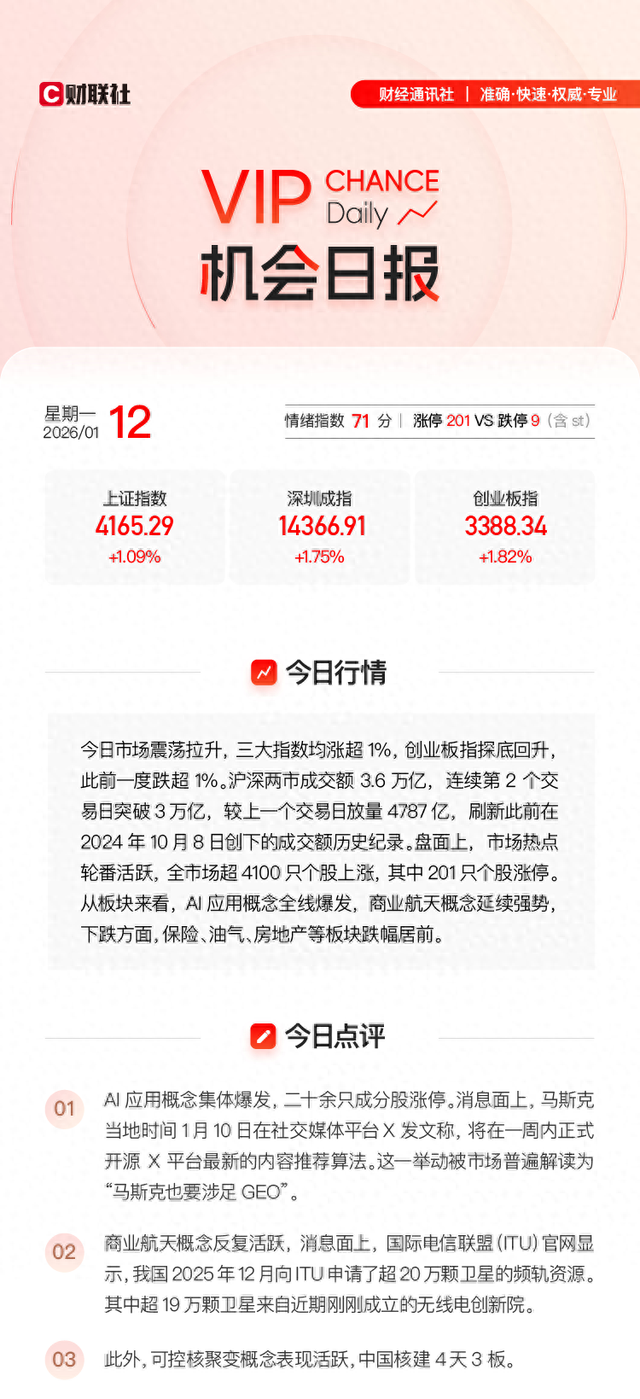
VIP机会日报AI应用概念全线爆发 栏目精选精选“GEO”主题研报并解读 提及多家公司大涨
Xin Lang Cai Jing· 2026-01-12 10:28
Group 1: AI Applications - Elon Musk announced on January 10 that he will open-source the latest content recommendation algorithm for the X platform, interpreted as a move into Generative AI Optimization (GEO) [4] - GEO, based on generative AI, aims to enhance the visibility of AI search results and is expected to evolve advertising marketing models, potentially creating a market worth billions [5] - Companies like Zhejiang Wenlian, BlueFocus, and Insai Group have seen significant stock price increases, with respective gains of 10.61%, 27.21%, and 25.63% as of January 12 [5] Group 2: AI in Healthcare - OpenAI's release of ChatGPT Health is seen as a significant step into the trillion-dollar AI healthcare market, with institutions identifying healthcare as a key application area for AI [8] - Weining Health achieved a 20% price limit increase following the news, reflecting strong market interest [8] Group 3: AI Marketing - JD.com launched an AI agent named "Jing Xiaotong," with projections indicating that the AIGC advertising market could grow tenfold to 150 billion yuan by 2030 [10] - Yidian Tianxia, a Google partner, has benefited from this trend, experiencing a stock price increase of 42.86% [10][11] Group 4: Commercial Aerospace - The Guangzhou government plans to build a globally influential "Sky City" and a new hub for commercial aerospace by 2035, with the market expected to reach 7.8 trillion yuan by 2030 [14] - Companies like Tongyu Communication and Mengsheng Electronics have seen stock price increases of 41.05% and 26.07%, respectively, as of January 12 [14] Group 5: Satellite Technology - The commercial aerospace sector is entering a new phase of rapid development, with a significant increase in satellite applications, including 200,000 new satellite applications in China [25] - China Satellite's stock reached a limit increase following this news, reflecting strong investor interest [25][26] Group 6: Brain-Computer Interfaces - Strong Brain Technology has reportedly submitted a confidential IPO application in Hong Kong, indicating a significant move in the brain-computer interface sector [33] - The company completed a 2 billion yuan financing round, positioning itself as a key player in the market, second only to Neuralink [33][34]
利好突袭!杭州“六小龙”,传出大消息!2000亿巨头大涨10%!
券商中国· 2026-01-12 10:16
Core Insights - The article highlights the increasing momentum in the brain-computer interface (BCI) sector, with significant developments such as the IPO application of Qiangnao Technology and the establishment of new industry standards by the National Medical Products Administration [1][4][7] Group 1: Company Developments - Qiangnao Technology has reportedly submitted a confidential IPO application in Hong Kong, indicating strong market interest and potential for growth in the BCI sector [1][4] - The company has completed approximately 2 billion yuan in financing, with investors including IDG, Huaden International, and Lens Technology, showcasing strong capital recognition and industry collaboration expectations [4] - Lens Technology, a strategic investor in Qiangnao Technology, has seen its market value exceed 200 billion yuan and is actively involved in the mass production of core hardware modules for Qiangnao [1][4] Group 2: Industry Trends - The BCI industry is experiencing rapid growth, with projections indicating that the global market could reach $12.4 billion by 2034 and the Chinese market could reach 6.14 billion yuan by 2028 [8] - The industry is transitioning from research and development to commercialization, with various segments such as invasive, semi-invasive, and non-invasive approaches gaining attention [8] - The Chinese government is strengthening its top-level planning for the BCI sector, with initiatives like the "Brain-Computer Interface Industry Innovation Development Action Plan (2025-2028)" highlighting national support for the industry [7] Group 3: Technological Advancements - The focus on non-invasive BCI technologies is growing, with companies exploring dual-driven models combining medical and consumer applications, which are expected to accelerate commercialization [8] - The upcoming J.P. Morgan Healthcare Conference is anticipated to provide insights into the latest developments in the global pharmaceutical and biotechnology sectors, including BCI technologies [5]

恒生科技指数劲升3.1% AI应用爆发引发科技股狂欢
Xin Lang Cai Jing· 2026-01-12 08:47
Market Performance - The Hong Kong stock market indices strengthened collectively, with the Hang Seng Index rising by 1.44% to 26,608.48 points, the Tech Index increasing by 3.10% to 5,863.20 points, and the National Enterprises Index up by 1.90% to 9,220.08 points [2]. Sector Highlights - The leading sectors included internet technology, AI applications, SaaS concepts, AI healthcare, paper industry, film and entertainment, and commercial aerospace, while pharmaceutical research services and lithium battery sectors experienced a pullback [5]. AI and Technology Sector - Major internet companies showed strong performance, with Alibaba Health rising by 10.23%, Kuaishou by 7.43%, and Meituan by 6.60% [6]. - The rise in AI applications was notable, with stocks like Zhiyun (31.40% increase) and Weimeng Group (21.39% increase) leading the charge [8]. Paper Industry - The paper sector saw gains due to improved supply-demand dynamics and favorable exchange rates, with Nine Dragons Paper up by 10.06% and Lee & Man Paper by 5.81% [12]. Film and Entertainment Sector - The film sector benefited from rising expectations for the upcoming Spring Festival box office, with stocks like Damai Entertainment increasing by 6.98% and Maoyan Entertainment by 3.86% [14]. Commercial Aerospace - Stocks in the commercial aerospace sector rose due to policy benefits, with Asia Pacific Satellite increasing by 18.16% [16]. Pharmaceutical Sector - The pharmaceutical sector showed mixed results, with stocks like Zhaoyan New Drug down by 4.29% while the healthcare index overall rose by 10.3% in the first week of 2026 [18]. Lithium Battery Sector - The lithium battery sector faced pressure from policy adjustments, with stocks like CATL down by 2.45% following the announcement of changes to export tax rates [20]. Individual Stock Movements - Tongcheng Travel saw a rise of 5.61% due to increased demand for off-peak travel as students enter their winter break [22]. - Bilibili increased by 6.54% as AI technology improved marketing material production efficiency and advertising effectiveness [23].

巨头加速入场AI医疗,2025年AI医疗相关专利申请量创新高
Qi Cha Cha· 2026-01-12 08:00
Core Insights - The entry of major players into the AI healthcare sector is accelerating, with a significant increase in patent applications expected by 2025 [1] Group 1: Market Growth - The global AI healthcare market is projected to reach $56 billion (approximately 391.3 billion RMB) by 2026, indicating a substantial user demand for health and wellness inquiries [2] - In 2023, the registration of AI healthcare-related companies in China surpassed 20,000 for the first time, marking a 45.59% year-on-year increase to 21,900, which is the highest registration volume in the past decade [3] Group 2: Company Distribution - As of January 9, there are 108,000 existing AI healthcare-related companies in China, with 38.36% located in first-tier cities, followed by 22.77% in new first-tier cities and 15.63% in third-tier cities [4] Group 3: Patent Applications - There are currently 12,800 AI healthcare-related patents in China, with a continuous increase in patent applications over the past decade; the total applications are expected to reach 2,000 in 2024 and 2,471 in 2025, setting a new record [5]
医药生物周报(26年第1周):脑机接口、AI医疗行情火热,关注相关产业链投资机会-20260112
Guoxin Securities· 2026-01-12 07:35
Investment Rating - The report maintains an "Outperform" rating for the pharmaceutical and biotechnology sector [5]. Core Insights - The pharmaceutical sector has shown weaker performance compared to the overall market, with the biopharmaceutical sector outperforming with a 7.81% increase [1]. - The brain-computer interface (BCI) industry is experiencing significant breakthroughs and commercialization opportunities, driven by favorable policies and technological advancements [2][18]. - The AI healthcare market is projected to grow substantially, with the global market size expected to increase from USD 13.7 billion in 2022 to USD 155.3 billion by 2030, reflecting a CAGR of 35.5% [23][28]. Summary by Sections Market Performance - The overall A-share market increased by 4.09%, while the biopharmaceutical sector rose by 7.81%, indicating strong sector performance [1]. - The TTM price-to-earnings ratio for the biopharmaceutical sector is at 38.96x, which is at the 85.59th percentile of the past five years [1]. Brain-Computer Interface (BCI) - The BCI market is expected to see explosive growth due to policy support, including the "14th Five-Year Plan" and the establishment of independent billing codes for BCI devices [2][18]. - Key investment opportunities include upstream hardware suppliers, midstream companies with core patents, and downstream firms that create commercial applications in rehabilitation and industrial control [2][18]. AI in Healthcare - AI is identified as a critical application area in healthcare, with various themes such as AI in drug development, multi-omics, precision diagnostics, imaging devices, and smart healthcare being highlighted for investment [3][22]. - The launch of ChatGPTHealth by OpenAI signifies a growing trend in integrating AI with healthcare applications, enhancing patient interaction with health data [29]. Company Earnings Forecasts - Several companies in the sector have been rated as "Outperform," with projected net profits for 2024 ranging from CNY 1.4 billion to CNY 116.7 billion [4]. - Notable companies include Mindray Medical (CNY 116.7 billion), WuXi AppTec (CNY 93.5 billion), and Aier Eye Hospital (CNY 35.6 billion), all showing strong growth potential [4].



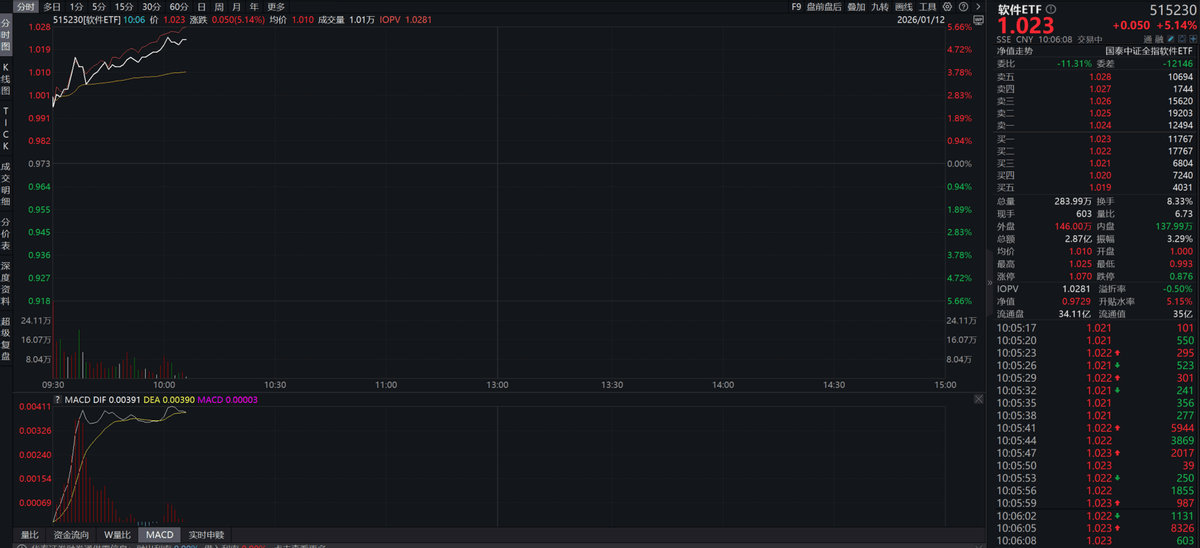
GEO重塑营销版图,软件ETF(515230)大涨超5%
Mei Ri Jing Ji Xin Wen· 2026-01-12 07:11
GEO推动广告投放升级,市场规模有望高速增长 GEO生成式引擎优化是面向生成式AI应用的广告投放技术,其通过广告内容投喂,使得广告内容被纳入AI信息库,进而提升广告内容在AI生成内容中 的被引用概率。从模式来看,用户直接向浏览器提问,不再点入网页,有望重塑营销版图。 | | | 12 1 1 1 2 1 2 1 2 1 1 1 1 1 1 1 1 1 1 1 1 1 1 1 1 1 1 1 1 1 1 1 1 1 1 1 1 1 1 1 1 1 1 1 1 1 1 1 1 1 1 1 1 1 1 | | | | --- | --- | --- | --- | --- | | | 1990年代 | 2000年代 | 2010年代 | 2020年代 | | 主要媒介 | 电子邮件 | 搜索引擎 | 社交媒体 | 社交媒体 | | 流量入口 | 电视机 | 门户网站 | 移动App | 原生AI应用 | | 主要广告 | 邮件广告 | 网站banner | 开屏广告 | 内容营销 | | 形式/技术 | 电视广告 | 竞价排名、SEO | 信息流广告 | GEO | 近期,GEO、AI医疗等概念持续发酵,其中GEO ...